
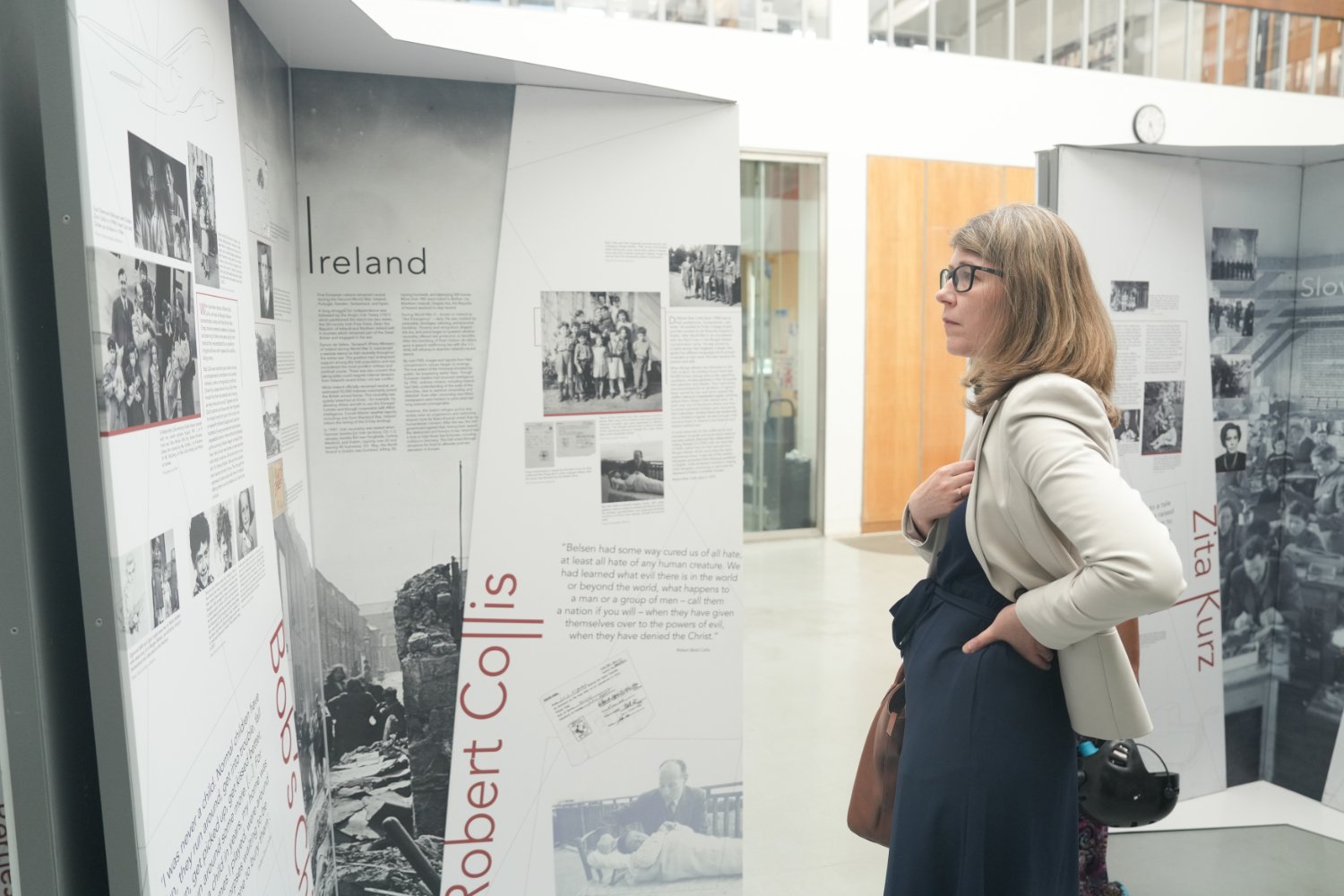
The travelling exhibition reaches north London to share the stories of both rescuers and survivors affected by the Holocaust
Between Life and Death: Stories of Rescue During the Holocaust is an important exhibition that has travelled to more than 30 venues in 15 countries across Europe, Asia and North America. Chipping Barnet Library is the 11th, and final, stop on its current UK tour. Many British and international organisations have supported its journey, in particular the ENRS (European Network Remembrance and Solidarity). With its long list of sponsors, the exhibition is a salutary reminder of the mutual dependence and need for cooperation between nations.
Located in the main area of the library, freestanding panels clearly present the work. Each triptych provides a historical summary of 16 European countries, flanked on one side by a survivor story and the other with details of rescuers. The introductory panel makes it clear that, whilst other groups were persecuted by the Nazis, Jews were their main target and only Jewish, Roma and Sinti people were designated for total extermination. We are also reminded that all rescue stories are complex and some will never come to light.
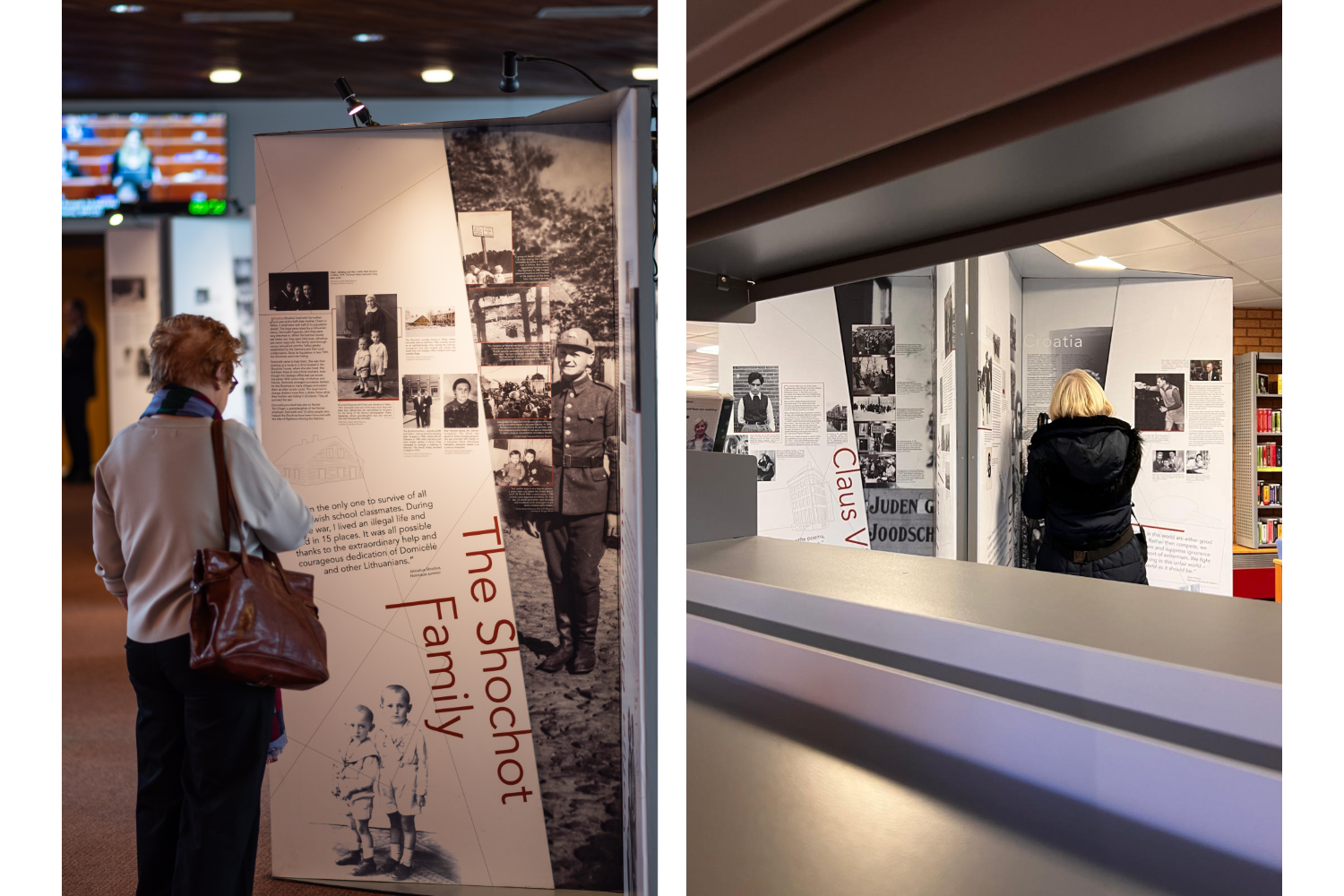
Between Life and Death (left) at Palais de l’Europe, Strasbourg, 2025 © Benjamin Hincker; and (right) at Chipping Barnet Library, London, 2026 © Peter Aron
While this is an exhibition about rescuers, it does not neglect the survivors. There are some well-known names here, such as Nicholas Winton, who brought 669 children to England from (then) Czechoslovakia. Less known, are the opera-loving British sisters Ida and Louise Cook, who helped 29 Jews, mainly music professionals, to escape from Germany and Austria. Ida wrote romantic novels to supplement their civil servants’ salaries and to fund their rescue missions. In a village in northern Holland, during Nazi occupation, the Bogaard family, who were religious Calvinists, hid around 200 Jews on their farm and in the surrounding area. Johannes Bogaard senior was known as ‘Grandpa’; he was arrested in 1943 and murdered in Sachsenhausen concentration camp. Two of his sons were also captured and died. A third, also called Johannes, continued to help fugitive Jews, despite the arrest of his wife and sister. In Denmark, hundreds of people were helped by Henry and Ellen Thomsen and their 13-year-old son Franz. In 1944, Henry was arrested and died in Neuengamme concentration camp. Between Life and Death highlights the ‘ordinary’ people prepared to risk their own lives to save those of strangers. It raises the question: how many of us would do the same?
Between Life and Death at Swiss Cottage Library, Camden, July 2026 © Cris Blaize
I visited on a wet Sunday afternoon, when I met someone who had returned for a second look. There was also a group of 14-year-old girls, who discovered it while catching up with homework. One liked the way it informed, yet "didn’t feel like a history lesson". Another said: "It portrays lives just like our own." Their families, it turned out, had come from Africa, Bangladesh, Mauritius, Germany, Dubai and Ireland. A university student came across the display while searching for a maths text; his parents were refugees from Somalia. This array of visitors, in age and background, exemplifies how immigrants can enrich our society. Their interest amplifies the message of the exhibition: that geographic boundaries and ethnic origins are unimportant to those willing to share their humanity.
By Irene Wise
Between Life and Death: Stories of Rescue During the Holocaust runs until Tuesday 14 December. FREE. Chipping Barnett Library, London, EN5 4QT. enrs.eu
The Between Life and Death Official Opening takes place Wednesday 18 November at 7pm, featuring special guest Lady Milena Grenfell-Baines, who was born in Czechoslovakia in 1929 and was one of the 669 children who escaped to Britain on Kindertransport trains organised by Sir Nicholas Winton in 1939. barnet.gov.uk