
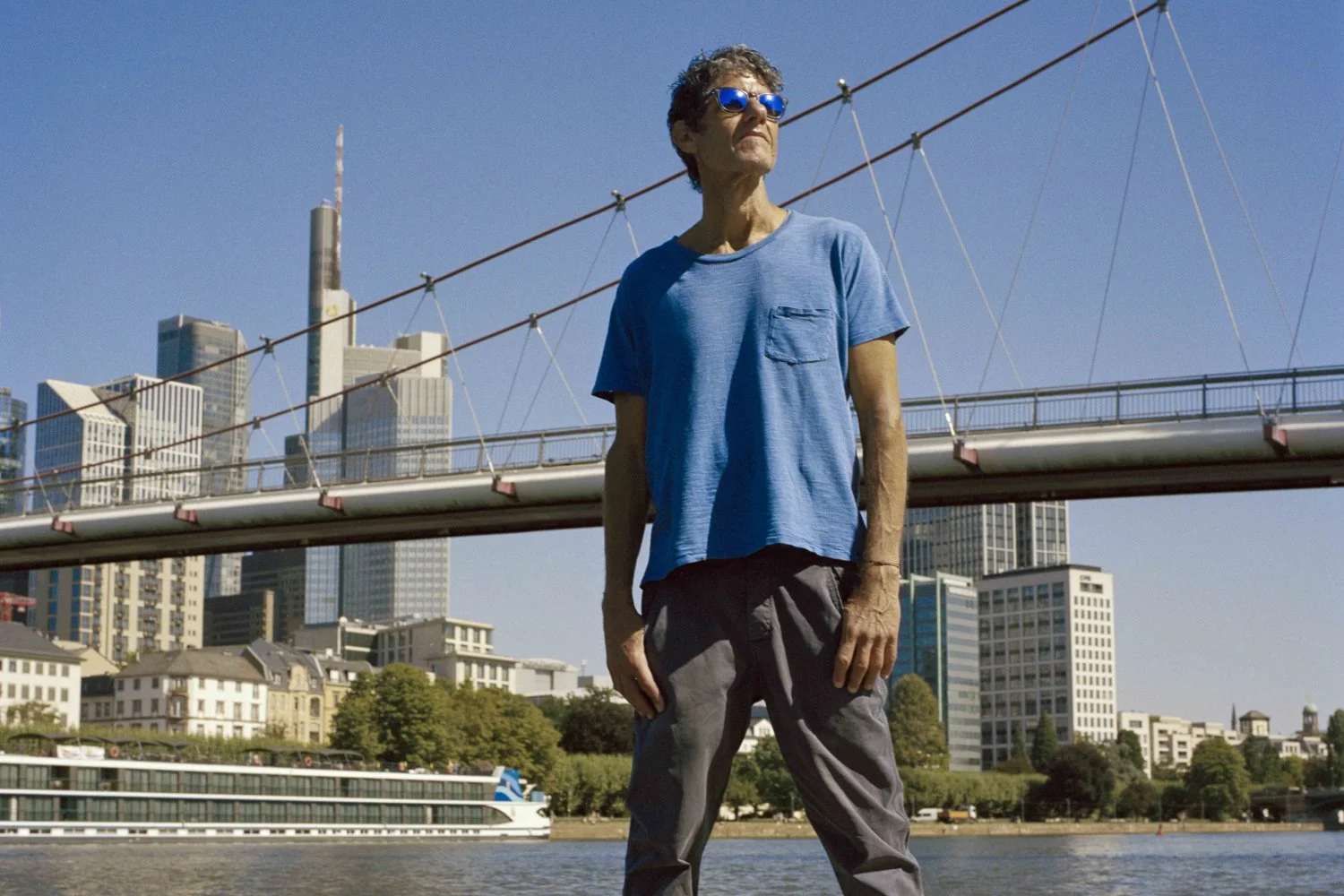
A new exhibition spearheaded by Beastie Boys member Mike D about chosen family opens in Frankfurt this week. We talk to the team behind it to learn more
What makes a family? A blood tie that goes back centuries? Or a unique connection? Either way, there’s a Jewish word for it: mishpocha. It’s both the Yiddish and Hebrew term for a network of family and friends. In other words, your tribe – a concept that the folk at the Jewish Museum in Frankfurt are exploring further in this season’s new exhibition, Mishpocha: The Art of Collaboration.
It evolved from a seed sown by the museum’s creatives and blossomed with the help of musician Michael ‘Mike D’ Diamond, one third of behemoth hip-hop/punk outfit Beastie Boys. “I was always fascinated by the story of these three Jewish boys from New York,” says Mirjam Wenzel, director of Jewish Museum Frankfurt. “How they managed to become so successful in music that was based in the BPOC [Black People and People of Colour] community at the time. I related it to Martin Luther King demonstrating with Rabbi Abraham Joshua Heschel [during the 1960s Civil Rights Movement].” Making alliances, such as the one formed between King and Heschel, was the initial idea for Mishpocha, Wenzel explains, before it evolved to family connections.
A first visit by Mike D to Frankfurt in July 2024 set the ball rolling, followed by many more visits. The musician, who is also the exhibition’s artistic director, worked closely with the team and other artists involved in the show, but he also explored the Jewish heritage of the city. “Being Jewish [in Frankfurt] doesn’t necessarily mean the same as it does in New York, where almost everybody around you is Jewish,” says Wenzel. “Here, you constantly have to deal with echoes from the past. I think that was touching for him.”
Mike D was born to two Jewish New Yorkers on the city’s Upper West Side. His father Harold was an art dealer specialising in 20th-century work and his mother Hester was a renowned collector and critic. “He grew up with artists,” says Wenzel, “so he knows what museums are about. He has a good intuition of what works together and what doesn’t.” Utilising his background, Mike D contributed numerous angles for the show, including reflections on how mishpocha is created through artistic connection. “The idea was based on his experience as part of the Beastie Boys,” Wenzel explains. “Through collaboration, you develop not only a community, but a whole lifestyle. And we felt that for a Jewish museum, where family always means looking back to ancestors and tradition, this was a challenging but very nice approach.”

A cross-section of Memory’s Touch by Nirit Takele. Image courtesy of Nirit Takele
Spread over four rooms, Mishpocha is a sprawling display of drawings, paintings, sculpture, photographs, videos and a 360 degree immersive multimedia installation. It looks not only at connections between musicians, but also those made through family (and chosen family) histories, shared memories and language crossovers. The rooms offer a range of experiences: there’s a “dark and reflective” vibe, as the museum’s curator Franziska Krah describes it, in a space where visitors can sit and listen to voices from around the world speaking in their mother tongue about what ‘mishpocha’ means to them. There are also interactive elements, where people can make their own music digitally via a connection of loop machines. Krah is particularly excited about one of the rooms: “The space features some wonderful contemporary compositions, both Jewish and non Jewish, that reflect on the family we are born into, focusing on painful experiences such as loss, flight and migration. Visitors then pass through a tunnel creating the transition to the next room, which is entirely dedicated to musical families. The focus is on four different musical genres: hip-hop, punk, techno and riot grrrl. We chose them because they were particularly important and influential for the Beastie Boys.”
The Art of Collaboration is an apt title on many levels. The sentiment is reflected in the concept, but also in the array of creatives involved. Take artist and prison educator Jessica Ostrowicz, who is from Birmingham in the UK. She creates drawings, sculptures and sound installations that aim, according to her website, to provide a feeling of home for the “displaced, uprooted or confined”. Her featured piece, Grandma’s Plates, incorporates her grandmother’s broken porcelain with pebbles gathered near her home. “I find her work very moving,” says Krah. “She comes from a Jewish family with roots in Eastern Europe and [Grandma’s Plates] nods to the tradition of placing a stone on the grave of the deceased. It evokes the feeling that some things simply have to be accepted as they are.”
Elsewhere, you’ll find work by Ethiopian-Israeli painter Nirit Takele, who explores identity and migration in her figurative pieces. “I absolutely love her work, not least because of her very distinctive style and vivid colours,” says Krah. “At the age of six, Takele fled with her family from a village in Ethiopia to Israel. In Ethiopia, they were regarded as ‘the Jews’ – outsiders – only to become ‘the Ethiopians’ in Israel. But her pieces focus on solidarity. She depicts moments in which memory conveys not only loss, but also life, connection and unextinguished hope. One particular piece [in the show] is Memory’s Touch, which radiates optimism, even though it deals with the loss experienced during 7 October.”

Grandma’s Plates by Jessica Ostrowicz at OP ENHEIM, Wroclaw. Image courtesy of Jessica Ostrowicz © Alicja Kielan
Mishpocha is partnered with two other art shows taking place in the city, all of which are part of the World Design Capital initiative, which this year has been awarded to Frankfurt Rhine-Main. One of these is Under the Skin: Focus on Tattoos at the Opel Villas Rüsselsheim, which features work by German photographer Jan Zappner.
“Of course, tattoo culture is at the core of hip-hop, punk, riot grrrl and rave,” says Wenzel, referencing the music that appears in the show. “But Jan also has a project called Mishpocha, [for which] he interviewed Jews living in Germany and took portraits of them. The work is a transcript of those talks, plus the photos. We asked him to develop it further, together with Mike D, so he took a walk with Mike and took photographs and one of the images features in the [Mishpocha] exhibition.”
While Zappner looks at the present, the other show, by Marcelo Brodsky at Kunsthaus Wiesbaden, looks to the past. “Marcelo is an artist from Argentina,” explains Wenzel, “who portrayed the Heschel and King demonstration as part of his series of photos [1968: The Fire of Ideas], which overlays and reworks historical photos with colours and words. It’s all about the 1968 revolts around the world. He met with Mike and then we linked a solo exhibition of his with the idea of BPOC and Jewish communities demonstrating together for civil rights.”
Mishpocha invites viewers to consider what family truly means. “When I was younger,” says Wenzel, “I had this definition that my mishpocha was my friends and we were forever young. I’m a mother now, so my definition is more traditional, but we all start from different points and it’s good to be aware of that.” Of course, the word can mean many things, Krah reminds us. “At the museum, the focus has always been on Jewish family origin,” she says. “It gives me great pleasure to know that we are now expanding this perspective and celebrating chosen family, which all of us can find over the course of our lives and with whom we can feel that sense of belonging.”
By Danielle Goldstein
Header photo: Mike D © Jan Zappner
Mishpocha: The Art of Collaboration runs 17 April to 27 September 2026 at the Jewish Museum Frankfurt. See juedischesmuseum.de for more info.
This article appears in the Spring 2026 issue of JR.