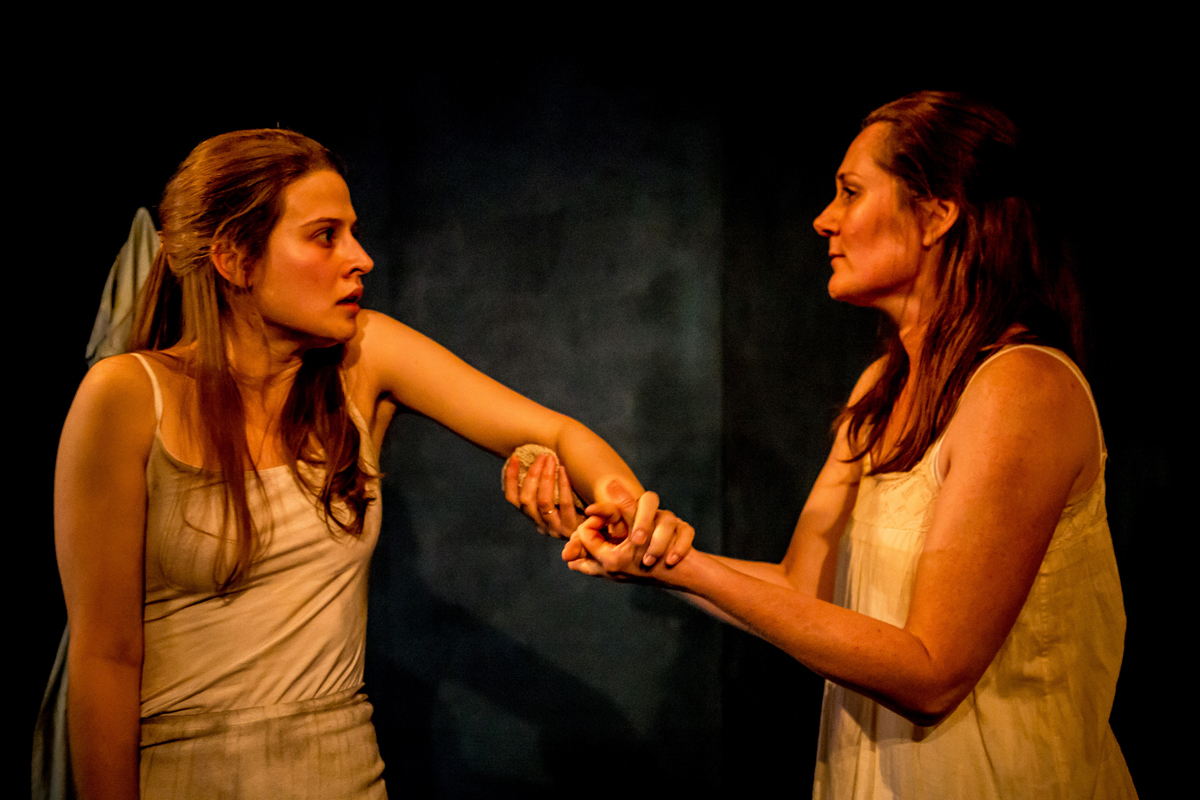
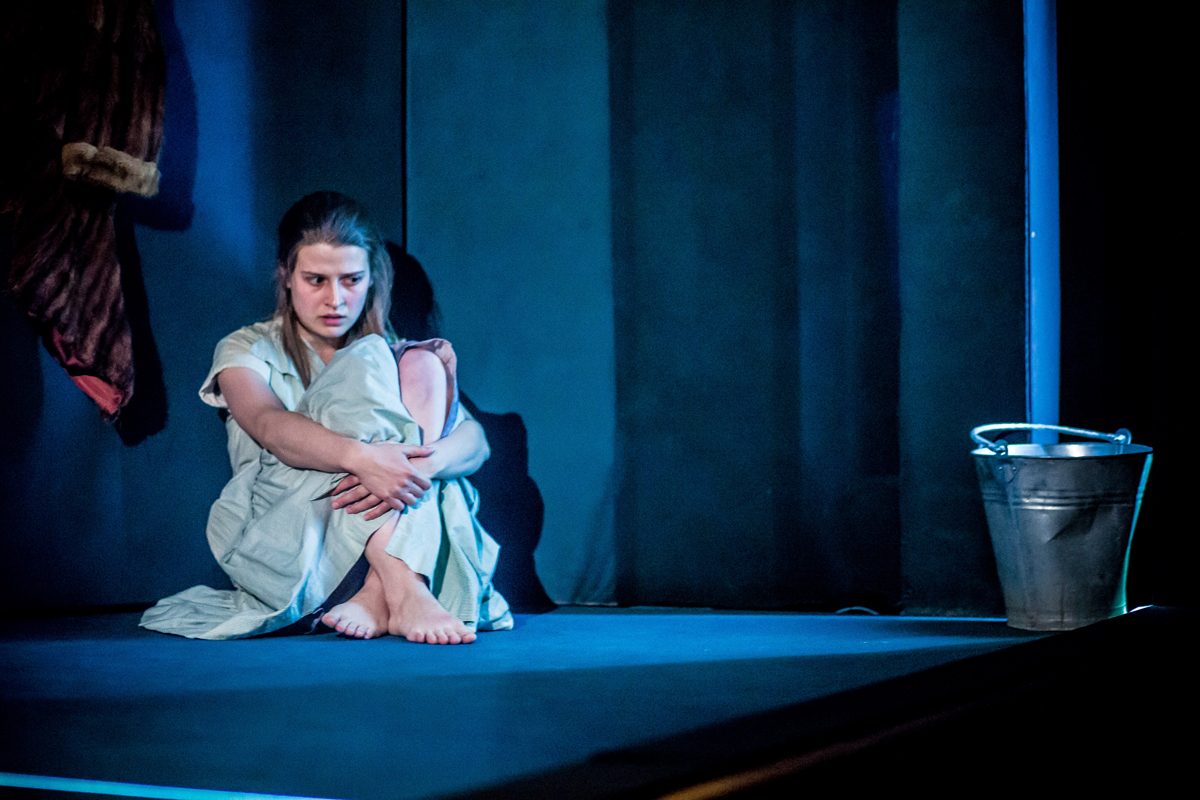
Fresh from a richly evocative tour of the ‘real Anatevka’ led by Sholom Aleichem himself (aka Saul Reichlin in his one-man show), I find myself in the heart of the shtetl again. Here at the Menier Chocolate Factory, a huddle of dimly-lit run-down dwellings embraces villagers onstage and in the…
Borders and Games ★★★★
Fanatical ★★★★
Kiss Me Kate ★★★★
Finishing the Picture ★★★★
Into the Woods ★★★
Shirleymander ★★★★
The Chess Player ★★★★
Interview: Na’ama Zisser
Israeli composer Na’ama Zisser tells us about writing her Jewish opera Mamzer Bastard. Imagine you’re in New York in the 1970s. Jimmy Carter is either in office or about to be, bands like the Bee Gees and Elton John are vying for top spot in the charts, and one very apprehensive groom named Yoel is dreading his impending wedding…
Review: The Secret Theatre ★★★★ – Two Elizabethan ages meet at Shakespeare's Globe in a witty, bloodthirsty game of politics
In the Wanamaker Playhouse’s candlelit space Jon Bausor’s clever set divulges sinister built-in drawers of files. Conspirators plotting treason discover the hard way that a mole is privy to their plans. Religious refugees fleeing to England in the wake of massacres on the continent find themselves unwelcome in isolationist Britain. Late 16th-century London feels a lot like a John le Carré thriller set right now. And indeed playwright Anders Lustgarten owes his title to le Carré, who wrote “espionage is the secret theatre of our society”.
Lustgarten comes from Hungarian Jewish ancestry via American immigrant parents who brought him up in Oxford. He began writing plays teaching in prison in America and his political activism has led to his arrest on four continents. He has previously written about the plight of refugees and an earlier play about Italian artist Caravaggio moves between 17th-century Italy and 21st-century Britain, so this seems a logical progression.
At the heart of his web of intrigue is a spymaster who would chill Smiley to the marrow. Aidan McCardle’s Sir Francis Walsingham is as addicted to espionage as a teenager to their smartphone – and how he would have loved the modern technology evoked by the programme cover showing Queen Elizabeth I caught on surveillance cameras! Lustgarten’s dark and witty latter-day revenge melodrama nails the parallels to Russian influence, fake news and post truth.
Lines such as "our relations with Europe being not what they were" elicit knowing audience laughter. Brexit divisiveness is neatly echoed by a Chippenham man evoking the solidarity of Wiltshire men, only to be felled by a Swindon man, who points out the rivalry between the two towns.
Walsingham’s chilling tactics include setting up a stool pigeon caught with a gun in Queen Elizabeth’s private gardens to prove the necessity for his surveillance by catching and killing this ‘would be assassin’ on the spot. So Mary Queen of Scots has no chance of surviving his tactics facilitating the Babington plot that leads to Elizabeth sanctioning her execution.
Tara Fitzgerald’s arresting Elizabeth looks every inch the chalk-faced, frizzy Titian-haired, sumptuously-gowned Queen. It’s only when she opens what proves a foul mouth to berate Walsingham that she seems more shrew than monarch – a fun reversal.
Cassie Layton has a memorable cameo as Mary, her brave exit to the block cut short by a bloodcurdling scream. She is also an eloquent Frances Walsingham, estranged from her father by his machinations that lead to the death in battle of her husband Sir Philip Sidney (appealingly noble Sam Marks).
Our Protestant antihero does reveal to his daughter that witnessing the St Bartholomew ‘s Day Massacre in Paris at first hand as he sought to offer Huguenots refuge from murderous Catholics in the English ambassador’s residence first motivated his machinations.
He may gain some sympathy, though ultimately he loses all in this game of thrones. But it’s an exhilarating, if bloody, game while it’s afoot in Matthew Dunster’s fast-moving production.
By Judi Herman
Photos by Marc Brenner
The Secret Theatre runs until Saturday 16 December. 7.30pm (Tue-Sat), 6.30pm (Sun only), 1pm & 2pm (days vary). £10-£62. Shakespeare's Globe, SE1 9DT. www.shakespearesglobe.com
Review: Young Marx ★★★★ - On your Marx for an exhilarating chase through 19th-century Soho (in 21st-century comfort)
Welcome to 1850 – a genuine welcome to political refugees from Europe, including 32-year-old Karl Marx. But is he in danger of outstaying his welcome as he goes on the razzle through Soho, funding his pub crawls by trying to pawn the family silver? His wife’s family that is, for Jenny von Westphalen is of aristocratic German stock, her relatives scandalised by her marriage to the penniless Jewish revolutionary. As young Marx himself puts it “at our wedding I was only invited to the reception”.
This is one of many knowing one liners from the collaboration of Richard Bean (of One Man, Two Guv’nors fame) with witty barrister/radio writer Clive Coleman. Their young Marx is a full-blooded “solipsistic, self-regarding prick”, in the words of his often exasperated, though always devoted sidekick Engels. They write Marx and Engels as a sort of early music-hall double act and Rory Kinnear and Oliver Chris are perfectly cast.
Kinnear’s Marx, hair and beard wild and out of control as his behaviour, is in the throes of writer’s – and thinker’s – block. He achieves the vital balance between infuriating as the reprobate hiding in cupboards when creditors come calling, and earning sympathy as the adoring father, anxiously tending his sickly son and listening proudly to his daughter’s prowess at the piano (before the broker’s men take it, along with the rest of the family’s furniture and clothes).
Chris’s Engels, equal parts admiration and frustration, convinces as the man whose unwavering self-sacrifice will lead to years of financing Marx’s project (and keeping his family going) by slipping him cash from the till of his father’s Manchester textile factory. In Chris’s performance, he is the vital moral heart of the play too; you can believe that he wrote passionately about the plight of workers observed first hand in those factories.
For all this is fact, Bean and Coleman have mined a rich seam of eyebrow-raising biographical detail and transmuted it into precious theatrical mettle (pun intended!).
They create a vibrant messy Victorian London, peopled by rival factions of émigré activists, German spies – and ‘peelers’. Our odd couple’s run in with one of Sir Robert Peel’s prototype policemen is an ‘arresting’ example of the writers’ anachronistic, self-referential wit. The drunken pair, caught in possession of a wrought-iron church gate, are surprised and grateful to avoid a beating. “I’ve been on a course” explains the officer.
Big set-pieces – a political meeting, a dawn duel on Hampstead Heath and best of all a deliciously transgressive brawl in the British Museum reading room – contrast nicely with these cameos and with the intimate family scenes cramped into the two tiny rooms where Marx lives with wife, children, and housekeeper Nym. Nancy Carroll is magnificent as passionate, put-upon Jenny and Laura Elphinstone’s quiet hard-working Nym, whose devotion to Marx ultimately gets physical, matches Carroll as Chris matches Kinnear.
Nick Hytner directs a uniformly superlative cast with wit, sensitivity and pace on Mark Thompson’s fold-out set in London greys and browns, lit by Mark Henderson’s atmospheric lighting and topped by Soho rooftops and chimneys, among which Marx climbs to evade the law, which still look much the same today.
It’s a terrific demonstration of the versatility of Hytner and project partner Nick Starr’s brand new Bridge Theatre and augurs well for future productions. Julius Caesar, complete with audience promenaders as the Roman mob, is up next in January. As befits this democratic vibe, seat prices start at £15 and the horse-shoe shaped, spacious auditorium is inclusive, with sightlines looking uniformly good and seats are especially comfortable. The whole is completed in golden leather and wood, and if there is currently a bit of a flow problem because the single doors to the auditorium are too narrow, this could be corrected. The public spaces are spacious, well-lit and welcoming – and ladies, you will be, er, relieved to find so many toilet cubicles with your name on them.
By Judi Herman
Photos by Manuel Harlan
Young Marx runs until Sunday 31 December. 7.45pm (Tue-Sat), 2.30pm (Wed & Sat), 3pm (Sun only). £15-£65. Bridge Theatre, SE1 2SG. https://bridgetheatre.co.uk
Also broadcast live to 700 UK cinemas and many more worldwide on Thursday 7 December. Visit www.ntlive.com for further details.
Review: No Place for a Woman ★★★★ - The imagined story of two women caught in the Holocaust has real power
Extraordinary stories continue to come out of the Holocaust. And writers continue to explore how human nature is pushed to its limits through the extraordinary circumstances of the Shoah.
Writer Cordelia O’Neill sets her play in 1945. Her protagonists, Jew and Nazi, appear to the audience as interviewees of the Allied forces. Isabella is a Jewish ballerina, interned in a concentration camp; like the well-documented real-life examples where musicians were corralled into playing for camp officials, she is ordered to dance at a party thrown by Annie, wife of the camp commandant, Fredrick. Their lives become not only intertwined, but actually interchanged (almost like Mark Twain’s The Prince and the Pauper, in which the future Edward VI, Henry VIII’s little son, swaps lives with a street urchin), so that they actually change places, as Annie sees Fredrick attracted to Isabella, who begins to see Fredrick – himself disillusioned with the war – as a man she could love.
O'Neill has imagined a nightmarishly Kafkaesque situation, which she handles with an extraordinary subtlety and delicacy, making it all the more unsettling. For the two women speak not just for themselves but for Fredrick and interchange their personalities on a seesaw of power and influence over each other and over Fredrick, as they try to understand, influence and change their own plight – their own reality and indeed their own pasts. There are vivid memories of Isabella’s childhood, family and life as a dancer; of Annie’s meeting with Fredrick, how dependent she is on his love, her increasing isolation, even from her children, in the role imposed on her as an officer’s wife.
I guess you could call this a 'woman's story' and director Kate Budgen gets beautifully nuanced performances from Emma Paetz as Isabella and Ruth Gemmell as Annie. Paetz shows all the contrasting delicacy and steely resolve and discipline, even ruthlessness, necessary to become a leading ballerina – and to survive, even flourish in a concentration camp. Gemmell makes the repressed, damaged Annie sympathetic. Extraordinarily hers is the cup that is half empty, Isabella’s half full, as they recall intimate moments with Fredrick, the mistress remembering tenderness, affection; the wife anger and impatience.
Composer/musician Elliott Rennie’s plangent live cello music underscores the whole and helps the constantly shifting balance on Camilla Clarke’s eerie set – truly a black box intersected with a jagged light (courtesy of Sarah Radman). He and his cello make an extra physical presence, at once dividing and uniting the women. And Movement Director Lucy Cullingford works equally subtly with the pair, somehow making their movements seamless and complementary, just as their words are, without them actually connecting physically. O’Neill consulted survivors and it shows, for her imagined story has real authenticity and dramatic power.
By Judi Herman
Photos by Jack Sain
Click here to listen to Judi Herman's interview with Cordelia O'Neill on JR OutLoud.
No Place for a Woman runs until Saturday 27 May. 7.45pm (Tue-Sat), 3pm (Wed & Sat only). £15, £12 concs. Theatre 503, SW11 3BW. 020 7978 7040. www.theatre503.com
Click here to read more theatre reviews.
Review: All Our Children ★★★★ - Director turned writer Stephen Unwin vividly brings a lesser-known Nazi atrocity to our attention
The horrors of the mass killing of disabled children perpetrated by the Nazis are less well-known than the Holocaust, though they were arguably a rehearsal for the final solution. All Our Children, a moving drama from director turned writer Stephen Unwin, tells their story by focusing on one so-called clinic and the awakening conscience of Victor, the ageing doctor who runs it. Unwin dedicates his drama to his son Joey, who has profound learning difficulties, so this first play from the acclaimed theatre director is an intensely personal story.
Colin Tierney captures every nuance of Victor's struggle in a finely-calibrated performance, neatly contrasted with the cool certainty of his co-administrator Eric, a ruthless young Nazi ideologue, played with terrifying authenticity by Edward Franklin. Eric has no problem with the argument that these 'imbeciles' are a waste of money and precious resources.
The only woman in Victor's life is his gentle solicitous housekeeper Martha (luminous Rebecca Johnson). Indeed there is a suggestion that the bachelor might be gay, which we know could mean he'll share the fate of his charges. Meanwhile Martha has a hinterland that brings the outside world into the clinic, a husband at the front, a bright five-year-old son and a nubile 17-year-old daughter attracting unwelcome attention from Eric.
The doctor receives two visitors, catalysts for a change of heart, Frau Pabst, devoted mother of one of his 'patients' and Bishop Von Galen, a real-life champion of the helpless victims of Hitler's Euthanasia Decree.
Lucy Speed plays Frau Pabst, with heartbreaking and increasingly strident desperation, convinced Victor is hiding the fate of her son, but his evasive answers are more an indication of his inability to explain why he cannot help her and his fears for his own predicament than of callousness.
So it is left to Bishop Galen to make a difference, to add his righteous anger to her furious distress, and so fully awaken Victor's conscience. David Yelland plays Galen with blazing authority – the words righteous indignation are overused, but this is surely what they mean.
Mindful of the fate of so many committed Christians under Hitler and in the light of Eric's contemptuous denouncement of the Bishop, you fear for him. Unwin does not reveal his fate – suffice to say he was beatified by Pope Benedict XIV.
One of the most moving moments, a beautiful heartfelt declaration of real love and affection for her charges from Martha which serves to finally determine Victor's way forward, has all the authenticity of the playwright's experience of the love and joy of living with these children. That he can also write witty, albeit dark lines, evoking audience laughter, only makes the situation more real and immediate. A fine writing debut for this seasoned director.
By Judi Herman
Photos by Camilla Greenwell
All Our Children runs until Saturday 3 June. 7.30pm (Mon-Sat), 3.30pm (Sat only; plus 18 & 25 May). £22-£30. Jermyn Street Theatre, SW1Y 6ST. 020 7287 2875. www.jermynstreettheatre.co.uk
Click here to read more theatre reviews.
Review: A Dark Night in Dalston ★★★ - A night of discovery at Park Theatre that will keep you guessing
Some years back, I interviewed Rabbi Jonathan Black for radio, making a cameo appearance in EastEnders conducting a Jewish wedding. Not already a viewer, I duly researched by watching an omnibus edition and learned how you ‘gotta talk’. Jewish (non-Orthodox) playwright Stewart Permutt did his research by consulting a Charedi friend. So there’s a real authenticity about his protagonist Gideon – what brands of bread and crisps he can eat (Kingsmill and Walkers) and what he cannot drink from (glass).
Permutt has form when writing strong female characters, often for well-known TV stars, including Lesley Joseph, Celia Imrie and the much-missed Miriam Karlin.
His latest play was specially commissioned by EastEnders and Coronation Street star Michelle Collins, who was born in Hackney. Collins' maternal grandfather was a Belgian Jew who moved to Wales to escape the Holocaust. Having played the confused mother Evelyn in Diane Samuels' Kindertransport, Collins sought another dramatic stage role and proactively commissioned a play with a juicy part for herself.
The resulting two-hander is a present-day drama set in the East End flat of Collins’ character Gina, a feisty, friendly ex-nurse living on a Dalston council estate, whose days are filled caring for her partner, who's been bed-bound after a stroke. When young Orthodox Jew Gideon (Joe Coen) is beaten up one Friday night on her doorstep, Gina takes him in. But Shabbat has begun and this strictly observant Jew can’t travel home to Stanmore, so is forced to spend the night with her, a night during which they find themselves drawn to each other as regrets about their lives emerge.
Tim Stark directs this dark comedy exploring the “madness of the human condition”, as he says, with a sensitive ear for dialogue so that the evolving emotional conflict is genuinely involving. Simon Shaw’s set beautifully evokes (now ex) council flats, with their signature external landings. However, it’s a challenge to sustain dramatic tension over a scenario that doesn’t evolve sufficiently during its playing time, so it might benefit from losing a few of its 105 minutes.
Collins and Coen admirably inhabit their characters despite gaps in their development over the drama’s duration. Collins convincingly captures the conflicted Gina, and her small-screen acting is well suited to the intimate Park90 space. Coen, fresh from The Mighty Walzer and Bad Jews, invests Gideon with that curious mix of self-righteousness and self-knowing often seen in the ultra-orthodox of any religion. Their final scenes together are touching, bringing out the common bonds shared by the characters and the chemistry between the actors.
A Dark Night in Dalston is a good night out, given enough good will and patience to discover Gina and Gideon’s deep-seated hopes and needs.
By Judi Herman
Photos by Helen Murray
A Dark Night in Dalston runs until Saturday 1 April. 7.45pm (Mon-Sat), 3.15pm (Thu & Sat only). £18, £16.50 concs. Park Theatre, N4 3JP. 020 7870 6876. www.parktheatre.co.uk
Click here to read more theatre reviews.
Review: Once in a Lifetime ★★★ - Sophisticated fun set in Hollywood at the birth of the talkies
When witty Jewish writing duo George Kaufman and Moss Hart wrote this back-of-the-movie-lot comedy, set at the birth of the talkies, neither had been to Hollywood, but they knew enough about the goings-on in the movie business to know it would suit their satirical wise-cracking style. Kaufman co-wrote The Cocoanuts and Animal Crackers for the Marx Brothers and this witty habitué of the Algonquin Round Table never lost his sense of sarcasm. He said about one play: "I saw it under adverse conditions; the curtain was up!" The plotlines in their collaborations were primarily Hart’s while Kaufman focused on the witty, sarcastic dialogue.
It's 1928 and The Jazz Singer, the first all-talking picture, is a sensation. Three struggling vaudevillians, sardonic May Daniels, smooth-operator Jerry Hyland and their stooge George Lewis, the "best deadpan feeder in the business", head west to present themselves as elocution experts, hoping to teach movie stars to speak on screen. With help from gossip columnist Helen Hobart, they’re hired by megalomaniac film mogul Herman Glogauer (Harry Enfield making his theatrical debut), who is trying to come to terms with talking pictures. "Things were going along fine. You couldn't stop making money – even if you made a good picture, you made money."
The three encounter a proverbial dumb blonde wannabe actress and her pushy mum, a playwright driven to distraction and then a sanatorium by studio bureaucracy, a silent-screen beauty with a screeching voice, and Glogauer’s faithful put-upon receptionist.
Glogauer hails dimwit George as a visionary genius, when he is the only one to tell him to his face that he turned down the VitaPhone sound film system. Glogauer makes him head of production and it all goes wrong – or right? – from there…
Director Richard Jones and designer Hyemi Shin set the action on a clever revolve, with lightning-fast set changes rolling through train carriages, offices and studios. The plot gains momentum as the action hots up. Claudie Blakely’s lightly acerbic May sparks off Kevin Bishop’s laid-back Jerry and John Marquez’s increasingly confident and funny George. Lucy Cohu’s wondrously-clad grande-dame columnist exudes authority, Amy Griffiths’ silent-screen star is literally a scream and Lizzy Connolly is deliciously dumb and dumber in a succession of wigs and gowns (all hail costume designer Nicky Gillibrand). And Amanda Lawrence’s receptionist steals scenes without pulling focus – her physicality, the mobility of her face, her comic delivery – she is simply riveting.
Harry Enfield’s Glogauer is curiously understated, though he delivers wonderful lines such as "That's the way we do things here – no time wasted on thinking" with (dare I say it) Trump-like panache.
And more please of that joyous sense of insanity and frenzy demanded by the plot, the lines and the built-in wise-cracking from a Marx Brothers scriptwriter. Richard Jones successfully populates the studio lot with a substantially smaller cast than in the original show. As his production gains pace, it will zip along in the gleeful and effervescent way the silly ploy and vivacious dialogue demand. It’s already a fun evening in the theatre with lots of laughs to be had in the run up to Christmas and a happy New Year.
By Judi Herman
Photos by Johan Persson
Once in a Lifetime runs until Saturday 14 January, 7.30pm (Mon-Sat) & 2.30pm (Wed & Sat only), note there are no performances 24 & 31 Dec, £10-£35, at Young Vic Theatre, SE1 8LZ; 020 7922 2922. www.youngvic.org