Reviews

Review: Jerry Herman's Grand Tour is a breathless, though tuneful chase across war-torn Europe

The Grand Tour – Zoë Doano (Marianne), Alastair Brookshaw (Jacobowsky), Nic Kyle (The Colonel) - Jan 2015 © Annabel Vere There’s usually a good reason why largely forgotten material from the oeuvre of a master such as Jerry Herman remains forgotten. The Grand Tour had the shortest run of all Herman’s shows and has not even achieved some form of cult status among the cognoscenti, despite US actor Joel Grey starring as the original Jackobowsky.

Thom Southerland’s imaginative staging of The Grand Tour in the tiny space of Finborough Theatre is a minor creative miracle and makes you wonder what made it less than a success in the first place (in the same season as hits such as Sweeney Todd, The Best Little Whorehouse in Texas and They’re Playing our Song). Perhaps the New York audience wasn’t ready for a chamber musical with production values that didn’t overwhelm the simplicity of the story.

And that’s just what we have here, in the tale of Jacobowsky, a Polish Jew and eternal optimist who's been keeping one step ahead of the Nazis all the way to Paris, and Polish nobleman Colonel Stjerbinsky, who's almost comical in his knee-jerk anti-semitism, and who has papers he must get to London as they play a vital part in the fight against the Nazis. Jacobowsky has a car but can’t drive and the Colonel knows how to drive but has no car. They reluctantly agree to join forces, along with Colonel’s girlfriend, Marianne. The Colonel's initial dislike for Jacobowsky is reinforced as Jacobowsky befriends and then falls in love with Marianne. But is it possible that through their joint experiences in evading the Nazis and learning to survive, the two men might get over their differences and even come to admire each other?

The Grand Tour – Alastair Brookshaw (Jacobowsky) – Jan 2015 © Annabel Vere

Herman's source material was Jacobowsky and the Colonel, an original, semi-autobiographical play by Czech writer Franz Werfel, who collaborated with screenwriter S N Behrman to bring it to the stage in 1944. Like the main character in his play, Werfel, a prominent Jewish intellectual and playwright, was chased all over Europe by the Nazis before successfully escaping to America. Later Danny Kaye played the mercurial Jacobowsky in a film of the same name.

Phil Lindley’s fold out backdrop and fold up floor make maximum use of the limited space to create hotels, countryside, rivers, railway carriages, a café, circus, a Jewish wedding and a Nunnery! And Cressida Carre marshals the 11-strong cast with intricacy and panache to people all these spaces.

What also works this time round is the use of just two pianos, under the musical direction of Joanna Cichonska, to provide the right tone for this small-space chamber musical, allowing the words to dominate. Jerry Herman can’t write an un-tuneful song, even if they are not always memorable, and all 11 numbers here do at least move the plot along rather than hold it up.

The show gets off to a spellbinding start as Alastair Brookshaw’s beautifully understated and thoughtful Jacobowsky opens not with a song but with a whisper. And then he takes his audience into the spine-tingling opening number, 'I'll Be Here Tomorrow', detailing his family's painful path across Europe, settling in one city after another, not just escaping persecution, but making a new life every time. Here Brookshaw has this heartbreaking quality in his voice, but he also displays delicious comic flair, for example in 'Mrs S L Jacobowsky', dreaming of marriage to Catholic Marianne: "I'll go to mass and I'll respect her wishes / And she'll start using separate dishes".

Nic Kyle’s Colonel thaws appropriately in an almost caricature part and gets to sing (beautifully) the best ballad in the piece, the haunting 'Marianne'. Zoe Doano makes a charming Marianne and the rest of the ensemble splendidly fill the many other parts, especially in the requiste first act finale, 'One Extraordinary Thing'.

Southerland’s direction brings out the tension between the European acting style and the US musical style to great effect. It does not always paper over some clunky plotlines and the music just occasionally underwhelms, but this Grand Tour is worth seeing in its own right and not just by collectors of musical ephemera.

By Judi Herman.

The Grand Tour runs until Saturday 21 February. 7.30pm (also 3pm Sat-Sun). £16-£28. Finborough Theatre, 118 Finborough Rd, SW10 9ED; 020 7244 7439. www.finboroughtheatre.co.uk
A heartening wonder of the modern world – JR readers enjoy another year at Limmud

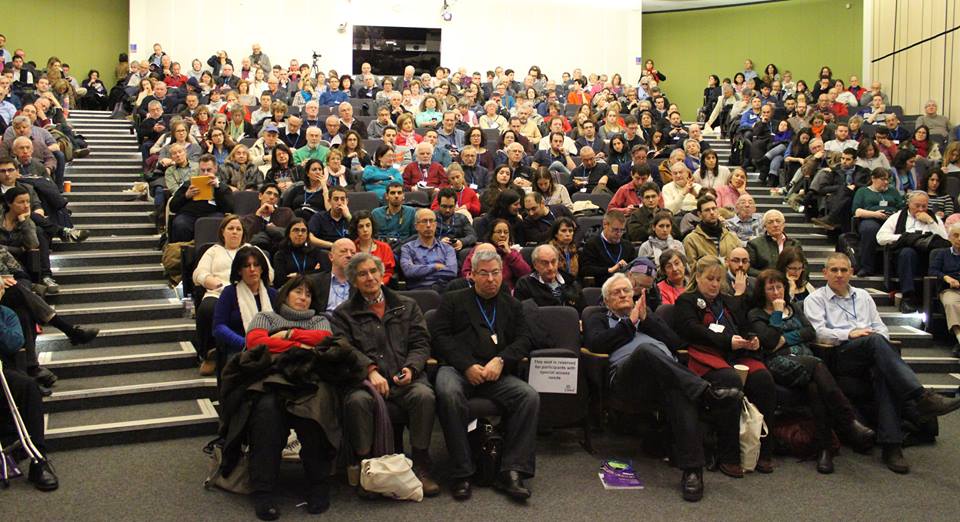
limmud 2014 session

limmud 2014 session

It was as an amazing experience as ever. I have been going to Limmud for 13 years and can never get over how a team of young volunteers, changing yearly, can put on such a huge event with its problems of feeding and housing 2,500, let alone running hundreds of stimulating sessions each day. It is a heartening wonder of the modern world. And this year even the food was great (congratulations Manchester-based Celia Clyne Banqueting).

There were of course many JR readers there and I asked a few about their best Limmud experience.

Mentioned most frequently was the sight of Chief Rabbi Ephraim Mirvis and Senior Rabbi of the Reform Movement Laura Janner-Klausner, deep in conversation at the bar – at an event that a couple of years ago was boycotted by United Synagogue Rabbis and that Jonathan Sacks never attended while he was Chief Rabbi.

Several seconded my selection of the JDOV talk with Patrick Moriarty, head of JCOSS and, amazingly, a trainee Anglican priest. His very funny and affectionate take on his own experience of the Jewish world, not neglecting the firmness of his own faith, was an encouragement for the future of interfaith relations. These filmed talks (Jewish Dreams, Observations, Visions) with their very personal and original perspectives can be viewed on the JHUB website. The 12 from this year's Limmud ("the highlight of my Limmud afternoons," says Anne Clark) should be up there shortly.

Anne Clark gave these additional highlights: "By far the best teacher for me this year was the wonderful Gila Fine from Jerusalem, whose packed-to the-gills series on A History of The Talmud in Four Objects was a masterclass in scholarship and presentation. My favourite musical performance was a concert by Craig Taubman. Craig was skilled and generous enough, not only to engage the entire audience, but also to share the stage with a crowd of young British musicians; Zara Tobias singing a solo in Craig’s 'Yad b’ Yad' ('Hand in Hand', watch it below) accompanied by EJ Cohen’s sensitive signing, was a spine-tingling revelation."

https://www.youtube.com/watch?v=vHnReS0ICeE

Artist Ruth Jacobson also had a musical experience that delighted her: "''Shtel Dem Samovar', with Rachel Weston and Jason Rosenblatt, first a workshop of Yiddish song, then a concert. Rachel's beautiful voice conveys the sweetness and poignancy of her repertoire."

Ruth was also fascinated by the work of Edward Serotta: "His beautiful exhibition of old family snapshots, combined with interviews with some of Central Europe's oldest Jews, created a vivid and moving 'Library of Rescued Memories'.  These are used in many educational projects, and captivate the enthusiasm and interest of new generations."

Rachel Weston

Rachel Weston

Ari Shavit was the presenter mentioned most often. From Brighton's Doris Levinson: "The highlight of my week was the interesting and enlightening, and even shocking, talk given by Ari Shavit about his book My Promised Land – the triumph and tragedy of Israel.  He is such an accomplished speaker with such depth and clarity.  Everyone who gives lectures could learn a lot from his delivery, his timing and his sincerity."

JR Chairman Ian Lancaster was impressed by "Dr Joel Hoffman giving a very animated, erudite and energetic talk about the challenge of translating the Bible, given it’s written in a language that is no longer in use." And our Northern supremo Gill Komoly was enthused by "the passion and energy" Gershon Baskin put into his talks, telling of how he goes backwards and forwards on his motorbike to the West Bank. He was a skilled negotiator on the Gilad Shalit return as well as on many other issues.

Limmud features not only sessions. Delegates don't need any prompting to start talking to the people next to them at mealtime. One such conversation was a highlight for JR sub-editor Diane Lukeman: "It happened that sitting down with me at breakfast one morning was a Rabbi from Hamburg and Rabbi Soetendorp, whose account of growing up in the traumatised community of Amsterdam had resonated with me at my first Limmud experience and had influenced my professional work with children and families. We all became so engrossed in the conversation that we missed the start of our first session – with no regrets."

So passion, energy, sincerity, animation, generosity, humour and erudition, not to say enlightenment and revelation; not a bad series of epithets for a silly season experience.

By Janet Levin

For further information on Limmud, visit their website: www.limmud.org