Reviews

Review: Mack & Mabel – Jerry Herman's love affair with the silent screen is a thrill

Rebecca LaChance (Mabel), Michael Ball (Mack) and company in Chichester Festival Theatre production of Mack & Mabel © Manuel Harlan Although I've seen two terrific small-scale productions of Jerry Herman's musical biopic, this is the first time there's been a chance to see just how this love song to early movie pioneers would work on the big stage – and with enough money to throw at it to exploit the idea of actually making and showing "tribute" film footage. And before the lights went up, I realised there was another vital element of this great big show that was going to make all the difference – a big band with a wonderfully big brassy sound! So my feeling of well-being began with the overture. A trio of big, familiar numbers at the top of the show serves as a delicious reminder of Herman's lush score – at the same time sophisticated, yet drawing on that evocative minor "Jewish" fall.

Once the lights go up on the deserted movie lot about to be vacated by studio boss Mack Sennett at the end of his career, you won't be disappointed either. For of course book writer Michael Stewart's device is to have him look back over his long career and especially to the glory days that began when fresh young Mabel Normand tripped into his studio to deliver a lunch snack. She came in an unknown delivery girl and, well, you can guess the rest.

So the production revels in recreating the glory days of Sennett's Keystone Studios, spiritual home of the silent comedy two-reeler, complete with custard pie fights (apparently invented by Normand) and yes, you've guessed it, comic Keystone Cops capers and chases. These routines and more are lovingly recreated on stage with great brio by a company of triple threats (they sing, they dance, they act, and that applies to both principals and ensemble). They are not only spectacularly choreographed by Stephen Mears, but also so well drilled in physical comedy by Spymonkey's Toby Park and Aitor Basauri that they look as if they can actually afford to revel in what they are doing too.

Jack Edwards (Fatty) and the Keystone Cops in Chichester Festival Theatre production of Mack and Mabel © Manuel Harlan

One of the greatest delights of the storytelling is the recreations of silent movie footage: frames and frames of Mabel (played by Rebecca LaChance) are eerie and touching, as well as convincing. By the time the footage reappears at the end of the story, it has earned the emotional punch it packs.

The story of Mack & Mabel, as told by Stewart and revised by Francine Pascal, is of an uneasy working relationship that soon developed into an on-off romantic relationship – the latter summed up by Herman in Sennett's gloriously unromantic romantic manifesto, 'I won't bring roses', which is probably the show's best-known number. Sennett looks back in sorrow at how he missed his chance with Mabel and lost her to rival filmmaker William Desmond Taylor, a sinister character, who is shown encouraging her drug dependency to ensure she becomes dependent on him.

Although it makes a good story, the reality, according to a revealing programme note by Film Lecturer Rebecca Harrison, is that Normand was an accomplished writer/director/ producer herself. It does seem a shame that Stewart, and especially later reviser Pascal, did not tell the story of the rather stronger more empowered woman who was the real Mabel Normand.

Michael Ball (Mack) in Chichester Festival Theatre production of Mack and Mabel © Manuel Harlan

Still it would be churlish to cavil too much, just because there is so much to enjoy here. Michael Ball is on top form as Mack Sennett, a detailed portrait of a man used to having his own way. After his last triumphant appearance at this address in Sweeney Todd with his outstanding Imelda Staunton as Mrs Lovett, it seems likely that he will follow her into the West End, where she is currently repeating her stunning 2014 Chichester success in the title role in Gypsy. Rebecca LaChance proves a fully justified American import to play Mabel, with a performance that manages to be both gutsy and ethereal at the same time.

Anna-Jane Casey, whom I had seen at the Watermill as a marvellous Mabel in their more chamber version of the show, shines again here as Lottie, the star already in residence at Keystone, who seems to have become Mabel's bosom friend. Her tap routine leading the whole ensemble in 'Tap Your Troubles Away', the show's 11 o'clock number, is simply breathtaking and joyfully life-enhancing. It's a real treat of a spectacle, entirely dressed in black and white with artful touches of scarlet. Designer Robert Jones uses the device of monochrome to great effect throughout the show to pay homage to black and white film both scenically and often with the terrific costumes too. The way he makes full use of the huge thrust of the Chichester Festival Theatre is a real joy.

There's strong support from the rest of the principals too, especially Jack Edwards as co-star of the Keystone stable Fatty Arbuckle. And then of course there is that orchestra under musical director Robert Scott, the very backbone of this great big glorious show.

By Judi Herman

Photography © Manuel Harlan

Mack & Mabel runs until Saturday 5 September. 7.30pm & 2.30pm. £8-£45. Chichester Festival Theatre, PO19 6AP; 012 4378 1312. http://cft.org.uk
Review: 5 Kilo Sugar – Gur Koren’s tale is bittersweet magic realism

5 kilo sugar So your late grandfather assumes the role of a fairly benign dybbuk (malevolent spirit) and enters the bodies of a variety of unsuspecting hosts, mostly Israeli (as we are mostly in Tel Aviv), to gee you up to right what he perceives as a historical wrong perpetrated during the 1940s in post-war Eastern Europe. It’s not quite on the same scale of the vengeance that, say, Hamlet’s father demands. All Grandfather’s co-survivor and landsman (person from the same village) has done is slope off when the pair are apprehended for trying to sell smuggled sugar on the black market, leaving Grandfather to face the music and two months in a Russian labour camp. But Grandfather is rankled in death, as in life, and now he’s spotted a chance to set the record straight, for the cowardly landsman's historian of a grandson, Yoad Riva, is writing a book about his grandfather.

This is the clever, quirky premise of Gur Koren’s moving, funny chamber piece, which opens a window onto the past, to remind us that it is always with us, particularly in the case of second and third generation Holocaust survivors, and especially for Israelis.

This is a lovely intimate piece of writing, with a hero who engages one-to-one with his audience (it’s a mockumentary, so we're cast as a TV or film audience) that gets the production it deserves by director Ariella Eshed.

The cast of four work wonderfully together and tackle the different roles that most of them get to play with relish. Tom Slatter’s Gur Koren is indeed engaging and sympathetic and gets a lot of fun out of the surreal situation of talking to people who are being ‘occupied’ by grandfather’s ghost – and explaining to them that when he addresses what is apparently the air (shades of Hamlet again) he is actually doing a monologue to camera. Spencer Cowan’s Yoad Riva is both funny and appealing, trying to trade sexual favours for that mention in the book, and Shia Forester and Micah Banai have the intriguing job of playing everything from 'bored prostitute' to 'well-read taxi driver' and 'Dostoyevsky aficionado', most of them morphing into bodies possessed by grandfather so he can engage with grandson Gur (so playing a personality within a personality – most of them expansive).

This tale has a real feel of the magic realism of Isaac Singer.  When I saw the show, it was taken to the collective heart of its hugely enthusiastic and eclectic audience, who guffawed and cheered appreciatively in this tiny (hot and sweaty) fringe theatre. Eshed’s Tik-Sho-Ret Theatre (the name means communication in Hebrew) aims to give a platform to Israeli and Jewish theatre in the UK and encourage collaborations through cultural and artistic exchange and to promote communication and co-existence. Perhaps this is the production that will achieve all that in its forthcoming run in Edinburgh, after the debacle of last year’s beleaguered shows from Israel. Unsurprisingly the Israeli version has been running since 2009.

By Judi Herman

Hear Ariella Eshed and cast members talking to Judi post-performance at London's Etcetera Theatre:

5 Kilo Sugar runs Friday 7 – Saturday 15 August. 10.25pm. £7-£9. theSpace on the Mile, Edinburgh EH1 1TH. http://tik-sho-ret.co.uk

Review: Come In! Sit Down! – Judi Herman gladly accepts the invitation

come in sit down, press 2015 On a day when the number of anti-Semitic incidents reported has risen again – and has, as usual, risen to the top of the news – it’s heartening to report on an evening that made an auditorium full of people of different backgrounds and ages laugh a lot together, as a bunch of talented Muslims and Jews mercilessly sent up both with great and good humour.

It’s good too, that this took place at the Tricycle Theatre and that the MuJu Crew is celebrating 10 years since it started life as a youth theatre group to bring together young Jews and Muslims through theatre. Indeed I remember reporting on the group’s early days myself.

One of the secrets of MuJu’s success is that they bring so many talents to create comedy – and musical comedy at that. They boast writing, clowning, improvising and composing experience on their CVs and it shows. In addition other experienced comedy creatives, including Chris Cookson and Dave Cohen (of BAFTA Award-winning Horrible Histories), were on hand with extra input. Another secret is that it’s often hard to tell who is the Muslim and who is the Jew in this talented bunch. For example, the luxuriant dark beard sported by Dominic Garfield proves equally handy to portray assorted Rabbis – and a sexy siren of a Jihadist, clad only in tight pants and velvet waistcoat, luring western women to go East.

What’s not to like about Israeli-type security checkpoints at all entrances to Brent Cross, the delectable prospect of Muslim women with four husbands to satisfy different needs (why limit it to Muslims!) and a chorus of Jihadists rendering 'Let it Go' from Frozen in a whole new way? And I did especially appreciate a sketch that sent up the Tricycle’s recent dilemmas with great good humour.

There’s hard-hitting stuff too. A white journalist captured by Jihadists claims superiority over his Arab counterpart because his execution will be high-profile with media coverage and a star executioner, while his fellow captive can look forward only to the anonymity of a mass execution in the middle of the desert.

It was good to see Daniella Isaacs, featured in Jewish Renaissance recently talking about Mush and Me, the play which she co-created and in which she also toured the UK, in a range of comedy creations – I especially liked the Jewish gap-year princess on the pull in the IDF (you had to be there, as they say). And I loved Amina Zia starring in her own sketch as that smug Muslim wife with four adoring men in attendance.

Everyone clearly had a ball creating Come In! Sit Down! And to add to the exclamation marks, what a friendly title that is!

By Judi Herman

Listen to cast members Daniella Isaacs and Ramzi DeHani talking to Judi (in the busy bar at the Tricycle after the performance): 

Come In! Sit Down! runs until Sunday 2 August. 7.30pm & 3pm. £13. The Tricycle Theatre, 269 Kilburn High Rd, NW6 7JR; 020 7328 1000. www.tricycle.co.uk

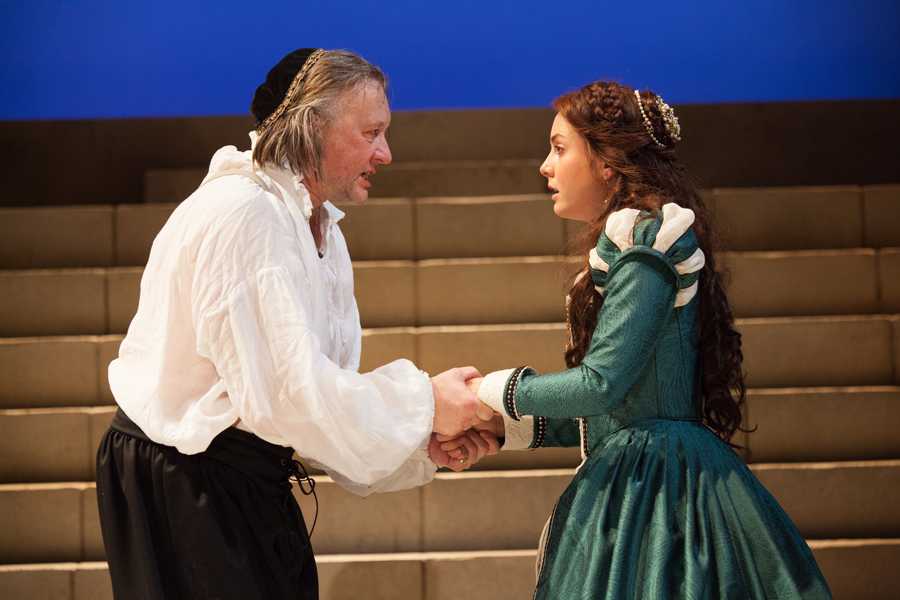
Review: Volpone – Judi Herman gets guilty pleasure from Henry Goodman’s wickedly good performance in the title role of The RSC's Volpone

Volpone, RSC, 2015 © Manuel Harlan Ben Jonson’s scabrously and cruelly comic take on greed premiered to huge acclaim in 1605, the year of the Gunpowder Plot, and has remained his most popular play. Although it shares its exotic (especially in Jacobean England) Venice setting with two other plays in the current Royal Shakespeare Company season – The Merchant of Venice and Othello – the RSC is actually pairing it with Christopher Marlowe’s The Jew of Malta (and a lesser known play, John Ford’s Love’s Sacrifice) calling them "contemporary takes on classic plays exploring the idea of the outsider".

Of course the RSC is also reviving The Merchant of Venice this season (which we reviewed), which could also be considered a classic exploring the idea of the outsider, as Shylock, though not the title role as in Volpone and The Jew of Malta,  is considered such a central character.

It is perhaps a relief that Jonson didn’t choose to cast his title character in this study of greed, the supremely greedy Volpone, as a Jew. His ruthless schemes to acquire more wealth and precious objects are based around his brilliant masquerade as a childless invalid on his deathbed seeking an heir to whom to leave his wealth. And they are, if anything, more ingenious than Barabas’s machinations in Marlowe’s play and like Barabas, he starts the play by taking the audience into his confidence. But Volpone is the wily fox not the wily Jew and pretty well everyone else in the play is as greedy and morally bankrupt as he is. Plus most of the other characters also have Italian names that flag up their types to the audience straightaway – like the greedy would-be heir, Corvino, the Crow and Mosca, Volpone’s assistant and partner in crime, The Fly.

More than 15 years ago, Henry Goodman played Shylock at the National Theatre, in a production of The Merchant of Venice by Trevor Nunn. I am not alone in considering Goodman’s Shylock to be the finest, the most complex, the most moving that I have ever seen. Now he is reunited with Nunn and actor and director find themselves back in Venice, once again in a modern dress production of a classic dark comedy. This time though, instead of playing a man who is an outsider cast in that role by his fellow citizens because of his race and religion, Goodman plays a man who is supremely comfortable in his skin. He’s positively gleeful in the Machiavellian masquerade that means he can never be himself with anyone except the circle of minions who are in his pay and in his confidence, Mosca his private secretary, and his dwarf, his eunuch and his hermaphrodite. But then his very best friends are his golden treasures and he simply can’t get enough of them.

Volpone, RSC, 2015 © Manuel Harlan

Like his earlier Shylock, this is a stellar performance by an actor at the height of his powers, working wonderfully with the director with whom he goes back such a long way. Goodman’s is a marvellously warm stage presence, with a vigorous energy and an irresistible twinkle in his eye, even if it is perhaps the glint of avarice. When he takes the audience into his confidence at the start of the play, it’s quite hard not to be bowled over by all that enthusiasm – and not to be impressed by the close tabs he keeps on the stock market, with an LED display of share prices constantly updating above his head – courtesy of Stephen Brimson Lewis. The British set designer has a spectacular sense of how to use the Swan Theatre’s roomy thrust stage with light and airy glass display cases containing the treasures and vital props and scenery, like Volpone’s sickbed, complete with drips and heart monitor, arriving smoothly and swiftly on stage as needed.

Goodman’s transformation, with the aid of his staff, from, frankly, a rather sexy millionaire clad in designer silk pyjamas and dressing gown into a pathetic, dying invalid "sans eyes, sans teeth, sans everything" is masterly – a fantastic and very funny coup de theatre.

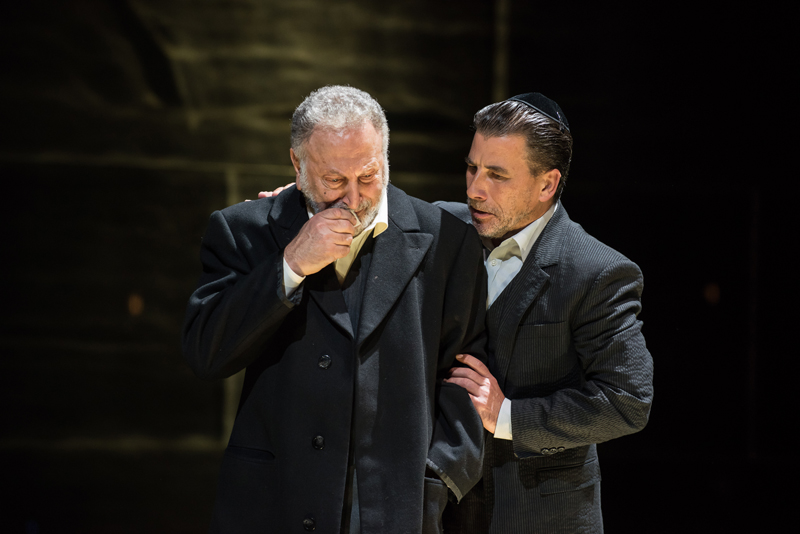
As in The Jew of Malta, it’s hard to feel any sympathy for most of these greedy types. It’s also great to see so many members of The Jew of Malta playing almost parallel roles here. So Matthew Kelly and Geoffrey Freshwater, who played a pair of greedy clerics in Marlowe’s play, here get to play a pair of equally greedy clients and would-be heirs of Volpone. They are so unscrupulous that the one is not above prostituting his own wife when it’s implied that would further his chances to inherit and the other is prepared to disinherit his son for the same reason. Both men seem physically crooked and diminished by their lust for riches, while Volpone and his acolyte Mosca (a performance of terrifically sly and energetic intelligence from Orion Lee) seem rather invigorated by theirs.

Steven Pacy, the pusillanimous Governor of Malta, enjoys a great comic turn as the preposterous gentleman traveller in Venice, Sir Politic Would-Be, whose name speaks for himself. He is more than matched by his vacuous wife, the superbly brassy Annette McLaughlin, who's all big hair and extensions, tiny tight frocks and dizzyingly high heels, channelling Kim Kardashian and TV Reality show The Only Way is Essex followed by her long-suffering personal cameraman and girl assistants at all times. So no pearl of wisdom, no handy make up tip is lost to her Youtube followers; and with selfie stick at the ready so no photo opportunity is lost either. Again great use is made of huge onstage screens blowing Lady P up to a lot more than life-size (video designer Nina Dunn). Colin Ryan is great fun as Sir Politick’s nemesis, Peregrine (or ‘pilgrim’), a much more savvy, young American backpacker, complete with dreadlocks and iPad.

Volpone, RSC, 2015 © Manuel Harlan

Nunn and his creative team work seamlessly and wondrously together to build a production so fluid and so intelligent and so right for this time of social media and self-publicising, intrusive media scrutiny – and unbridled corporate and individual greed and inequality – that it’s hard to see how it could be bettered. There is a breath-taking moment when Volpone realises his deceptions are catching up with him. The bustling action of the court to which the invalid has been called to testify freezes around Volpone and his household, who are thrown into sharp monochrome relief by Tim Mitchell’s masterly lighting. It’s a real moment of truth and as fine as any I can remember from any of Nunn’s extraordinary body of work.

The whole is fabulously enhanced by Steven Edis’s gloriously appropriate music, directed by John Woolf on keyboards, with Andrew Stone-Fewings (trumpet), Andrew Waterson (guitar) and Kevin Waterman (percussion). In particular a speech about Pythagoras’s potentially problematical theory of the migration of souls becomes a bravura rap performed by Jon Key’s Nano the dwarf, Ankur Bahl’s Androgyno the hermaphrodite (a sexy Eurovision winner Conchita Wurst lookalike) and Julian Hoult’s Castrone the eunuch – all lovely movers! And I should finish by paying tribute to Ranjit Bolt’s sparkling script revisions which are spot on. This really is a must see.

By Judi Herman

Photography © Manuel Harlan

Volpone runs until Saturday 12 September. 7.30pm & 1.30pm. £8-£40. Swan Theatre, CV37 7LS; 084 4800 1110. www.rsc.org.uk

Review: The Trial – Judi Herman finds this updated Kafka fable suitably unsettling

Rory Kinnear as Josef K in The Trial at Young Vic, London © Keith Pattison© Keith Pattison

Franz Kafka's 1915 novella has always seemed uncannily prescient, first of life in Nazi-occupied Europe, then in the post-war Communist era. Now it assumes a whole new chilling significance in a 21st century full of mass media scrutiny, social media, online surveillance and CCTV.

Joseph K (played by Rory Kinnear) finds himself on trial for an unspecified crime. He is informed he is under arrest after a rude awakening by a pair of court officials who make off with some of his personal effects. At first it hardly affects his daily life and work, but soon righteous indignation gives way to frustration at not being able to get across his case and how it is progressing through seemingly unending layers of bureaucracy. So obsessive paranoia kicks in, fuelled by an uneasy sense of unspecified guilt, as events move inexorably – and not without a grim quirky humour – towards a dark conclusion.

The fable has proved attractive to theatre practitioners, including, notably, Steven Berkoff and now it has attracted the attention of playwright Nick Gill and director Richard Jones, himself no slouch in the staging of the dark and quirky. Together with designer Miriam Buether, costume designer Nicky Gillibrand, lighting designer Mimi Jordan Sherin and composer and sound designer David Sawer (sound also by Alex Twiselton), they have come up with a version that reflects the Kafkaesque in the era of Facebook and Twitter exactly one hundred years after Kafka wrote it.

Jones’s hugely accomplished and dedicated cast, led by Kinnear, skilfully negotiate Buether’s highly original conveyor belt set, moving between two banks of seating, casting the audience as jurors, and delivering rooms and offices as required. There’s something voyeuristic too about peering at these rooms furnished with coffee tables of family photographs, which also sits well with the paranoia. Best of all is that Kinnear’s increasingly-perspiring Joseph succumbs first gradually, and then faster and faster, to guilty feelings as he delves back through his life; starting with preschool toddler days, finding reasons to be guilty that would have done Sigmund Freud proud.

Kinnear gives an extraordinary performance, hugely intelligent and as open as a wound. Kate O’Flynn is wonderfully versatile as the young women and girls in this stage of Joseph’s life, from the what-you-see-is-what-you-get barmaid, who is everything from the girl next door, to sexy temptress and demanding adolescent. Sian Thomas shines in a terrific pair of turns as the stridently ineffective lawyer from hell and a scarily smooth doctor, and Hugh Skinner (the useless intern from TV comedy W1A) relishes two contrasting roles as a dangerously aspirational Number Two at Joseph K’s office and a terrifying example of what might be in store for K as an accused man almost at the end of the process on which he has inexorably been set. The rest of the cast are equally superb, working especially well in various incarnations of a sinister ensemble. Sarah Fahie's movement direction enhances their shifting stage pictures, raising the threat level exponentially as the conveyor belt rolls by.

Gill’s update mostly works a treat (or should that be a threat!). My only quibble is with the semaphore babble of K’s internal monologues, where verbs become imperatives with which he addresses himself, sentences and phrases lose the odd word and words lose the odd letter – "and" for example becoming "an". To quote the opening lines: “An almost woke ee up one morn – like baby innocent an bold, the great white hole, lord of all surveys, unslandered, clear of mind an hurt, future ahead an ee all indestructible – Josef K.”

These soliloquies are interestingly idiosyncratic, but they are more jarring than arresting (pun unintended).

By Judi Herman

The Trial runs until Saturday 22 August. 7.30pm & 2.30pm. £10-£35, £10 concs. Young Vic Theatre, 66 The Cut, SE1 8LZ; 020 7922 2922. www.youngvic.org

Small and perfectly proportioned: TAU Night at the Movies features the next big thing in Israeli talent

Every year I’m impressed by the quality of short student films presented by the Tel Aviv University Trust. It’s delightful to see such tight storytelling in as little as 12 minutes. That’s the length of Kapunka (trailer above), the film that opened this year’s mini festival, and it set the benchmark high.

The tale of crafty Shmulik – who sees his way round the rabbinate law of shmita that decrees land be left fallow every seven years – is also timely for this is that seventh year. Shmulik’s solution to sell his land temporarily to Changrong, his senior Thai worker, with the idea of buying it back when the year is up, inevitably goes spectacularly wrong. And I do mean spectacularly! To reveal more would be a shame, but director Tal Greenberg’s abrasively funny film may well remain a unique opportunity to marvel at a Thai temple sprouting in an Israeli field like Jack’s beanstalk. Greenberg’s cinematography is gorgeous, colouring a vivid landscape, the Spaghetti Western score is spot on for a comic confrontation on the land and the actors are wonderfully matched. It’s great to see the significant community of Thai workers in Israel given space too. Greenberg is definitely one to watch.

The spotlight turns on a rather larger minority community in Leeor Kaufman’s Papa. At first sight this is a story of schoolboys bullying 11-year-old Stas, who is a recent immigrant from Russia. His violinist father is reduced to busking and Stas, desperate for acceptance into a gang of Israeli boys, is reduced to a less than filial act. Kaufman says the film is first and foremost about fatherhood, putting your children first. Poignantly Sioma Perl, the TAU theatre department carpenter who plays Papa, was a theatre director in Russia before he emigrated to Israel. No wonder his performance has such depth. Kaufman gets terrific performances out of his young actors too and his film is both poignant and unsettling.

Even more unsettling is HomeMade, Lior Sagi’s story of a kibbutz mother trying to clear her son’s name when he is arrested for molesting a kibbutz child. Sagi cleverly puts the mother in charge of the nursery of even younger children, so she first appears confidently regaling them with bright, happy children’s stories. Her body language crumples as soon as she is confronted by the adult world in which she herself has become a news story. The cruelty of the young female TV journalist by whom she has agreed to be interviewed and the eventual outcome of the film are discomfiting and Sagi is not afraid to tackle this difficult subject.

Maayan Cohen is not afraid to be explicit in his shockingly funny comedy Zazaland, about a Georgian family trying to arrange a marriage for their gay son. The contrast between the prim, po-faced bride and her family and her prospective bridegroom’s louche and rather gorgeous lover, gleefully hiding naked in his bedroom, make for squeals of audience laughter and Cohen orchestrates the increasingly farcical situation he’s created with aplomb. His film is part of a project to take inspiration from a classic Israeli film to make a new short. He’s done a great job of making a pithy, daring little comedy inspired by Dover Koshashvili's full-length drama Late Marriage and his choice of a Georgian family is a subtle extra homage to Kosashvili's Georgian heritage.

dinner

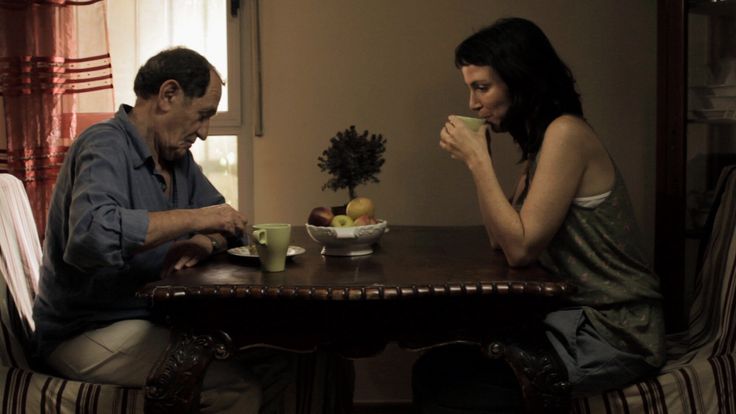
Finally, the most unashamedly charming of the five films, Lee Nechushtan’s Dinner (pictured above) proves that it’s never too late to date. Gadi, a 76-year-old local deliveryman, is looking forward to a dinner date he’s arranged via an agency, but he must first get through his busy day and one delivery threatens to scupper his evening. Veteran film and theatre actor Gedalia Besser charms as feisty Gadi and Nechushtan sets up the situation beautifully. She introduces her hero in his cosy cluttered apartment listening to an old favourite and organising his date on a cream-coloured old-fashioned Bakelite telephone, and then expertly steers her story through the encounters he has with a succession of regular customers.

On this showing the future of the Israeli film industry is safe in the hands of its graduating filmmakers and I’d be surprised if we don’t hear these five names again.

By Judi Herman

Review: The Hook by Arthur Miller – A compelling study of the ongoing struggle working man has for social justice

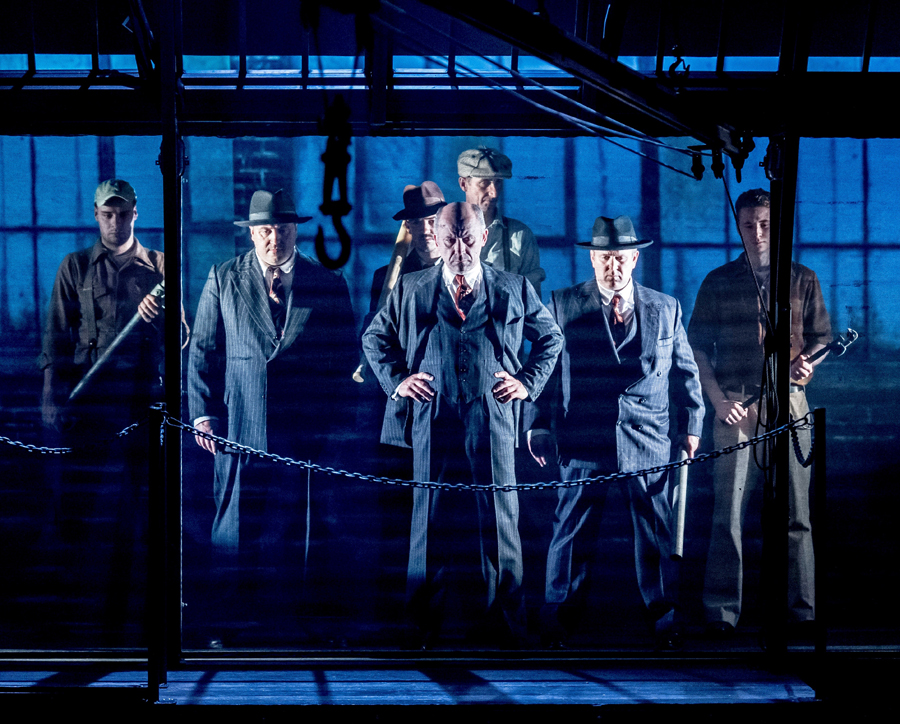
The Hook, Jamie Sives and company, 2015 © Manuel Harlan In the mid 1940’s Miller was captivated by the Red Hook neighbourhood of Brooklyn that contained so many docks and landing piers. He was fascinated by the close community of longshoremen (dockers) and their precarious life of casual day hire, unsafe working practices and exploitation by corrupt Union officials in thrall to the Mafia. Intrigued by the death of Pete Panto, a longshoreman who vanished after confronting Union corruption, Miller wrote “a play for the screen", believing that cinema could be a more democratic way of playing his story to the community he was writing about.

Miller’s Panto is Marty Ferrera, a loud-mouthed and opinionated longshoreman, complete with docker’s hook round his neck. He is also, as Miller himself wrote, that “strange, mysterious and dangerous thing” that is a “genuinely moral man…it’s as though a hand had been laid upon him, making him the rebel, pressing him towards a collision with everything that is established and accepted.” What is established and accepted on the docks is the injustice and corruption of a system that sees work awarded in exchange for bribes, making the hand-to-mouth existence of the longshoremen even more precarious. Marty makes his stand against the system when he can no longer support his wife and child, denied work even after offering his own bribe. So he decides to stand for Union President to address the issues head on.

But Marty Ferrera never reached the screen. Pressure from Hollywood executives and arm-twisting by the FBI who worried it would foment dissent in the dockyards, caused Miller to abandon the project and his director, Elia Kazan, went on to make the more acceptable On the Waterfront some five years later.

The Hook, Joe Alessi (centre) with ensemble, 2015 © Manuel Harlan

So how come the play is receiving its world premiere at Northampton’s Royal and Derngate Theatres this year? It’s down to the painstaking work the theatre's Artistic Director James Dacre has put in on realising the project. Of course his staging, a co-production with Liverpool's Everyman, coincides with the centenary of Miller's birth and Dacre says this timely play “talks about the living wage, zero-hours contracts and industrial communities on the brink of enormous change.” Together with designer Patrick Connellan, Dacre spent years collating Miller’s drafts of the play, illuminated by Miller’s own notes. But what we see has been pulled together into a more than workable script by playwright Ron Hutchinson, who proved he has a special insight into and era for Americana in his brilliant Hollywood comedy Moonlight and Magnolias (charting the painful birth of Gone With the Wind, the movie). Hutchinson was struck by the way Miller went out of his way to avoid stock characters and show just how the main protagonists are neither all good nor bad.

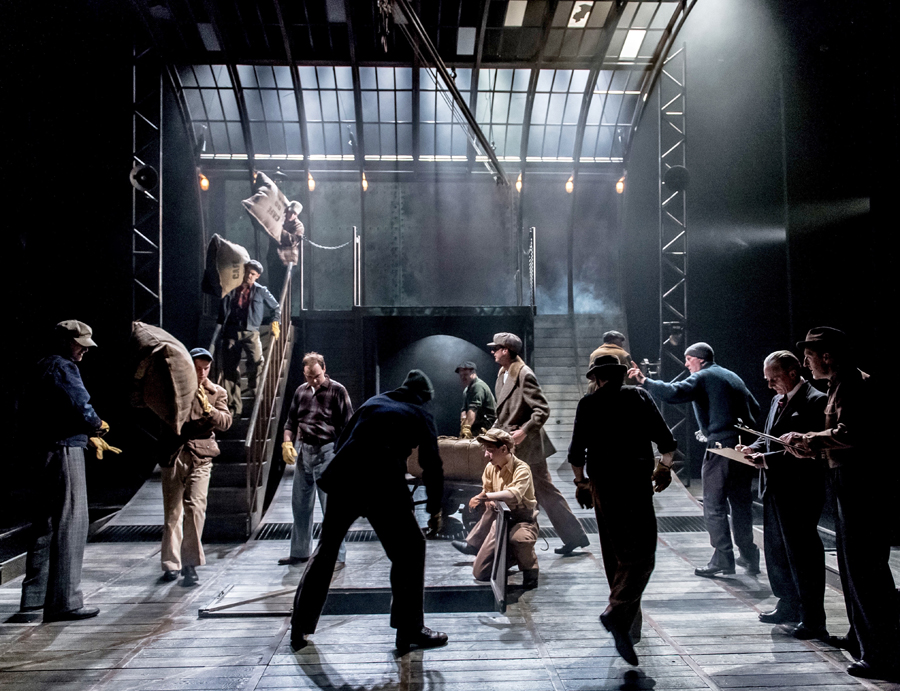
The challenge for the team has been to translate something written for the scale of the cinema into a stage production. Connellan’s brooding set, thanks to clever use of Nina Dunn’s projections and Charles Balfour’s moody lighting, is dockyards, streets, offices and homes, allowing all the cross-cutting demanded by the filmic element of the script. There is more than a nod here to film noir and the strictures of black and white lighting.

Dacre marshals his cast as if they are a vital part of the intercutting, and working with movement director Struan Leslie, choreographs the transitions between scenes with beautiful precision and speed.

The Hook, company, 2015 © Manuel Harlan

Jamie Sives as Marty Ferrera (pictured centre, at the top of the review) is suitably Brando-esque as required, yet brings out the humanity of this common man in a way Miller would have appreciated. Susie Trayling, as Marty’s passively supportive and docile wife Therese is nicely understated in a part that’s reminiscent of Linda Loman in Death of Salesman. Joseph Alessi gives a commanding performance as the ruthless Union Chief (if anyone is the man you love to hate, he is!) and the ensemble is effectively swelled by a community ensemble of local amateurs, totally convincing in the non-speaking crowd scenes. Some of the professionals, though, occasionally distract with slightly wandering New Jersey accents.

It’s not in the end as completely satisfying as Miller at his best in the plays we know and love, but it is a compelling study in treachery and probity and the ongoing struggle for social justice for the working man. It all makes for a genuinely exciting evening, with unexpected and twists and turns in a story perhaps more fast-moving yet less in-depth than in Miller’s dedicated stage plays.

By Judi Herman

Photography by Manuel Harlan

The Hook runs until Saturday 27 June. 7.45pm & 2.30pm. £10-£29. Royal & Derngate, Northampton, NN1 1DP; 016 0462 6222. www.royalandderngate.co.uk

The show then moves to Liverpool Wednesday 1 - Saturday 25 July. 7.30pm. £12-£20. Everyman, Liverpool L1 9BH; 015 1709 4776. www.everymanplayhouse.com

SERET 2015 reviews: Do You Believe in Love?

Do_You_Believe_in_Love, israeli film, seret 2015 Funny, tender and even gripping, this is Tova’s story – a larger-than-life matchmaker with a heart of gold, down-to-earth philosophy, a devoted husband and a crippling disease.

Tova conducts her business from the easy chair to which she is confined, loud and proud despite having no movement at all from the neck down, thanks to the muscular dystrophy that struck after she gave birth to her daughter Dolly. “I do everything with my mind,” she declares, and she certainly proves it in Dan Wasserman’s documentary.

Although she has a special interest in would-be brides and grooms with their own disabilities, she welcomes everyone and anyone of any age looking for a life partner. So the film opens with a parade of the long, the short and the tall; the old and the young; the abled and the differently-abled; all looking for love and each with their own wish list. She pulls no punches and is not afraid to ask wheelchair user Yossi whether he can get to the toilet unaided. “Do you believe in love?” is her constant question and she advises all her clients to be prepared to compromise.

And so the viewer is drawn in to the stories of Tova’s clients. You find yourself hoping against hope that they will find happiness with Mr or Ms Right. There’s spiky Rosan in her wheelchair, out and proud about her chain-smoking and entirely unprepared to compromise to impress health-conscious Asi on their first (and probably last) date. The beautiful young blind woman, with whom you get to share the pain of having a potential date hang up the phone when she confides that she cannot see, gets short shrift from Tova, who tells her sternly not to mention her sight until the prospective husband has set eyes on her.

In case you think her successes are few and far between, it is her proud boast that she has arranged more than 550 matches. The filmgoer does get invited to the wedding of one of Tova’s successes, thanks to daughter Dolly who goes on behalf of her mother and relays the ceremony via her mobile phone. The joy of both bride and groom is palpable and immensely touching and Wasserman does indeed give the audience a guest’s-eye-view of the details of the traditional ceremony.

And then there’s the overarching story of Tova herself and her devoted husband Gaby. It doesn’t matter that he has "heart and psyche problems", including a strange compulsion to buy huge quantities of fresh peppers every day. It’s his total devotion to Tova that is so moving and their unwillingness to survive each other as they make clear in the living wills they make on video.

The climax of the film is their 43rd wedding anniversary party, surrounded by their large and noisy family and many friends. The highlight is watching the film of their 1960s wedding, and it is extraordinarily moving to see the young sprightly couple dancing together – she so slender and lively, as she points out herself. But time certainly has not withered this indomitable spirit and she and Gaby are a shining example of what you can look forward to if you believe in love.

By Judi Herman

Do You Believe in Love screens Monday 15 June. 4pm. £14. JW3, 341-351 Finchley Rd, London NW3 6ET. www.seret.org.uk

Review: On her third helping of The Merchant of Venice, Judi Herman has a discomfiting but enthralling evening

The Merchant of Venice production photos_ 2015_Photo by Hugo Glendinning (c) RSC _MER_157

Don't let the buggers grind you down. Try to come over as laid back. They wear a strange eclectic mix of what they see as achingly trendy, or sharp city wear, set off with flamboyant footwear in bright – too bright – poster colours. So wear a dingy blouson over an old cardigan and keep your dignity, simply wipe off their spit when they show their contempt for you. This could be what's going through Shylock's mind in Makram J Khoury's finely calibrated performance, which positively radiates a relaxed gravitas.

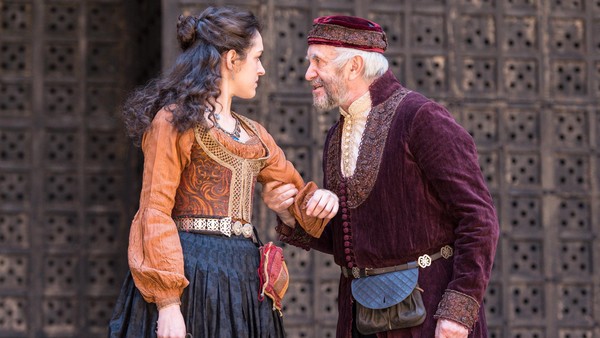
It is to be hoped that Khoury, the popular, award-winning Palestinian-Israeli actor didn't base it too closely on his experience as a man caught between two worlds in his native country. Certainly when Christian Venice shows its contempt by spitting on Shylock's "Jewish gabardine", the gasp of horror that runs through the audience is even more of a shock wave than the similar audience reaction when this treatment is meted out to Jonathan Pryce's dignified Shylock at Shakespeare's Globe.

Khoury’s trajectory is frighteningly clear here, from distracted father outraged by his daughter Jessica’s's elopement and her profligate spending and disregard for her dead mother's ring, to vengeful would-be killer. Given the special disgust displayed towards him by Jamie Ballard's alarmingly volatile Antonio, it's hardly surprising he seizes the opportunity to whet his knife and prepare his scales in open court, now entirely indifferent to what the hostile Christians make of his behaviour.

This is the third time this year that I have seen this problematical play and each time I am struck by how little stage time Shylock shares with Jessica. Shakespeare magnifies the awkwardness of what today would be dubbed their dysfunctional relationship by showing so little of it onstage. And, in the few moments they do share together, Jessica is in turmoil over her imminent elopement and the need to deceive her father to make her escape.  Here director Polly Findlay and designer Johannes Schültz trap Scarlett Brookes’ awkward, gawky Jessica at an impossibly high window in her father’s house. So there even less connection as he leaves for the dinner with his new creditor Bassanio that will give her the window of opportunity she needs to escape with her Christian lover Lorenzo (James Corrigan), as well as her father’s jewels and ducats.

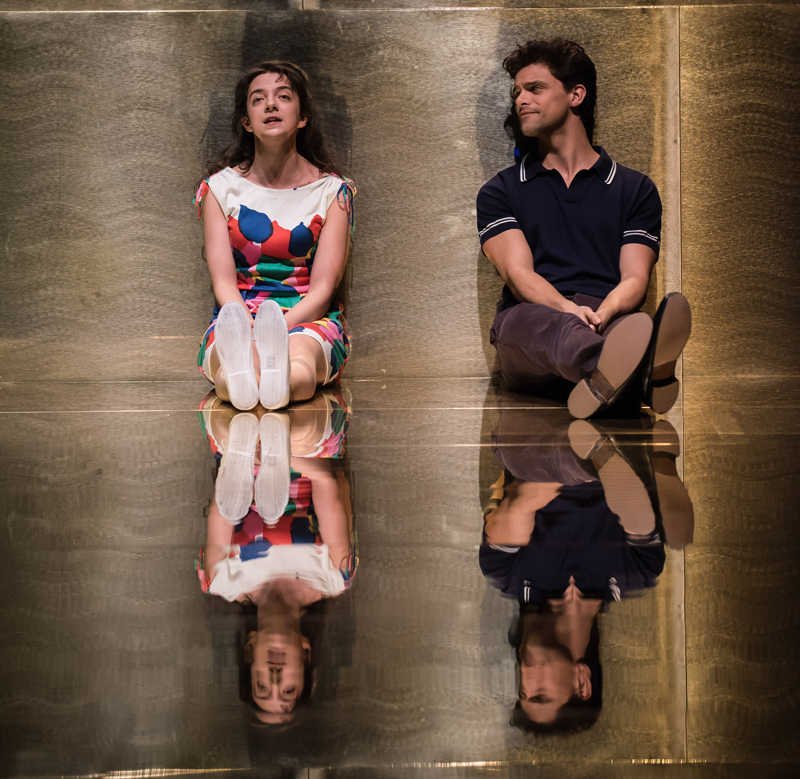
Indeed Findlay, sharing her vision with Schültz and costume designer Anette Guther, builds an especially alienating dystopic Venice, where it’s easy for the audience to share Shylock’s discomfiture. Belmont, wealthy heiress Portia‘s nearby estate, similarly offers little in the way of refuge, even to its owner and her chosen guests from the city, let alone the foreign suitors at whom this Venetian lady pokes fun. The audience is reflected in the huge brass mirrored wall atop which Jessica appears and there is nowhere to hide on a thrust stage with only a mysterious (and perhaps more distracting than hypnotic) pendulum on which to rest the eye, joined briefly later by three symbolic ‘caskets’ lowered from above.

There is certainly nowhere to hide in Venice or Belmont, from creditors in the city, from the whim of a dead father, controlling his daughter’s choice of husband from beyond the grave. And there is nothing to distract from the actors, who first take the stage from seats on Brechtian benches at the rear. If anything, Guther’s flamboyant, jarringly disparate costumes are the set dressing. Patsy Ferran’s intelligent Portia might be grateful to don sober lawyer’s garments, after the hard poster colours of the little shift dresses that seem to be current Venetian jet set fashion here.

There is, though, a shock awaiting her at court. For at the centre of Findlay’s reading of the play is what turns out to be a love triangle, where Portia sees what the audience has known from the start – she must share her new husband Bassanio (Jacob Fortune-Lloyd) with Ballard’s tortured (and I don’t mean by Shylock), depressive Antonio, who claims him with a desperate kiss as he awaits his fate. It certainly makes sense for Portia to channel her discomfiture and anger into her inspired and literally blood-chilling case against Shylock. So this ‘comedy’ becomes even more of a problem play, if Portia and Bassanio’s wedded bliss looks uncertain before their marriage is even consummated.

Meanwhile, Khoury’s now coldly focused, implacable Shylock makes the most of his day in court, almost whetting his knife on Antonio’s bare chest. No wonder Antonio screams and cringes. And though Shylock loses everything, he is perhaps more incredulous than broken and makes it clear that playing for sympathy - from court or audience – is beneath him.  Even he is upstaged by a tsunami of banknotes raining down on the court – effective but perhaps heavy-handed symbolism.

The Merchant of Venice production photos_ 2015_Photo by Hugo Glendinning (c) RSC _MER_148

By the time Portia and her faithful waiting gentlewoman Nerissa (an especially warm and literally supportive performance from Nadia Albina – these girls are close) return to Belmont, Jessica and her Lorenzo do not look entirely comfortable with each other either. Jessica seems almost aggressive as she and Lorenzo top each other with their references to pairs of mythical lovers who might have shared such an enchanted night as theirs, alone on Portia’s estate while its mistress is away at court. The magic should have been enhanced by a floor gradually lit by candle after candle filling the stage, the effect doubled by that mirror wall. But their brash brightness is too obvious a visualisation of Lorenzo’s description of "the floor of heaven thick inlaid with patines of bright gold"; the patina on the brass of that mirror would have done nicely. Perhaps the only real beauty in the evening is provided by the choristers, "young-eyed cherubim" indeed, to quote Lorenzo again, singing Marc Tritschler’s unearthly plainsong from the heights of the set. It’s a particularly discomfiting and alienating reading of this difficult play and though the creative vision is clear, it is perhaps too much of a straitjacket for the drama.

By Judi Herman

The Merchant of Venice runs until Wednesday 2 September (broadcast live in cinemas on 22 July). 7pm & 1pm. £5-£60. Royal Shakespeare Theatre, CV37 6BB; 084 4800 1110. www.rsc.org.uk

Greetings from Israel! Raphael Gee reports on Limmud Tel Aviv

The Two Rafis - Raphael Gee (R) and Rafi Zarum (L) at Limmud Tel Aviv, 2015

The Two Rafis - Raphael Gee (R) and Rafi Zarum (L) at Limmud Tel Aviv, 2015

The two Rafis: Raphael with Rafi Zarum, the dean of the London School of Jewish Studies, who presented sessions on James Bond and 7 levels of laziness

"Just back from the two-day inaugural Limmud Tel Aviv. I am not certain how many attended but those who did were a mixture of Israelis and olim from many countries including the UK, France, Italy, Turkey, the USA, South Africa and Australia. There were sessions in both Hebrew and English. Of the English sessions, topics included leadership, a talk by a retired Israeli intelligence agent (his name was not given but when he got up to speak, I recognised him from previous UK Limmud conferences, so his cover was effectively blown), Nidda (Jewish family law), Israeli innovation for developing countries, water co-operation and Jewish origins of value investing. There were also some journalists from the Jerusalem Post and The Media Line."

By Raphael Gee

For future Limmuds, visit their Tel Aviv or UKwebsites.

Review: The Merchant of Venice – The Globe offers a full-blooded production of a problem play

Shylock The Merchant of Venice may be considered the most problematical of Shakespeare’s problem plays, especially in the current climate of a perceived threat of heightened antisemitism, but there’s more than one Yiddish version of the story, including M. Zamler’s 1929 novel with a brand new title, Shaylock (Der Soyher fun Venedig). Tellingly it is billed as based on Shakespeare’s tragedy.

Shylock’s is not the title role in Jonathan Munby’s spirited, yet thoughtful new production for Shakespeare’s Globe, but Jonathan Pryce’s commanding, complex Shylock takes centre stage in each of the few scenes Shakespeare writes for him. In fact Shylock and his rebellious daughter Jessica (played by Pryce’s real-life daughter Phoebe Pryce) get a few more lines than usual – they first erupt on to the stage in the middle of a furious row – in Yiddish!

Pryce (a notable Fagin, but banish all thoughts of that here) has said in interview that he would love it if the audience booed him, yet by the time they watch him arriving in court armed with knife and scales to cut and weigh the famous pound of Antonio’s flesh, it’s clear how much he has had to bear from all the Christians of Venice – especially from Antonio, who really does "spit upon" his "Jewish gabardine" (with the compulsory yellow circle, forerunner of the Nazi yellow star, stitched on the breast) even as he is asking to borrow money. There’s an especially shocking moment, when Shylock’s treasured copy of the five Books of Moses (the Torah), that he clearly carries with him for constant consultation (here looking up the story of Jacob and Laban which Shakespeare has him reference), is wrenched out of his hands and contemptuously flung on the ground. And skull caps off to Munby for some nice research – when Shylock stoops to rescue it, he kisses it to restore respect, a gesture you can see in any synagogue when a prayer book is accidentally dropped.

His distress at hearing that Jessica has exchanged his late wife’s ring for a monkey is especially touching, bringing a temporary moment of quiet sympathy from the usually raucous groundlings, at least the night I saw the play.

Phoebe Pryce’s Jessica has her own awkward path to negotiate once she has broken free of her father to flee with her Christian love Lorenzo. Although wealthy heiress Portia makes the new couple welcome at her grand home and leaves them in charge of it, she causes her young guest a moment of discomfiture when she takes her place to partner Lorenzo in a formal dance that just happens to be slightly suggestive too – does it perhaps smack a little of droite de seigneur?

And usually the last the audience sees of Shylock is a broken man begging for leave to go from the court, under imminent threat of being forced to convert to Christianity. Here his last word is "credo" ("I believe") part of a Latin mass, a conversion ceremony orchestrated by Antonio – either watched or imagined by a distraught Jessica.

THE MERCHANT OF VENICE Shakespeare's Globe 2015 CREDIT: MANUEL HARLAN ... HANDOUT ...

But of course Shakespeare’s Globe is not staging Shaylock. Munby’s reading of Shakespeare’s comedy really does get laughs from the whole house, not just the delighted groundlings, two of whom get to strut their stuff onstage to some of the loudest applause that greets every bit of inspired stage business. They are roped in to help out the clownish servant Launcelot Gobbo, who deserts Shylock for a new master ahead of Jessica’s flight. Stefan Adegbola works the crowd with obvious and expert delight. It’s a pleasure to watch him at work – and so happy in it too!

Others shine in smaller roles as well. Dorothea Myer-Bennett as Portia’s waiting gentlewoman Nerissa, is wonderfully sprightly and intelligent, getting laughs from every echo of her mistress, for example as she is courted by Gratiano, man to Portia’s chosen suitor Bassanio; and even in the sometimes tedious subplot which sees both mistress and maid, disguised in male attire tricking their new husbands into yielding up the rings they gave them to plight their troth. David Sturzaker’s Gratiano is more likeable than some, despite his eager embrace of antisemitism, which is after all as endemic in Venice as anywhere else in 16th-century Europe – and despite an opening gambit that has him throwing up after a night out.

Scott Karim’s Prince of Morocco, somehow managing to be dignified and ridiculous at the same time and Christopher Logan’s wonderfully daft Prince of Arragon, straight out of Carry On Columbus, get the very most out of their cameo roles. They underline the ‘Little Venice’ prejudice of Portia and her clique, worthy of UKIP; for the young women have already ridiculed suitors from all over Europe before this brave pair dare to face the rather cruel trial that Portia’s late father has decreed for those who seek her hand.

That’s not to say that Rachel Pickup’s intelligent, even prickly Portia and Daniel Lapaine’s handsome though febrile Bassanio and Dominic Mafham’s repressed Antonio don’t hold their own throughout. It’s more a paean to the completeness and effectiveness of this production in every role.

Mike Britton’s simple stage design, letting his colourful costumes sing out, and Jules Maxwell’s delicious music, played and sung by a surprisingly small and hugely effective ensemble (singers Jeremy Avis (also musical director) and Michael Henry and Nuno Silva with Dai Pritchard on clarinets and Catherine Rimer on cello) enrich this hugely satisfying period production.

By Judi Herman

Photography by Manuel Harian

The Merchant of Venice runs until 7 June. 7.30pm & 2pm. £16-£43 seats, £5 standing. Shakespeare's Globe, 21 New Globe Walk, SE1 9DT; 020 7401 9919. www.shakespearesglobe.com

Review: I Wish to Die Singing – Judi Herman is moved by this shocking and timely documentary

I Wish to Die Singing – Siu-see Hung © Scott Rylander© Scott Rylander

The January issue of Jewish Renaissance highlighted the life and work of Czech writer Franz Werfel, who played a significant part in bringing the Armenian genocide to the notice of both Europe and America after he came across survivors living in desperate conditions in Damascus in the late 1920s. He also wrote a devastating novel, based on a defiant stand by Armenian survivors, The Forty Days of Musah Dagh. Nonetheless, a century later, the terrible massacres that began in 1915 are still not universally recognized as genocide, to stand alongside the Holocaust and the Rwandan genocide in the record of atrocities inflicted by humankind on their fellows.

If you walk through the Armenian Quarter in Jerusalem’s Old City, you will find, as I did, the memorial to the Armenian genocide. If you read celebrity pages in newspapers, it’s hard to avoid the Kardashians, currently probably the most famous bearers of one of those distinctive Armenian surnames. They came together last week as the Jerusalem memorial became the focus of protests demanding the recognition of the Armenian genocide, 100 years after it began; and Kim, the most renowned Kardashian, visited the memorial in Yerevan, Armenia’s capital, to pay her respects and play her part in raising world awareness of the genocide that inspired Hitler. And Kardashian and Hitler come together in Neil McPherson’s documentary drama which also plays its part in demanding recognition for the annihilation of 1.5 million men, women and children.

How do you tell the story of a genocide when the basic facts are unknown to most? How best to convey the attempt by the Ottoman Government to systematically exterminate all its Armenian subjects? Holocaust plays often work by letting the story of the one or the few stand for the story of the many, so that the wider picture emerges from the narrative. But, when no one knows the narrative and there is an ongoing story to tell, how can you convey the scale, the politics, the disputed facts and the personal stories?

Neil McPherson employs documentary drama, and to shocking effect, charting the history of wholesale killings, massacres, forced labour and death marches to the Syrian desert. Eye-witness testimonies give chilling evidence of what happened in 1915 and the cast take on the challenge of playing many roles. The convention of delivering verbatim texts proves extraordinarily powerful and just occasionally constraining.

Cleverly, MacPherson frames the events with an illustrated lecture, complete with slides, narrated with lucid authority by Jilly Bond who guides and links up the scenes. She first grabs attention with portraits of well-known personalities of Armenian heritage (Kim K for one) and Hitler’s chilling quote, “Who after all speaks today of the annihilation of the Armenians?” Bond points up other parallels with the Jews of Europe and their fate. The Armenian community was a Christian minority in a Muslim society. Many earned their living as bankers. They became “second-class citizens”.

Director Tommo Fowler steers his dedicated cast through a chilling 90 minutes on Phil Lindley’s appropriately minimalist set. Rob Mills brooding lighting and Max Pappenheim’s intricate soundscape add to the atmosphere of menace, after a brief moment of sunshine, light and laughter as the Armenian community celebrates Easter 1915 with song and dance.

Bruce Yadoo and Tom Mansfeld turn in strong performances playing the older men, from victims to perpetrators - and outside observers. One of these observers is Henry Morgenthau, the US’s Jewish ambassador to the Ottoman Empire, who, like Werfel, saw all too clearly the fate of the Armenians. His writings are just one the many sources for McPherson’s thorough research.

Delivering child testimonies, Tamar Karabetyan, Siu-See Hung (pictured above) and Bevan Celestine movingly convey the child-like direct observation that represents so much sorrow. It’s all the more moving because the three also represent different cultural backgrounds, a reminder, along with programme notes on the eight stages of genocide  (from a briefing paper at the US State Dept), of how the celebration of cultural diversity and the dehumanization of the other might be different  sides of the same coin.

The wrap-up between surviving grandmother (Kate Binchey) and unschooled granddaughter alone would have provided a fine ending but the story does not finish there.

Poignantly, press night was Friday 24 April, the date the Turkish government placed under arrest over 200 Armenian community leaders in Constantinople, which is therefore regarded as the date of the start of the genocide. Today, most of the world’s governments, including Turkey, the USA, the UK and, surprisingly, Israel, still refuse to use the “g-word", preferring euphemistic terms like “tragedy” in the game of geo-political friendships.

While there’s all too much information to communicate in limited time, McPherson and the Finborough, where he is artistic director, must be congratulated on playing their part in demanding long overdue recognition for the terrible fate of those 1.5 million Armenians as genocide.

By Judi Herman

I Wish to Die Singing – Voices from the Armenian Genocide runs until Saturday 16 May. 7.30pm & 3pm. £18, £16 concs. Finborough Theatre, 118 Finborough Rd, SW10 9ED; 084 4847 1652. www.finboroughtheatre.co.uk

Review: Death of a Salesman – The RSC's production is a highlight of Arthur Miller's centenary year

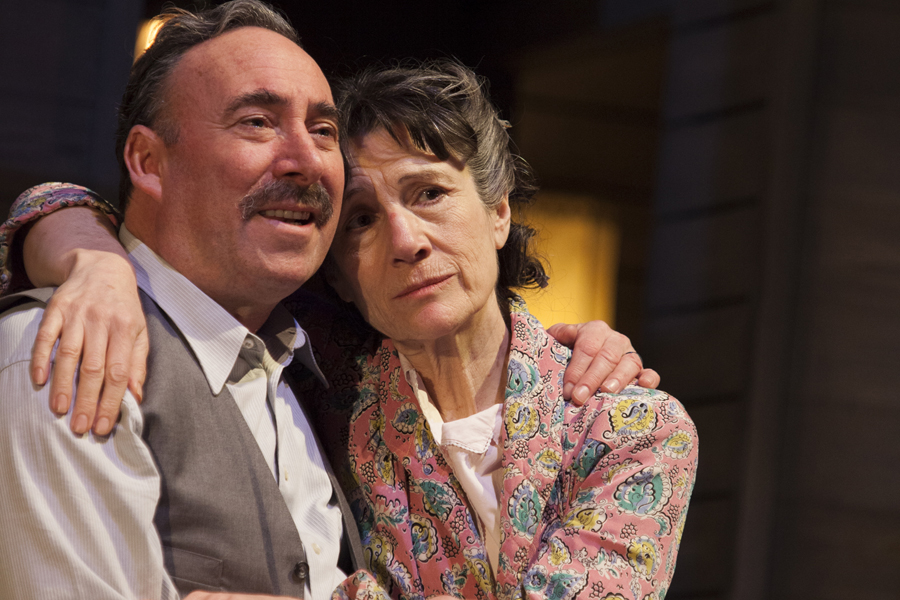
Death of a Salesman: L-R - Alex Hassell (Biff), Harriet Walter (Linda Loman), Antony Sher (Willy Loman) and Sam Marks (Happy), 2015 © RSC Director Gregory Doran is in no doubt that Arthur Miller's Death of a Salesman is the greatest American play of the 20th Century, addressing not only the heartbreaking conflicts within a family, but also bigger issues of national values and uncritical acceptance of the American Dream.

After a life of honest toil, Willy wants to stop travelling, pay off the mortgage and bask in the success of his two sons. But he can’t come to terms with the fact that his life and the lives of his boys are so different from his dreams of wealth and triumph. Miller explores the tragedy of what happens to a man who does not have a grip on the forces of life, as he puts it, whose career is disintegrating and the toll this takes on relationships between family members.

Miller was the son of Austrian-Jewish immigrants. His father worked his way up in New York's Lower East Side garment industry to become a wealthy man. The family lived in Manhattan until they lost it all in the depression and withdrew across the bridge to Brooklyn. As a teenager Miller worked to help supplement the family income with a bread delivery round before school. And he saw at first hand men like his salesman uncle Manny who sold not so much their product as their personality. Indeed, Miller is careful not to reveal what products Willy sells, leaving each audience member to furnish their own and make a closer connection to this everyman left battered and broken by capitalism.

Part of the challenge of the play comes from Miller’s extensive use of what he calls the continuous present – not quite flashbacks but simultaneous layers of memory. This means the actors have to shift almost instantaneously into playing a range of different ages and psychological states, and the production too must find ways of mirroring the layers.

Antony Sher is outstanding as the weary, manic-depressive Willy, from his iconic entrance – “tired to the death” – lugging his two heavy sample cases, through to the man who “realised that selling was the greatest career a man could want”, to the sad soul who opines that "After all the highways and the trains and the appointments and the years, you end up worth more dead than alive.” Sher’s performance brings out the contradictions in Willy that make him an irritating noodge (insistent bore) and a man whom it is hard not to pity.

Harriet Walter’s Linda is extraordinary. She gives a wonderfully nuanced account of Willy's doting wife, a woman with complete and blinkered devotion to her husband, who simply refuses to see through Willy’s lies and resignedly accepts whatever the "American Dream" throws at her. In a finely restrained performance, Walter seamlessly transitions between younger and older Linda, her face apparently visibly ageing and then losing its lines again. She is heartbreaking as she pleads on his behalf: “I don't say he's a great man. Willy Loman never made a lot of money. His name was never in the paper. He's not the finest character that ever lived. But he's a human being, and a terrible thing is happening to him. So attention must be paid. He's not to be allowed to fall in his grave like an old dog. Attention, attention must finally be paid to such a person.”

Death of a Salesman: Antony Sher (Willy Loman) and Harriet Walter (Linda Loman), 2015 © RSC

Father/son relationships are at the heart of the play. Alex Hassell as Bif, Willy’s older son (Hal to Sher’s Falstaff in Henry IV, so the bond between the two actors is palpable) creates a portrait of a flawed man, haunted by his signal failure to fulfil his early promise as a sportsman, unable to hold down a job, a thief who has stolen from his employers and even been to jail. Yet he still manages to be likeable, perhaps because he values simple pleasures over the rat race. Like his father, he is at once infuriating and touching. Sam Marks is equally convincing as womanising younger brother Happy, as a young version of Willy, reframing situations so they are more acceptable to him. Again, both actors display remarkable ability to switch convincingly between playing younger and older.

Set designer Stephen Brimson Lewis makes clever use of the Royal Shakespeare Company’s thrust stage to deliver people and furniture for the scenes in Willy’s head against a backdrop of high-rise Brooklyn, all fire escapes and windows. Tim Mitchell cleverly lights the semi-transparent set to reflect the transitions between memory and reality.

Miller originally conceived the play to be happening entirely in Willy’s head and Gregory Doran’s production blends time and space so the audience finds itself at the same time both in the film directed by Willy’s mind and in the ‘real world’ of the play. Perhaps the message of Miller’s play is that the American Dream is as much an expression of the internal movie each of the characters runs as the external idea of a life of personal happiness and material comfort.

Unsurprisingly this production, another highlight of Miller’s centenary year, is to transfer to London’s West End as soon as it finishes its run in Stratford-on-Avon.

By Judi Herman

Death of a Salesman runs until May 2 in Stratford-on-Avon and May 9 - July 18 in London. 7.15pm & 1.15pm. £2.50-£70. Royal Shakespeare Theatre, CV37 6BB; 084 4800 1110. www.rsc.org.uk 7.30pm & 2pm. £12.25-£59.75. Noël Coward Theatre, St Martin's Lane, WC2N 4AU; 0844 4825140. www.noelcowardtheatre.co.uk

Review: Oppenheimer – A detailed bio-drama about the father of the atomic bomb chills and exhilarates in equal measure

Oppenheimer, press 2014 © Keith Pattison To make a nuclear bomb, you assemble enriched uranium into a supercritical mass that starts an exponentially growing chain reaction. Tom Morton-Smith’s play assembles the team building the first nuclear bomb and shows the chain reaction that ensues amongst them. And just as a bomb needs a trigger, the “Manhattan Project” needed J Robert Oppenheimer.

The play questions whether the physicists were mad scientists who should have known better than to participate in such a project and how far they felt justified at the time, even if subsequently doubting the genie they had unleashed that cannot be put back in the bottle.

Morton-Smith sees the events through the lens of Oppenheimer, intertwining his intellectual struggle with the physics and his emotional struggle with the need to abandon his early and fervent embrace of communism, which Oppenheimer saw as the only remedy to Fascism, in order to appease the US authorities. He had after all been schooled at New York’s Ethical Culture School, where many of his fellow pupils were also secular Jews and where he discovered the ethical teachings of Judaism. And later he was engaged by other ethical texts and scriptures including the Bhagavad Gita (a 700-verse Hindu scripture in Sanskrit), which stayed with him all his life and Morton-Smith has him quote it at the end of the play.

J Robert Oppenheimer (the J stands for Julius) may have been born in Manhattan, but as the son of German-Jewish immigrants, he was acutely aware of the fate overtaking Europe’s Jews, especially as the US scientific community welcomed an influx of eminent Jewish physicists seeking refuge from the Nazis. The list of characters in the play is in part a roll call of these brilliant fugitives, most of whom would go on to win Nobel Prizes. In addition, the young prodigy had studied under (Jewish-born) Max Born in Göttingen in Germany in the 1920s, gaining his PhD at age 22. So he was much exercised by the rise of fascism in Europe.

Oppenheimer, press 2014 © Keith Pattison

After a brief lecture from Oppenheimer, with the audience cast as students, Morton-Smith starts the action with an upbeat party scene on the Berkeley Campus at a Communist fundraiser for International Brigade members off to fight fascism in Spain. It’s the sort of party at which anyone who’s anyone in the intellectual and academic community must be seen. Morton-Smith’s brilliance is to cut between the party and the students and academics in full creative flight as they learn and teach in the lab – using the stage floor as a chalkboard on which they feverishly scribble theorems and theories. Even the chronically unscientific members of the audience (among whose number I count myself) immediately get the feel of how engrossing and exhilarating the pursuit of scientific knowledge and discovery must be for members of the scientific community. This works especially well as a counterpoint to the party segments – all choreographed with huge panache by Scott Ambler.

Everyone in this community is aware of the work of German scientist Werner Heisenberg and his Danish-Jewish mentor Niels Bohr in Europe (as brilliantly imagined in Michael Frayn’s play Copenhagen). Is Bohr making a stand against letting Hitler get anywhere near the bomb? Does Heisenberg dread the ‘fall-out’ from The USA getting there first? Well, clearly in the USA they see it as a necessity to get there first and scientists are under intense pressure to do so. But Morton-Smith imagines, with the feel of chilling authenticity, not only the pressure but also the febrile excitement of these extraordinarily focused (often one-track) minds as they realise they are nearing a breakthrough, albeit one that will prove deadly to millions.  The detachment with which the boffins discuss the bombs they call Little Boy and Fat Man and what they are capable of, with a matter-of-factness about the numbers of Japanese likely to be sacrificed, is frighteningly convincing.

John Heffernan brilliantly inhabits the persona of Oppenheimer, mesmerisingly charismatic from the moment he engages with the audience at curtain up. He embodies the struggles and contradictions in the man – a womaniser with “a core of cold iron” – with a wife and mistress; scared that he has the scientific ability “to murder every last soul on the planet, yet at the same time a leader who expects to be followed. And indeed he is the magnet that attracts a huge number of scientists to join him at Los Alamos to work on the Manhattan Project.

Oppenheimer, press 2014 © Keith Pattison

Morton-Smith creates wonderfully authentic communities and he plays up the friction between the unruly scientists and the military with their, ahem, 'military' precision at Los Alamos to terrific and rather comedic effect.

Morton-Smith’s portraits of Oppenheimer’s women are especially complex. There’s Catherine Steadman’s mercurial manic depressive Jean Tatlock, the mistress who checks in and out of his life, in her element rallying the intellectuals for the communist cause. And Thomasin Rand’s wonderfully vivid Kitty, another bright and frustrated female intellect, who leaves her previous husband to marry Oppenheimer, only to find herself reluctantly kicking her heels though not her alcohol habit through pregnancies before and during her stay at Los Alamos.

Angus Jackson directs with panache a large cast in a production that sweeps effortlessly from those cocktail parties in Berkeley to the then empty plain of Los Alamos, thanks to designer Robert Innes Hopkins, whose costumes – especially for the women – are both authentic and stunning, and the action is heightened by Grant Oldman’s exhilarating score played live by a superb six-piece band directed by Jonathan Williams, and that organic choreography by Scott Ambler.

By Judi Herman

Oppenheimer runs until Saturday 23 May. 7.30pm, 2pm (Wed/Sun only). £25-£49.50. Vaudeville Theatre, 404 Strand, WC2R 0NH. www.vaudeville-theatre.co.uk

Review: The Jew of Malta – Bracingly amoral violence on the island of Malta (circa 1565)

The Jew Of Malta, Swan, Stratford-On-Avon, Press 2015 © RSC The different faiths are rubbing along together until politics and money get in the way and then all sides justify their actions as religious duty and malicious antisemitism provides a rationale for action. Not the Middle East today but Malta circa 1565 in Marlowe’s play, The Jew of Malta.

Here Malta is ruled by the Knights of St John (Knights Hospitaller) under Governor Ferneze, ostensibly as an outpost against the Ottoman Turks, although Ferneze is happy to pay the Turks protection money not to be invaded by them. Barabas is the richest merchant in the region but Ferneze plunders his fortune to pay off the threatening Ottomans. The Christian Knights justify taking his money – as a Jew, Barabas is cursed and sinful. He is understandably indignant: “What, bring you Scripture to confirm your wrongs? Preach me not out of my possessions.”

This is evidently a revenge tragedy – the dominant motive is revenge, here for a series of very real injuries. But Marlowe’s play goes beyond revenge, satirising religious hypocrisy, statesmanship and the human condition. We know where Marlowe stands when the Prologue, in the person of Machievel(li) says, “I, Machievel, count religion but a childish toy. 
And hold there is no sin but ignorance.” No one individual or community’s stupidity or vices are spared Marlowe’s ridicule and criticism in what might be the earliest film noir script.

Because this injustice is the trigger for Barabas to embark on a road to hell paved with anything but good intentions. Nobody – Christian, Turk, or even Jew – is safe from his increasingly bloody revenge, especially once he finds a kindred spirit in a newly-purchased slave Ithamore, and together they revel in ever more ingenious methods of murder and even mass slaughter.

At first sight, Marlowe’s play, with its eponymous anti-hero Barabas (whose namesake is the criminal released by Pilate instead of Jesus, at the behest of a Jewish mob according to the Christian Gospels), looks even more uncomfortable viewing for a Jewish audience than The Merchant of Venice. And it seems like a worryingly timely revival in the light of recent antisemitism. But 16th-century Malta is a bear pit where Turks and Christians fight indiscriminately and Marlowe allows Barabas to have the stage to himself to confide in his audience before they get to meet any of the island’s other amoral schemers (including a brace of villainous friars) who are, after all, after his money – or his fair daughter Abigail. And even before Barabas appears, his gleeful Machiavellian plotting comes with the endorsement of Machiavelli himself in that prologue.

The Jew Of Malta, Swan, Stratford-On-Avon, Press 2015 © RSC

Director Justin Audibert’s exhilarating revival points up Marlowe’s vicious humour and intelligence with Jasper Britton’s ruthless Jew as its poster boy. It has all the colour and sweep of a Renaissance painting, thanks to designer Lily Arnold’s glorious vision. Her staging is simple – marble-like steps sweep down from an upper level to the lower thrust stage which has as its focus a trough of water that proves wonderfully useful. And she fills the space with an entrancing palette of colour on costumes that swirl around the place, enhancing Lucy Cullingford’s choreography and in their turn enhanced by Oliver Fenwick’s lighting.

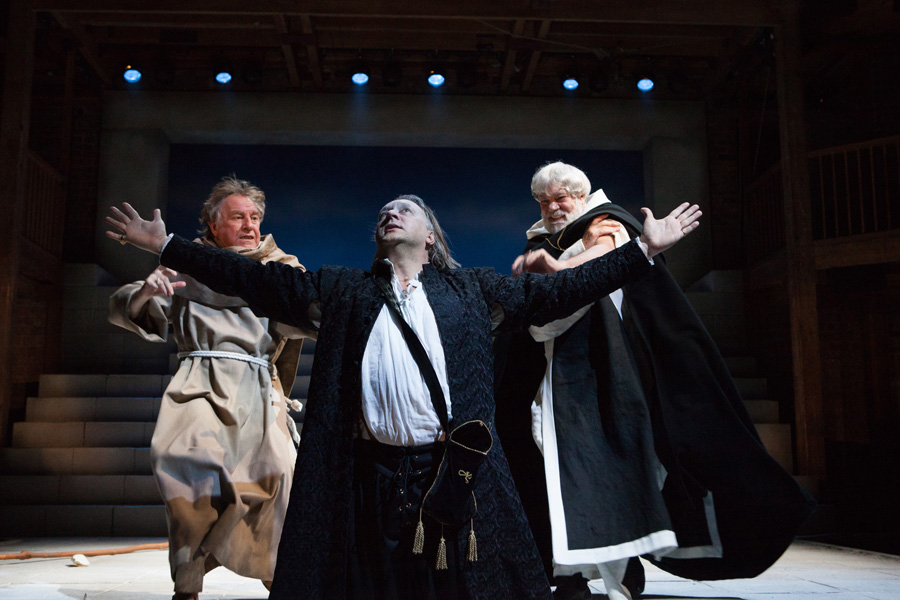
Audibert’s cast clearly enjoy creating equally colourful characters, led by Britton’s frighteningly practical and fearsomely intelligent Barabas, and Lanre Malaolu’s gleeful Ithamore, revelling in his promotion to partner in crime. Geoffrey Freshwater and Matthew Kelly, as those two wicked friars, make as gleeful a pair of plotters as any on the Renaissance stage. There’s attractively seductive work from Beth Cordingley’s avaricious courtesan, and Catrin Stewart makes a feisty Abigail, hand in glove with her father until… Well, that would telling, you’ll have to go and see it to find out!

The terrifc ad hoc klezmer band has added value for those in the know. The pre-show music is traditional wedding fare, ‘Chosen Kallah Mazel Tov’ ('Good Luck to Groom and Bride') and the show opens with another Jewish wedding staple – Barabas leads the cast singing ‘Erev Shel Shoshanim’ ('Evening of Roses') from the Song of Songs, in the popular setting by Yosef Harar and Moshe Dor (timed well for the production’s early April opening as it is part of the Passover Service too). And throughout the show Gareth Ellis’s musicians bring their own colour to the action, thanks also to Jonathan Girling’s original music.

Does it all leave a bad taste in the mouth though, as the action reaches its apocalyptic climax? By that time, everyone has behaved badly and Barabas is not the only one to face retribution. So however Marlowe’s contemporaries reacted, modern audiences are no more likely to burst into gleeful laughter than they would at the climax of Stephen Sondheim’s Sweeney Todd.

By Judi Herman

The Jew of Malta runs until Tuesday 8 September. 7.30pm & 1.30pm. £5-£45. Swan Theatre, Straford-On-Avon CV37 7LS; 084 4800 1110. www.rsc.org.uk