Reviews

Review: Allegro ★★★★ – Rodgers and Hammerstein’s story of a small-town hero lives up to the ‘quick tempo’ of its name

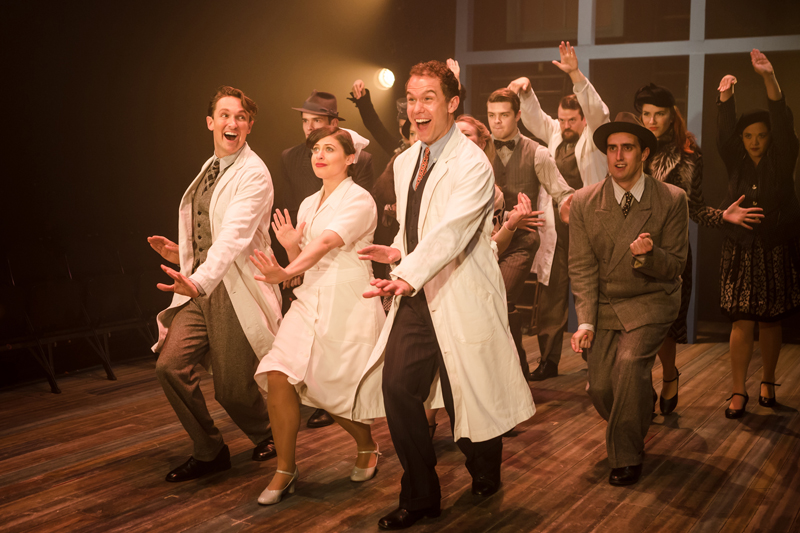
ALLEGRO 1 Gary Tushaw (Joseph Taylor Jr.) and company Photo Scott Rylander Allegro is a curious musical. Released between 1945’s Carousel and South Pacific (1949), it goes some way to form the missing link in the canon of work by Richard Rodgers and Oscar Hammerstein's ground-breaking partnership. Theatrical ideas and innovative storytelling make Allegro a teasing and engaging watch, though it was ahead of its time; employing a Greek chorus to pass comment and an unfussy set to ensure the fluidity of its scenes.

Now a dream team gives Allegro its European premiere. Director Thom Southerland (Grand Hotel, Titanic) works seamlessly with choreographer Lee Proud and musical director Dean Austin to create a sophisticated production on designer Anthony Lamble’s moveable feast of levels, from what might appear at first to be simplistic, folksy subject matter.

Allegro tells the story of Joseph Taylor Junior, an everyday ‘Joe Blow’, from birth to mid-life crisis (originally until death, but revised down). Gary Tushaw’s attractively awkward Joe is the town doctor's son and inherits his father's calling, which seems too special a career for an everyman, but his story arc calls for the temptation of status and wealth.

ALLEGRO 3 Gary Tushaw (Joseph Taylor Jr.) and company Photo Scott Rylander

The musical opens with the townsfolk's extravagant celebration of Joe’s birth. As he grows they tenderly manipulate a puppet 'playing' Joe as a toddler taking his first steps. The intense delight of the town’s scrutiny, paired with the greys and tans of their ginghams contrasting with the splashes of colour worn by Joe and his parents (thanks to costume designer Jonathan Lipman), puts you wise. These smiling small-town men and women aren’t just wonderfully matched singers and perfectly-drilled dancers, but also the all-seeing chorus, mediating between audience and protagonists. In the original Broadway production there were over 100 dancers alone. Here, less is more, especially given Proud’s eloquent choreography.

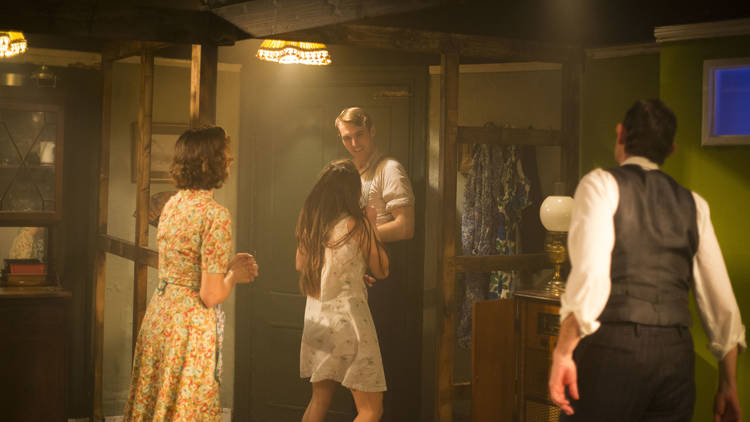
This is a tale of challenge, disappointment and compromise, where boy might get girl, but they might not live happily ever after. The first half features Joe’s youth: at college with fellow medical freshman Charlie (wickedly charming Dylan Turner), who has all the confidence around girls Joe lacks; marriage to childhood sweetheart Jennie (Emily Bull), after an on/off courtship and despite parental misgivings (which his deceased mother (Julia J Nagle) gets to voice after death too).

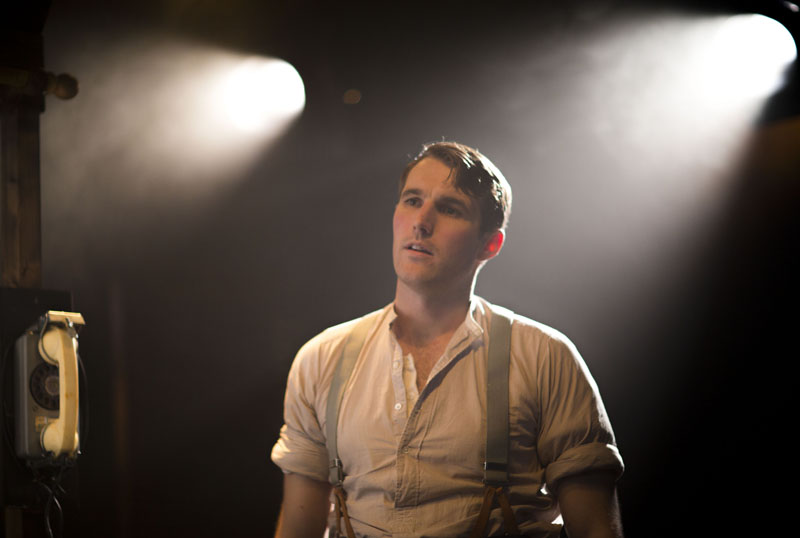
ALLEGRO 4 Gary Tushaw (Joseph Taylor Jr.) Emily Bull (Jennie Brinker) and company Photo Scott Rylander

The second (shorter) half moves with the 'allegro' of the title, emulating the fast pace of life in the big city. Jennie pushes Joe to accept a society medic’s job in Chicago to escape poverty when the Depression hits town. But Joe is uncomfortable ministering to wealthy hypochondriacs and Jennie is playing away again. Will he return to his roots, especially now that he's working alongside Katie Bernstein’s clear-eyed nurse Emily?

Bernstein is terrific in the show’s most memorable number, The Gentleman is a Dope. Hers is a late standout performance in perfect counterpoint to Bull’s full-blooded anti-heroine.

The show is elegantly rounded off with a reprise of One Foot Other Foot, the number that described Joe as a puppet toddler, serving as a metaphor for his philosophy of life. Mark Cumberland has artfully arranged the score for just eight musicians, mainly woodwind and brass. At times it can be over-the-top-upbeat and wholesome, but it’s cleverly done and no doubt Allegro’s late creators would be gratified by its realisation of their vision and intent, if they too, as ghosts, could comment on the action. Perhaps we’ll find out what their gopher on that first production thinks of it if he gets to see it, for young Stephen Sondheim also grew up to fulfil his destiny.

By Judi Herman

Photos by Scott Rylander

Allegro runs until Saturday 10 September, 7.30pm & 3pm, £25, £20 concs, at Southwark Playhouse, 77-85 Newington Causeway, SE1 6BD; 020 7407 0234. http://southwarkplayhouse.co.uk

Review: The Merchant in Venice ★★★★ – Shylock triumphs in the Ghetto and in the courtroom

Merchant in Venice © Andrea Messana There's nothing like an anniversary to resonate with a production of a play. The conjunction of the 500th anniversary of the establishing of the Venice Ghetto and the 400th anniversary of Shakespeare's death have provided an irresistible opportunity to stage The Merchant of Venice in the ghetto itself for the very first time.

An ambitious and bold production of what is arguably Shakespeare's most controversial play by the joint forces of the Compagnia de' Colombari and Ca' Foscari University of Venice brings together an international cast performing in several languages and styles in the heart of the Jewish ghetto, lending a symbolism and interpretation impossible elsewhere.

While it's doubtful that Shakespeare ever encountered an actual Jew or had that much, if any, knowledge of the ghetto (he never mentions the word) and writes largely stock English characters and their perception of "aliens", the play explores the innate prejudices and bias of all of us and our behaviour when faced with the 'other', and so remains as relevant as ever in today's world. The play is not just about antisemitism but about ethnic and religious differences, conflict between parent and child and the fickleness of love.

The playing space is three sides of the Square at the heart of the Ghetto Nuovo, with a backdrop of vertiginously high buildings that any art director could only dream of. When Jessica throws down Shylock's money and jewels to the waiting Lorenzo, she literally throws them out of a first floor window. Set and lighting designer Peter Ksander merges nature (gradually adding lighting as night falls) and architecture with the touches needed to enhance both atmosphere and action. His vision is enhanced and complemented by costume designer Stefano Nicolao's monochromes, creams and whites, loose trousers with flowing robes, organza sleeves and overskirts – all slashed with the scarlet of Venice for the pomp of the court scene. Andrea Santini’s sound also gets help from nature, with a chorus of stage-struck cicadas.

The Venetian theme is realised wonderfully from the opening by Francesca Sarah Toich. Playing the servant Lancillotto (aka Lancelot Gobbo), Toich does so as an androgynous Arlecchino figure in Commedia dell'arte style, complete with an extraordinary deep-voiced interpretation of a comic speech about love in old Venetian dialect, which is joyously picked up by the rest of the cast as a jaunty carnivalesque song.

Merchant in Venice © Andrea Messana (1)

The song has been created and arranged for the cast and glorious small band by composer Frank London, who also provides the rest of the music that beautifully underscores the action. London draws on Judaeo-Ladino and Italian traditions, lending that carnival atmosphere to Lancillotto's antics and a heady romance to the air of Belmont as required. In their black organza robes, which contrast attractively with the creams worn by the actors, the band look as good as they sound, particularly London himself, in arresting headgear, and the twin violinists Nikole and Alexandre Stoica.

Members of the cast slip easily in and out of Italian, localising the play ever more. And since English is not the first language of many of the cast, it is good to hear them speaking Italian from the present as well as the past, alongside Shakespeare's English, spoken here by actors from numerous countries and backgrounds, and so often sounding unfamiliar to those of us brought up on productions made and performed in Britain.

Director Karin Coonrod and her team made a conscious decision not to run a straightforward version of the play but to show how we all have a Shylock within by casting the role of Shylock to five different actors, making a statement about how complex and confusing he is; how hard it is to really know him.

The five different styles of the actors playing Shylock make the audience create their own multiple personality of the character, helped by the use of Yiddish, Judaeo-Venetian, Ladino and English, emphasising the multiplicity of Jewish experience, as well as the Jewish complexity of the Venice Ghetto. Each successive Shylock must don a yellow sash, Nicolao's choice for the badge to identify the wearer as Jewish, which of course immediately recalls badges imposed on Jews from the circles of Medieval Europe to the stars of Nazi Europe. These are especially powerful ritual moments as one Shylock succeeds the other, 'ministered to' by silent figures dressed in black and dubbed "black angels".

There is another striking image of all five Shylocks sharing the space around the trees at the heart of the stage (and therefore the ghetto); a company of Jewish ghosts almost offering each other support, just as Jessica steals her fathers’ treasure – and is stolen away herself – among a crowd of loud, crude, laughing revellers. For otherwise, each Shylock is as isolated as we might imagine the Jews to be in the ghetto. Although the Ghetto 500 exhibition charting its history argues powerfully that there was plenty of two-way traffic, despite the enforced closure and confinement of its Jews between midnight and 6am.

Merchant in Venice © Andrea Messana (2)

In fact, a feature of the production is the uneasy isolation of all the players in this problem 'comedy'. There's a clear directorial decision to play the scenes wide and out to the audience, which knowingly limits the intimacy between the characters, especially Shylock and Jessica and the various pairs of lovers.

Of the five Shylocks, one is played by a woman, Jenni Lea-Jones. She pointed out to us on JR OutLoud that because his wife Leah has died, Shylock has had to be both mother and father to Jessica. In a way it’s perhaps a pity then that Lea-Jones is not the Shylock who gets to share the one brief scene Shakespeare gives him with his daughter. But she does articulate all the fury and clarity of Shylock’s impassioned claim for consideration as an equal: "Hath not a Jew eyes?" Perhaps it is here the impassioned claim of a woman, too.

The first of the other four Shylocks is Bombay-born Sorab Wadia (who doubles as arch Jew-hater and baiter Gratiano). He gets to lend 3,000 ducats to Antonio and suggest the "merry bond" of the pound of flesh, giving as good as he gets with a sturdy fearlessness in the face of the shocking antisemitism of the Christians he must deal with. The last is American actor Ned Eisenberg, playing the trial scene with such an implacable stillness that you can see he will not be moved, and why, until he is forced to break by what seems like a shocking reversal (see the verdict of the mock appeal below).

The other two Shylocks are Italian Adriano Iurissevich, who gets to relate to Jessica as a rather older father (he also makes a splendid older suitor for Portia as a Spanish guitar-playing Duke of Aragon); and a second Italian actor Andrea Brugnera, who gets to play the wronged father, his fury awoken by his errant daughter’s flight with his treasure (as reported to him by fellow Jew Tubal, again played by Eisenberg), including that turquoise ring with its emotional significance and what surely tips him into the implacable revenge-seeker of the court scene.

It’s worth remembering, as already mentioned, that it's as much rejection of the other as the Jew that Shakespeare explores here, for Portia, who expounds on the quality of mercy, is merciless in sending up and rejecting the 'other' lovers who seek her hand, above all the Prince of Morocco (a dignified and sympathetic Matthieu Pastore), who fears rightly that his "complexion" will count against him.

Merchant in Venice © Andrea Messana (4)

As for the various pairs of lovers, they seldom touch one another, much less embrace. All Linda Powell's intelligent Portia gets from her Bassanio (Michele Athos Guidi) once he has chosen the casket that delivers her as his bride, is a kiss, albeit a lingering one. The closest contact between anyone is, ironically and shockingly, between Antonio (Stefano Scherini) and Shylock, as Antonio "prepares his bosom for the knife".

And I have seldom seen the love of Jessica and Lorenzo nipped in the bud quite so quickly and cruelly. By the time they return from the 'honeymoon' spending spree on which she gives her dead mother's betrothal ring in exchange for a pet monkey, Lorenzo is already treating her like a serving maid, shoving the heavy case of jewels into her arms to carry without a backward look as she trails uneasily behind him. And by the time they reach the beautiful ornate poetry of their moonlit love scene in Belmont, things are so uneasy between them that Lorenzo's plea of "sit Jessica" becomes a command she obeys by sitting on a fountain several metres away. Paul Spera is not afraid to play Lorenzo as a cool calculating young man, obviously in it for the money. His concupiscent smirk when he learns he has 'inherited' half of Shylock's wealth is so transparently chilling that it can only confirm to Jessica that she has made a fatal mistake. Watching the light go out of Michelle Uranowitz's vulnerable, affection-starved Jessica is almost heart breaking.

Howard Jacobson avers that he usually leaves the play at the end of act four when Shylock leaves the action, and the end of the play here is a little rushed. Nonetheless, although the audience might allow itself some much-needed laughter and apparent light relief at the fun Portia and Nerissa have at the expense of their new husbands, who, failing to recognise them attired as barrister and clerk, have given away to them their betrothal rings (especially designed by Giampaolo Babetto, so not to be parted with lightly), it is far from clear what the future holds for Portia, Bassanio and Antonio, trapped in a strange love triangle, and for the apprehensive Jessica.

Yet as the five Shylocks emerge from the assembled company, asking each other and the audience, "Are you answered?" and the word "mercy" is projected on the tenement blocks of the ghetto square in the languages of the play, including the Yiddish, Rachmones, the contradictions of years of ghetto life help to illuminate this darkest of Shakespeare's comedies.

Merchant in Venice © Andrea Messana (3)

The Mock Appeal (in the matter of Shylock v Antonio)

Here at Jewish Renaissance, we’ve been working up quite a head of steam about Venice Ghetto 500, The Merchant in Venice, and the Mock Appeal on behalf of Shylock, heard before a jury of Judges presided over by The Honourable Ruth Bader Ginsburg, associate justice of the Supreme Court of the United States.

Before the performance of The Merchant in Venice on Wednesday 27 July, an expectant audience – including the great and good of Venice and further afield – gathered in the stunning surroundings of the Scuola Grande di San Rocco in the centre of Venice, taking in the rich, dark Biblical scenes with which Tintoretto adorned the high ceilings, and to marvel at the gilded pillars and pediments, wooden reliefs on the benches and the shining red and cream marble floors.

Everyone stood as the judges and advocates processed in, dignified in their dark robes set off with golden tassels. American actor F Murray Abraham, a famous Shylock in America, gave some of his most famous lines, with Judge Ginsberg supplying Portia’s lines. Then three advocates in turn – first for Shylock, then for Antonio and the Republic of Venice and finally for Portia – had 20 minutes each to make their cases. Or rather be put through their paces by Judge Ginsburg, for the razor-sharp mind of the octogenarian justice was more than a match for the three advocates, each of whom found himself pulled up by her incisive questions.

As Ginsberg appeared to floor Avvocato Manfredi Burgio, representing Shylock, I feared that his fate would be as bad, or worse, than in that first court scene in Shakespeare’s play. But as she put Avvocato Mario Siragusa, representing Antonio and the Republic of Venice, and New York’s Jonathan Gaballe, representing Portia, through a similar ordeal, I thought the scales might tip in his favour after all. When the distinguished jury went out to consider its verdict, two extraordinary Shakespeare scholars (and both Jewish), Stephen Greenblatt and James Shapiro, took to the podium to share their thoughts on the play. They assured that even if the judges took eight hours to deliberate they could keep going. They spoke so brilliantly that I rather wished they had been obliged to go on all night.

But the jury did return and the singular and exciting news is that they ruled in favour of Shylock. Since Portia was not a trained lawyer and appeared under false pretences; and since they deemed it a miscarriage of justice that Shylock should find himself accused, found guilty and sentenced in the court at which he had come to appear as plaintiff; and since it was unconstitutional, to say the least, for Antonio, the former accused, to suggest Shylock’s punishment of confiscation of half his goods in favour of Lorenzo, with whom his daughter has eloped, and conversion to Christianity on pain of death, those punishments should be revoked. And what of Portia? She was found guilty of fraud and bigotry and sentenced to three years at law school.

Happily both the production and the mock appeal have been carefully filmed and will be available online as part of the Shylock Project, thanks to the organisers of Venice Ghetto 500, under the extraordinarily resourceful and imaginative leadership of Shaul Bassi, associate professor of English Literature at Ca’ Foscari University. Full details of how, where and when these resources will be available online will be posted here on the JR Blog.

By Judi Herman

Photos by Andrea Messana

www.themerchantinvenice.org

Review: The Mighty Walzer ★★★★ – Howard Jacobson’s comedy of table tennis and Jewish teenage angst in 1950s Manchester comes home in triumph

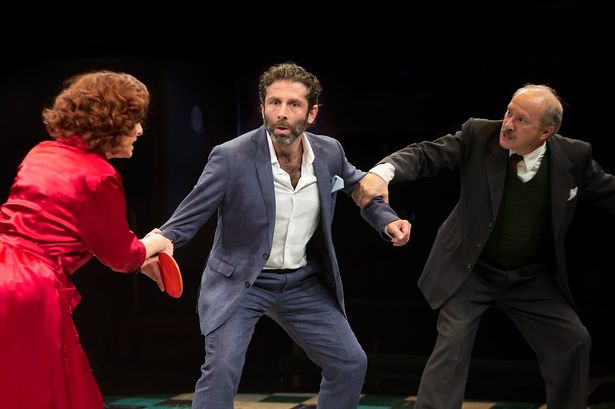
The Mighty Walzer 2016 c Jonathan Keenan 1 From the moment Elliot Levey ‘s Oliver Walzer bounds on stage and takes in the 360 degrees of audience seated around him, the warmth and inclusivity of Jonathan Humphreys’ perfectly-cast production works its magic, taking its audience back to 1950s Jewish Manchester, conjuring it up with what seems like just a few props and sound effects.

Simon Bent’s adaptation is extraordinarily faithful to the spirit and narrative of Howard Jacobson’s now classic comic novel of teenage angst and table tennis. He has a lovely knack of putting the right words into the right mouths to bring to life incidents described by the narrator in the novel. The comic tale of Oliver’s larger-than-life father Joel’s own attempt at competitive ‘sport’, entering the World Yo-yo Championship armed with his homemade, ridiculously outsized yoyo, makes for a delicious opening narrative, shared by Oliver and his parents, batting retorts to each other like a game of verbal ping pong.  Jonathan Tafler’s ebullient  Joel and Tracy-Ann Oberman’s beautiful portrait of  warm and worried Sadie, staying just the right side of classic Jewish mother, work wonderfully together as a sort of marital double act – can’t live together, can’t live apart. And Bent has come up with a wonderfully theatrical device for Oliver’s houseful of aunties. Not only are they reduced to just two, but both are played by the same great character actor, Ann Marcuson. She has a lot of fun as strangely identical love rivals Dolly and Dora, who of course are never seen onstage together …

Levey’s Oliver is also a 180 degree rounded creation. Bearded so that he recalls his creator Jacobson as gently as he recalls his youth, he engages with his eccentric family and all the denizens of his past, entering his own youth with all the hindsight of middle age, and the crisis he is negotiating, and brokering the deal between audience and action.

Oliver is backed up by a wonderfully eccentric gang of nerds, the ping pong posse into whose ranks he breaks so spectacularly during one memorable day at the local Jewish social club. The actors deftly create these individual young men but at the same time subsume their personalities as necessary to create the gang of nerds Oliver joins. So let’s hear it for Ilan Goodman aka Aishky, James Parris’s Twink, Joe Coen’s Sheeny Waxman and Daniel Abelson (niftily doubling as Uncle Motty and RoyBoy a (non Jewish) rival at the ping pong table) – and not forgetting David Grellin as destructive eminence grise, veteran player and serial Auntie seducer Gershom Finkel.

The Mighty Walzer 2016 c Jonathan Keenan

They are all totally convincing as driven, obsessive, competitive - and highly skilled - table tennis players. The game itself is brilliantly realised by bats on thin threads descending from the flies to be grasped and wielded by eager and expert hands. The balls themselves are simply sound effects – made, in a brilliant coup de theatre, by cast members breathing through microphones. Ben and Max Ringham are responsible for this and all the other highly effective soundscapes.

James Cotterill’s set goes for that very best of strategies for theatre in the round – selective realism, with judicious use of props and effectively enhanced by Lizzie Powell’s lighting. So audience attention focuses for example on the high cistern lavatory, the teenage Oliver’s refuge where he pores over his soft porn mags, keeping his infuriated father safely on the outside.

Perhaps the most spectacular focus is the van off the back of which Dad Joel sells his ‘swag’ – the rubbish souvenirs and novelties, cheap toys and trinkets with which he hopes to make his fortune. It’s wonderfully detailed – full of enticing stuff and brilliantly lit - a great background to the rollicking sales pitch of Joel and his acolyte Sheeny Waxman (Coen really relishes channelling Waxman’s gift of the gab here). And then – lights, camera, action – it’s replaced by a glowing, spectacularly-lit catwalk down which Lorna Peachley, the frighteningly desirable shiksa (non-Jewish girl) after whom Oliver lusts, sashays with her tennis racket – a perfectly pitched performance from blonde (and actually Jewish!) Mancunian Lily Sarcofsky!

But when it’s actually necessary to fill the stage – for example with cardboard boxes towards the end when the family is faced with having to pack up and move away, it all happens with consummate smoothness. For Bent wisely takes his action only as far as Oliver’s offer of a place at Cambridge, leaving the audience in the warm bubble of 1950s Manchester he and the company have so perfectly created to share with their audience.

It’s a marvellously detailed portrait of the life, loves, lusts and complexes of a Jewish teenage boy, perfectly evoking a particular time and place and bringing it to life, but actually subtly nuanced just because it’s seen through the lens of experience. And it’s warmly inclusive too – just enough Yiddishisms to get the feel right but always accessible from the context – you don’t have to be Jewish! Bent and Humphreys have done Jacobson and Jewish Manchester proud and they can kvell (Yiddish: express pride) over a job well done.

By Judi Herman

The Mighty Walzer runs until Saturday 30 July, 7.30pm & 2.30pm, £8-£16, at Royal Exchange Theatre, Manchester, M2 7DH. www.royalexchange.co.uk

Howard Jacobson and Sherry Ashworth appear in conversation on Monday 11 July, 7pm, £5, at Royal Exchange Theatre.

The Mighty Walzer Walking Tour runs Sunday 17 – Thursday 28 July, 10.30am, £7, at Manchester Jewish Museum, M8 8LW; 084 3208 0500. www.manchesterjewishmuseum.com

Chess in Shorts, an exhibition by Howard Jacobson and Manchester Jewish Museum, runs until Saturday 30 July, FREE, at the Royal Exchange Theatre.

Read our interview with The Mighty Walzer's playwright and actor, Simon Bent and Elliot Levey as well as hearing our podcast with table tennis champion Jeff Ingber.

Gefiltefest 2016 - Jewish Renaissance visits Finchley Road’s very own Gastro-nbury

gefiltefest5 copy

gefiltefest5 copy

Gefiltefest featured surprisingly few actual gefilte fish, but as one of the arguably less tasty staples of Jewish cuisine, it was more than made up for by the variety of food, including dairy-free ice cream, vegetarian caviar and multi-coloured hamentashen, all of which we dutifully and extensively sampled. Beth Duncan of Stapleton Dairy poured out tasting pots of the best yoghurt known to Finchley Road, and the courtyard was dominated by the exuberance of Michelle from Visit Israel – if this radiant lady can’t convince you to make Aliyah, no one can.

Founded by Michael Leventhal in 2010, Gefiltefest is a charity whose work culminates in the annual festival celebrating Jewish culture, heritage and food (and lots of it). JR spoke to Charlie from Mitzvah Day Charity, who ran an apple crumble making workshop for children attending the event. The crumbles were donated directly to asylum seekers at the Liberal Jewish Synagogue, exemplifying the kind of charity work Mitzvah Day encourages: giving up your time instead of just your cash.

gefiltefest2 copy

gefiltefest2 copy

A particular gem was the children’s books being promoted at the Jewish Vegetarian Society’s stall. Reminiscent of the recent children’s book And Tango Makes Three, about two homosexual penguins who decide to adopt, the power of ideas in fiction for the youngest of readers is not to be underestimated. We may just see a generation of little vegans yet.

The festival attendees were also treated to a range of workshops, talks, films and events, including a rip-roaring edition of Just a Minute, Gefiltefest style. The host quickly dispelled fears that the show would be akin to the poorly received Have I Got Jews For You or Schmock the Week. This was almost immediately evident after a comment from a panel member about 30 seconds in caused another to spray of water over the front row (alas, we quickly regretted our seating choice).

gefiltefest3 copy

gefiltefest3 copy

Topics ranged from ‘bagel or beigel?’ and ‘latkas vs hamentashen’ to Mrs Elswood and 'my mother’s chicken soup’, each extrapolated on beautifully by the gifted wits Abigail Morris, Dan Patterson, Adam Taub and Jenni Frazer, who were bolstered by host Raymond Simonson. Although wholly enjoyed by most, the event was put into perspective by the sleeping (or worse) older lady at the back of the room, as Simonson confirmed after a joke about Mr Elswood’s pickle: “This is about as niche as it gets.”

The day was rounded off by a cooking demonstration by Tomer Amedi, head chef of the new award-winning restaurant The Palomar, who revealed the secrets behind the restaurant’s signature Jerusalem-style polenta. The audience murmured angrily as Amedi explained the difficulties of finding kosher asparagus, and we left quietly with a full stomach and on a beeline for Babke ingredients.

By Rachel Wood

Review: No Villain ★★★★ – The world premiere of a vital addition to Arthur Miller’s canon of work – his very first play

No Villain - George Turvey - cCameron Harle "My first attempt at a play, rather inevitably," Arthur Miller once wrote, "had been about industrial action and a father and his two sons, the most autobiographical work I would ever write."

You may not have heard of Miller's play No Villain. It was his first, written when he was just 21, and submitted for the $250 Hopgood Award in drama at the University of Michigan, where he was studying in 1936. As the prize was worth about a quarter of the average family income at the time, it was extremely valuable to the Miller family, who had become impoverished during the Great Depression of the early-30s in the USA.

That you are reading about it now and can go and see it at London's Trafalgar Studios, is thanks to director Sean Turner, who worked doggedly to unearth this previously unpublished and unperformed play with the explicit aim of exploring the roots of Miller’s playwriting skills. So Turner has earned his place among Miller scholars for this invaluable insight into the development of one of America’s greatest playwrights. In this production, first seen at Islington’s Old Red Lion Theatre, he directs a close-knit cast in a way that lets Miller’s early voice shine through in all its youthful vigour, whatever the inevitable imperfections.

The plot is what would become familiar Miller territory, the family tensions between fathers and sons, here in a New York Jewish family, all bound up in a moral dilemma that explores the contradictions between soulless capitalism and the hopes and desires of the individual. In this self-avowedly autobiographical world, would-be communist Arny (a suitably chippy Alex Forsyth) comes home from University to find his father’s coat business on the point of collapse, precipitated by a recently-unionised workers’ strike that stops him shipping his output to customers. His struggling father Abe (David Bromley) and older brother Ben (George Turvey) urge Arny to help them save the business by getting out the orders, but Arny is trapped between loyalty to both his own family and a wider cause.

no villain © Cameron Harle

David Bromley’s Abe is full of the frustrations and tensions of a man whose business has already run down and is now finally collapsing. He is supported by that other Miller trope – his long-suffering wife – brought to life in a somewhat underwritten part by Nesba Crenshaw, with both actors capturing a real sense of time and place. George Turvey does sincere justice to the part of Ben, effectively Miller’s advocate, a good man who sees and tries to balance everything that life throws at him but finally accepts that that things fall apart and the centre cannot hold.

Helen Coles, Michael Lyle, Kenneth Jay and Stephen Omer brace the main characters with vivid character sketches in a variety of those supporting roles (kid sister, worker, grandfather born in the shtetl, rabbi, businessman, doctor…) we would now anticipate in a Miller play. Max Dorey’s small set evokes both the family home and the garment factory, where his realisation of those rails of white coats behind the action in the factory peoples the stage with an eerie chorus of extras, and he takes us from home to factory with a simple but effective switch. The lighting (Jack Weir), sound and original composition (Richard Melkonian), along with Natalie’s Pryce’s costumes, all help engender a real feel of 1930’s New York.

There’s plenty of recognisably Miller-style language, full of vivid, lyrical imagery and a heightened tone that still sounds real. Yet there’s a certain overall coolness in the delivery of Miller’s lines here that doesn’t quite capture the colour and humour of Jewish New York. In the end, it’s a play for Miller aficionados and theatre buffs who like to collect the rare. If you are one of these, it won’t disappoint. If you are not, it still gives a vital insight into the roots of one of the most important prolific and playwrights, not just in American theatre, but on the world stage.

By Judi Herman

No Villain runs until 9 July, 7.45pm & 3pm, £15-£30, at Trafalgar Studios, 14 Whitehall, SW1A 2DY; 0844 871 7632. www.atgtickets.com/venues/trafalgar-studios

Review: The Flying Lovers of Vitebsk ★★★★★ – An unforgettable flight of imagination

Kneehigh The Flying Lovers of Vitebsk 4 c Steve Tanner Marc Antolin as Marc Chagall Audrey Brisson as% Marc Chagall and his beloved Bella would surely have loved this magical synthesis of moving pictures, words, music and song. It is also a glorious and seamless synthesis of the talents of a superb creative and performing team.

Writer Daniel Jamieson and director Emma Rice got to know the couple intimately when they played the roles in an early version of his play. Now they return to realise their vision anew and share it with a new audience. Of course the two multi-talented actors, Marc Antolin and Audrey Brisson, are at the heart of the vision, bodies intertwining as they sing and speak, and seemingly floating above Sophia Clist’s quirky Chagallesque machine for acting on, all crazy angles, rakes, beams and crannies thanks to Etta Murfitt’s choreography and Malcolm Rippeth’s gorgeous, painterly lighting.

Brisson is an accomplished acrobat, her background with Cirque du Soleil, as well as a soprano with a glorious voice and Antolin matches her note-for-note, move-for-move. But there are actually four performers on stage more or less throughout – composer Ian Ross, together with fellow multi-instrumentalist James Gow, plays his own haunting atmospheric music, often with a klezmer vibe as appropriate, underscoring most of the action. And they play a range of supporting roles in the story, moving from side to centre stage as the story demands.

So the production ravishes the senses, it’s a sort of total immersion in the world Chagall creates in his paintings. And happily Jamieson spins the story of the lives and loves, the talents and aspirations of Chagall, and Bella too. He conjures their world in early 20th-century Europe, from Vitebsk to Moscow in the East, to the heady Paris of iconoclastic new art movements, Fauvism and Cubism in the West. So Jamieson effortlessly introduces the promising but poor young artist and the daughter of the wealthy owners of a trio of jewellery shops. Bella’s recollection of their first meeting is deliciously sensual and sexy, wonderfully reinforced by the intertwining of the lovers’ limbs, hers clad in bright scarlet, for Clist’s costumes vividly evoke the figures of the lovers in Chagall’s paintings.

Kneehigh The Flying Lovers of Vitebsk c Steve Tanner Audrey Brisson as Bella Chagall (1)

Both are caught up in the world-changing events of the First World War and the Russian Revolution and are affected by the antisemitism and pogroms that swept across Eastern Europe. Tellingly, this makes the second half altogether a darker and more monochrome affair than the bewitchingly colourful first half. Life in a Moscow torn by war and revolution is dreary for Bella, left alone all day while Chagall seeks to make a living working in an equally dreary bank until he tries to make his mark under the new order.

Unsurprisingly, but almost heartbreakingly, Bella, one of the four brightest students in Russia, subsumes her potential, even as she recognises and encourages her husband’s genius. She reproaches him surprisingly gently for his selfish tunnel vision, especially considering he misses the birth of their daughter Ida by several days because he is absorbed in finishing work on a series of canvases.

Nonetheless Bella gets to take acting classes with Stanislavsky and later works with the legendary Yiddish theatre actor Mikhoels, so it is thanks to her that Chagall is commissioned to paint backdrops for the Jewish Theatre; work that proves to be among his favourite and most fulfilling.

Kneehigh The Flying Lovers of Vitebsk 3 c Steve Tanner Marc Antolin as Marc Chagall Audrey Brisson as%

As they migrate across Europe and then flee to America, they take with them the baggage of the world of the shtetl, movingly evoked by objects and animals from the paintings that they carry or wear as headgear – a cockerel here, a cow there, and an etrog (the lemon-like citrus fruit used ritually at the Jewish harvest festival Sukkot) to boot. Thus the stage is peopled not just by the cast of four, but by images of a lost world. At one point it's almost heartbreaking when you see a painting of a fleeing rabbi created by Chagall as he falls into an exhausted sleep, his arms provided by Bella’s (protruding through holes in the canvas), which chimes with the flight of refugees across Europe today, just as Jamieson intended.

Eventually they reach safety in New York and it takes Bella's death during the Second World War to wake Chagall from the solipsistic tunnel vision of the selfish artist and go some way towards realising her potential by publishing her writings before his return to Europe. There his work flowers, he settles with his second wife Valentina, and ends his days in the South of France.

But let’s leave them looking back at the height of their love, early on that glorious morning of his birthday when she surprised him by flitting over his windowsill bearing armfuls of colourful flowers. There’s a gorgeous synaesthesia in a declaration of Chagall's: “My whole life is pervaded by the colour of loving you”, and it’s wonderfully realised in this transcendent production.

By Judi Herman

The Flying Lovers of Vitebsk runs in Bristol until Saturday 11 June, 7.30pm & 2.30pm, £7.50-£30, Bristol Old Vic, BS1 4ED; 0117 987 7877. www.bristololdvic.org.uk

In London from Thursday 16 June – Saturday 2 July, 8pm & 2.30pm, £10-£62, at Shakespeare’s Globe, 21 New Globe Walk, SE1 9DT; 020 7902 1400. www.shakespearesglobe.com

In Southampton from Tuesday 5 – Saturday 9 July, 7.30pm & 2.30pm, £10-£25, Nuffield Theatre, SO17 1TR; 023 8067 1771. www.nuffieldtheatre.co.uk

In Cornwall from Thursday 14 – Sunday 31 July, 7.45pm & 3pm, £14-£32, Lost Gardens of Heligan, PL26 6EN; 01872 262466. www.hallforcornwall.co.uk

Review: The Threepenny Opera ★★★★ – Worth paying rather more than half a sixpence to see

The Threepenny Orchestra_4 When is an opera a play with music? When it’s Simon Stephens’ sharp new reworking for the National Theatre of Brecht’s adaptation of John Gay's 1728 ballad opera (The Beggar's Opera). The perfect match of Kurt Weill’s thrilling, chilling music and Bertolt Brecht’s update of John Gay’s comic, heartless satire seems as timely and timeless as ever in Rufus Norris’s new production.

Brecht and Weill’s ‘play with music’, based on Elisabeth Hauptmann’s translation, opened in 1928, two hundred years after Gay’s first night. Brecht and Weill continued the short and intense collaboration that produced Mahagonny, Happy End and more in the years leading up to the rise of National Socialism. GW Pabst’s film adaptation of Die Dreigroschenoper opened in the more dangerous Germany of 1931, and by 1933, the Jewish Weill and his Austrian wife actor/singer Lotte Lenya (the first Polly) had fled Nazi Germany, emigrating to the USA by 1935, followed by Brecht and his Austrian Jewish wife, actor/director  Helene Weigel (the first Mother Courage). Their ‘opera’ had pride of place in the ‘degenerate music’ exhibition curated by the Nazis in Dusseldorf in 1938.

Weill’s ‘avant-garde’ music for the show has become a vital part of our musical landscape but the unwieldy storyline has been wrestled by Stephens into a clearer plot in which London – and its underworld – pull out the stops for a coronation. There’s no consideration of financial crisis as there was in the original but it’s still a monumental fable of the corrupting power of unprincipled sex, money and violence, wrapped up in Brechtian mode for the modern audience.

Vikki Mortimer’s rough and ready design, all staircases and stage flats through which the cast hurl themselves, leaves plenty of space on the front of the vast Olivier stage for David Shrubsole's onstage band to take to that stage and for choreographer Imogen Knight to thread the 20 strong cast through the set. Her effectively grungy, louche costumes give the nod to Otto Dix’s paintings, but you might bump into any of this unsavoury lot in London 2016.

The Threepenny Orchestra_1 © Richard H Smith

George Ikediashi (aka cabaret performer Le Gateau Chocolat) as the Balladeer, an imposing figure with a huge (yes, chocolatey) voice, gets the show off to a barnstorming start with the Ballad of Mack the Knife. His dark tale is told as a sort of Grand Guignol puppet show in a larger-than-life flimsy paper Punch and Judy booth – with ‘Mackie’ as a cross between Jack the Ripper and Mr Punch, his victim’s guts spilling colourfully over the booth. So the scene and tone are set for a tale that wears its heartlessness on its grubby, grungy sleeve by the time Nick Holder’s superb, exuberantly amoral Peachum gets to set out his stall, singing his Morning Song – with its delicious tune that Weill shrewdly realised he should lift straight from Gay’s original ballad opera.  Peachum ruthlessly deploys his gangs of hooded beggars (divided into types 1-4: war veterans, immigrants, teenage runaways and unhoused lunatics) integrating hapless newbie Filch just in time for the rich pickings he anticipates at the forthcoming Coronation.

He'd like to be equally ruthless with his womenfolk at home, but Haydn Gwynne’s comically cartoonish Mrs Peachum is a match for him. She's drunken and randy, bent on revenge when she discovers her errant daughter Polly has eloped with one of her own squeezes, übervillain and gangleader Macheath. And she’s all angular limbs in black stockings and garters hardly covered by the clinging scarlet swathes of her dress as she crawls up a scaffolding ladder to find Polly’s  ‘room’ at the top empty. But Polly is more than a match for both her parents – and pretty well anyone else who crosses her. The brainy, bespectacled lass in her purposeful cardie comes across as more than resourceful and articulate in Rosalie Craig’s stunningly intelligent and gloriously sung performance. Thankfully, Pirate Jenny’s Song (the tale of the servant girl who dreams of becoming a ruthless pirate who can order the deaths of the insulting bosses and customers she serves) is restored to Polly here (sometimes it is sung by the character Jenny Diver – of whom more later). It sends shivers up the spine, just as it should – no wonder Macheath’s gang listen in awe, stifling their sexist remarks and regarding his new bride with new respect. No wonder he makes her his ‘business partner’ with alacrity!

The Threepenny Orchestra_2 © Richard H Smith

Central to this play with music is the infamous Macheath, described by Brecht as a ‘short, stocky man of about 40 with a head like a radish, a bit bald but not lacking dignity, someone who impresses women less as a handsome man than a well-situated one’. Rory Kinnear makes an impressive singing debut and it’s good to see the part played as Brecht intended rather than as a lovable rogue or misunderstood bad boy. Kinnear’s Macheath is no slacker when it comes to chilling and thrilling. His casual cruelty belies his fatal attraction to and for the ladies that will prove his eventual downfall. The thrills come from the melodious rounded tones of his singing voice, in this, his first sustained singing role.

Polly is well matched, by Debbie Kurup’s comically indignant foul-mouthed Lucy Brown, her rival in love, to whom Macheath has also promised himself and gives as good as she gets in their Jealousy Duet; and by Sharon Small’s Jenny Diver, the fragile, damaged tart with a wounded heart who shops Macheath to the Peachums. Small gets to sing Surabaya Johnny, a happy interpolation from Happy End – it’s such a great number that the ‘end’ seems to justify the means.

Peter de Jersey also impresses as Lucy’s father Tiger Brown, the gleefully corrupt Chief Inspector of Police who is hand in glove with Peachum, his old mucker from the armed forces– together they make a deliciously malign double act in this pantheon of vicious characters.

Director Rufus Norris shoves in all the usual Brechtian techniques, from props labelled 'DRUGS' and the cast shouting ‘scene change’ or ‘interval’ to remind us we are watching theatre and not real-life and they palpably add to the enjoyment of the opera as entertainment. But perhaps the sheer pace of the performance gives little space to reflect on the predicament of the characters and their reality in the theatre of life. This is left to powerful actor and wheelchair user Jamie Beddard, like so many disabled actors, a natural Brechtian, whose physicality and vocal quality is a constant reminder of his reality.

By Judi Herman

The Threepenny Opera runs until Saturday 1 October, 7.30pm & 2pm, £15-£45 at National Theatre South Bank, SE1 9PX; 020 7452 3000. www.nationaltheatre.org.uk

Review: Les Blancs ★★★★ – Beauty and terror out of Africa in Yael Farber's devastating production of Lorraine Hansberry's last play

LES BLANCS by Hansberry, , Writer - Lorraine Hansberry, Director- Yaël Farber , Design - Soutra Gilmour, Lighting - Tim Lutkin, Movement - Imogen Knight, The National Theatre, 2016, Credit: Johan Persson/ It’s not by accident that the title of this review recalls Yeats’ poem Easter 1916, so often quoted in this centenary year of the Easter Uprising in Ireland. Lorraine Hansberry was inspired to become a dramatist by seeing a rehearsal of Sean O’Casey’s Juno and the Paycock at university. And she saw parallels in the struggle for Irish independence with the struggles for equality of both African Americans and the nations in Africa under white rule.

In Les Blancs (The Whites), Lorraine Hansberry was notably the first African-American dramatist to explore the African search for freedom from European colonization. The first drafts of Les Blancs came soon after the success of her landmark play, A Raisin in the Sun in 1960. Although at the beginning of 1965, she was dead from pancreatic cancer, aged 34, she left several drafts of the play. Its title is an answer to Jean Genet’s play The Blacks: A Clown Show, a ritual performance of black resentments against the white oppressor. She saw Genet’s absurdism as escapist, when realism was what was required. Her own story of being black and female in America, To Be Young, Gifted and Black, like Les Blancs, came to the stage thanks to her literary editor and former husband, Jewish publisher, songwriter and political activist Robert Nemiroff. Hansberry’s death inspired Nina Simone to write her famous song in her memory using the poignant title of her autobiography.

Hansberry entrusted Les Blancs, the work she was redrafting in hospital during her last illness, to Nemiroff to nurse into production. He continued to make further drafts based on notes and their conversations and gathered all the drafts into a production text so that it premiered in New York in 1970. Nemiroff kept polishing the script, publishing a revised version in 1983. He died in 1991 and his stepdaughter Joi Gresham, Director and Trustee of the Lorraine Hansberry Literary Trust, collaborated with dramaturg Drew Lichtenberg and director Yael Farber on the text of this National Theatre production.

The storyline is ostensibly clear enough. The people of a fictitious African nation are on the point of rising up to fight their colonial overlords and masters and establish an independent state and the action is seen through the experience of settlers, natives, and an American journalist in the waning days of colonial control.

Although she never went to Africa, what Hansberry brings to the stage in Les Blancs is an extraordinary vivid and credible account of the flashpoint of the struggle in one unnamed African country in the middle of the 20th century, which could stand for them all. At the same time, her play is also a comment on the struggles against racism and inequality in her native country two years before Martin Luther King delivered his "I Have a Dream" speech. Hansberry wanted to reflect the inequality of the African-American voice in the black/white conversation at the time and an African setting gave a useful distance from which to pillory the strategy and reasoning of American Civil Rights leaders.

In South African-born Farber, 51 years after her death, Hansberry’s play has found a director to fashion a production she would surely have relished. Hansberry writes into her play African-based folklore, chanting, drumming, and dancing, serving both to heighten the tension and reflect the ceremonial role of music and dance in traditional African life. And from its opening minutes Farber brings her play to full-blooded life with the entry of four Matriarchs, who accompany their slow, dignified passage across the stage with an extraordinary and obviously authentic chant (one of the four, Joyce Moholoagae, is Music Director) amid the heady, acrid smell of incense .  Add to this Adam Cork’s music and pretty continuous soundscape and Tim Lutkin’s lighting, almost characters in themselves, on Soutra Gilmour’s set, a skeletal mission hospital and living quarters complete with veranda, steadily revolving in the centre of the village it serves under the dark star-studded velvet of the African night sky, and there is tension, even menace, built in from the start.

LES BLANCS by Hansberry, , Writer - Lorraine Hansberry, Director- Yaël Farber , Design - Soutra Gilmour, Lighting - Tim Lutkin, Movement - Imogen Knight, The National Theatre, 2016, Credit: Johan Persson/

Then there is the striking, etiolated figure of Sheila Atim’s Woman, slowly stalking around the set under the burden of a flaming firepot. Hansberry originally planned to have a female protagonist, but revised the play so this, the only black woman, has no name and no lines. And yet the impact of Atim’s presence is unsettling from the start and eventually devastating. An  accusing mother Africa indeed.

By the time a procession of white characters enters from the audience to the contrasting plangent western strains of a cello (one of them is indeed carrying, though not playing, a cello – the chosen instrument of the Albert Schweitzer-like figure who founded the mission), before a word has been spoken, Farber has established her credentials.

And yet this is nothing if not a wordy play, a play of dialectic and conversation, as well as action and ceremony. There is an elegant pairing of characters – offstage that legendary missionary who has founded the mission, away visiting his flock and the village tribal elder on his deathbed; arriving in the village, journalist Charlie Morris, keen to write about the success of the white man’s mission in both senses of the word and Tshembe Matoseh, eldest son of the dying elder returning home from London, where he now lives with his wife and child, to attend his father’s deathbed.

Morris is of course a useful ‘outsider’ lens through which to ‘meet the natives’, both black and white. Elliot Cowan makes of Morris a wonderfully persistent and resilient terrier resolutely going for the killer interview, even when he is by turns sent up and scorned by Danny Sapani’s toweringly intelligent and complex Tshembe.

When he tries to ply Tshembe with whisky and cigarettes, Tshembe retorts with a series of telling put downs. It’s hard to come back from “Do you really think the rape of a continent dissolves in a wreath of cigarette smoke?”, but Morris does his best even if he is not quite a match for Tshembe. It’s a long exchange but a telling and a gripping one and it’s at the heart of this play.

Morris fares better with the missionary doctors, Anna Madeley’s hard-working idealistic Dr Gotterling and James Fleet’s disillusioned, Chekovian Dr Dekovan (another of Hansberry’s neat pairings) - both excellent. And he is welcomed with open arms by Madame Neilson, the absent missionary’s elderly, almost blind but resilient wife (a wonderfully detailed performance from Siân Phillips), embodying the hopes and dreams of the long-term white settler who has thrown in her lot with the continent and done all in her power - and with her mindset - to make bridges with its people. Her blindness is symbolic and indeed she even declares that she is pleased not to be able to see the horrors going on around her as the events of the play become ever darker.

This is down in no small part to Major George Rice, representative of white rule and the British army, first seen dragging behind him a tortured and bleeding native whom he has been interrogating. Clive Francis plays the terrifying racist martinet to the hilt, spitting out the word boy he uses to address the black villagers. It’s a chilling counterpart (again a pairing) to Madame Nielsen’s love of this continent to hear him speak lyrically of the land on which he has settled, when he clearly regards its inhabitants as sub human. There are shades of Steve Biko, whose  death in custody in South Africa caused armed insurrection, when a similar case gives those inhabitants all the incitement they need to rise up against The Whites of the title.

Hansberry ratchets up the tension by condensing the action into just a matter of hours, almost into real time. No sooner is his father dead than Tshembe is caught between two worlds – the West that he has left behind and his native village where he trapped by an insurrection he is urged to join. And then there are his two brothers, desperately sincere Abioseh (Gary Beadle), who has found his home in the church and Eric, the anguished illegitimate product of mixed race parentage (a heartbreakingly convincing performance form Tunji Kasim). All three are damaged and defined by the rape of their native land and the bloody struggle it is undergoing.

By the time the play reaches its stunning, terrifying climax, Tshembe has evoked Anne Frank, Auschwitz and Dachau. Hansberry’s vision, realized by Farber, Lichtenberg and Gresham, has a terrible beauty indeed.

By Judi Herman

Les Blancs runs until Thursday 2 June, 7.30pm & 2pm, £15-£35, at National Theatre, South Bank, SE1 9PX; 020 7452 3000. www.nationaltheatre.org.uk

Review: Bar Mitzvah Boy ★★★★ – The musical version of Jack Rosenthal’s coming of age story gets the intimate production it deserves

Bar Mitzvah Boy, Adam Bregman © Kim Sheard Photography Jack Rosenthal’s television play, originally transmitted in the BBC’s Play for Today in 1976, passed into folk legend, at least in the Jewish community. It told the simple but shocking story of young Eliot Green and his apprehensions over his forthcoming Bar Mitzvah and his worry that all the grown men in his life are somewhat immature and imperfect. In the meantime, the family goes through all the stock neuroses of putting on the then almost obligatory celebratory dinner dance.

At the time, it was wonderful to see even such caricatures on mainstream television and Rosenthal’s concept, that the play was about universal themes of adolescence and family rather than insular concerns, was helped by his genial writing and affectionate performances and direction.

So when Don Black offered to put together a Jewish team, including Jule Styne, to stage Bar Mitzvah Boy as a musical, surely it had to be a smash hit? Yet it only ran for 77 performances in London and was equally a failure when reset in 1946 Brooklyn in a New York tryout.

Critics at the time blamed the failure on an awkward mix of American tunes and British words and a focus on the parents’ battles over the Bar Mitzvah party rather than Eliot’s qualms about the whole point of the day. Indeed, Rosenthal himself went on to write 'Smash', a stage play about his own anguish at seeing his television play mangled into a musical West End failure.

So why would a revival of Barmitzvah Boy – the Musical, succeed this time round? Well, the new book by David Thompson (The Scottsboro Boys, and script adaptation for Chicago) goes back to Rosenthal’s original intentions and places Eliot and his worries centre stage so the actions of others are clearly seen through his eyes. Thompson has also reduced cast numbers to an essential 8 from the 14 in the TV play and 12 in the original musical, making for a much tighter focus on the plot, and Don Black has written new lyrics to previously unheard Styne compositions to complement  the revisions.

Lara-Stubbs-Lesley-Sue-Kelvin-Rita-Robert-Maskell-Victor.-Bar-Mitzvah-Boy-Production-Stills.-Upstairs-at-the-Gatehouse © Kim Sheard Photography

Sue Kelvin and Robert Maskell, as Eliot’s parents Rita and Victor Green, bring out the heart and soul of the aspirational Jewish working class, particularly in the numbers ‘The Bar Mitzvah of Eliot Green’ and ‘We’ve Done Alright. The whole cast is in great voice, but Sue Kelvin's is a marvel - huge, brassy and tender as appropriate. There’s a fine, wonderfully warm performance, beautifully sung, by Lara Stubbs as Lesley, Eliot’s older sister (lucky the new teenager who has one as perceptive and supportive as this!) , who brings everyone together at the end. Will she end up with her current boyfriend, the over-nice Harold (Nicholas Corre) who comes into his own delivering “Harold’s Dilemma'?

Adam Bregman makes his professional debut as Eliot and celebrated his own Bar Mitzvah last year! He is the archetypal 13 year old trying to make sense of the world and those around him and he doesn’t let lyrics or tunes get in the way of conveying what Eliot is trying to tell us. And there's a delicious performance from Hannah Rose-Thompson, as Denise, Eliot's mouthy playground mate, much more than just Rosenthal's clever prism for looking at Eliot's dilemma through non Jewish eyes (and providing a way out of it in the end).

Playing supporting roles in the adult world, Jeremy Rose is pitch perfect as Rabbi Sherman and Hayward B Morse makes Granddad loveable and just a tad irritating as all good Jewish Granddad's should be ...

The big surprise is that only Sue Kelvin and Adam Bregman are actually Jewish. The whole cast invests every performance with a real unforced authenticity

The Gatehouse is configured long and thin but Stewart Nicholls’ musical staging and direction makes good use of the space so that choreography seems both natural and appropriate and never over the top. Edward Court’s four-man band provide richer support than you might expect from a quartet, with an evocative, klezmer vibe to match the music– it’s a pity they were mostly hidden behind a fringed curtain on Grace Smart’s otherwise uncluttered set. Yes the plot is still thin, the music still too American for 1970’s Willesden, but there’s an integrity here that Jack Rosenthal would probably have approved of. Will it be a smash hit? Go and see for yourselves, you’ll have a lovely time deciding.

By Judi Herman

Bar Mitzvah Boy runs until Sunday 10 April, 7.30pm & 4pm, £18-£22, Upstairs at the Gatehouse, Highgate Village, N6 4BD; 020 8340 3488. www.upstairsatthegatehouse.com

As well as Saturday 16 & Sunday 17 April, 7.30pm & 3pm, £22, £18 concs, at The Radlett Centre, Herts, WD7 8HL; 01923 859 291. www.radlettcentre.co.uk

Review: NotMoses ★★★ – Carry on taking the tablets, there's some epic fun to be had amongst the groans and jokes

Thomas Nelstrop (Moses) in NotMoses © Darren Bell Filmmaker Gary Sinyor’s irreverent retelling of the Exodus story starts with the baby left floating on the Nile when the Princess takes up Moses, a nicer baby who doesn’t cry and has a proper - er – Moses basket. NotMoses grows up a slave in Prince Moses’ shadow, until God orders both of them to lead the Israelites out of bondage – though it takes feisty Miriam to lead the Exodus. Synor’s intent was Life of Brian meets The Ten Commandments, but it’s rather more Carry On Taking the Tablets, silly humour that sends up the biblical story and religion. Like the Carry On films it could just get the audience vote and become a cult hit.

Knowledge of the Bible and its language (or the first five books anyway) certainly helps, and Synor displays his lightly, learned in cheder (religion school) and synagogue in his Manchester childhood. It all starts with a comedy canter through the stories of the patriarchs leading up to the plight of the Israelites as slaves in Egypt. The Bible lesson turns out to be an extended sermon from Leon Stewart’s well-meaning, though misguided (and anachronistic) rabbi, ministering to the Hebrew slaves. A bit of popular culture helps too as Joseph inevitably bursts into song …

You can’t fault the cast for playing the characters with sincerity as well as a knowing twinkle, for staying in character and not sending it up unless appropriate.  Greg Barnett invests NotMoses with the determination and frustration of the atheist who doesn’t believe in God, ready to lead the Children of Israel out of Egypt without anyone’s help. He is comedy paired with Thomas Nelstrop’s Moses, a preppie budding accountant at the palace who grows the beard and perfects the biblical epic lingo once he's heard God in the Burning Bush - and had his kebabs singed there (ooh, Matriarch!).

There’s the expected cast of stock characters, notably the admirable Jasmine Hyde channeling Amanda Barrie in Carry On Cleo, Niv Patel's pouting, petulant Rameses and Joe Morrow as a camp, crowd-pleasing slave driver. But Moses’ sister, Miriam, is a modern fighter for equal women’s rights in this very patriarchal world and Danielle Bird delivers the strongest and most serious speech of the evening with great compassion and conviction.

Life at number 613 (the number of commandments Jews are supposed to keep - geddit), where NotMoses lives with his slave parents, provides a send up of Jewish family life with a nod to Fiddler on the Roof, the Papa (Dana Haqjoo doubling as a legless Pharoah, squatting on his throne like a Dr Who villain or Dan Dare’s Mekon) bemoaning his lack of riches and the Mama (Antonia Davies) preoccupied with food and finding a nice Jewish girl for her son.

Dana Haqjoo (Pharoah) in NotMoses © Darren Bell

And struggling with a series of diktats heralded by thunder, the chosen people have spotted that the Divine Being is also preoccupied with food, not to mention clothing. In the light of the laws on keeping kosher and synagogue readings from of the Torah in recent weeks dwelling in detail on what priests should wear, Sinyor has a point. This is a family Being too, who has to deal with his difficult adolescent Child (presumably omnipresent rather than anachronistic), an extra dimension to ponder, voiced by 13-year-old Izzy Lee at this performance.

There are, of course, plenty more anachronisms, word jokes and double-entendres, from Jethro, Moses' future father-in-law, offering meat he says “Is-lamb” to the toilet humour of the effects of eating unleavened bread (matzah). It often smacks of student revue or something a synagogue youth drama group might come up with for a fundraiser, which does mean there are actually  real nuggets of crowd-pleasing fun amongst the groans and lamer jokes.

Synor says the project started life as a film script and this shows in the too frequent fadeouts between the many scenes, effectively salvaged though by Carla Goodman’s sparse sets and Lola Post Production’s epic visual effects creating Egyptian palaces and pyramids and an impressive divided Red Sea, to the soundtrack of Erran Baron Cohen’s matching epic music. The plague of rather realistic plastic frogs which rains down on stage and audience alike is a nice (or should that be nasty) touch.

Some years ago, the playwright Steve Waters wrote that working with a good director is rather like going into analysis – however lucid you might feel to yourself, what emerges in the production of a play exceeds your intention. “Your set might be definitive, your dream cast fixed, but your play in the hands of another often yields a far more surprising piece of theatre than you're capable of envisaging.”

It would have been interesting to see what emerged with a theatre director at the helm and without the expectations of West End opening, albeit in the intimate surroundings of the Arts Theatre, but nevertheless, it certainly gets a lot of laughs so it could prove to be that cult hit.

By Judi Herman

NotMoses runs until 14 May 2016, 7.30pm & 2.30pm, £19.50-£49.50, at Arts Theatre, Great Newport St, WC2H 7JB, 020 7836 8463. https://artstheatrewestend.co.uk

Review: Next to Her ★★★★ – Powerful game-changer about mental illness based on real-life experience

nex to her Asaf Korman’s powerful, challenging film, with script by his wife Liron Ben Shlush, who also stars alongside Dana Ivgy and Yaakov Zada Daniel, explores the symbiotic relationship between 27-year-old Chelli, sole carer for her mentally-challenged younger sister Gabby (24), until she is forced to find her part-time daycare and at the same time embarks on a relationship with Zohar a new work colleague. Ben-Shlush based her story on her own experience of having a mentally disabled sister and worked closely with friend and co-star Dana Ivgy on her role.

The result of the real-life three-way close relationship between Director Korman and his two lead actors is a film that is as painful as it is beautiful in its uncompromising treatment of living with mental illness. Ben Shlush’s strength lies in taking her own experience as a starting point to develop a new story where the boundaries between carer and dependent are blurred. Chelli is no saint but a troubled and difficult young woman with her own needs and demands and failure to recognise boundaries and Ben Shlush pulls no punches in writing and portraying her flaws.

Chelli and Gabby live together in a dark, dingy chaotic apartment, Chelli in sole charge of her sister since their mother has abandoned the responsibility of caring for Gabby that she cannot face. The pair’s lives are closely intertwined, touchingly and sometimes uncomfortably demonstrated by the way they are so often physically intertwined, curled together on the sofa watching films, sleeping and taking baths together and even sharing toothbrushes.

It’s soon evident that Chelli is as dependent on Gabby as her vulnerable younger sister is on her. Ivgy’s Gabby is much more than a wild child, head-banging, out of control and without boundaries – no wonder the neighbours’ complaints force Chelli to find daycare for her, rather than leaving her locked up home alone. But watching her relate to others and not just to Chelli helps the viewer to ‘meet’ her on her own terms – as who she is, rather than what she can never be. Indeed Gabby soon begins to relate to the other residents of the daycare centre (in scenes where actors with special needs give moving performances); and it’s not long before the mutual affection that develops between Gabby and Sveta, who runs the daycare centre, makes Chelli feel uneasy pangs of jealousy.

Perhaps this is one reason why Chelli develops a relationship with the sensitive Zohar, the supply PE teacher at the school where she works. When she brings him home to meet Gabby, he too proves able to relate to her and when he leaves his mother’s home to move in, an uneasy ménage à trois develops. It is again largely Chelli’s own neediness that sets off the unsettling chain of events that follows, where all three cross boundaries.

Korman’s direction and the atmospheric cinematography and soundscape ensure total immersion in the world he creates with his actors. The truth in Ivgy’s extraordinarily naturalistic performance is a testament to the time she spent working in the home where Ben Shlush’s sister lived. Ben Shlush herself creates a complicated young woman in Chelli, caring and needy, selfless and selfish, loveable and spiky. So she is full of contradictions and shaped by the difficult cards that have been dealt to her, the duties she has not shirked. It’s not an easy film to watch, but its power and truth ensures that it is impossible not to be drawn in.

It has been deservedly hugely successful in Israel and wherever it has been seen, both as a powerful and accomplished film and for its understanding of mental illlness and the complexities of caring relationships, of any sort.

By Judi Herman

Next to Her can be watched on BFI Player for £6 or at the following screenings:

Friday 25 – Wednesday 30 March, times vary, £7.50, at MAC Birmingham, B12 9QH; 0121 446 3232. https://macbirmingham.co.uk

Sunday 20 March, 8pm, £8.50, at Glasgow Film Theatre, G3 6RB; 0141 332 6535. www.glasgowfilm.org/theatre

Hear our interview with Dana Ivgy

Review: Mrs Henderson Presents ★★★★ – Vintage British fun in a new musical that evokes good old wartime spirit

Mrs Henderson Presents © Alastair Muir Musical theatre doesn’t need to be ground-breaking or stuffed full of numbers that go on to become ‘standards’ to be thoroughly enjoyable. What’s needed is a compelling story, an excellent ensemble and music and lyrics that move the plot along rather than holding up the action. Mrs Henderson Presents is just that – and it’s unashamedly and eccentrically British – with a Jewish protagonist sharing top honours for good measure.

Writer and director Terry Johnson was captivated by the 2005 film Mrs Henderson Presents, the story of the Windmill Theatre in London starring Judi Dench and Bob Hoskins, and he jumped at the chance of developing a musical of the film with leading Jewish lyricist Don Black and composers George Fenton and Simon Chamberlain.

In 1930, recently-widowed Mrs Laura Henderson buys the old Palais de Luxe cinema as a creative diversion and fits it out as a tiny, one-tier theatre, renamed the Windmill. It is, of course, not profitable so she hires Vivian Van Damm to change its fortunes. Van Damm, of Dutch Jewish origin, hits on the idea of ‘Revudeville’, a programme of continuous variety with 18 entertainment acts. But this is also a commercial failure, so they add the daring dimension of nudity to create the allure of the Folies Bergère. To get round the censorship laws policed by the Lord Chamberlain’s office, Mrs H argues that since nude statues cannot be banned on moral grounds neither can living statues or tableaux vivants. Hence the ruling "If it moves, it's rude".

This is the true story ripe for transmuting into first cinema and now stage-musical gold. And Van Damm's flair for public relations created the legend of the theatre that "never closed". Newspapers carried pictures of plucky Windmill girls in tin hats on fire-watching duty, and stories of showgirls giving V-signs to German bombers. Indeed, except for a 12-day period in 1939, when all London theatres were ordered closed, the Windmill remained open throughout the Blitz.

Mrs Henderson Presents © Dewynters

The plot inevitably rests heavily on the shoulders of Henderson and Van Damm and the love interest of artiste Maureen and stage hand turned airman Eddie. Tracie Bennett suffuses doughty Mrs Henderson with an extraordinary zest for living, not least in the numbers Whatever Time I Have and Anything But Young, and she captures that marvellous British spirit of no-nonsense eccentricity. Ian Bartholomew's caring Van Damm manages to be at once authoritative and self-deprecating - and not a little surprised at how well his precarious show business is turning out. The plight of Jews in Europe is suddenly placed centre stage when he receives news of the German invasion of Holland and the rounding up of Jews by the Nazis, including his own relatives left behind. Wearing a Star of David armband in solidarity, he expresses his distress in the number Living in a Dream World. There’s fun at his expense too, when Emma Williams’ warm, feisty Maureen challenges all the men in the theatre company to reveal all first if they want the girls to strip off and Mrs Henderson, feigning surprise, exclaims drily “You are Jewish!” Williams displays a lovely dawning  realisation as a woman discovering the 'power of her own presence' as Johnson puts it, notably in her full frontal nude castigation of Mr Hitler as the bombs fall, while Matthew Malthouse's Eddie is at his best trying to 'Fred and Ginger' Maureen.

Johnson directs his own story (first seen at the Theatre Royal, Bath, last year) against Tim Shorthall's set that vividly conjures up back and front stage (and roof) of the Windmill, all backcloths and props, superbly lit by Ben Ormerod to suggest both the dinginess of backstage and the bright lights of the front. And there’s a witty single light that comes on above Mrs Henderson's head when she has her ‘lightbulb’ moment - nudity is the way out of their problems! But paradoxically, nude revues need glamorous costumes and Paul Wills comes up with some gorgeous outfits for the revues and lovely period authenticity for the workaday clothing.

It's all good-natured and corny pre-war and war-time chipperness, from the front of cloth comic ("cheeky chappie" Jamie Foreman) to the back-stage crew and dance captain (Samuel Holmes, elegant and waspish in just the right proportions). Robert Hands’s Lord Chamberlain and his secretary (Oliver Jackson) have a lot of fun with the writing team’s homage to Gilbert and Sullivan, the eponymous Lord Chamberlain’s Song. Lizzy Connolly, Lauren Hood and Katie Bernstein as the pioneering  statues baring all for raised wages of 30 bob a week are terrific throughout. They give delightful support (no pun intended)  in a nifty little number with famous paintings ‘dressing’ the set to demonstrate the high art displayed by those ample Rubens and Renoir nudes. Andrew Wright’s choreography is spot-on convincing for the period – and I guess he gets the credit for those tableaux vivants too. And the music and lyrics team of Fenton, Chamberlain and Black have been around long enough to pastiche the 40's style with panache. They give the music their own original flavour too, never allowing the music to overwhelm lyrics that do a nice job moving on the plot. There's a debate to be had as to whether the portrayal of such nudity in 2016 is inappropriately exploitative or empowering but judging by the response the night I saw the production, audiences are enjoying the fun and sharing it with the cast onstage – clothed and unclothed.

By Judi Herman

Mrs Henderson Presents runs until Saturday 18 June, 7.30pm, £10-£97.50, at Noel Coward Theatre, St Martin’s Lane, WC2N 4AU; 0844 482 5140. www.mrshenderson.co.uk

Review: Poppy + George ★★★★ – A beguiling, thought-provoking exploration by Diane Samuels of identity and possibility after the Great War

Poppy and George, Watford Palace Theatre © Richard Lakos The year is 1919. The Great War is finally over and Poppy Wright, inspired by her suffragette teacher, arrives in London from the north of England to make her mark, rather than stay in service as a nanny. In the heart of the East End, in a back alleyway, she finds work in Smith’s tailoring and costumiers’ workshop. There she meets not only Smith, the Russian Jewish tailor with a Chinese past, but also George the chauffeur and war hero and Tommy Johns, the music hall female impersonator, also back from the trenches.

This beguiling, thought-provoking play, from the writer of the hugely successful Kindertransport, explores a time of change and opportunity after the cataclysm of the First World War and the subsequent influenza flu pandemic, when all classes questioned their subsequent lives and their roles in a new, modern era. Poppy is increasingly entranced by the freedoms held out by the suffragette movement, at the same time as falling in love with George, while the supportive Smith consoles Tommy as he attempts to reconcile with a wife and child he has not seen for years.

David Holmes lighting works magic with Ruari Murchison’s open set, all brickwork and fabric storage, with costumes flying above that are flights of fancy in themselves – plus the all-important piano – to create an enchanted space in which the unexpected can happen. And perhaps taking a cue from Polonius’ saw “the clothes doth oft proclaim the man”, she explores how those garments can be used as ‘shape-changers’ to fashion an individual’s  image   The sound and composition by Gwyneth Herbert, reflecting, as she says the “bawdy music hall, the rhythm of sewing machines and shadowy, uneasy echoes" wonderfully evokes the world of possibilities in which the four characters dwell.

Poppy and George, piano, Watford Palace Theatre © Richard Lakos

Jennie Darnell directs Samuels’ exploration of gender identity and new possibilities in a changing world with a charmingly light and good-humoured touch that never preaches or lectures. Together Darnell and Samuels conjure the pathos of the fading music hall and its artistes after the Great War. Nadia Clifford’s luminous warm-hearted Poppy captures a woman starting to open her mind to those new possibilities, and teetering on the brink of exploring life with George, swaggering Rebecca Oldfield, comfortable in her skin and her chauffeur’s braces and trousers. Jacob Krichefski , an imposing bushy presence, beautifully conveys Smith’s exotic past and intriguing hinterland; and multi-talented actor/musician Mark Rice-Oxley gives an outstanding and deeply affecting performance as Tommy, believably making up tunes and lyrics on the hoof.

Twenty years after its first incarnation as Turncoat, a one-act play Samuels wrote for young people’s company Theatre Centre, in an increasingly gender blind world, she reminds us that it's still good to dare to leap into the unknown and to question our roles. And there's no better place do that than in the former music hall that is the current Watford Palace Theatre.

By Judi Herman

Poppy + George runs to 27 February, 7.30pm & 2.30pm, £12-£22.50, at Watford Palace Theatre, 20 Clarendon Rd, WD17 1JZ; 01923 225671. http://watfordpalacetheatre.co.uk

Listen to Diane Samuels on JR OutLoud discussing Poppy + George and her new oratorio, Song of Dina.

Review: Battlefield ★★★★ – Peter Brook returns to the Mahabharata with a meditation on the aftermath of war that will stay with audiences

Battlefield at the Young Vic, Sean O'Callaghan, Jared McNeill, Ery Nzaramba, Carole Karemera and Toshi Tsuchitori © Simon Annand Thirty years ago, the great and influential Jewish theatre practitioner Peter Brook worked with writer Jean-Claude Carriere and a large cast from the company who had gathered around him in Paris to dramatise The Mahabharata: the Sanskrit epic of the mighty Bharata family torn apart by a great war. The result was nine hours of mesmerising epic theatre, which I was fortunate enough to see in a Glasgow tramshed transformed by red earth into the Indian subcontinent. Now aged 90, working with his long-term collaborator Marie-Hélène Estienne, he returns to just one section of the mighty epic, which they've called Battlefield.

This meditation on the sorrow and pity of war, eloquent and moving in its extraordinary simplicity, is sadly both timely and timeless as we continue to commemorate two World Wars, while the world is ripped apart and whole peoples put to flight by conflict in Syria and elsewhere. Battlefield is about the aftermath of war and especially internecine struggle within dynasties, here two great families, the Pandavas and Kauravas. The five Pandava brothers may have triumphed over their cousins the hundred sons of the blind King Dritarashtra, but for Yudishtira, oldest of the Pandavas who must now become king, it is a Pyrrhic victory. He has lost so much and so many family members and confederates lie dead on the field of battle. So he finds he has all too much in common with the old blind King he has defeated.

And so many themes and threads in this story sound as familiar as the weekly Torah portions and Haftorah readings you can hear in synagogues around the world every Shabbat. For David’s lament over Saul and Jonathan, “The beauty of Israel is slain among thy high places,” and his later raw cry over the death of his traitor son Absalom, “Oh, Absalom, Absalom, my son…” resonate with the anguish of these survivors of battle, both victor and vanquished. There is even the story of a baby pulled from a river where his mother has abandoned him floating in a basket. His rescuers are princely and he grows up to be the mighty warrior Karna.

The glory of this production, little more than an hour long, is its stunning simplicity. It is performed on a thrust stage, again covered by that orange-red dust, by four powerful performers – at the same time physical and cerebral – who morph sinuously from one role to another as necessary. Nobody is credited with the simple design, but Oria Puppo’s streamlined costumes, echoing that theme of the modern and timeless, are enhanced by huge bolts of red and orange cloth to wonderful effect, serving as robes and cloaks, rivers, the elements of fire and earth, storms and even untold riches. Philippe Vialatte’s mood-making lighting too seems like an extra character. And the whole is brilliantly underscored and orchestrated by the drumming of master musician Toshi Tsuchitori, whose rhythms eloquently enhance and alter the mood and pace.

Battlefield at the Young Vic, Carole Karemera and Jared McNeill © Simon Annand

Stories are folded within stories, and amidst that sorrow and pity there are plenty of flashes of humour, albeit dark or rueful. Each performer is singular and all work wonderfully together. Sean O’Callaghan is a huge and imposing presence, especially moving as the blind and bereaved King Dritarashtra, but ruefully comical as a worm in danger of being crushed. To Jared McNeill falls the role of the victorious Yudishtira, as graceful – and abashed – in victory, as the vanquished old King he has toppled. While Ery Nzaramba is both funny and authoritative as the wise men whose advice to the king comes in the form of those parables about a succession of animals including that worm, as well as a pigeon and a mongoose.

Stately Carole Karemera (who plays the pigeon with comic economy) is as capable of huge dignity as the queenly women caught up in the struggle, principally Yudishtira’s mother Kunti, but it is her heartrending Ganga, her terrifying cry of grief and loss at the death of her son that I shall long remember – standing for every bereaved mother indeed.

“For an idea to stick it must be burnt into our memories,” says Brook in his hugely influential meditation on theatre, The Empty Space. The singularly funny and thought-provoking tale of a king who offers more and more of his body to be weighed in the scales against that pigeon till every bone is part of the weigh-in proves to be a telling and memorable metaphor. And then one of the wise men has a parable for the new King in which a mongoose tells a rich man to give away all his riches to the poor. He begins to involve the audience, homing in on various members asking if they are rich or poor. Some fess up to being rich, others assert they are poor and are ‘rewarded’ with some of those red and orange cloths. The last of these ‘lucky’ recipients finds his lap piled so high he cannot move and can barely applaud at the end. It is the image of this discomfiture, which so perfectly embodies the ambiguity of riches – and indeed victory – that sticks in my memory. The storytelling of Brook and Estienne accrues power even as they continue to strip it bare to the bone.

By Judi Herman

Battlefield runs until Saturday 27 February, 7.30pm & 2.30pm, £10-£35, at Young Vic Theatre, 66 The Cut, SE1 8LZ; 020 7922 2922. www.youngvic.org

Review: Jeepers Creepers ★★★ – Get perhaps a bit too up close and personal with supreme Jewish comic writer/performer Marty Feldman

Jeepers Creepers 3 David Boyle (Marty Feldan) and Rebecca Vaughan (Lauretta Feldman) photo by steve ullathorne Marty Feldman features as the world's favourite Jewish vampire in one of my favourite sketches ever, with the punchline, “Oi, have you got troubles,” when the vampire hunter holds up his cross. He was the writer/comedian with the wild hair and staring eyes, the result of a botched operation for Graves’ disease, though they stood him in good stead as the creator of some of the funniest characters ever seen on small or big screen. Think ‘Young’ Frankenstein's hunchbacked henchman Igor in Mel Brooks' movie. Indeed he is sort of undead in Robert Ross’s new biodrama, directed by Feldman’s old mucker and lifelong admirer, Terry Jones. It opens with silent film titles on a screen at the back (in appreciation of Feldman’s appearance in another Mel Brooks film, Silent Movie), announcing ‘three years’ dead’, then two, then six months, each title accompanied by the appearance of a ghostly luminescent skull in a glass case, until Feldman is alive again and not so much kicking as contorting – for he is indeed in Igor mode, complete with hunchback prosthetic.

David Boyle’s frenetic, elastic recreation of Feldman engages with the audience – in my case one-to-one, for he lures me briefly onto the small cramped stage set up as a claustrophobic, Stateside hotel room – be ready to take part if you sit in middle of the front row!

Happily his partner on stage is Rebecca Vaughan as his life partner Lauretta Feldman. The year is 1974, Young Frankenstein is about to be released and Feldman is about to hit the big time in the USA. The couple are playing a waiting game, holed up in the hotel the night before Feldman is due to appear on a prime-time chat show. The warning in the foyer that herbal cigarettes are used in this production is not in vain. The Feldmans chain-smoke their way through the night and Marty drinks his way through it too, while Lauretta leafs through Vogue as her efforts to persuade him to get to sleep prove futile.

Jeepers Creepers 5 David Boyle (Marty Feldan) and Rebecca Vaughan (Lauretta Feldman) photo by steve ullathorne

So it’s a night of dissecting previous triumphs and disasters and for Lauretta at least, nervously anticipating what might go wrong in front of millions of viewers the next evening.

We learn that Feldman is a womaniser as well as a hard drinker (though we also learn that he knows that home is where the heart is and always goes back to Lauretta); and we are present when he has his fatal heart attack at the tragically young age of 48 in a Mexican hotel room. But I’m not sure that those who don’t already know his work (and love it, for I’m sure to know it is to love it), will pick up the references to his extraordinary back catalogue of radio and TV script writing and appearances – including co-writing Round the Horne on radio and The Army Game and The Frost Report for TV, and writing and appearing in iconic shows, such as At Last the 1948 Show and his own series Marty. But if it makes folk seek out the work then that’s no bad thing – and they can always read playwright Robert Ross’s well-reviewed biography of Feldman, Marty Feldman, The Biography of a Comedy Legend.

Meanwhile there is much to enjoy in the performances of Boyle and Vaughan (he could also tackle Gene Wilder any time he likes, for he’s a dead ringer for Feldman’s co-star in Young Frankenstein), despite their uncomfortable proximity in the confines of the tiny – and herbal smoke-filled – studio theatre.

By Judi Herman

Jeepers Creepers runs until Saturday 20 February, 7pm & 4pm, £20.50-£22.50, at Leicester Square Theatre, 6 Leicester Place, WC2H 7BX; 020 7734 2222. www.leicestersquaretheatre.com