Reviews

Review: The Last Five Years ★★★★ - A poignant dissection, in a unique timeframe, of a relationship going nowhere

theatre-the-last-five-years-scott-rylander Jason Robert Brown's poignant, semi-autobiographical journey through a relationship, from heady first meeting to marriage and then downhill to disillusion and divorce, is an intimate chamber piece with just two protagonists: Cathy and Jamie. She is a struggling actress, he is a young Jewish writer on the cusp of  success.

The musical's remarkable USP is that Cathy and Jamie travel through time in opposite directions. She begins with the final break up and ends with the delicious moment of meeting – with all the excitement of possibility still ahead. He starts off full of the enticing novelty of his "Shiksa goddess" (shiksa being slang for non-Jewish girl) after all those nice, safe and suitable Jewish girls.

Jonathan Bailey and Samantha Barks seize the opportunities offered by this clever structure. Brown turns a fine lyric – “Jamie arrived at the end of the line / Jamie's convinced that the problems are mine / Jamie is probably feeling just fine and I'm still hurting” – and his music is both lush and nuanced. The show succeeds brilliantly in demonstrating the ultimate isolation of its protagonists, just because the structure dictates that they must spend most of its duration singing alone on stage to an imaginary partner.

theatre-the-last-five-years-1-scott-rylander

It's an extraordinary relief when, at what is really the show’s climax half way through, they do at last have a duet of transcendent joy as he proposes and she accepts. I was left longing for more shared stage time and song. True the show ends with both on stage singing, not together, but as far apart as is possible to be. The audience is all too aware that the youth and optimism with which Barks shimmers is destined to have its shine dulled by Jamie's unthinking neglect. He climbs the slippery pole to success and has his head turned by the adoration of other women, while she remains earthbound, her career never taking off.

It's heartbreaking to watch Barks' beautifully realised account of Cathy unfolding like a flower in sunlight as she goes back to the time when she was full of hope. And Bailey is not afraid to be unsympathetic as success turns his head and he leaves his young wife at home for yet another showbiz party.

Brown gets away with directing himself, though it would have been interesting to see what an outside director makes of the piece. Derek McLane's design of window frames above a bare stage lit with squares of lights suggests New York apartment buildings and is supplemented sometimes more/sometimes less effectively by truck stages wheeled on and off. It seems a large empty space for just two performers at times; though the space above and behind the window frames is wonderfully filled by the glorious band – the plangent strings of two cellos, violin, guitar and bass, with MD Torquil Munro's piano, but no percussion in Brown's own orchestrations. And costume designer Gabriella Slade provides Miss Barks with a fabulous succession of entirely appropriate outfits for every stage of this sad little dissection of a relationship. An affecting evening.

By Judi Herman

Photos by Scott Rylander

The Last Five Years runs until Saturday 3 December, Monday to Saturday 7.30pm, Thursday & Saturday 2.30pm, £10-£59.50, at St James Theatre,12 Palace St, SW1E 5JA; 0844 264 2140. www.stjamestheatre.co.uk
 

Review: Mr Predictable ★★★★ - Israeli romcom complete with canine and human stars to set your tail wagging

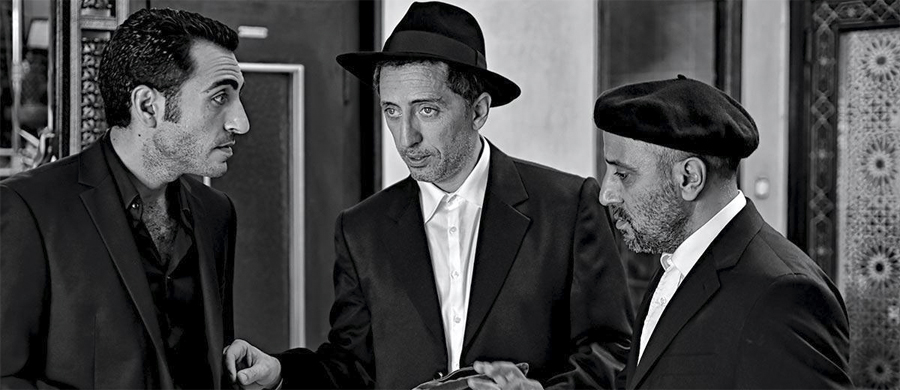
film-mr-predictable As the 20th UK International Jewish Film Festival gets underway (5-20 November), we take our first look at the selection of films on offer. Roee Florentin’s Mr Predictable will have you cheering as  its eponymous hero finally refuses to sit up and beg…

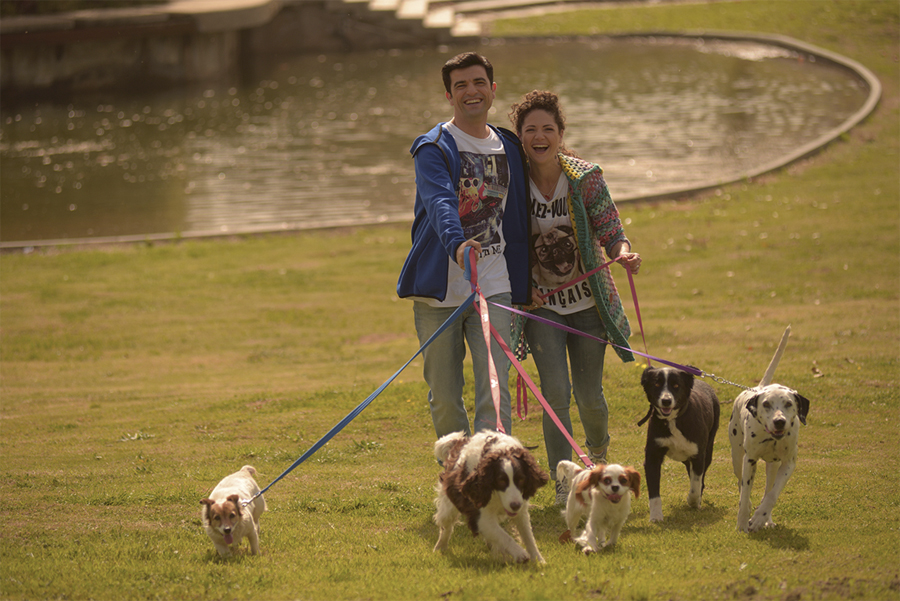
As a dog lover and owner myself, I was especially delighted to be asked to introduce the UKJFF screening of Roee Florentin’s real doggie treat of a romcom. Meet Adi Levi – a man who is simply too nice for his own good – until he literally bumps into Natalya , or one of the dogs she walks. Natalya is what you might call naughty but nice – just the girl to take our hero in hand and retrain him, while the dogs she walks give him a good licking too. It’s one of those marvellous Israeli films that give you insights into ordinary life in Israel, with the situation there in the background, informing it rather than being at the heart of the story.

Ever since Adi's soldier father left for Lebanon saying he’d be back soon, only to be killed in action, Adi has been careful and cautious to the point of timidity and so very aware of others that he has become a pushover, walked all over not just by his boss, his wife and his mother, but even his spoilt brat of a pre-teen son. A mix-up at a hospital appointment that leads him to believe he has mere weeks to live proves a life changer, but only because it’s compounded by the one careless act of his life – narrowly avoiding killing one of Natalya’s charges when he runs it over.

From this unpromising beginning, a new relationship and a new man are born. If you’re anything like me, you’ll find yourself cheering Adi on as he finds not just his mojo, but his inner hard man. Much of this is down to the winning performances of a beautifully matched pair of actors, Amos Tamam and Meytal Gal Suisa as Adi and Natalya (and not forgetting the canine supporting cast), directed with equal parts of sensitivity and panache by Roee Florentin against a great backdrop of Tel Aviv’s parks and suburbs. I guarantee Mr Predictable will make tails wag and I predict dog-friendly screenings very soon!

By Judi Herman

Mr Predictable has the following UKIJFF screenings:

Sunday 6 November, 3pm, at Odeon Swiss Cottage, NW3 5EL.

Sunday 20 November, 6pm, Phoenix Cinema, N2 9PJ.

http://ukjewishfilm.org

Review: Moos ★★★★ - A charming, contemporary comedy set in Amsterdam’s Jewish community

film-moos As the 20th UK International Jewish Film Festival gets underway (5-20 November), we take our first look at the selection of films on offer on offer. Job Gosschalk's  beguiling comedy Moos gives an insight into life in Jewish communities in Amsterdam.

This entirely charming and absorbing comedy set in Amsterdam’s Jewish community wears its ‘kosher’ credentials lightly but convincingly from the opening frames. Twenty-something Moos and her widowed father are preparing for a Chanukah party with the relatives. She is his right-hand woman, both in his draper’s shop and as homemaker, though now he is dating a likely single mother whose son is coming up for bar mitzvah, Moos realises her life’s been on hold too long.

The main storyline revolves around Moos’ unsuccessful efforts to get into drama school and her settling for a job in the school’s canteen; and the visit of her long-time childhood friend Sam, now living in Israel and how that chimes with her attraction to sexy singing teacher Chris, who offers (very) private coaching. Meanwhile life in the community – which embraces Moos and her father, family and friends, including Sam – continues to be a vital part of the film’s fabric. The Chanukah latkes, the preparations for the bar mitzvah and the celebration of a ceremonial circumcision in the family all play their part in Moos’ story.

As played by Jip Smit, Moos is an engaging, kind-hearted young woman, unselfconscious and natural, attractive rather than beautiful, and you can’t help warming to her. Frederik Brom is touching as her father Maup; and from the moment he appears at the door, we can see, even if Moos can’t, that Daniel Cornelissen’s open, sincere Sam is made for her.

Writer/director Job Gosschalk and co-writer Judit Goudsmit take their audience to drama school and give us time out in the café with its quirky characters. And they are equally adept at creating an attractive and subtle picture of Moos’ network of family and other relationships. There are delightful flashbacks to Moos and Sam as children and touching glimpses of Moos caring for her father.

Then at the bar mitzvah in synagogue, in a scene reminiscent of Jack Rosenthal’s Bar Mitzvah Boy, it is Moos who is there for the bar mitzvah when he gets stage fright. Meanwhile the story of her efforts to face up to her own diffidence has its own delightful set-piece climax where she gets to duet with real-life Israeli singing star Asaf Hertz. There are some marvellously evocative settings too – the Amsterdam street with folk cycling past the draper’s shop, the lush bales of cloth piled inside and of course that grand synagogue, the men in prayer shawls gathered on the central bimah (platform) around the Torah scroll. Moos is a delight from start to finish.

By Judi Herman

Moos has the following UKIJFF screenings:

Sunday 6 November, 6pm, at Odeon South Woodford, E18 2QL.

Thursday 10 November, 7.30pm, at Odeon Swiss Cottage, NW3 5EL.

Sunday 13 November, 4pm, at HOME Manchester, M15 4FN.

http://ukjewishfilm.org

Review: The Midnight Orchestra ★★★★ - A poignant, magical story about regret and relationships set in Morocco

film-midnight-orchestra As the 20th UK International Jewish Film Festival gets underway (5-20 November), we take our first look at the selection of films on offer. Jérôme Cohen-Olivar's poignant The Midnight Orchestra gives an insight into life in Jewish communities in Morocco.

Wall Street whizz kid Michael Abitbol returns to his childhood home in Casablanca to be reunited with his elderly father: legendary band leader and local hero Marcel Botbol, from whom he is estranged. Botbol is returning there himself for the first time since leaving his native city and adoring fans for Israel in 1973, when the Yom Kippur War caused an antisemitic backlash in Morocco. But no sooner do they meet again than tragedy strikes and the son must engage with officials of the local Jewish community to bury his father. But first Michael must fulfil his father’s last wish – to reunite the band and this becomes an overwhelming desire to do so for one last, transcendent gig.

It's Michael's dogged pursuit of these eccentric and impossible, even dangerous old men that drives the narrative. A  pimp and gangster, complete with moll, an eccentric millionaire who prefers life as a beggar and the harmonica player confined in an asylum since he jumped into the nighttime harbour swearing he heard the midnight orchestra playing out at sea.

Perhaps just as important is what actually proves to be the film's central relationship, between Michael and an eccentric Arab taxi driver and ardent fan of Botbol. He becomes Sancho Panza to Michael’s Don Quixote, local guide and lifesaver. It's almost a bromance, but given the age gap it's perhaps more a consolation for the father and son relationship he has just lost. Their quest to find the band members is both comical and suspenseful and for Michael a bittersweet nostalgia trip too. His childhood around the band and its members is beautifully evoked by sepia tinted footage of the musicians in their prime. Michael sees the little ghost of his younger self too, haunting the places where he played as a boy.

For the audience the film is an insight into the past and present of a Jewish community little known outside Morocco and into the now cordial relationship it has with the country's Muslim majority. There are stand-out performances from Jewish Moroccan actor Avishay Benazra as Michael and Aziz Dadas as his taxi driver helpmeet. And there's another effective comic cameo double act from two actors, whose names I have searched for in vain, as a pair of officious and oleaginous representatives of the local Jewish burial society. This is a poignant, magical story set in Casablanca now, about regret and relationships, memory and getting old. My one regret is that we had only a brief, tantalising taste of how the fabled orchestra might have sounded. I would have loved to hear the whole of the tribute played at the graveside of their leader.

By Judi Herman

The Midnight Orchestra has the following UKIJFF screenings:

Sunday 6 November, 8.30pm, at Odeon Swiss Cottage, NW3 5EL.

Tuesday 15 November, 7.30pm, at Seven Arts Leeds, LS7 3PD.

Saturday 19 November, 7.30pm, at CCA Glasgow, G2 3JD.

http://ukjewishfilm.org

Two consecutive evenings, two talented young Israeli performing artists, both with so much to offer

knock-and-falling

knock-and-falling

I rounded off October by spending two consecutive evenings being excited and challenged by the work of two talented young Israeli performing artists, both with so much to offer. Niv Petel is heartbreaking in Knock Knock, his beautifully nuanced account of a devastating situation faced by too many Israeli families, and Hagit Yakira attracted full houses for her exciting new work Free Falling.

Petel is an extraordinary physical actor, wonderfully convincing as a devoted mother whose son is the centre of her life. An engaging and important contribution to our understanding of life in Israel. And at Sadler’s Wells last week, dancer/choreographer Yakira presented four talented performers falling and recovering again as they take what life throws at them. Supporting each other, their eyes and faces as important as the rest of their bodies as they look out for each other. In a beguiling add on, three more dance artists responded to Free Falling – including full audience participation on the studio floor, everyone linked in a joyful dance – a sort of Hora at Sadler’s Wells, which makes Israeli dance so welcome. Niv Petel and Hagit Yakira are certainly names to watch.

Continue through the blog to read our reviews of Knock Knock and Free Falling, as well as an interview with Niv Petel, or click the names to go straight to each one.

by Judi Herman

A Report on Free Falling, the new show from Israeli dancer/choreographer Hagit Yakira at Sadler’s Wells

free-falling1

free-falling1

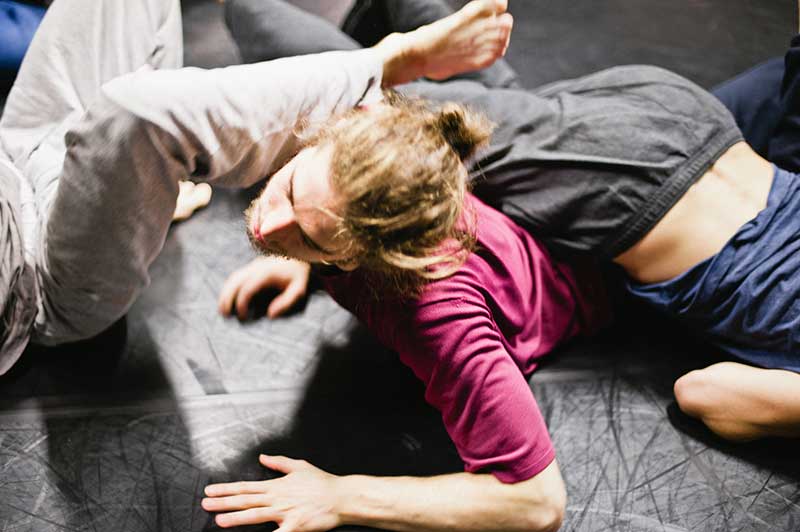
Hagit Yakira attracted full houses for her exciting new work, four talented performers falling, recovering and supporting each other, as they take what life throws at them. Their eyes and faces are as important as the rest of their bodies as they look out for each other. Yakira says she invites her audience “to experience the unravelling of real life experiences”. What I loved, though, was the synthesis – the building up of the elements that make up this seemingly simple but actually complex work performed on a vast bare stage.

One eloquent male dancer repeatedly falls and rights himself, while uttering the words "fall" and "recover". He’s joined by a second male dancer, full of solicitude for his partner, whom he repeatedly lifts and allows to slip away. A female dancer joins them and composer and multi-instrumentalist Sabio Janiak adds his serenely plangent music to the mix. A second female dancer makes a quartet and all four display the same solicitude for whichever of them is falling – clearly making recovery possible, not just by supporting them physically, but with the empathy in their expressions. I thought of the motto of the Three Musketeers (with D’Artagnan also four of course): “All for one and one for all”. The space is vast but they crisscross through it all. Janiak adds percussion too – and sometimes takes away his music leaving just the dancers in their loose, pastel clothes. It's moving, telling, soothing, startling and always engaging. The dancers are Sophie Arstall, Fernando Belsara, Stephen Moynihan and Verena Schneider.

free-falling2

free-falling2

In a beguiling addition, three dance artists respond to Free Falling – a different trio each night. The night I went there was a considered response from Dr Emma Dowling on video and an immediate response from Rosemary Lee, a choreographer and creator of extraordinary large-cast community pieces for dancers of all ages. It was fascinating to compare Dr Dowling’s conscientious onscreen response with Rosemary’s joyful movement through the space, retracing the footsteps of the dancers and throwing down pages from her notebook in response to what she had seen and experienced in each spot.

Between these two came the response from dancer Rachel Krische, drawing on the movement quality choreographed by Yakira for the quartet, but relating to members of the audience – using them as her dance partners, first touching, then asking for more – for support and the intertwining of limbs. And finally, gloriously climaxing in full audience participation on the studio floor – everyone linked in a joyful dance – a sort of Hora at Sadler’s Wells, which makes Israeli dance so welcome. Hagit Yakira is a name to watch – and JR will be watching out for more Israeli dance at Sadler’s Wells.

By Judi Herman

Photos by Loy Olsen and Kiraly Saint Claire

Free Falling was presented as part of Wild Card, a series of specially curated evenings at Sadler's Wells Theatre from a new generation of dance makers, bringing fresh perspectives to the stage. www.sadlerswells.com

To read more about Hagit Yakira and Free Falling, click here http://www.hagityakira.com

Review: Knock Knock ★★★★ - A beautifully nuanced account of a devastating situation

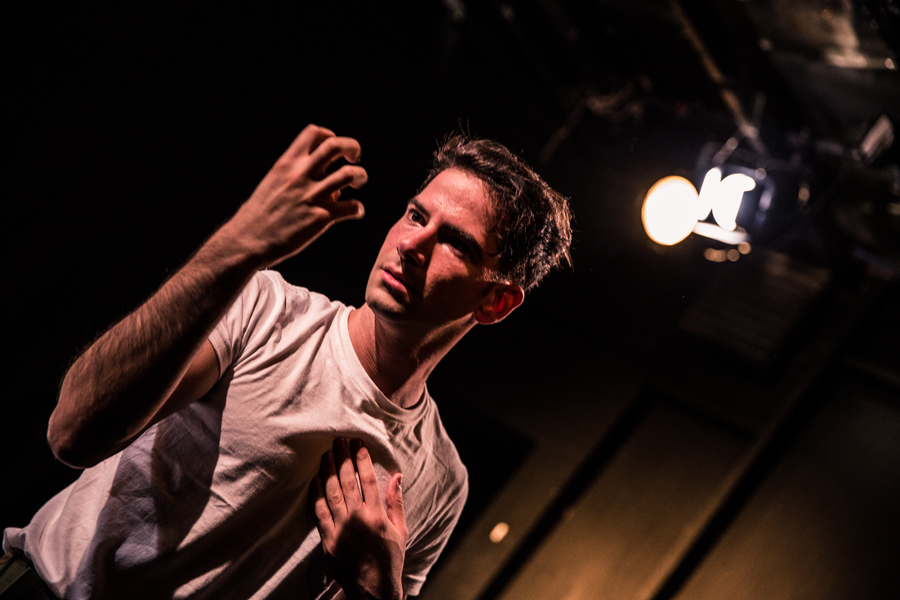
knock-knock-ectetera-theatre-niv-petel-writer-and-performer-credit-chris-gardner-6 Clad simply in a white top and khaki trousers, to which he adds such details as a white apron, Petel bowls a blinder by playing the mother of his young conscript. He stacks the emotional stakes high – she's a single mother and an army therapist, trained to tell bereaved parents the worst, to make that dreaded knock on the door, and to work with them through the grief and loss that will form part of the rest of their lives. For most of the show Petel talks intimately and affectionately to his son. The account of their intense relationship is beautifully paced, starting with Ilad as a babe in arms and then as a toddler; at kindergarten, then junior school; as stroppy teenager and, inevitably, at 18 preparing for the draft.

Petel’s is a beautifully nuanced physical performance that takes the audience with him through the whole of what we know is to be a tragically short life. There's a moment of hope when we discover that as an only child, he can opt out of active service; we live with his mother through the nail-biting agony of trying to dissuade her son from choosing service to prove himself. But mothers must let go if children are to grow up at all.

With the aid of designer Rhiannon White the show is made up of an extraordinarily simple set and minimal, versatile props to set off the physical and vocal skill and simplicity with which Petel tells his story. White lives up to her name, for everything on stage is stark and clinical: a table, chair, telephone and the towel that Petel winds first into baby Ilad and then almost everything else needed to tell his tale. Under lighting designer Oliver Bush’s equally stark white light, the feel is of a waiting room, a surgery or a morgue – perhaps a waiting room in the afterlife even. The only other colour is the khaki of those trousers, suggesting that Petel is Ilad, as well as his mother, which is a touching duality. Overall, Knock Knock is an engaging and important contribution to our understanding of life in Israel.

By Judi Herman

Knock Knock runs until Sunday 6 November, 7.30pm, £8-£10, at Etcetera Theatre, 265 Camden High St, NW1 7BU; 020 7482 4857. http://etceteratheatre.com

Listen to Niv Petel talking about Knock Knock on JR OutLoud

Review: Ragtime ★★★★ – A timely revival for a musical about immigration, aspiration and discrimination

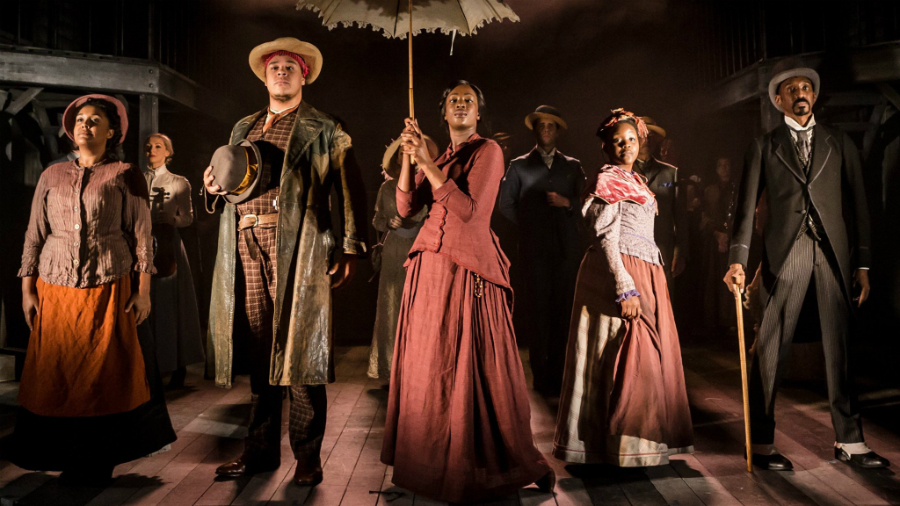
ragtime At this time of post-Brexit xenophobia and with refugees in crisis, Ragtime’s dramatic account of the hardships and hatred faced by early 20th-century immigrants to America is all too timely.

Terrence McNally’s book works seamlessly with Lynn Ahrens’ lyrics to bring EL Doctorow's 1975 novel to the stage. The story revolves around the interaction of three families: well-established WASPs (white Anglo-Saxon Protestants) Mother, Father and their Little Boy, with Grandfather and Mother's Younger Brother; ragtime piano-playing African American Coalhouse Walker and Sarah, the mother of his baby son; and Tateh (Yiddish for daddy), a young Jewish widower newly-arrived from Latvia with his daughter, as well as his hopes. “A Shtetl iz Amereke,” sings Gary Tushaw’s starry-eyed, sympathetic Tateh.

When Father leaves for a polar expedition, compassionate, resourceful Mother proves she can think for herself, rescuing the new-born abandoned by troubled Sarah, taking her in too and effecting reconciliation between Sarah and Coalhouse. There is an immediate connection when she meets Tateh, in danger of having his aspirations crushed by grinding poverty. But the racial hatred faced by Coalhouse leads to violence that threatens to engulf them all.

ragtime-1

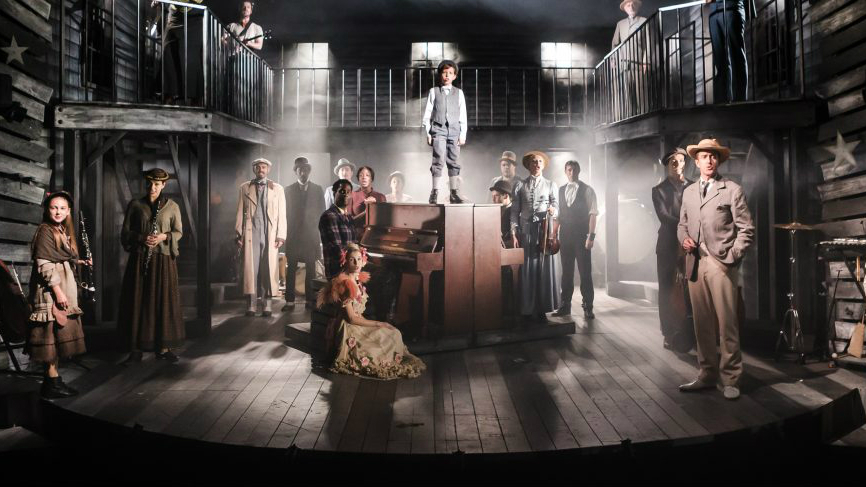
Famous personalities of the era play a part, the Jews represented by escapologist Harry Houdini (played by winning Christopher Dickins, his accordion part of his personality) and fiery anarchist activist Emma Goldman (the splendid Valerie Cutko), inspiring and advising alongside civil rights pioneer Booker T Washington (impressive Nolan Frederick channelling Obama). The car Coalhouse buys from Henry Ford (Tom Giles) provokes the hatred and envy that drives the story. And as professional femme fatale Evelyn Nesbit, Joanna Hickman, funny and ravishing, perches on a piano, her cello-playing part of the allure that mesmerises Jonathan Stewart’s likeable, hot-headed Younger Brother.

Thom Southerland’s production fills the Charing Cross’s tiny stage with ‘teeming masses’ - his cast of 24 actors, mostly musicians, dynamically choreographed along with their instruments, by Ewan Jones on a versatile set (designers Tom Rogers and Toots Butcher). Their twin balconies swing across stage to double as ocean liners and twin pianos make vehicles, platforms, and magnificent music thanks to dynamite onstage MD Jordan Li Smith and the nimble fingers of Ako Mitchell’s Coalhouse.

The rhythms of Stephen Flaherty’s score, ranging from the syncopation of ragtime itself to the klezmer brought by Jewish immigrants, wrap the auditorium with powerful sound, thanks to Mark Aspinall’s orchestrations. When the cast sing in chorus it is breathtaking, sometimes overwhelming. There are glorious individual voices. Anita Louise Combe’s Mother has rich warm tones to match her generous personality. Jennifer Saayeng’s Sarah moves to tears with the quiet vehemence of Your Daddy’s Son and soars in a duet with Mitchell’s virile, passionate Coalhouse, and Seyi Omooba’s voice is heart-stopping in this often spellbinding evening.

by Judi Herman

Photos by Annabel Vere and Scott Rylander

Ragtime runs until Saturday 10 December, 7.30pm, 2.30pm & 3pm, £17.50-£29.50, at Charing Cross Theatre, The Arches, Villiers St, WC2N 6NL; 08444 930650. http://charingcrosstheatre.co.uk

Review: Lunch and The Bow of Ulysses ★★★ – Steven Berkoff coupling on fine form

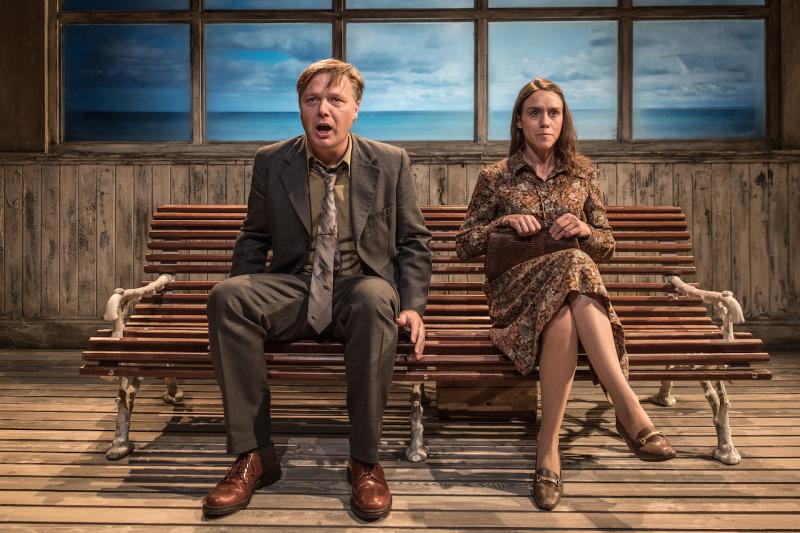
lunch-1-shaun-dooley-and-emily-bruni-photo-marc-brenner I’ll always be grateful to Steven Berkoff. Back in my days as drama lecturer, blown away by his 1983 play West, his second foray into life on London’s gangland manors, I wrote to him via his agent to ask if I might borrow the unpublished script. The hard copy arrived almost as fast as an email might now, by return with a friendly invitation to keep it. My students adored playing the scabrously ornate muscular verse and the body language it demanded.

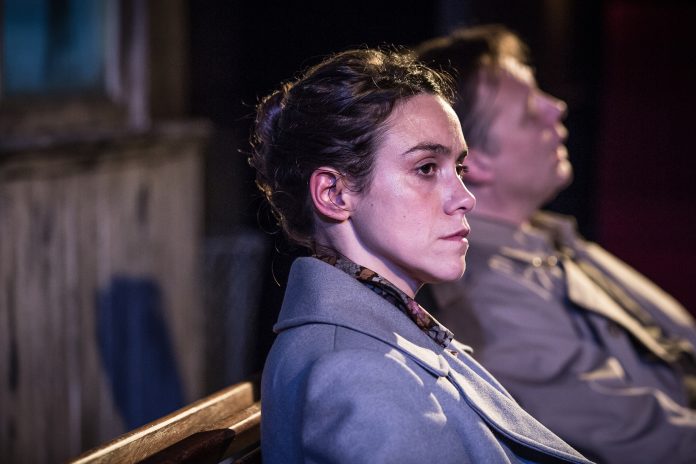
Lunch dates from 1983, too and although it is prose, the language is often as extravagant – and as bracingly sexual. A man and a woman share a seaside bench at lunchtime. He confides lustful thoughts that she arouses, which make Trump’s ill-judged bragging look prim, and it’s in-yer-face in this intimate space, too. He is yearning, rather than boasting, with every muscle and fibre in Shaun Dooley’s extraordinary performance. Emily Bruni’s woman is equally physical – at first sight primly upright and uptight, but actually coiled like a spring ready to snap – or catch him in those coils...

Thanks also to Nigel Harman’s direction and movement director Alistair David, what follows is a masterclass in physicalising Berkoff’s language that would have enthralled my students. They prowl around each other like courting cats, he wiping from his brow real drops of sweat with a real hanky. At this proximity, audience members might also sweat uncomfortably as the couple eventually end up adjusting their dress at our feet.

lunch-marc-brenner

But it’s their relish of the language that carries you along, the taste of it on the tongue – even when his chat-up line is trying to interest her in the space he sells for a living “electro-type on quarto double weight” (yes, space on paper, not online, Lunch is of its time) he enunciates alluringly in his attempt to melt “an ice lolly in a whirlwind.” “You’re not looking for me, you’re looking for it, you canine groper,” is her riposte (this comes more like a chat-up line before that apparent tumble behind the beach shelter).

That’s just a taste of what’s to come in the Bow of Ulysses, set (and indeed written) 20 years later and as many years into a marriage on the rocks. Rather than trading bracing insults, though, the estranged couple express themselves in longer, bitter monologues, downbeat this time. It was good to see these short companion pieces together, though strangely the first, as a real period piece, seemed less dated than its sequel. Ben and Max Ringham provide an evocative seaside soundscape and designer Lee Newby has a great eye for shades of brown that match at least the dress of this ill-matched pair in a seaside shelter that’s the only restful element in an unsettling evening.

By Judi Herman

Photos by Marc Brenner

Lunch and The Bow of Ulysses  runs until Saturday  5 November, Monday to Saturday 7.45pm Thursday and Saturday 3pm, £19.50-£35, at Trafalgar Studios 2, 14 Whitehall, SW1A 2DY; 0844 871 7632. www.atgtickets.com

Review: Fagin’s Twist ★★★★ - The exhilarating dance drama gives a thought-provoking twist on a familiar tale

8-fagins-twist-photo-by-rachel-cherry You'll recognise the battered toppers, silk handkerchiefs and the pocket watch, but will you recognise the characters you thought you knew and loved (or hated)? Young orphan Fagin, resourceful and charismatic, escapes the workhouse with his best mate Bill Sykes to build an underground empire, a refuge for the likes of Sykes's girl Nancy and the Artful Dodger. Then they stumble upon young Oliver Twist.…

Fagin’s Twist is a breathtaking synthesis of dance, words, music and design, which succeeds brilliantly in finding – or fashioning – the fully-rounded humanity of Dickens’ characters we think we know so well already from the page, stage and screen.

Writer Maxwell Golden has dared to add his gloss to Dickens to tell those back stories – for Bill Sykes, Nancy, the Artful Dodger and of course Fagin himself. Aaron Nuttall’s Dodger narrates as niftily as he moves, so that Golden lives up to his name – his script sounding direct, fresh and as muscular as the dance itself.

Exploring the dark side of London in Dickens’ time and indeed right now, Tony Adigun’s restless, shape-shifting choreography is complemented by the constant morphing of Yann Seabra’s angular wooden slats lit with extraordinary versatility by Jackie Shemesh, to evoke alleys and streets and the sinister interiors of workhouse and thieves’ den.

3-fagins-twist-photo-by-rachel-cherry

A dark and thrilling eclectic score, both found and original, ranges from strings, piano and harp to music to blast you into submission, but even when it’s ‘in yer ears’ it earns its place there, thanks to sound designers Brian Hargreaves and Seymour Milton.

The performers crown this glorious synthesis by tackling both the dance and drama with energy and brio. Ensemble and soloists are equally at home in the breathlessly fast-moving routines and changing tableaux (sleight of hand looks like it comes naturally to this gang), as well as the escape over London's sinister roofscape; and the more measured duets and solos that explore the burgeoning relationship between Lisa Hood’s passionate Nancy and Dani Harris-Walters’ virile Bill. Joshua James Smith is an intriguingly complicated Fagin, a damaged youth using the cards fate deals him to find his golden opportunity in the gang leader’s swinging pocket watch. He’s a fine lithe figure in his swirling coat with fur tippet, cleverly evocative of Victoriana and yet cutting a more timeless dash like all Seabra’s costumes. Plus there’s Jemima Brown’s little orphan Oliver, working hard on tugging at Nancy’s heartstrings with his efforts to find his niche ...

There’s also an intriguing exhibition in the theatre bar of George Cruikshank’s illustrations for Oliver Twist, complete with correspondence from Dickens. Add some sly quotations from Lionel Bart’s Oliver in Golden's script and it all makes for an unexpected twist on Dickens.

By Judi Herman

Photos by Rachel Cherry

Fagin's Twist runs until Saturday 15 October, 8pm & 2pm, £18, £12 concs, at The Place, 17 Duke's Rd, WC1H 9PY; 020 7121 1100. www.theplace.org.uk

Then on tour at the following places:

Monday 17 October, 8pm, £10, at Gloucester Guildhall, GL1 1NS; 01452 503050. www.strikealightfestival.org.uk

Thursday 20 & Friday 21 October, 7.45pm, £12, at Birmingham Hippodrome, B5 4TB; 0844 338 5010. www.birminghamhippodrome.com

Tuesday 25 October, 7.30pm, £15, £10 concs, at Nottingham Lakeside, University of Nottingham, NG7 2RD; 0115 846 7777. www.lakesidearts.org.uk

Friday 28 October, 7.30pm, £14, £11 concs, at Barbican Plymouth, PL1 2NJ; 01752 267131. www.barbicantheatre.co.uk


Read more theatre reviews and interviews

Review: Adding Machine: A Musical ★★★★ - An enthralling account of a life lived by and for numbers

adding-machine-c-alex-brenner-1 What’s the difference between a musical and an opera? One definition might be that in opera the drama is largely generated by the music, in a musical it is largely defined by the text. And of course there are the honourable blends exemplified by Kurt Weill's Street Scene, adapted from Jewish writer Elmer Rice’s play.

Seeing Street Scene prompted Jason Loewith to attempt a similar musical adaptation based on Rice’s 1923 play The Adding Machine. Joshua Schmidt composed the music, as well as writing the libretto and book together with Loewith for a 2007 American opening.

The storyline makes a play of two halves. The first is a stifling, all too real account of the life of white-collar worker Mr Zero, exploited at work and hen-pecked at home till he snaps and murders his boss when he is let go in favour of the new-fangled adding machine. The second half is a surrealist journey into the Elysian Fields of the afterlife (complete with swimming pool in the confined playing space in the Finborough), where even Zero and a fellow condemned prisoner might join other souls offered another chance.

Kate Milner-Evans’ Mrs Zero powers the opening, her singing deploring her unhappy life and worthless husband stark, challenging and in-yer-face in this tiny space, her emotional expression transcending what language alone can communicate. The ensemble respond with an intricate mix of movement and song about numbers, perfectly setting up the claustrophobic atmosphere of a life where people are given numbers according to their social standing. Mr Zero – excellent Joseph Alessi – conveys the burden and boredom of a zero, trapped adding numbers day in day out, incapable of escape and unable to liberate himself (as well as performing the feat of devouring ham and eggs as he sings). There’s excellent support from James Dinsmore as a believable Boss here and in the hereafter, from Edd Campbell Bird as Shrdlu, another murderer, in both worlds and from Joanna Kirkland as the girl of Zero’s dreams.

The music was originally scored for just three instruments, Schmidt explaining that he approached the task with this combination in mind and tried to create a full blown, challenging score for three instruments. “It’s not a matter of compensating for instruments that aren’t there." His music sometimes recalls Kurt Weill, but he has a style and punch all his own and Ben Ferguson (Musical Director), Tristan Butler (percussion) and Hamish Brown (synth) give a full account of the enterprise. Chi-San Howard’s movement direction beautifully fuses actions, movements and words with the musical intent on Frankie Bradshaw’s clever transverse set. Direction by Josh Seymour intelligently contrasts the two halves of the show and seamlessly integrates drama, music, spoken word and movement.

By Judi Herman

Photos by Alex Brenner

Adding Machine: A Musical runs until Saturday 22 October, 7.30pm & 3pm, £20, £18 concs, at Finborough Theatre, 118 Finborough Rd, SW10 9ED; 0844 847 1652. www.finboroughtheatre.co.uk

Read more theatre reviews and interviews

Review: My Family: Not the Sitcom ★★★★ – David Baddiel finds the funny in losing his parents

david-baddiel-c-marc-brenner Often at shiva prayers it strikes me how much the late-lamented might have enjoyed the gathering of nearest and dearest, but would they have enjoyed the eulogies? Might they not have confessed (or complained) “that’s not the real me, warts and all”? David Baddiel goes further in his scurrilous tribute to his late mother, who died suddenly in 2014. He confides in his audience that Sarah Baddiel loved not only being centre stage, but also a bearded, pipe-smoking golf salesman for 20 years – apparently unnoticed by her husband, even wangling him an invitation to David’s bar mitzvah. Seriously, he’s there in the photo album.

If you think that this might make for uncomfortable laughter, don't worry. Sarah herself gives posthumous sanction, caught on camera delighted at being the centre of attention as a volunteer audience member in a TV comedy panel game starring Baddiel and Frank Skinner. To her son’s visible discomfiture she pulls focus by writing something on the board that offers far too much information about her sex life – his mortification is complete when he feels he must correct her spelling of an unmentionable word to boot.

What follows is an exasperated and affectionate no-holds-barred exposé, not just of the nuts and bolts of her grand passion, but also of her foibles. Her lover sold golfing memorabilia, so, presumably working on the theory that imitation is the sincerest form of flattery, she set up a rival business.

She would send inappropriate emails to her lover, copying in her sons, perhaps so they could share her facility with misplaced inverted commas. I found myself weeping - with laughter. Sarah would surely have loved sharing the joke too.

Baddiel is wonderfully at home alone onstage, on a set (production design by Declan Randall) decked out like a Jewish rococo living room, surrounded by family photos in frames of every shape and on every surface including the back walls, underfoot a black-and-tan Persian-style carpet.

Baddiel’s father Colin survives Sarah, but perhaps his son is in mourning for him too, for he has dementia – a particularly difficult form called Pick’s disease, which makes him extraordinarily foul-mouthed, aggressive and – you’ve guessed it – prone to sexually inappropriate behaviour. Baddiel gets laughs when he responds to the neurologist’s explanation of the symptoms: "Sorry, does he have a disease or have you just met him?" He gets guffaws when he shares the Daily Mail’s shock-horror headline: "David Baddiel’s agony amid fears he is contracting dementia". And he gets my sympathy and admiration for finding and sharing the funny in losing his parents.

By Judi Herman

My Family: Not the Sitcom runs from Tuesday 28 March - Saturday 3 June. 8pm, 3pm (Wed & Sat only), from £23.50, at Playhouse Theatre, WC2N 5DE. www.playhousetheatrelondon.com

Suitable for ages 16+ as the show contains mature language and subject matter

Review: King Lear ★★★★ – Antony Sher is every inch a king in Gregory Doran's mighty production

king-lear-production-photos_-2016_2016_photo-by-ellie-kurttz-_c_-rsc_202088 Antony Sher's performance is literally towering at the opening of the play, directed by his husband, RSC Artistic Director Gregory Doran. Lear is borne in on a huge platform above the glittering monochrome of his court (designer Niki Turner), wrapped in fur cloaks that make him larger than life, his every pronouncement accompanied by thunderous chords to make of him a primitive demigod. He may look "every inch a king", as he says ironically later in the strange lucidity of his madness on the cliffs at Dover, but he is equally a very foolish old man, as he also refers to himself later. His rejection of youngest daughter Cordelia (Natalie Simpson, all quiet resolution in white) is especially cruel, arbitrary and yes, senile, simply because of that god-like build up.

But it is the reaction of oldest daughter Goneril (excellent Nia Gwynne, an auburn-plaited Saxon princess in russet jewel-encrusted gown) that is most startling. Foreboding at the impropriety of his asking his daughters how much they love him turns to horror on Goneril's face, as her father turns the full force of his cruel rage on Cordelia for her honest reply. Goneril’s fears are well-founded of course, for later he curses her womb, and the physicality of Sher's spite as he grabs hold of her in a cruel travesty of an embrace and her momentary hopeful and needy response to it are all the more shocking.

Doran also gives Lear several of the hundred knights demanded to keep for his retinue to carouse with him around his daughter's table, and a downright noisy boorish shower they are too, so that to start with it's hard not to sympathise even with Kelly Williams's vivid scheming middle daughter Regan.

king-lear-production-photos_-2016_2016_photo-by-ellie-kurttz-_c_-rsc_202354

This engaging of sympathy for a child who will ultimately prove unnaturally cruel is echoed in the relationship between David Troughton's exceptional Gloucester and his bastard son Edmund (Paapa Essediu, a villain with a fine sense of irony), clearly nursing a 'legitimate' grievance as his father introduces him to Kent with that well-worn tactless joke about the "sport" he had conceiving him.

The brilliance of both Sher and Troughton is in their ability to engage sympathy once they are changed by what they endure. Sher sloughs off the layers of clothing that make him imposing from the outside, as he gradually gets to know himself and understand reality and, for the first time, other people. If he is touching in his  madness on those cliffs, it's because he is content – even happy – in that altered state (in the way that dementia patients often present  for example). The audience learns to love him as he learns himself and is truly reunited with Cordelia.

The parallel reunion between Gloucester, who only sees clearly once he has lost his sight, and his true loving son Edgar, forced to disguise himself as a mad beggar when Edmund convinces his father he’s the villain, is equally moving thanks to Oliver Johnstone's resourceful Edgar, proving ultimate filial devotion as his father, like Lear, achieves closure at life's end.

By Judi Herman

Photos by Ellie Kurttz © RSC

King Lear runs until Saturday 15 October, 7.15pm & 1.30pm, £16-£70, at the Royal Shakespeare Theatre, Stratford-upon-Avon, CV37 6BB; 01789 403493. Then at the Barbican Theatre, London, ECY2Y 8DS; 020 7638 889, 10 November to 23 December, 7.15pm & 1.30pm £25-£55 . In cinemas from 12 October.

www.rsc.org.uk

Review: How to Date a Feminist ★★★★ – Samantha Ellis does it in style in this fast and funny comedy

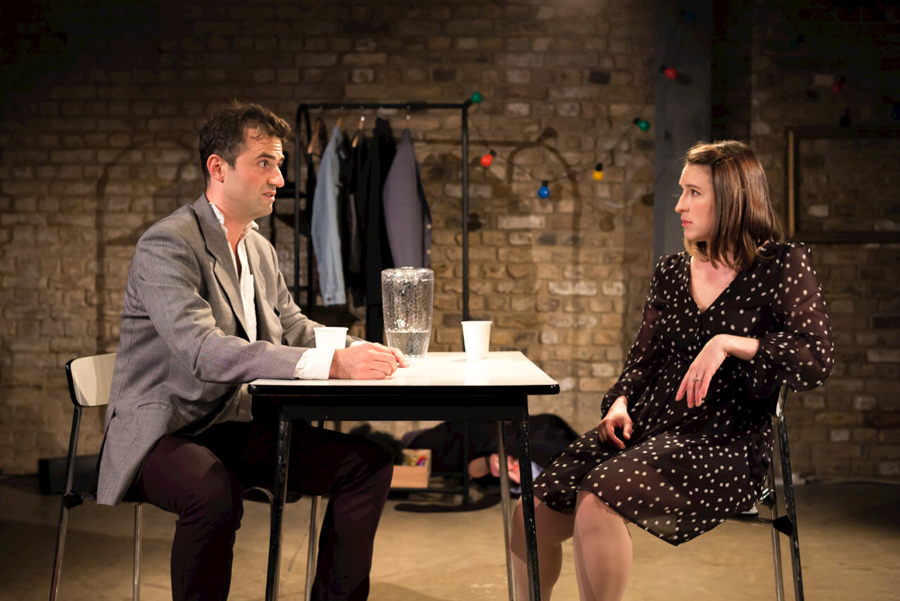
how-to-date-a-feminist-at-the-arcola-c-nick-rutter-2016-2 Ah, the F word again. No surprises there. But it's the man who's the feminist in Samantha Ellis’s fast and funny spin on Hollywood screwball romcoms, billed as "a romantic comedy turned upside down".

Kate is a journalist who happens to be Jewish. She also happens to have a fatal attraction to bad men, both on the page (Heathcliff) and in the all too solid flesh (her ex is her promiscuous editor). Then there's Steve, a man who happens to be a feminist. His mum brought him up at Greenham Common Women's Peace Camp, while Kate's dad is an Israeli brought up in a refugee camp. She wants to be swept off her feet and into bed. Steve probably wants to sweep the floor for her first. Can they get (and keep) it together despite their prejudices, their predilections and their parents?

Ellis has huge fun turning our preconceptions on their heads, giving artisan baker Steve all the PC lines (his marriage proposal begins, “I want to apologise for the patriarchy”) and Kate the, er, balls.

how-to-date-a-feminist-at-the-arcola-c-nick-rutter-2016-3

With delicious wit, Ellis follows the pair's rocky road from meeting at a fancy dress party – she "symbol of female power" Wonder Woman, he "brilliant ethical hero" Robin Hood  (the quotes are Steve's seals of approval - Kate's opening quip is "Are those ladders in your tights or stairways to heaven?") – to very cold wedding day feet at a yurt in Greenham, not the hall in Hendon favoured by Kate's dad, though there is a rabbi to bless the couple and a glass to stamp on.

Ellis zigzags back and forth in time with panache and Matthew Lloyd directs the dynamic duo of Sarah Daykin and Tom Berish with matching brio. Thanks to designer Carla Goodman's clever costumes and some artful velcro, they win our hearts with their onstage lightning changes, morphing into his mum and her dad and their exes in the wink of an eye, literally, as they revel in sharing the fun.

Ellis has some real points to make about those preconceptions and a fine skill at suggesting the emotional hinterlands of her lovers and their parents. And the icing on the cupcake (even though Steve doesn't approve of those either) is that it really works as a romantic night out, too.

By Judi Herman

Photos by Nick Rutter

How to Date a Feminist runs until Saturday 1 October, 8pm & 3.30pm, £17, £14 concs, at the Arcola Theatre, 24 Ashwin St, E8 3DL; 020 7503 1646. www.arcolatheatre.com

The show then tours to Stephen Joseph Theatre, Scarborough on Friday 21 & Saturday 22 October, www.sjt.uk.com; and Watford Palace Theatre on Friday 4 & Saturday 5 November, http://watfordpalacetheatre.co.uk

Review: The Great Divide ★★★★ - Beautifully-imagined lives reclaimed from the flames

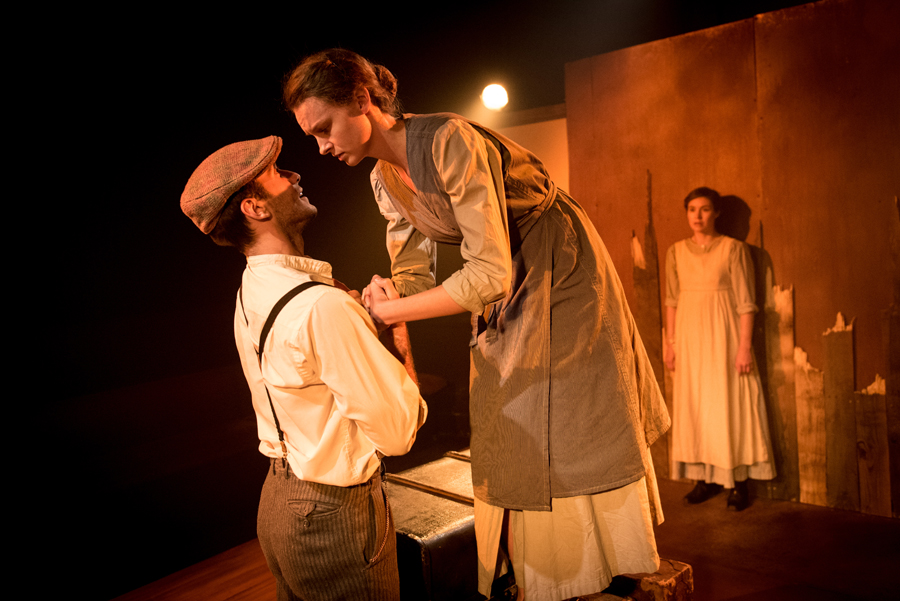
emma-king On the simplest of sets – designer Sebastian Noel’s cabin trunks piled and rearranged to create levels on the set of the play with which it’s in repertoire – and with the audience focusing intently from either side, three young women and two young men begin The Great Divide. They're telling the story about a New York garment factory fire in 1911 that took the lives of 146 workers, mainly young women and Jewish refugees from Russia. Such is the power of Alix Sobler’s storytelling and the lyrical intensity of director Rory McGregor’s cast that there is little need for much more.

Sobler immediately establishes a ritualistic quality to playing out the story. Her play opens with Havdalah, the ceremony that ends the Jewish Shabbat each Saturday with a light kindled and then extinguished, accompanied by a haunting chant. Light and darkness (controlled expertly by Sam Waddington), music and sound (courtesy of musical director and composer Tim Shaw) will continue to play their part, whether for beauty and atmosphere or to establish the grinding repetition of factory work and the horror of fire and smoke. Each ‘player’ has at least one detailed identity – someone the audience will get to know and care about – as well as sketching out other characters as needed. But it’s clear that they have told this story before and must tell it again and that it will be played out in other times and places where wellbeing and safety are sacrificed for profit. The 'profit-conscious' supervisor here is represented by Michael Kiersey's Max, who works well to earn sympathy and contempt as appropriate.

josh-collins-hannah-genesius-and-miztli-rose-neville

It is Hannah Genesius’s spiky, intelligent Rosa and Emma King’s luminously poetic Manya that we get to care about, as they become inseparable on the boat from the old country, work swingeing hours at the Triangle Shirtwaist Factory and face even more hardship on the picket lines during an 11-week strike for better conditions and hours. It’s hard not to be touched as initially frosty Rosa gradually melts to the sturdy wooing of Josh Collins’s delightfully disingenuous Jacob. And I found myself blinking back tears listening to Manya telling in heart-breaking detail a story of the marriage, children and death in old age surrounded by grand- and great-grandchildren that she would never have. It’s some consolation to meet the real activist, strike organiser Clara Lemlich (feisty Miztli Rose Neville, who also doubles as other women), who did indeed survive into fiery old age, unionising workers in her care home in her 90s.

Lemlich's may be the only real happy ending, yet Sobler and her company succeed in giving back beautifully-imagined full lives and identities to these long-dead young women and men.

By Judi Herman

Photos by Graeme Braidwood

The Great Divide runs until Tuesday 20 September on Sundays, Mondays and Tuesdays only, 7.30pm & 2pm, £18, £16 concs, at the Finborough Theatre, 118 Finborough Rd, SW10 9ED; 0844 847 1652. www.finboroughtheatre.co.uk