Reviews

Review: Pinocchio ★★★★ - Israeli-born choreographer Jasmin Vardimon and her company create breath-taking stage pictures to enchant

If you want to introduce your child to the magic of live theatre, then the captivating combination of physical dance theatre and brilliantly imaginative staging with which Yasmin Vardimon and her company weave the story of Pinocchio should leave any theatregoer, new or experienced, eager for more.

Vardimon has an extraordinary imagination and with her collaborators, set designer and dramaturg Guy Bar-Amotz and lighting designer Chahine Yavroyan, she finds a fresh way of conjuring each scene in Collodi’s story of the wooden puppet boy who yearns to be a real boy. Perhaps the most distinctive signature of her style is the stunning and seamless way her eight performers work together to use their bodies – or often just one body part each – to create a whole.

Working together with precise discipline, three performers open the show by assembling the disturbing, dark, squat figure of the narrator (perhaps the Cricket) from their gloved hands. Meanwhile, within a brightly-lit conical tent, shadow-play creates the illusion of puppet-maker Gepetto fashioning the life-size puppet from his magical piece of wood. The Blue Fairy materialises and floats effortlessly upwards as the tent morphs into her gown, all blue light.

In Geppetto’s workshop all eight dancers revolve around as figures in a clockwork musical box, each face a smiling mask, each body moving as precisely as clockwork as they rise in turn to the centre of their mechanical frieze, like paper cut-out dolls. Even the performers’ feet create ‘puppets’ and many hands make light work of Pinocchio’s nose.

The episodic nature of Pinocchio’s journey lends itself perfectly to this problem-solving teamwork. But of course the heart (beating rather than wooden) of the story is Pinocchio himself. Maria Doulgeri brings extraordinary physicality to the role, limbs revolving stiffly at first as if her joints are indeed awkwardly jointed with pins; flailing wildly and unnaturally to the scornful amusement of the nasty children in a playground who revel in excluding the little outsider; and gradually softening as he achieves empathy and selflessness – and so humanity.

The shape-shifting cast is uniformly excellent, equally at home as animals, puppet or humans, on the ground or in the air – or suspended on puppet strings. Scheming cat and fox are present and correct and banish any memories you may have of that Disney film.

The evocative music ranges from Shostakovitch to Beyoncé via accordion music from the Faroe Islands and the vocalising sighs and gasps from the cast add to the inclusive atmosphere. If some scenes are a tad long, the whole, at 90 minutes is just right. And it’s testimony to the show that despite there being no interval its young audience was spellbound throughout.

By Judi Herman

Pinocchio runs Friday 3 & Saturday 4 November. 7.30pm, 2pm (Sat only). £13, £8.50. Grand Theatre, Blackpool, FY1 1HT. www.blackpoolgrand.co.uk

Review: Young Marx ★★★★ - On your Marx for an exhilarating chase through 19th-century Soho (in 21st-century comfort)

Welcome to 1850 – a genuine welcome to political refugees from Europe, including 32-year-old Karl Marx. But is he in danger of outstaying his welcome as he goes on the razzle through Soho, funding his pub crawls by trying to pawn the family silver? His wife’s family that is, for Jenny von Westphalen is of aristocratic German stock, her relatives scandalised by her marriage to the penniless Jewish revolutionary. As young Marx himself puts it “at our wedding I was only invited to the reception”.

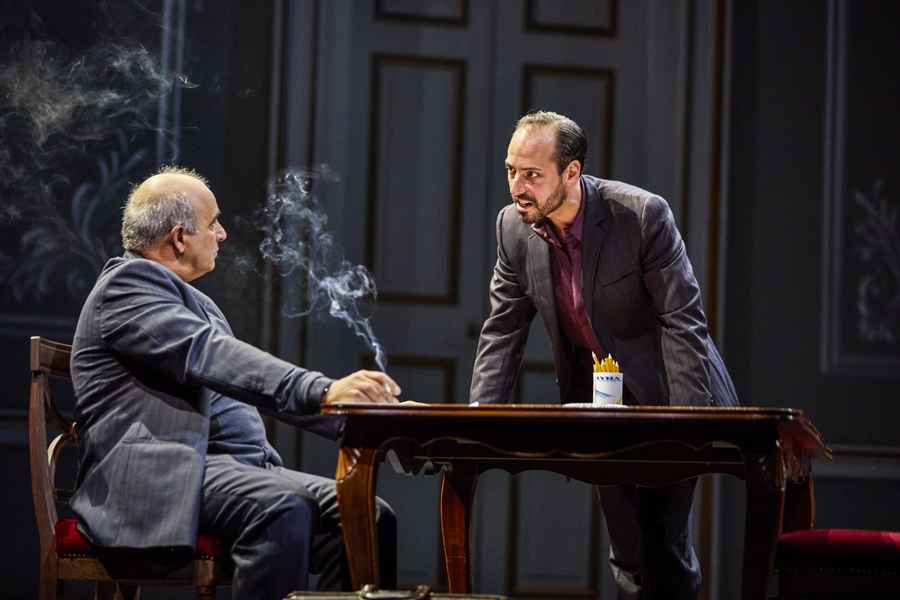
This is one of many knowing one liners from the collaboration of Richard Bean (of One Man, Two Guv’nors fame) with witty barrister/radio writer Clive Coleman. Their young Marx is a full-blooded “solipsistic, self-regarding prick”, in the words of his often exasperated, though always devoted sidekick Engels. They write Marx and Engels as a sort of early music-hall double act and Rory Kinnear and Oliver Chris are perfectly cast.

Kinnear’s Marx, hair and beard wild and out of control as his behaviour, is in the throes of writer’s – and thinker’s – block. He achieves the vital balance between infuriating as the reprobate hiding in cupboards when creditors come calling, and earning sympathy as the adoring father, anxiously tending his sickly son and listening proudly to his daughter’s prowess at the piano (before the broker’s men take it, along with the rest of the family’s furniture and clothes).

Chris’s Engels, equal parts admiration and frustration, convinces as the man whose unwavering self-sacrifice will lead to years of financing Marx’s project (and keeping his family going) by slipping him cash from the till of his father’s Manchester textile factory. In Chris’s performance, he is the vital moral heart of the play too; you can believe that he wrote passionately about the plight of workers observed first hand in those factories.

For all this is fact, Bean and Coleman have mined a rich seam of eyebrow-raising biographical detail and transmuted it into precious theatrical mettle (pun intended!).

They create a vibrant messy Victorian London, peopled by rival factions of émigré activists, German spies – and ‘peelers’.  Our odd couple’s run in with one of Sir Robert Peel’s prototype policemen is an ‘arresting’ example of the writers’ anachronistic, self-referential wit. The drunken pair, caught in possession of a wrought-iron church gate, are surprised and grateful to avoid a beating. “I’ve been on a course” explains the officer.

Big set-pieces – a political meeting, a dawn duel on Hampstead Heath and best of all a deliciously transgressive brawl in the British Museum reading room – contrast nicely with these cameos and with the intimate family scenes cramped into the two tiny rooms where Marx lives with wife, children, and housekeeper Nym. Nancy Carroll is magnificent as passionate, put-upon Jenny and Laura Elphinstone’s quiet hard-working Nym, whose devotion to Marx ultimately gets physical, matches Carroll as Chris matches Kinnear.

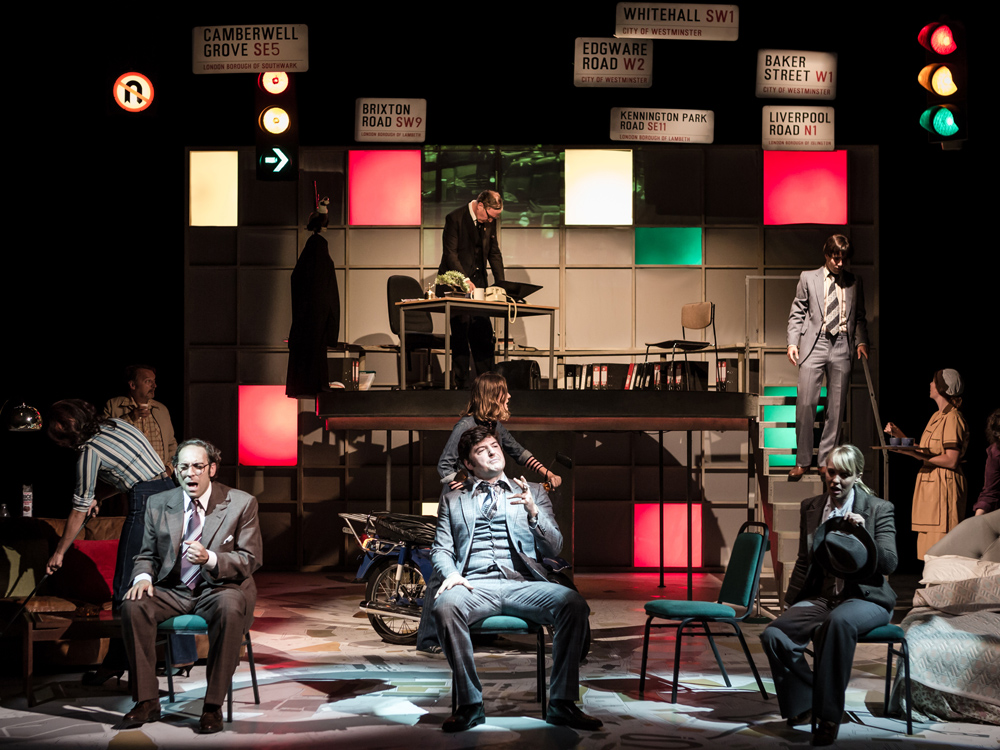
Nick Hytner directs a uniformly superlative cast with wit, sensitivity and pace on Mark Thompson’s fold-out set in London greys and browns, lit by Mark Henderson’s atmospheric lighting and topped by Soho rooftops and chimneys, among which Marx climbs to evade the law, which still look much the same today.

It’s a terrific demonstration of the versatility of Hytner and project partner Nick Starr’s brand new Bridge Theatre and augurs well for future productions. Julius Caesar, complete with audience promenaders as the Roman mob, is up next in January. As befits this democratic vibe, seat prices start at £15 and the horse-shoe shaped, spacious auditorium is inclusive, with sightlines looking uniformly good and seats are especially comfortable. The whole is completed in golden leather and wood, and if there is currently a bit of a flow problem because the single doors to the auditorium are too narrow, this could be corrected. The public spaces are spacious, well-lit and welcoming – and ladies, you will be, er, relieved to find so many toilet cubicles with your name on them.

By Judi Herman

Photos by Manuel Harlan

Young Marx runs until Sunday 31 December. 7.45pm (Tue-Sat), 2.30pm (Wed & Sat), 3pm (Sun only). £15-£65. Bridge Theatre, SE1 2SG. https://bridgetheatre.co.uk

Also broadcast live to 700 UK cinemas and many more worldwide on Thursday 7 December. Visit www.ntlive.com for further details.


Review: Anything That Flies ★★★ - Soaring performances bring home a poignant message

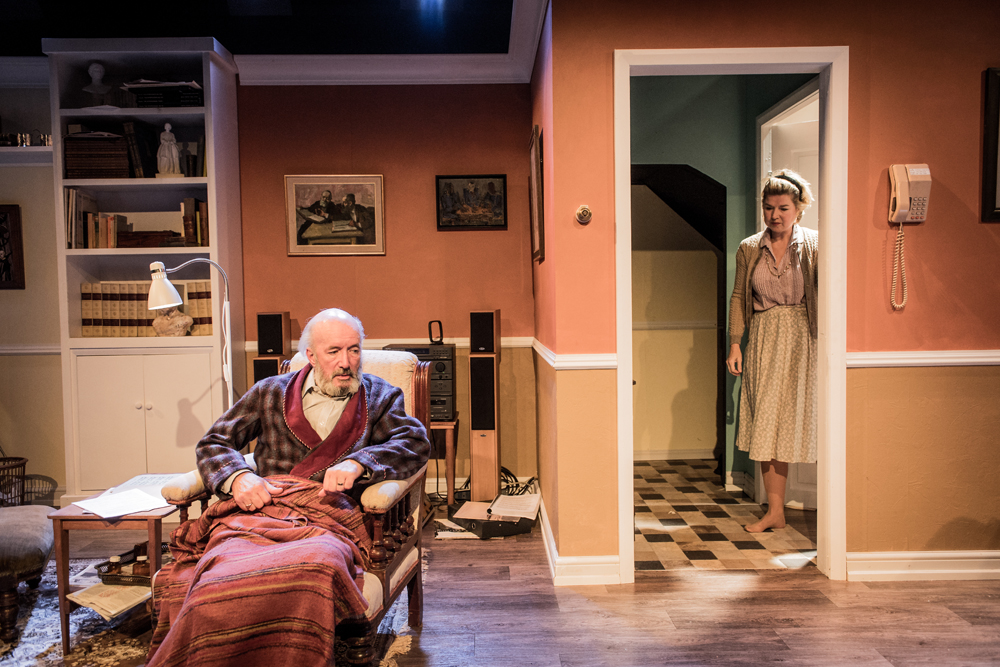
I won’t reveal why novelist Judith Burnley gives her moving debut play this intriguing title. To find out, you’ll have to get to know Otto and Lottie, he a Holocaust survivor and she an aristocratic German with her own story of devastating wartime trauma. Otto’s viola-playing days may be over, as he is also a stroke survivor, but he has the consolation of listening to Brahms on state-of-the-art speakers he designed himself!

It’s 1991, so 46 years since the war and two years after the Berlin Wall fell. The latter has repercussions for both; the former changed their lives forever. Escaping Germany in time meant Otto suffered further displacement, interned on the Isle of Man, only to discover the fate of his family once the war was over. Lottie’s father was hanged (‘with piano wire’) for his part in a plot to kill Hitler, and after the war she herself fled life under Communism as Germany was divided.

All this comes out as the unlikely pair size each other up once the life force that is Lottie bursts into Otto’s Belsize Park flat, apparently sent to care for him by his daughter. Lottie explains they met in Israel, where Otto’s daughter now lives and where Lottie’s Israeli partner has just died. Daughter Erika wins him over by describing the traditional Mittel Europa dishes that are Lottie’s cooking credentials – of course it’s Otto we hear reciting, increasingly orgasmically, “Rostbraten? Schnitzel? Sauerbraten?” It’s a hilarious one-sided phone conversation, one of the more successful of a series of such phone chats that stud the action.

Lottie soon discovers Otto has other ways of attempting to reach orgasm – he is in short a transgressive randy old goat, so that by the time he has called Lottie a Nazi and a German shiksa (Yiddish for a non-Jewish whore), your sympathies are with her. And as much as he loves the dishes of his childhood, he despises that icon of Englishness, Christopher Robin. It’s his contemptuous dismissal of her recitations that leads Lottie to reveal that the great love of her life was the English nanny who introduced her to AA Milne.

Nonetheless the pair bond over their love of the English language. For him it means a yearning to fit in, to be part of the country where he’s made a new life, but nonetheless feels like an outsider: “Beneath the politeness … a dirty Jew.” For her it’s her concept that English children played poo sticks as “German children were being conscripted into Hitler’s Youth League."

This is one of the best scenes in a timely play that poignantly explores what it is to be an outsider – reminding contemporary audiences what the refugees of the last century underwent as the asylum seekers of the 21st century strive to make new lives. Clive Merrison and Issy van Randwyck are pitch perfect in this two-handed performance.

By Judi Herman

Anything That Flies runs until Saturday 11 November. 7.30pm (Mon-Sat), 3.30pm (Sat only). From £15. Jermyn Street Theatre, SW1Y 6ST. www.jermynstreettheatre.co.uk

Review: The Toxic Avenger the Musical ★★★★ - This grungy green giant is on message loud and clear

Producer Katy Lipson (Aria Entertainment) has a sure eye – and ear – for a hit musical. Between a summer of new musical theatre at The Other Palace, including Some Lovers, Burt Bacharach’s first for years, and the imminent autumn transfer of a sell-out immersive version of tribal rock musical Hair arriving at London’s Vaults from Manchester’s Hope Mills Theatre, comes this West End transfer of a musical that had a hugely successful first outing at Southwark Playhouse.

It isn’t the first high-camp schlock horror movie to make it from screen to stage, though it may be the weirdest (and loudest). Like soulmate Little Shop of Horrors, it’s based on a movie with a musical score added here by David Bryan (yes, Bon Jovi’s keyboardist David Bryan Rashbaum!). In place of the film’s comic-book biffs and bangs – enough to employ an army of Foley artists and stunt-persons – Joe DiPietro’s adaptation of Lloyd Kaufman’s (with Joe Ritter) bracingly violent screenplay has Benji Sperring’s fast-moving, out and loud, in-yer-face direction; designer takis’ versatile three-tier set, incorporating huge vats, library, beauty salon and much more; a loud and lovely five-piece band led by musical Wunderkind Alex Beetschen – and just five extraordinary triple threats playing a cast of (almost) thousands.

In fictional New Jersey town Tromaville, the dastardly Mayor ruthlessly exploits local resources, dumps waste like there’s no tomorrow and is behind local crime syndicates. Meanwhile puny weakling Melvyn is bullied mercilessly until his tormentors crown their violence by throwing him into a vat of toxic waste, transforming him into the (admittedly hideous) superhero Toxic Avenger – green in colour and credentials – sworn to cleanse Tromaville of waste and bullies, including the Mayor; and soon, beloved of pretty, blind librarian Sarah, who ‘sees’ him not exactly for what he is, as she’s convinced ‘Toxie’ is an exotic French name.

Where the film split Melvin/Toxie between two actors, Mark Anderson curls up as Melvin and more than mans up for Toxie. Natalie Hope achieves a spectacular double as sexually predatory, vampish Mayor, her shocking pink décolletage an offensive weapon (the film has a man in suit!), with lightning changes into Melvin’s Mum in hairnet and housecoat – even actually duetting with herself! Ché Francis’ ‘Black Dude’ and Oscar Conlon-Morrey’s ‘White Dude’ morph miraculously into multiple pairs of thugs, henchmen, cops and hilariously, girlfriends. Emma Salvo just gets to be plucky Sarah, in mismatched pop socks, and constantly mislaying her white cane – she really goes for the gleefully politically incorrect, definitely ‘blind’ rather than ‘visually impaired’. All five and their hard-working swing/understudies, Sophia Lewis and Peter Bindloss, have huge, true voices to carry Bryan’s witty (and mostly audible) lyrics. An intoxicatingly tasty – and tasteless – treat.

By Judi Herman

Photos by Irina Chira

The Toxic Avenger the Musical runs until Sunday 3 December. 7.30pm (Tue-Sat; exc. 3 Oct), 3.30pm (Sat only), 3pm & 6.30pm (Sun only). £19.50-£59.50. Arts Theatre, WC2HL 7JB. www.toxicavengermusical.co.uk

Review: Oslo ★★★★ – Travelling hopefully towards Middle East peace proves an exhilarating journey

You almost certainly know the venture ends in failure and tragedy but what a gloriously exhilarating and entertaining evening JT Rogers makes of the journey. It's 1991 and the US-sponsored Middle East Peace Conference is going nowhere, with the excluded PLO still ensconced in Tunis. Norwegian power couple Mona Juul, a diplomat posted to Cairo, and Terje Rod-Larsen, her foundation-running sociologist husband, get a chance to see first hand the conflict in Gaza, Jerusalem and the West Bank.

Witnessing a confrontation between a Palestinian stone-throwing youth and a similarly-aged Israeli soldier, they are struck by their similarities. They resolve to try and bring the two sides together in a fluid, non-confrontational way, luring them to a Norwegian country mansion where personal conversations over whisky and waffles work better than the institutional grandstanding of the official peace talks.

Director Bartlett Sher whisks his cast, as crisp as a Norwegian winter, through the back-channeling and clandestine meetings and the associated politics of the peace process that eventually lead to the famous handshake on the White House lawn between Yasser Arafat and Yitzhak Rabin. Sensibly, Rogers focuses on the negotiators and not the hand-shakers and the actors seamlessly break the fourth wall to move the action through time.

Peter Polycarpou invests pugnacious but charming PLO Finance Minister Ahmed Qurie with both warmth and anger, a portrait of a complex and conflicted man, eager for peace but scarred by conflict. His opposite number is Phillip Arditti's cocksure, arrogant and domineering Uri Savir, a typical prickly Sabra (native Israeli), who finds an unlikely friend in Qurie.

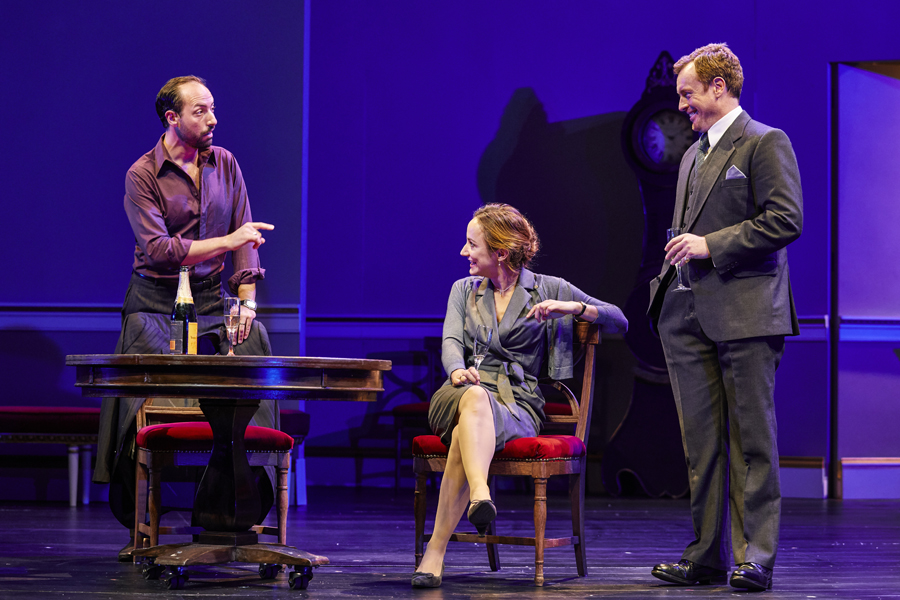
Lydia Leonard’s determined, grounded Mona stage-manages the action with Scandinavian cool and style. Monochrome-clad, carrying a drinks tray, at curtain-up you might take her for waitress, till she confides in the audience. Toby Stephens’ flamboyant, self-centred Terje is plausibly likeable and infuriating – and on (peace) message.

The Norwegian contingent includes Foreign Minister Holst (Howard Ward), Mona’s boss and his wife Marianne Heiberg (Geraldine Alexander) who works for Terje. "Well, Norway is a very small country!” as Juul puts it in one of her deliciously dry asides. Ward and Alexander double as Finn and Toril, the domestic staff sworn to secrecy.

The negotiations play out on Michael Yeargan’s set, a curved wall that doubles as a canvas for 59 Productions' effective projections with Scandinavian-sharp lighting from Donald Holder.

As the action rolls through the various crunch points on the way to that handshake, your hopes are equally elated and deflated at the prospect – or not – of peace. The play ends with a brief round-up of the subsequent history, but Terje’s final appeal to the audience to see his beautiful vision leaves you, heartbroken, with the dream of what could have been.

By Judi Herman

Photos by Brinkhoff Mögenburg

Oslo runs Monday 2 October – Saturday 30 December. 7.30pm (Mon-Sat), 2pm (Thu & Sat only). £18-£85. Harold Pinter Theatre, SW1Y 4DN. 0844 871 7627. www.atgtickets.com

Click here to read our interview with writer JT Rogers and director Bartlett Sher from the July 2017 issue of Jewish Renaissance.

Review: Grand Finale ★★★★★ – Apocalyptic vision in Shechter's triumphant total dance theatre

If that title sounds ominous, Shechter told me in interview: “I wanted to capture a sense of our time…that out-of-control feeling that things are coming to an end. And how can this have a happy ending?” * Plus, in a programme note on what he does – or does not – expect of his audience: “It’s about what is happening to them in their head, how they feel, [not about getting] it right in some way.”

These ideas coincide with news bulletins of refugees fleeing fresh violence and natural disaster to colour my response to what I’m seeing – figures in a stark, imagined landscape fleeing, falling, supporting each other’s bodies, dead or alive – often hardly noticing when they drop their burdens. Sometimes the flight is collective, sometimes one or two isolated figures move and pause in the shifting tableaux.

Shechter’s own original percussive soundtrack, with Yaron Engler, combines with Tom Visser’s harsh white lighting and the shadows it throws to add to the atmosphere of ominous apocalypse as screens like monoliths or tablets hide and reveal the dancers who also move them swiftly around the stage. These and the dancers’ fluid costumes are designed by Tom Scutt. It’s the first time Shechter has worked with a designer and it works triumphantly for this is total dance theatre.

The dancers also share the stage with a string sextet, the use of live music making another entirely successful first for Shechter. At first they are placed at one side, later they take centre-stage as the stark lighting gives way to something more golden, celebratory; but always they are part of the stage picture, even the choreography and design, as well as the sound.

That they are in formal evening attire is significant as they play ‘found’ music, notably Franz Lehar’s 'Merry Widow' waltz, 'Love Unspoken' (could that title be significant too?), as well as chamber music by Tchaikovsky and a Russian tune from Jewish composer Vladimir Zaldwich.

Although there’s room for lightness of touch and levity too, it’s perhaps that feel of early 20th-century Mittel Europa, between the wars, which brings to my mind the apocalyptic poetry of TS Eliot and WB Yeats. ‘Things fall part, the centre cannot hold’ writes Yeats in The Second Coming, though of course the dancers’ centres of gravity can hold – they are characteristically centred and grounded, unless they are ‘playing dead’.

Sometimes they recall the opening of Eliot's The Hollow Men: ‘We are the stuffed men / Leaning together / Headpiece filled with straw’. The poem closes with the famous lines ‘This is the way the world ends / Not with a bang but a whimper’. Shechter’s triumphant apocalyptic vision ends rather with a bang – and a standing ovation.

By Judi Herman

Photos by Rahi Rezvani

Grand Finale runs until Saturday 16 September. 7.30pm. £12-£32. Sadler's Wells Theatre, EC1R 4TN. 020 7863 8000. www.sadlerswells.com

Then tours overseas: 1 – 4 November Danse Montréal; 9 – 11 November BAM, New York; 24 - 26 November Dansens, Hus, Oslo; 12 December Scène Nationale d’Albi

More dates to be announced

*see Jewish Renaissance Magazine July 2017 issue page 28

Review: Follies ★★★★★ – Fabulous production proves this Sondheim/Goldman musical is no folly

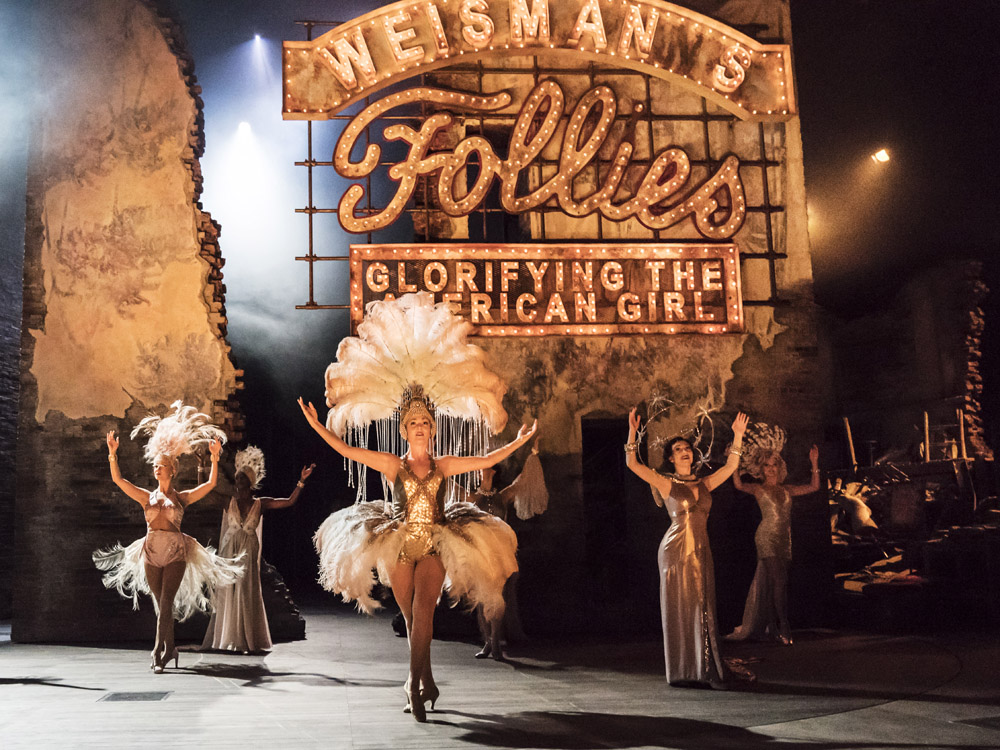
Welcome to Weismann’s Follies. Dmitri Weismann himself presides and the old gang of gorgeous gals are back for one last reunion in the theatre where they showed a leg and sang their hearts out between the wars, before it’s pulled down. It’s time to reminisce (cue for a song-list of glorious pastiches) and take stock of the ravages of the years – physical and emotional. So it’s equally the cue for a range of mould-breaking Sondheim numbers that excavate the regrets and neuroses eating away at the two couples centre-stage, former showgirls Sally and Phyllis and the stage-door johnnies, Buddy and Benjamin, whom they married. The genius of Sondheim and book-writer James Goldman is to intertwine and meld these two strands, building to a climax of ‘follies’ point numbers which become the expression of all that angst and heartache, one for each of the four, surprising, distinctive, appropriate and devastatingly revealing. The haunting of all the returnees by their younger selves, the girls in their gorgeous costumes and their stage door johnnies, acting out the past and observing their future, is another stroke of genius, another layer to this rich, complex show.

Years of revision by the creators and their work with successive creative teams have polished this multi-faceted gem. Director Dominic Cooke and his NT team work their own collective magic to delight and ravish. Cooke and choreographer Bill Deamer move an extraordinarily talented cast effortlessly through Vicki Mortimer’s ghost of a theatre, shabby rows of red velvet seats and make-up mirrors perching among piles of rubble – demolition already in progress as surely as the demolition of those youthful hopes and dreams.

Imelda Staunton and Janie Dee are dream casting for Sally and Phyllis; powerfully supported by Philip Quast’s Benjamin and Peter Forbes’ Buddy, they are first among equals in this genuine ensemble. All the Follies’ girls’ delicious solos, equally homage and pastiche get pitch-perfect interpretations. Dame Josephine Barstow yearns gloriously as Viennese operetta star Heidi Schiller, Dawn Hope’s honey tones ask thrillingly ‘Who’s That Woman?’, backed by the ghostly chorus helping the returnees to recall their mirror routine. Di Botcher makes ‘Broadway Baby’ a ruefully self-deprecating private moment in her old dressing room and Tracie Bennett’s ‘I’m Still Here’ is genuinely the story of survivor Carlotta Campion’s life told to a couple of chorus boys at the reunion.

Staunton’s obsessive, neurotic Sally, heartbreaking and disturbed in ‘Losing My Mind’ and Dee’s acid, knowing Sally, scintillating in ‘The Story of Lucy and Jessie’ (rightly restored here), are outstanding, beautifully supported by Zizi Strallen and Alex Young, telling as their younger selves.

Nicholas Skilbeck supervises the sizeable orchestra (of whom we get only a ghostly glimpse rear stage – though perhaps that was the intention) through Jonathan Tunick’s orchestrations, always an integral, satisfying element of Sondheim’s sound. Unmissable.

By Judi Herman

Photos by Johan Persson

Follies runs until Wednesday 3 January 2018. 7.30pm, from Sep 2pm (Sat & various Tue/Wed only; check website for details). £20-£60. National Theatre, SE1 9PX. www.nationaltheatre.org.uk

Broadcast live in cinemas in the UK and internationally Saturday 18 November as part of NT Live.

Review: The Knowledge ★★★★ – A funny heart-warming ride through pre-Uber London

Chief examiner Mr Burgess, played with thrilling comic cruelty by Steven Pacey, sets his latest cohort of four would-be London Taxi drivers the task of committing to memory all 320 routes, 15,842 streets and all places of interest on the way within a six-mile radius of Charing Cross. “No taxi driver in no other city in no other country in the world has to know a fraction of what you have to know. And not many brain surgeons neither.” The late Jack Rosenthal’s 1979 play for TV exploring the impact of this almost impossible challenge (70% drop-out rate then and some 25,000 streets now) is adapted for the stage by Simon Block and directed with comic verve by Rosenthal’s wife for 30 years Maureen Lipman, who appeared in the TV drama.

It’s a challenge that takes over every aspect of the aspiring cabbies’ lives as well as those of wives and girlfriends. The sacrifices provide the dramatic tension and much of the comedy. Simon Block channels Jack Rosenthal’s ability to imbue what might otherwise be comic stereotypes with genuine warmth and humour by homing in on the self-knowledge his characters acquire along the way. Wisely he does not attempt to deal with the television version’s affectionate paean to the streets of London or to update it. The parallels with today’s struggles for the man on the street are evident.

Ex-Eastender James Alexandrou invests Jack-the-Lad Gordon with a swagger and cockiness that doesn’t get entirely beaten out of him, even by his long-suffering wife Brenda (Celine Abrahams, abrasively assertive). Ben Caplan’s funny, heartbreaking Ted, with his photographic memory and desire to keep up the family tradition of go-to droshky drivers, is the sure cert to get his Green Badge, encouraged by his loving, supportive wife Val, whom excellent Jenna Augen invests with touching eagerness. The ‘one most likely to fail but you know he won’t’ is Fabian Frankel’s engaging nebbich teenage Chris, who physically and metaphorically undergoes the greatest personal transformations, egged on by girlfriend Janet. Alice Felgate invests her with a wonderfully sympathetic no-nonsense briskness that warms the stage.

Louise Callaghan brings a defiant laddishness to chain-smoking Miss Stavely, the sole female candidate. She feels a tad underwritten, perhaps because as a proudly independent young woman in a man’s world, she has no partner, supportive or otherwise.

Mr Burgess’s torture chamber/office dominates Nicolai Hart-Hansen’s split-level stage as his efforts to force his examinees off the road by questioning them with inhalers stuck up his nostrils or doing press-ups dominate the action. “Compared to people, The Knowledge is a piece of marzipan. They mumble. They can’t hear you. They don’t know where they want to go. They get up both your nostrils”.

By Judi Herman

Photos by Scott Rylander

The Knowledge runs until Saturday 11 November 7.30pm, 2.30pm (Wed only), 3pm (Sat only). £17.50-£42.50. Charing Cross Theatre, WC2N 6NL. 084 4493 0650. http://charingcrosstheatre.co.uk

An Edinburgh Festival Fringe 2017 round-up in reviews

Some fantastic shows are visiting the Edinburgh Festival Fringe this year, plenty of which have a Jewish cultural interest. There are even a few that our Arts Editor Judi Herman has already reviewed from previous runs and spoken to creatives behind the productions in some cases, so we thought it'd be great to revisit those. Below you'll find the listings info for Knock Knock, The Flying Lovers of Vitebsk, and Kafka and Son, as well as links to the theatre reviews and JR OutLoud podcasts.

Wednesday 2 – Sunday 13 & Tuesday 15 – Monday 28 August Knock Knock In his own physical solo show, Israeli actor Niv Petel uses his body and voice to explore the effects of National Service on a single mother and her only son in Israel. Knock Knock is inspired by real events in a country where children are destined to be soldiers from the day they are born; their parents, who were all soldiers once themselves, know that one day a knock on the front door might change their lives forever. 7.30pm. £8.50-9.50, £7.50-8.50 concs. C Primo, Edinburgh, EH2 3JP. www.edfringe.com

Listen to Niv Petel on JR OutLoud:

http://www.jewishrenaissance.org.uk/blog/jr-outloud-niv-petel/

And read our review of Knock Knock below:

http://www.jewishrenaissance.org.uk/blog/review-knock-knock/


Tuesday 15 – Sunday 20 & Tuesday 22 – Sunday 27 August The Flying Lovers of Vitebsk Daniel Jamieson’s The Flying Lovers of Vitebsk follows the story of a young couple, Marc and Bella Chagall, as they navigate the Pogroms, the Russian Revolution, and each other. Times vary. £21.50, £16.50 concs, £9.50 unemployed. Traverse Theatre, Edinburgh, EH1 2ED. www.edfringe.com

Click here to read about the making of The Flying Lovers of Vitebsk, an article that featured in the April 2016 issue of Jewish Renaissance and read our review below:

http://www.jewishrenaissance.org.uk/blog/review-the-flying-lovers-of-vitebsk/


Tuesday 8 – Monday 14 & Thursday 17 – Sunday 27 August Kafka and Son An award-winning, five-star, sell-out hit show on four continents from Canadian writer, director and performer Alon Nashman. At age 36, Franz Kafka wrote a monumental letter to his overbearing father that would change the course of his life and fiction forever. A blistering, often hilarious dissection of domestic authority, Kafka and Son is a revelatory visit with one of the architects of the modern psyche. 11.40am. £10-£11, £9-£10 concs. Pleasance Courtyard, Edinburgh, EH8 9TJ. www.edfringe.com

Listen to Alon Nashman on JR Outloud:

Click here to find out what else is going on at Edinburgh Festival Fringe.

JR reviews two ★★★★ picks from Edinburgh's International Shalom Festival: rap opera The City and documentary Disturbing the Peace

The City ★★★★ – Israel's Incubator Theatre makes its Edinburgh debut at Shalom - just three years after protests prevented it from being part of the Festival Fringe

One highlight of the International Shalom Festival is the return to Edinburgh of Jerusalem's Incubator Theatre with their hip-hop opera The City, a clever homage to all those private dicks who walk the mean streets of the city trying to solve crime. The City is entirely written in rhyme, combining rap, hip-hop and spoken word to tell a tale of vanity, lust and murder. This is the company targeted by pro-Palestinian demonstrators in 2014, which meant they were unable to perform at the Fringe. So it's all the more exciting and gratifying that they are at last making their proper Edinburgh debut. When JR's Arts Editor Judi Herman saw The City at JW3, London, where it played three sold-out performances in the aftermath of the Edinburgh protests, she was inspired to write the following four-star review in rhyme.

I’m telling you, friends, get down to The City,

A fast-moving show that’s mighty witty.

Israelis rap in English rhyme,

A dark twisted story of a web of crime.

A private dick, just an ordinary Joe,

Meets a mystery blonde and goes with the flow.

If you can get a ticket, you will too,

It’s a sparky performance from a versatile crew.

A band and beatbox, shared imagination,

The City never gets lost in translation…

The City runs Tuesday 8 – Thursday 10 August. 11.30am, 4pm, 8pm (Tue & Wed only). £12.50, £9.50 concs, £8 NUS. Drummond Community High School, Edinburgh, EH7 4BS. www.edfringe.com


Disturbing the Peace ★★★★ – Searing testimony from fighters for co-existence in Israel/Palestine

Some fine thought-provoking feature and documentary films are part of the entertainment and dialogue at the Shalom Festival, with filmmakers and activists involved in that discussion between Israelis and Palestinians taking part in post-show discussions and Q&As.

One in particular is the documentary Disturbing the Peace, from directors Stephen Apkon and Andrew Young. The film follows an activist group called Combatants for Peace and tells the story of these former enemies – Israeli soldiers and Palestinian fighters, many of whom served years in prison – who have decided to join forces in order to work towards a peaceful resolution and to stand up for what they believe in. The two screenings of Disturbing the Peace will be followed by a panel discussion and Q&A session.

Disturbing the Peace runs Wednesday 9 & Thursday 10 August. 3.30pm (Wed), 1.30pm (Thu). Free. Drummond Community High School, Edinburgh, EH7 4BS. www.shalomfestival.org

Judi Herman saw Disturbing the Peace at the 2016 UK Jewish Film Festival and you can read her four-star review below:

http://www.jewishrenaissance.org.uk/blog/review-films-disturbing-the-peace/#more-1374

Click here to find out what else is going on at Edinburgh Festival Fringe.

Review: Fiddler on the Roof ★★★★ - Raising the roof at Chichester Festival Theatre

I am grateful to my Bubbe, who arrived in London from the Pale of Settlement in 1890, cradling the first of her 10 children, my beloved grandma. And equally to the paternal grandfather I sadly never met, who made his painful way to Britain from Bobruisk, Belarus, despite his gammy leg. Thanks to them my family thrived here rather than perishing in a pit in the Holocaust. But did they leave voluntarily, or were they pushed out like the Jews of Anatevka?

Daniel Evans’ beautifully thought-through production made me ponder this question more than any previous incarnation of this much-loved musical, based on Shalom Aleichem’s equally-loved tales. Gloriously funny though it may be when appropriate, it provokes thought as well as sentimental tears, starting with the eloquent opening, which actually has these Jews arriving to set up home in Anatevka from wherever else they have fled or been ejected.

Each carries some form of luggage – a metaphor for emotional baggage, somehow simultaneously obvious and subtle. For much of the evening designer Lez Brotherston offers little more set than these precious objects, both sentimental and practical, accompanying their owners to change each scene (the Sabbath table is extended to accommodate visiting student Perchik by adding a trunk covered with a tablecloth).

So as they dare to put down tentative roots in Anatevka, instead of the opening number Tradition bursting brashly onto the stage, its performers earn the right to share the significance of their traditions with their audience.

It makes the humour of Omid Djalili’s splendidly warm and rounded Tevye all the richer and more nuanced. Iranian-born Bahai Djalili is no stranger to playing Jews. On his CV are Fagin in Oliver! and a Muslim who discovers he was born Jewish in Infidel – you could now add he was born to play Tevye. He splendidly embodies the conflicted milkman torn between the security blanket of tradition and losing his daughters if he won’t face up to the changes their generation embraces. And he effortlessly laughs with his audience at himself and that dilemma, coining anew those catchphrases: “On the one hand… on the other hand…” and “As the Good Book says…” so you feel his God might laugh sympathetically too.

He’s well-matched by Tracy-Ann Oberman’s brisk, dry-humoured, long-suffering Golde, especially in their touching “Silver Wedding” duet Do You Love Me? (“after 25 years it’s nice to know!”).

The show’s elegant structure has each of his three oldest daughters push the boundaries a little further. Tzeitel gets her father onside so she can marry her poor Jewish tailor rather than wealthy widower, the butcher Lazar Wolf. Hodel and student revolutionary Perchik will marry without Tevye’s permission if necessary. And Chava must accept that she is dead to her father if she marries ‘out’ – her beloved Fyedka is a Gentile. All are strongly cast here. Simbi Akande’s Tzeitel is touchingly single-minded in her love for Jos Slovick’s doggedly determined Motel. Emma Kingston’s spiky Hodel vividly charts her awakening love and awareness of a world outside Anatevka, as she falls for Louis Maskell’s ardent, assertive Perchik. And Rose Shalloo’s vulnerable, bespectacled Chava is heartbreaking, pleading for acceptance of Luke Fetherston’s sensitive Fyedka.

Watching the “little unofficial demonstrations” that the local militia are ordered to carry out against their Jewish population, starting with the chilling disruption of the joy and emotion of Motel and Tzeitel’s wedding, you can understand Tevye’s tipping point.

Set pieces like the wedding and Tevye’s dream conjuring Grandma Tzeitel (Mia Soteriou) to speak for Motel and Lazar Wolf’s formidable late wife Fruma Sarah (Laura Tebbutt) to forbid her husband’s remarriage are imaginatively realised, the latter with stunning lighting (David Hersey) and fiery effects. And Alistair David’s choreography has Anatevka’s Jews hold themselves with an authentic upper-body erectness, proud and graceful, whether in a circle dance for both sexes or the famous men-only bottle dance.

So if you’ve ever sniffled your way through what you thought was a schmaltzy musical, this production earns real tears alongside the gales of laughter, above all as those battered bags come out again when Anatevka’s Jewish population receives its marching orders. Here are the parallels with today’s migrations.  May tomorrow’s loyal citizens look back with love and admiration at the brave forebears who made perilous journeys to uncertain futures in the West.

By Judi Herman

Photos by Johan Persson

Fiddler on the Roof runs until Saturday 2 September. 7.30pm, 2.30pm (various Wed, Thu & Sat; phone to confirm). From £10. Chichester Festival Theatre, PO19 6AP. 012 4378 1312. www.cft.org.uk

Click here to listen to Emma Kingston, who plays Hodel, talking to Judi Herman on JR OutLoud.

A report on the inaugural Jewish Arts Festival For All in Manchester

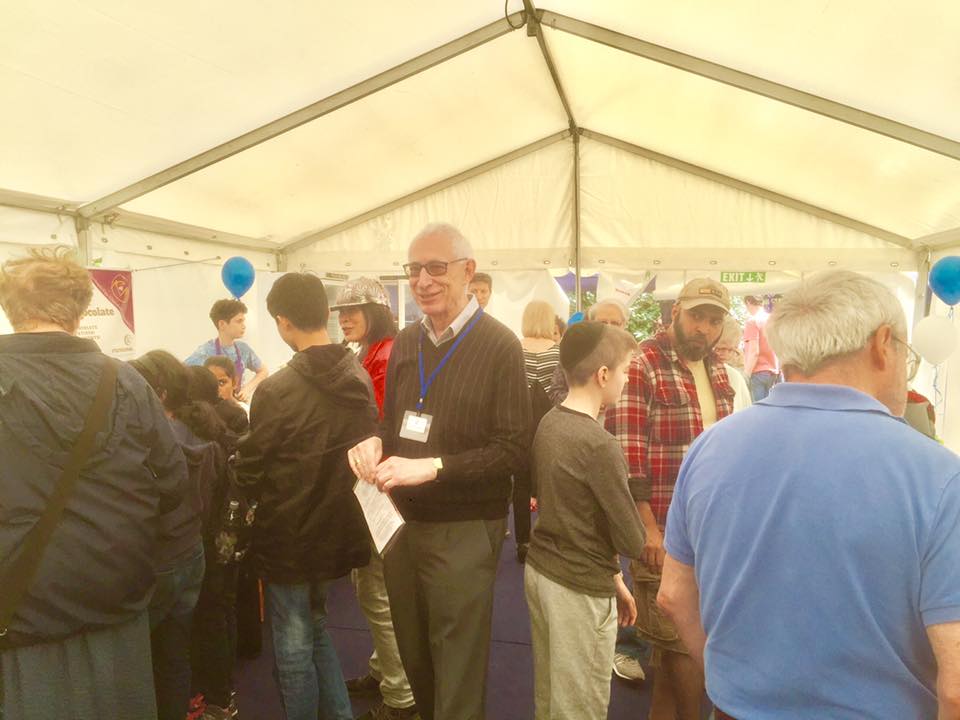
Hundreds  thronged to Manchester’s Jewish Museum on Sunday 2 July for the first Jewish Arts Festival For All (JAFFA).  Jews of all ages were joined by those of other faiths for a fun-filled day of food, music, art and entertainment.

The Lord Mayor of Manchester – who spent almost two hours at the festival with his wife – chose as his theme for a year that has seen the city’s emergence from the horrendous terrorist attack, "to promote community cohesion and mutual respect amongst and between the city’s diverse communities and individuals" and t was certainly in evidence on Sunday.

The mayor and mayoress of Trafford joined the museum’s regular Heritage Trail of Jewish Manchester, led by Merton Paul. And it was mainly Manchester – Jewish  Manchester – that featured in the exhibition launched by psychiatrist and artist Tony Raynes, arriving from Boston for the occasion with most of his family as entourage.

Children played happily outside on a rare sunny Mancunian day in the care of Laura Nathan and volunteers from Bnei Akivah. Inside the museum (the original sanctuary of the Sephardi shul) klezmer music from L’chaim Kapelye and the engaging music of Carol Jason’s trio interspersed entertaining talks from nutritionist Carmel Berke, Tracy Allweis and Raynes.

The audience listened enraptured to Raynes' tales of the Manchester of his youth depicted in his paintings. His grandfather, Joseph Hyman, famously survived the Titanic disaster and recuperated from his experience in Tony’s family home. Sharing a room with his grandfather, Raynes recalled how he would daven (pray) three times a day, rocking backwards and forwards to the rhythm of the prayers.

Raynes realised that this was a therapy for PTSD. Asked  his priority, psychiatry or painting, he replied: “Both. They are intertwined.”

Throughout the day a marquee was packed with stalls, tastings and demonstrations, all co-ordinated by Marilyn Blank. Sula Leon created delicious dishes, Tomi Komoly served sweetmeats from his Hungarian grandma’s recipes, Ros Livshin enchanted with fruit carving skills and Tova Ellituv, wife of Rabbi Amir, encouraged the children to decorate cupcakes in  vibrant colours.

Despite the presence of dignitaries, including the civic heads, MP Ivan Lewis, Jewish Representative Council President Sharon Bannister, Umer Khan the community policeman chief inspector and Deputy Lord Lieutenant Martin Newman, the day was notable for the absence of formal speeches. It was to be, promised JAFFA Chair Herzl Hamburger, a day of fun and celebration, followed the next evening by a comedy night and the following Sunday (July 9) by a spectacular gala concert at the new Stoller Hall.

By Gita Conn

Find out more about JAFFA on the website: http://jewishmanchester.org/JAFFA

Review: The Mentor ★★★ - Daniel Kehlmann’s waspish wit makes intellectual sparks fly

Narcissism is trending, so Germany's wunderkind Daniel Kehlmann (bigger there than JK Rowling) is in tune with the Zeitgeist in this tale of an ageing literary lion seeing off the threat of a cub writer by rubbishing the work he's supposed to be nurturing. Literary legend Benjamin Rubin (F Murray Abraham) still dines out on the hit play he wrote in his youth – a lucrative meal ticket as he's mentoring budding playwright Martin Wegner for just one week under a prize scheme that earns both writers €10,000.

There's no denying the elegance of Kehlmann's set up. First dibs goes to Rubin, who gets to establish his character with insecurities about being a one-hit wonder – his querulous nature flagged up by a list of demands, including his Scotch of choice. It's enough to try the patience of ineffectual arts administrator Erwin Rudiceck, presiding uneasily over this battle of egos. The names suggest the European location of Kehlmann's play (Rudiceck is Czech, Wegner German, Rubin alone could be a Jew from either side of the Atlantic), though Polly Sullivan's lush villa setting (it's Rudiceck's incidentally), with its wonderfully pretentious chairs that ape huge sculptured hands, sits as well in New England as, say, in the old country of Mittel Europa. Aspiring artist Rudiceck is looking for approval for his own artistic oeuvre, monochrome mood pictures handily displayed on his phone.

So we have the measure of these two by the time Wegner and his ice-cool art historian wife Gina arrive. Kehlmann drops some heavy hints that Wegner's play, with its 35 extras plus cement mixer, might be a tad pretentious and costly to stage. But he's had a ringing endorsement from a top critic and Kehlmann leaves us guessing whether Rubin is simply doing a demolition job out of envy of the younger man or whether he has a point. We also suspect that they see in each other the mirror of the past and the spectre of the future respectively.

More to the point, elegant though this 90-minute comedy is, pithily translated by Christopher Hampton, with nifty direction by Laurence Boswell and fine character work and interaction between Abrahams' spot-on solipsistic Rubin, Daniel Weyman's equally self-centred Wegner, Naomi Frederick's coolly intelligent Gina and Jonathan Cullen's rueful Rudiceck; yet it does not quite make the transition from the intimate studio of its UK debut at Bath's Theatre Royal. But it does give its audiences plenty to discuss over the post-show dinner for which Kehlmann has thoughtfully given them ample time

By Judi Herman

Photos by Simon Annand

The Mentor runs until Saturday 2 September. 7.45pm (Mon-Sat), 3pm (Thu & Sat only). £19.50-£75. Vaudeville Theatre, WC2R 0NH. www.nimaxtheatres.com/vaudeville-theatre

Click here to read more theatre reviews.

Review: Charlotte - A Tri-Coloured Play with Music ★★★★ - Charlotte Salomon's autobiographical work explodes onto the stage in glorious tri-colour

Charlotte Salomon produced an extraordinary series of autobiographical gouaches with texts. She overlaid them on transparent paper or wrote straight onto her paintings to provide dialogue, comments and even suggestions of musical accompaniments. Salomon provides a unique account of Jewish family life in Germany, and later France, spanning the troubled years from before World War I until the height of World War II, when she created work in the South of France, before her deportation to Auschwitz in 1943, aged just 26.

With its provocative title it has long fascinated so many who come across it. Playmakers are especially drawn to the work, which seems to invite staging. Yet with few exceptions, success has proved elusive. Now this new play with music gives Salomon a wonderfully authentic and persuasive voice onstage – a vivid life in the theatre.

I wrote in Jewish Renaissance’s April 2017 issue of the ‘tri-coloured’ collaboration of three original creatives. Czech composer Aleš Březina, who has written a glorious new score – witty, haunting and moving by turns, subtly echoing styles of the period in places, to complement the found music Salomon indicates. He writes for just four versatile musicians (who also have cameos and help with scene-shifting alongside the actors/singers) playing a striking and unusual mix of piano, clarinets, cello and trumpet. This is not an opera, but indeed a play with music, for playwright/performer Alon Nashman has written a script that works wonderfully to tell the story and make her characters spring to life in a voice true to Salomon’s, turning on a sixpence from passionate to ironic. He’s a nimble lyricist too, marrying clever apposite words with Březina’s music. Nashman is not afraid to pare down Salomon’s bustling expansive narrative to a lean and pacy account that works just fine to take the audience through her story.

The third ‘colour’ is designer/director Pamela Howard, who does indeed work in a palette trilogy. Red, blue and yellow mix artfully, just as a young Salomon did in wartime France, when the play’s conjecture is that she had access only to these three colours. Howard’s triumph is to realise Salomon’s images in vivid 3D – the ornate baroque furniture of her family‘s Berlin apartment, a series of doors, her bed and a wondrous red ladder. On this Nashman performs acrobatically to match the verbal pyrotechnics of his character Amadeus Daberlohn, the voice teacher as visionary as he is needy and Salomon’s inspiration and lover – though she pricks the pomposity of this self-styled ‘Prophet of Song’ with her knowing humour.  Behind are swishing translucent curtains, echoing Salomon’s scrims and her conjuring of the ghosts of her past, as performers are glimpsed through them in eerie silhouette.

Designer/directors are rare and Howard’s magic is a potent reason for the play’s effectiveness. She has a marvellous knack for making every configuration, every shift of the action and the furniture into dynamic tableaux vivants entirely true to Salomon’s vision.

I’m confident that Salomon would have joyfully recognised herself in Adanya Dunn’s candid, open, funny Charlotte (her youthful soprano deliciously clear); would have ardently embraced Nashman’s sexy, solipsistic Daberlohn; embraced with wonder Ariana Chris’s warm expansive golden-voiced diva Paulinka (her beloved opera-singer stepmother) and Derek Kwan’s upright clever Dr Kann, her father. She would have clung compassionately to Xin Wang’s mournful suicidal duo of her mother Franziska and her Grandmother. But she would have held at arm’s length Thom Allison’s unsympathetic, transgressive Grandfather (a tour de force that also includes other unsavoury characters, including Himmler), even as she enfolded with 'sisterly' feeling Kelly McCormack's ‘beautiful Barbara’, the ideal Aryan artist’s model and her fellow art student. McCormack is also excellent in other telling cameos, including the sullen housemaid in Villefranche who grudgingly thrusts the parcel containing their late daughter’s artwork into her grieving parents’ arms to tell her story to the world.

The Theaturtle Company have indeed heeded the plea written on the parcel, “Take care of this. This is my whole life”, breathing into it real, multi-dimensional life. Salomon’s shade surely joined in the standing ovation for this glorious incarnation of her tri-coloured play with music.

By Judi Herman (who saw the production at Toronto's Luminato Festival)

Photos by Adnaya Dunn and Cylla von Tiedemann, respectively

Charlotte - A Tri-Coloured Play with Music runs Friday 30 June - Sunday 2 July. World Stage Design Festival, Taipei, Taiwan. Visit www.theaturtle.com to view future performances.

Charlotte Salomon's artwork, Life? Or Theatre?, will be exhibited for the first time in full from Wednesday 25 October 2017 - Sunday 25 March 2018. Jewish Historical Museum, Amsterdam. www.jck.nl

Click here to read more theatre reviews.