Theatre

Another loss for the original 1968 Oliver! cast – Ron Moody will be missed

Ron_Moody_and_Lord_Dahrendorf,_1975Ron Moody (left) with Lord Dahrendorf, 1975

"My proudest moment was the number Reviewing the Situation. I suspect that, because I gave my all to the role, and because I was working with such a fine team of people, it inhibited my future career. I turned down quite a few offers afterwards because I thought the people didn't come close to those I'd worked with on Oliver! which, in retrospect, was a mistake." – Ron Moody, 8 January 1924 – 11 June 2015.

Judi Herman reports on the recent death of actor Ron moody, one of the last remaining adult actors, bar Shani Wallis, from the 1968 musical Oliver!.

Readers will no doubt have heard a great deal over the last week about the long life of Ron Moody. Of course he is best known for his creation of Fagin, unforgettable for his gleeful physicality and for his musical phrasing. He relished rolling Bart’s delicious lyrics around his tongue, something I was lucky enough to experience live when I was not quite old enough to be in Fagin’s gang.

Much later on I went with Steve, my husband, to see him live in his one-man show at the also late-lamented Mermaid Theatre in London’s Puddle Dock. Doing a shtick about Hamlet, testing the audience's knowledge about Shakespeare’s play, he barked out the question: "Where did Hamlet live?" Moody had done a lot of stuff about the East End that night and before I could stop myself, I heard my voice yelling "Tower Hamlets!" After that there was no stopping Moody, he picked on me mercilessly for the next hour and I loved every minute of it (as did the rest of the audience). A true great, apparently sprightly right up to the end – he’ll be missed!

Review: On her third helping of The Merchant of Venice, Judi Herman has a discomfiting but enthralling evening

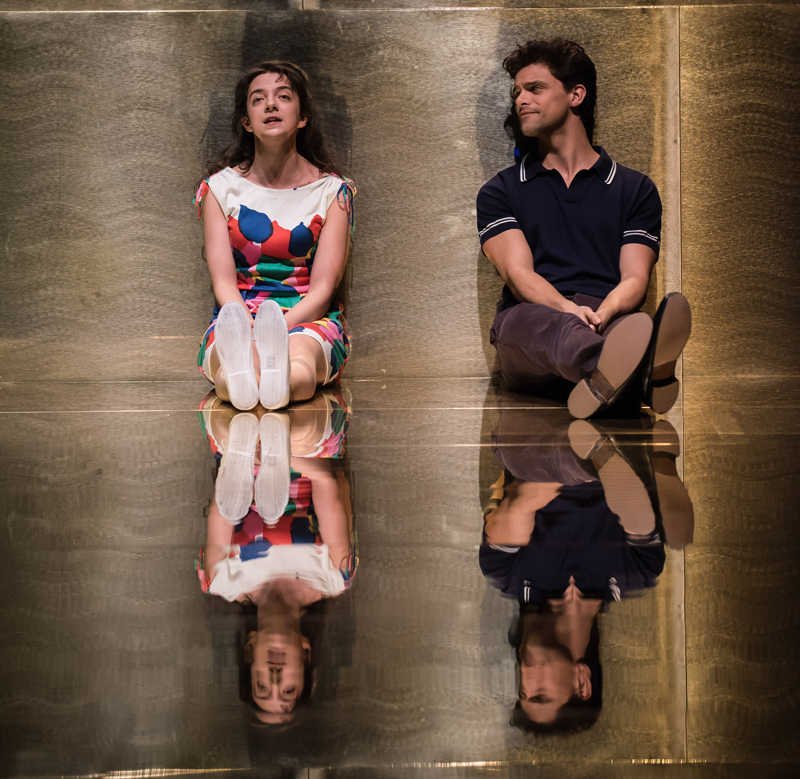
The Merchant of Venice production photos_ 2015_Photo by Hugo Glendinning (c) RSC _MER_157

Don't let the buggers grind you down. Try to come over as laid back. They wear a strange eclectic mix of what they see as achingly trendy, or sharp city wear, set off with flamboyant footwear in bright – too bright – poster colours. So wear a dingy blouson over an old cardigan and keep your dignity, simply wipe off their spit when they show their contempt for you. This could be what's going through Shylock's mind in Makram J Khoury's finely calibrated performance, which positively radiates a relaxed gravitas.

It is to be hoped that Khoury, the popular, award-winning Palestinian-Israeli actor didn't base it too closely on his experience as a man caught between two worlds in his native country. Certainly when Christian Venice shows its contempt by spitting on Shylock's "Jewish gabardine", the gasp of horror that runs through the audience is even more of a shock wave than the similar audience reaction when this treatment is meted out to Jonathan Pryce's dignified Shylock at Shakespeare's Globe.

Khoury’s trajectory is frighteningly clear here, from distracted father outraged by his daughter Jessica’s's elopement and her profligate spending and disregard for her dead mother's ring, to vengeful would-be killer. Given the special disgust displayed towards him by Jamie Ballard's alarmingly volatile Antonio, it's hardly surprising he seizes the opportunity to whet his knife and prepare his scales in open court, now entirely indifferent to what the hostile Christians make of his behaviour.

This is the third time this year that I have seen this problematical play and each time I am struck by how little stage time Shylock shares with Jessica. Shakespeare magnifies the awkwardness of what today would be dubbed their dysfunctional relationship by showing so little of it onstage. And, in the few moments they do share together, Jessica is in turmoil over her imminent elopement and the need to deceive her father to make her escape.  Here director Polly Findlay and designer Johannes Schültz trap Scarlett Brookes’ awkward, gawky Jessica at an impossibly high window in her father’s house. So there even less connection as he leaves for the dinner with his new creditor Bassanio that will give her the window of opportunity she needs to escape with her Christian lover Lorenzo (James Corrigan), as well as her father’s jewels and ducats.

Indeed Findlay, sharing her vision with Schültz and costume designer Anette Guther, builds an especially alienating dystopic Venice, where it’s easy for the audience to share Shylock’s discomfiture. Belmont, wealthy heiress Portia‘s nearby estate, similarly offers little in the way of refuge, even to its owner and her chosen guests from the city, let alone the foreign suitors at whom this Venetian lady pokes fun. The audience is reflected in the huge brass mirrored wall atop which Jessica appears and there is nowhere to hide on a thrust stage with only a mysterious (and perhaps more distracting than hypnotic) pendulum on which to rest the eye, joined briefly later by three symbolic ‘caskets’ lowered from above.

There is certainly nowhere to hide in Venice or Belmont, from creditors in the city, from the whim of a dead father, controlling his daughter’s choice of husband from beyond the grave. And there is nothing to distract from the actors, who first take the stage from seats on Brechtian benches at the rear. If anything, Guther’s flamboyant, jarringly disparate costumes are the set dressing. Patsy Ferran’s intelligent Portia might be grateful to don sober lawyer’s garments, after the hard poster colours of the little shift dresses that seem to be current Venetian jet set fashion here.

There is, though, a shock awaiting her at court. For at the centre of Findlay’s reading of the play is what turns out to be a love triangle, where Portia sees what the audience has known from the start – she must share her new husband Bassanio (Jacob Fortune-Lloyd) with Ballard’s tortured (and I don’t mean by Shylock), depressive Antonio, who claims him with a desperate kiss as he awaits his fate. It certainly makes sense for Portia to channel her discomfiture and anger into her inspired and literally blood-chilling case against Shylock. So this ‘comedy’ becomes even more of a problem play, if Portia and Bassanio’s wedded bliss looks uncertain before their marriage is even consummated.

Meanwhile, Khoury’s now coldly focused, implacable Shylock makes the most of his day in court, almost whetting his knife on Antonio’s bare chest. No wonder Antonio screams and cringes. And though Shylock loses everything, he is perhaps more incredulous than broken and makes it clear that playing for sympathy - from court or audience – is beneath him.  Even he is upstaged by a tsunami of banknotes raining down on the court – effective but perhaps heavy-handed symbolism.

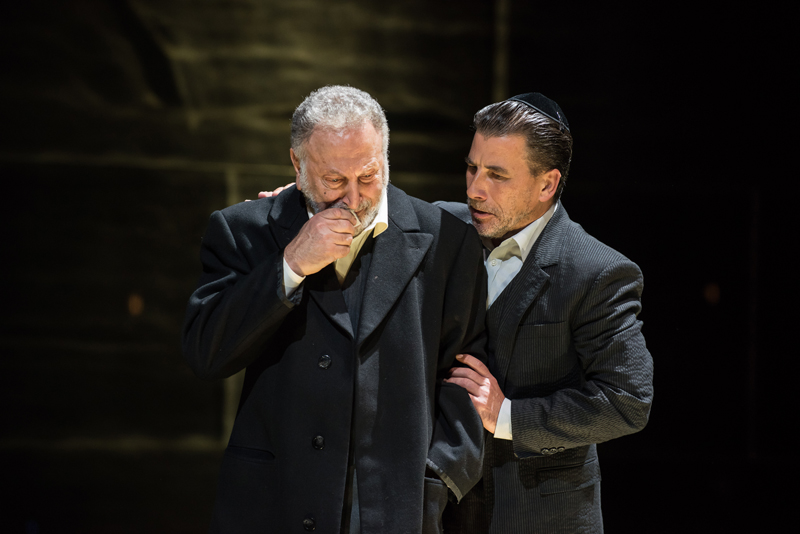
The Merchant of Venice production photos_ 2015_Photo by Hugo Glendinning (c) RSC _MER_148

By the time Portia and her faithful waiting gentlewoman Nerissa (an especially warm and literally supportive performance from Nadia Albina – these girls are close) return to Belmont, Jessica and her Lorenzo do not look entirely comfortable with each other either. Jessica seems almost aggressive as she and Lorenzo top each other with their references to pairs of mythical lovers who might have shared such an enchanted night as theirs, alone on Portia’s estate while its mistress is away at court. The magic should have been enhanced by a floor gradually lit by candle after candle filling the stage, the effect doubled by that mirror wall. But their brash brightness is too obvious a visualisation of Lorenzo’s description of "the floor of heaven thick inlaid with patines of bright gold"; the patina on the brass of that mirror would have done nicely. Perhaps the only real beauty in the evening is provided by the choristers, "young-eyed cherubim" indeed, to quote Lorenzo again, singing Marc Tritschler’s unearthly plainsong from the heights of the set. It’s a particularly discomfiting and alienating reading of this difficult play and though the creative vision is clear, it is perhaps too much of a straitjacket for the drama.

By Judi Herman

The Merchant of Venice runs until Wednesday 2 September (broadcast live in cinemas on 22 July). 7pm & 1pm. £5-£60. Royal Shakespeare Theatre, CV37 6BB; 084 4800 1110. www.rsc.org.uk

Review: The Merchant of Venice – The Globe offers a full-blooded production of a problem play

Shylock The Merchant of Venice may be considered the most problematical of Shakespeare’s problem plays, especially in the current climate of a perceived threat of heightened antisemitism, but there’s more than one Yiddish version of the story, including M. Zamler’s 1929 novel with a brand new title, Shaylock (Der Soyher fun Venedig). Tellingly it is billed as based on Shakespeare’s tragedy.

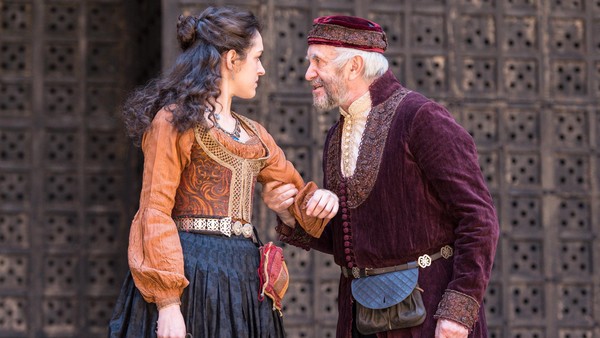
Shylock’s is not the title role in Jonathan Munby’s spirited, yet thoughtful new production for Shakespeare’s Globe, but Jonathan Pryce’s commanding, complex Shylock takes centre stage in each of the few scenes Shakespeare writes for him. In fact Shylock and his rebellious daughter Jessica (played by Pryce’s real-life daughter Phoebe Pryce) get a few more lines than usual – they first erupt on to the stage in the middle of a furious row – in Yiddish!

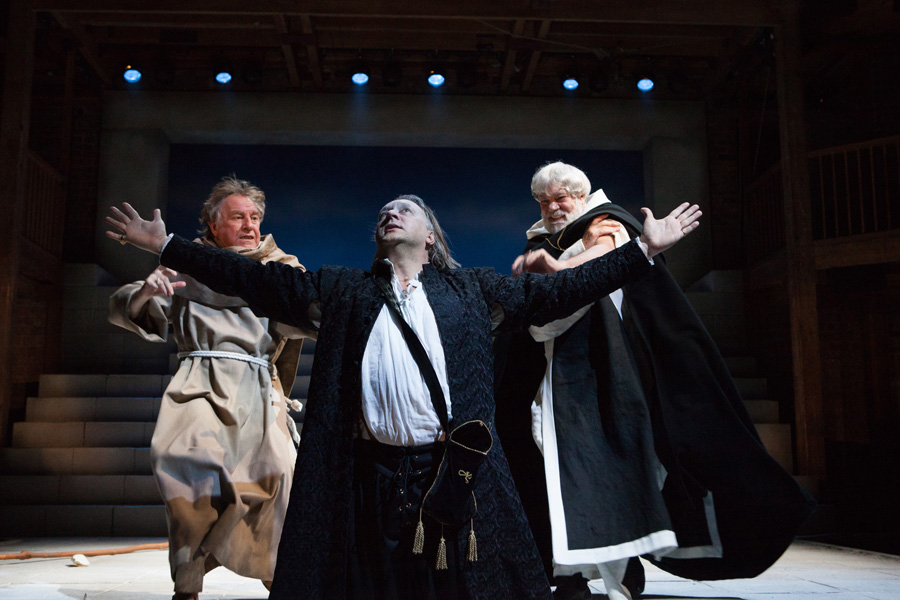
Pryce (a notable Fagin, but banish all thoughts of that here) has said in interview that he would love it if the audience booed him, yet by the time they watch him arriving in court armed with knife and scales to cut and weigh the famous pound of Antonio’s flesh, it’s clear how much he has had to bear from all the Christians of Venice – especially from Antonio, who really does "spit upon" his "Jewish gabardine" (with the compulsory yellow circle, forerunner of the Nazi yellow star, stitched on the breast) even as he is asking to borrow money. There’s an especially shocking moment, when Shylock’s treasured copy of the five Books of Moses (the Torah), that he clearly carries with him for constant consultation (here looking up the story of Jacob and Laban which Shakespeare has him reference), is wrenched out of his hands and contemptuously flung on the ground. And skull caps off to Munby for some nice research – when Shylock stoops to rescue it, he kisses it to restore respect, a gesture you can see in any synagogue when a prayer book is accidentally dropped.

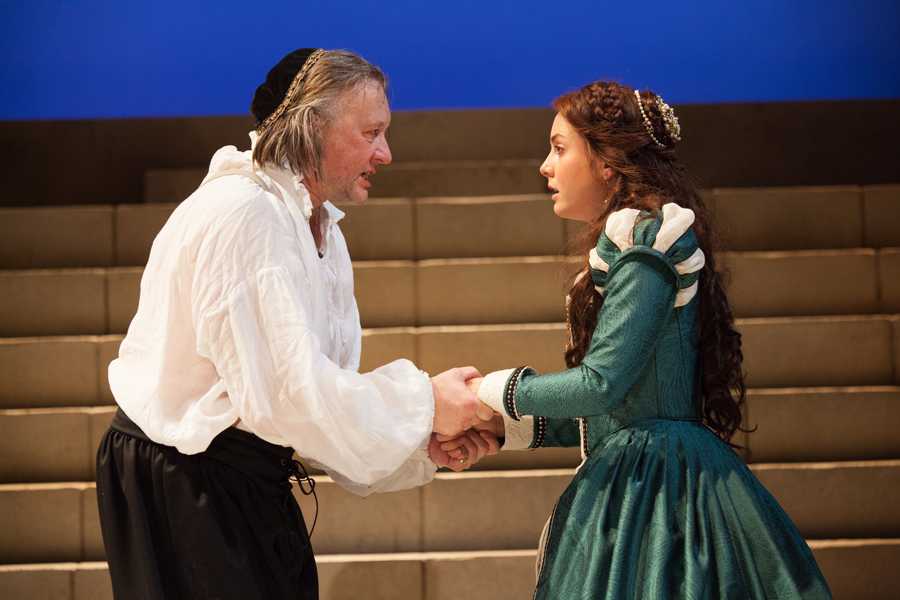
His distress at hearing that Jessica has exchanged his late wife’s ring for a monkey is especially touching, bringing a temporary moment of quiet sympathy from the usually raucous groundlings, at least the night I saw the play.

Phoebe Pryce’s Jessica has her own awkward path to negotiate once she has broken free of her father to flee with her Christian love Lorenzo. Although wealthy heiress Portia makes the new couple welcome at her grand home and leaves them in charge of it, she causes her young guest a moment of discomfiture when she takes her place to partner Lorenzo in a formal dance that just happens to be slightly suggestive too – does it perhaps smack a little of droite de seigneur?

And usually the last the audience sees of Shylock is a broken man begging for leave to go from the court, under imminent threat of being forced to convert to Christianity. Here his last word is "credo" ("I believe") part of a Latin mass, a conversion ceremony orchestrated by Antonio – either watched or imagined by a distraught Jessica.

THE MERCHANT OF VENICE Shakespeare's Globe 2015 CREDIT: MANUEL HARLAN ... HANDOUT ...

But of course Shakespeare’s Globe is not staging Shaylock. Munby’s reading of Shakespeare’s comedy really does get laughs from the whole house, not just the delighted groundlings, two of whom get to strut their stuff onstage to some of the loudest applause that greets every bit of inspired stage business. They are roped in to help out the clownish servant Launcelot Gobbo, who deserts Shylock for a new master ahead of Jessica’s flight. Stefan Adegbola works the crowd with obvious and expert delight. It’s a pleasure to watch him at work – and so happy in it too!

Others shine in smaller roles as well. Dorothea Myer-Bennett as Portia’s waiting gentlewoman Nerissa, is wonderfully sprightly and intelligent, getting laughs from every echo of her mistress, for example as she is courted by Gratiano, man to Portia’s chosen suitor Bassanio; and even in the sometimes tedious subplot which sees both mistress and maid, disguised in male attire tricking their new husbands into yielding up the rings they gave them to plight their troth. David Sturzaker’s Gratiano is more likeable than some, despite his eager embrace of antisemitism, which is after all as endemic in Venice as anywhere else in 16th-century Europe – and despite an opening gambit that has him throwing up after a night out.

Scott Karim’s Prince of Morocco, somehow managing to be dignified and ridiculous at the same time and Christopher Logan’s wonderfully daft Prince of Arragon, straight out of Carry On Columbus, get the very most out of their cameo roles. They underline the ‘Little Venice’ prejudice of Portia and her clique, worthy of UKIP; for the young women have already ridiculed suitors from all over Europe before this brave pair dare to face the rather cruel trial that Portia’s late father has decreed for those who seek her hand.

That’s not to say that Rachel Pickup’s intelligent, even prickly Portia and Daniel Lapaine’s handsome though febrile Bassanio and Dominic Mafham’s repressed Antonio don’t hold their own throughout. It’s more a paean to the completeness and effectiveness of this production in every role.

Mike Britton’s simple stage design, letting his colourful costumes sing out, and Jules Maxwell’s delicious music, played and sung by a surprisingly small and hugely effective ensemble (singers Jeremy Avis (also musical director) and Michael Henry and Nuno Silva with Dai Pritchard on clarinets and Catherine Rimer on cello) enrich this hugely satisfying period production.

By Judi Herman

Photography by Manuel Harian

The Merchant of Venice runs until 7 June. 7.30pm & 2pm. £16-£43 seats, £5 standing. Shakespeare's Globe, 21 New Globe Walk, SE1 9DT; 020 7401 9919. www.shakespearesglobe.com

Review: I Wish to Die Singing – Judi Herman is moved by this shocking and timely documentary

I Wish to Die Singing – Siu-see Hung © Scott Rylander© Scott Rylander

The January issue of Jewish Renaissance highlighted the life and work of Czech writer Franz Werfel, who played a significant part in bringing the Armenian genocide to the notice of both Europe and America after he came across survivors living in desperate conditions in Damascus in the late 1920s. He also wrote a devastating novel, based on a defiant stand by Armenian survivors, The Forty Days of Musah Dagh. Nonetheless, a century later, the terrible massacres that began in 1915 are still not universally recognized as genocide, to stand alongside the Holocaust and the Rwandan genocide in the record of atrocities inflicted by humankind on their fellows.

If you walk through the Armenian Quarter in Jerusalem’s Old City, you will find, as I did, the memorial to the Armenian genocide. If you read celebrity pages in newspapers, it’s hard to avoid the Kardashians, currently probably the most famous bearers of one of those distinctive Armenian surnames. They came together last week as the Jerusalem memorial became the focus of protests demanding the recognition of the Armenian genocide, 100 years after it began; and Kim, the most renowned Kardashian, visited the memorial in Yerevan, Armenia’s capital, to pay her respects and play her part in raising world awareness of the genocide that inspired Hitler. And Kardashian and Hitler come together in Neil McPherson’s documentary drama which also plays its part in demanding recognition for the annihilation of 1.5 million men, women and children.

How do you tell the story of a genocide when the basic facts are unknown to most? How best to convey the attempt by the Ottoman Government to systematically exterminate all its Armenian subjects? Holocaust plays often work by letting the story of the one or the few stand for the story of the many, so that the wider picture emerges from the narrative. But, when no one knows the narrative and there is an ongoing story to tell, how can you convey the scale, the politics, the disputed facts and the personal stories?

Neil McPherson employs documentary drama, and to shocking effect, charting the history of wholesale killings, massacres, forced labour and death marches to the Syrian desert. Eye-witness testimonies give chilling evidence of what happened in 1915 and the cast take on the challenge of playing many roles. The convention of delivering verbatim texts proves extraordinarily powerful and just occasionally constraining.

Cleverly, MacPherson frames the events with an illustrated lecture, complete with slides, narrated with lucid authority by Jilly Bond who guides and links up the scenes. She first grabs attention with portraits of well-known personalities of Armenian heritage (Kim K for one) and Hitler’s chilling quote, “Who after all speaks today of the annihilation of the Armenians?” Bond points up other parallels with the Jews of Europe and their fate. The Armenian community was a Christian minority in a Muslim society. Many earned their living as bankers. They became “second-class citizens”.

Director Tommo Fowler steers his dedicated cast through a chilling 90 minutes on Phil Lindley’s appropriately minimalist set. Rob Mills brooding lighting and Max Pappenheim’s intricate soundscape add to the atmosphere of menace, after a brief moment of sunshine, light and laughter as the Armenian community celebrates Easter 1915 with song and dance.

Bruce Yadoo and Tom Mansfeld turn in strong performances playing the older men, from victims to perpetrators - and outside observers. One of these observers is Henry Morgenthau, the US’s Jewish ambassador to the Ottoman Empire, who, like Werfel, saw all too clearly the fate of the Armenians. His writings are just one the many sources for McPherson’s thorough research.

Delivering child testimonies, Tamar Karabetyan, Siu-See Hung (pictured above) and Bevan Celestine movingly convey the child-like direct observation that represents so much sorrow. It’s all the more moving because the three also represent different cultural backgrounds, a reminder, along with programme notes on the eight stages of genocide  (from a briefing paper at the US State Dept), of how the celebration of cultural diversity and the dehumanization of the other might be different  sides of the same coin.

The wrap-up between surviving grandmother (Kate Binchey) and unschooled granddaughter alone would have provided a fine ending but the story does not finish there.

Poignantly, press night was Friday 24 April, the date the Turkish government placed under arrest over 200 Armenian community leaders in Constantinople, which is therefore regarded as the date of the start of the genocide. Today, most of the world’s governments, including Turkey, the USA, the UK and, surprisingly, Israel, still refuse to use the “g-word", preferring euphemistic terms like “tragedy” in the game of geo-political friendships.

While there’s all too much information to communicate in limited time, McPherson and the Finborough, where he is artistic director, must be congratulated on playing their part in demanding long overdue recognition for the terrible fate of those 1.5 million Armenians as genocide.

By Judi Herman

I Wish to Die Singing – Voices from the Armenian Genocide runs until Saturday 16 May. 7.30pm & 3pm. £18, £16 concs. Finborough Theatre, 118 Finborough Rd, SW10 9ED; 084 4847 1652. www.finboroughtheatre.co.uk

JR OutLoud: Good shtick on Bad Jews from two of the stars of Joshua Harmon's hit comedy, Jenna Augen and Ilan Goodman

In New York in a bachelor pad high over the Hudson River, cousins Liam and Daphna go head-to-head over a treasured heirloom left by their beloved grandfather, Poppy. Emotions are raw as they mourn his recent death and feelings run high – sometimes shockingly so – for at stake is not just Poppy’s Chai (a neck chain with the Hebrew letter that symbolises life), but a whole set of issues about family and identity and faith. Liam’s brother Jonah and his fiançée Melody don’t just watch from the sidelines either, but enter the fray as it becomes more scabrous and the battle more physical. Thus unfurls the dangerous, yet funny debut play by Joshua Harmon, which is now enjoying its third successful run – the second in London – at the Arts Theatre. Judi Herman caught up with cast members Jenna Augen (Daphna) and Ilan Goodman (Liam) to talk about battling it out live on stage.

By Judi Herman

Bad Jews runs until Saturday 30 May. 7.30pm & 2.30pm (Thu/Sat ony). £20-£49.50. Arts Theatre, Great Newport St, WC2H 7JB; 020 7836 8463. www.artstheatrewestend.co.uk

Read our review of Bad Jews.

Review: Death of a Salesman – The RSC's production is a highlight of Arthur Miller's centenary year

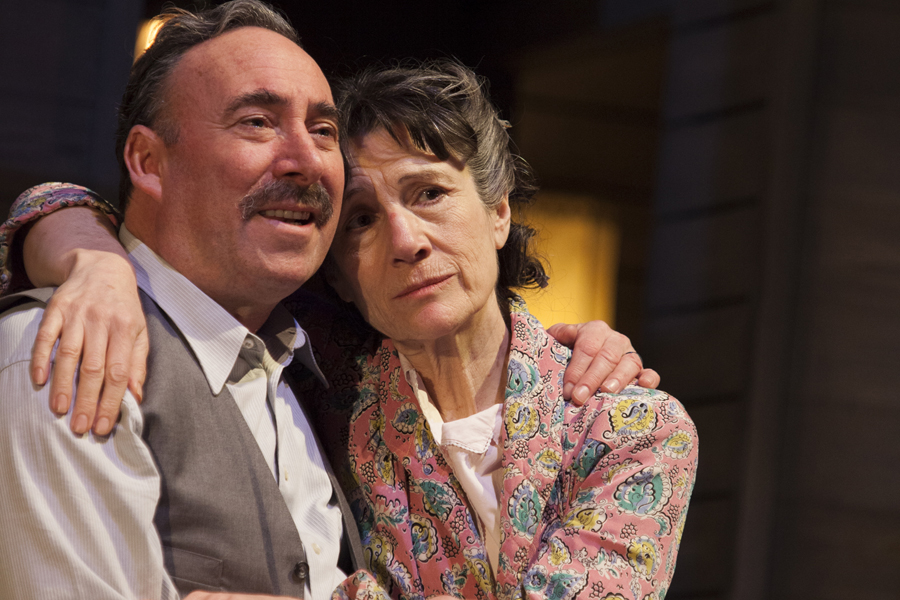
Death of a Salesman: L-R - Alex Hassell (Biff), Harriet Walter (Linda Loman), Antony Sher (Willy Loman) and Sam Marks (Happy), 2015 © RSC Director Gregory Doran is in no doubt that Arthur Miller's Death of a Salesman is the greatest American play of the 20th Century, addressing not only the heartbreaking conflicts within a family, but also bigger issues of national values and uncritical acceptance of the American Dream.

After a life of honest toil, Willy wants to stop travelling, pay off the mortgage and bask in the success of his two sons. But he can’t come to terms with the fact that his life and the lives of his boys are so different from his dreams of wealth and triumph. Miller explores the tragedy of what happens to a man who does not have a grip on the forces of life, as he puts it, whose career is disintegrating and the toll this takes on relationships between family members.

Miller was the son of Austrian-Jewish immigrants. His father worked his way up in New York's Lower East Side garment industry to become a wealthy man. The family lived in Manhattan until they lost it all in the depression and withdrew across the bridge to Brooklyn. As a teenager Miller worked to help supplement the family income with a bread delivery round before school. And he saw at first hand men like his salesman uncle Manny who sold not so much their product as their personality. Indeed, Miller is careful not to reveal what products Willy sells, leaving each audience member to furnish their own and make a closer connection to this everyman left battered and broken by capitalism.

Part of the challenge of the play comes from Miller’s extensive use of what he calls the continuous present – not quite flashbacks but simultaneous layers of memory. This means the actors have to shift almost instantaneously into playing a range of different ages and psychological states, and the production too must find ways of mirroring the layers.

Antony Sher is outstanding as the weary, manic-depressive Willy, from his iconic entrance – “tired to the death” – lugging his two heavy sample cases, through to the man who “realised that selling was the greatest career a man could want”, to the sad soul who opines that "After all the highways and the trains and the appointments and the years, you end up worth more dead than alive.” Sher’s performance brings out the contradictions in Willy that make him an irritating noodge (insistent bore) and a man whom it is hard not to pity.

Harriet Walter’s Linda is extraordinary. She gives a wonderfully nuanced account of Willy's doting wife, a woman with complete and blinkered devotion to her husband, who simply refuses to see through Willy’s lies and resignedly accepts whatever the "American Dream" throws at her. In a finely restrained performance, Walter seamlessly transitions between younger and older Linda, her face apparently visibly ageing and then losing its lines again. She is heartbreaking as she pleads on his behalf: “I don't say he's a great man. Willy Loman never made a lot of money. His name was never in the paper. He's not the finest character that ever lived. But he's a human being, and a terrible thing is happening to him. So attention must be paid. He's not to be allowed to fall in his grave like an old dog. Attention, attention must finally be paid to such a person.”

Death of a Salesman: Antony Sher (Willy Loman) and Harriet Walter (Linda Loman), 2015 © RSC

Father/son relationships are at the heart of the play. Alex Hassell as Bif, Willy’s older son (Hal to Sher’s Falstaff in Henry IV, so the bond between the two actors is palpable) creates a portrait of a flawed man, haunted by his signal failure to fulfil his early promise as a sportsman, unable to hold down a job, a thief who has stolen from his employers and even been to jail. Yet he still manages to be likeable, perhaps because he values simple pleasures over the rat race. Like his father, he is at once infuriating and touching. Sam Marks is equally convincing as womanising younger brother Happy, as a young version of Willy, reframing situations so they are more acceptable to him. Again, both actors display remarkable ability to switch convincingly between playing younger and older.

Set designer Stephen Brimson Lewis makes clever use of the Royal Shakespeare Company’s thrust stage to deliver people and furniture for the scenes in Willy’s head against a backdrop of high-rise Brooklyn, all fire escapes and windows. Tim Mitchell cleverly lights the semi-transparent set to reflect the transitions between memory and reality.

Miller originally conceived the play to be happening entirely in Willy’s head and Gregory Doran’s production blends time and space so the audience finds itself at the same time both in the film directed by Willy’s mind and in the ‘real world’ of the play. Perhaps the message of Miller’s play is that the American Dream is as much an expression of the internal movie each of the characters runs as the external idea of a life of personal happiness and material comfort.

Unsurprisingly this production, another highlight of Miller’s centenary year, is to transfer to London’s West End as soon as it finishes its run in Stratford-on-Avon.

By Judi Herman

Death of a Salesman runs until May 2 in Stratford-on-Avon and May 9 - July 18 in London. 7.15pm & 1.15pm. £2.50-£70. Royal Shakespeare Theatre, CV37 6BB; 084 4800 1110. www.rsc.org.uk 7.30pm & 2pm. £12.25-£59.75. Noël Coward Theatre, St Martin's Lane, WC2N 4AU; 0844 4825140. www.noelcowardtheatre.co.uk

JR OutLoud: As Hans Krása’s concentration camp opera, Brundibár, prepares to show on the Watford Palace stage, Judi Herman caught a rehearsal and spoke to the cast

Mahogany Opera Group’s critically-acclaimed production of Hans Krása’s Brundibár – the 1938 short children’s opera famously performed in the World War II concentration camp Terezin (German Theresienstadt) – heads to Watford Palace Theatre this weekend. So Judi Herman sat in on a rehearsal and met with the director Frederic Wake-Walker, conductor Alice Farnham and two of the 40-odd talented children recruited for these performances; nine-year-old Erin Daniels, who plays Aninku and 14-year-old Ethan George, who plays her brother Pepíček. Brundibár the evil organ grinder thwarts them in their attempt to raise money by busking to buy milk for their sick mother – until some clever animals come to their aid, enlisting the help of the town’s children. It’s a story of the triumph of the poor and powerless over the big, strong and ruthless that resonated throughout the camp – which is just as powerful today.

By Judi Herman

Brundibár runs Saturday 18 – Sunday 19 April in Watford and Sunday 28 June in Norwich. 7pm (Sat), 3pm (Sun). £10, £8 children. Watford Palace Theatre, 20 Clarendon Rd, WD17 1JZ; 019 2323 5455. www.watfordpalacetheatre.co.uk 2pm. £10, £6 concs. Norwich Playhouse, NR3 1AB; 016 0359 8598. www.norwichplayhouse.co.uk

For more on Brundibár, read Judi Herman's interview with Holocaust survivor Ela Weissberger, who created the role of the Cat in the original production in Terezin.

Review: Oppenheimer – A detailed bio-drama about the father of the atomic bomb chills and exhilarates in equal measure

Oppenheimer, press 2014 © Keith Pattison To make a nuclear bomb, you assemble enriched uranium into a supercritical mass that starts an exponentially growing chain reaction. Tom Morton-Smith’s play assembles the team building the first nuclear bomb and shows the chain reaction that ensues amongst them. And just as a bomb needs a trigger, the “Manhattan Project” needed J Robert Oppenheimer.

The play questions whether the physicists were mad scientists who should have known better than to participate in such a project and how far they felt justified at the time, even if subsequently doubting the genie they had unleashed that cannot be put back in the bottle.

Morton-Smith sees the events through the lens of Oppenheimer, intertwining his intellectual struggle with the physics and his emotional struggle with the need to abandon his early and fervent embrace of communism, which Oppenheimer saw as the only remedy to Fascism, in order to appease the US authorities. He had after all been schooled at New York’s Ethical Culture School, where many of his fellow pupils were also secular Jews and where he discovered the ethical teachings of Judaism. And later he was engaged by other ethical texts and scriptures including the Bhagavad Gita (a 700-verse Hindu scripture in Sanskrit), which stayed with him all his life and Morton-Smith has him quote it at the end of the play.

J Robert Oppenheimer (the J stands for Julius) may have been born in Manhattan, but as the son of German-Jewish immigrants, he was acutely aware of the fate overtaking Europe’s Jews, especially as the US scientific community welcomed an influx of eminent Jewish physicists seeking refuge from the Nazis. The list of characters in the play is in part a roll call of these brilliant fugitives, most of whom would go on to win Nobel Prizes. In addition, the young prodigy had studied under (Jewish-born) Max Born in Göttingen in Germany in the 1920s, gaining his PhD at age 22. So he was much exercised by the rise of fascism in Europe.

Oppenheimer, press 2014 © Keith Pattison

After a brief lecture from Oppenheimer, with the audience cast as students, Morton-Smith starts the action with an upbeat party scene on the Berkeley Campus at a Communist fundraiser for International Brigade members off to fight fascism in Spain. It’s the sort of party at which anyone who’s anyone in the intellectual and academic community must be seen. Morton-Smith’s brilliance is to cut between the party and the students and academics in full creative flight as they learn and teach in the lab – using the stage floor as a chalkboard on which they feverishly scribble theorems and theories. Even the chronically unscientific members of the audience (among whose number I count myself) immediately get the feel of how engrossing and exhilarating the pursuit of scientific knowledge and discovery must be for members of the scientific community. This works especially well as a counterpoint to the party segments – all choreographed with huge panache by Scott Ambler.

Everyone in this community is aware of the work of German scientist Werner Heisenberg and his Danish-Jewish mentor Niels Bohr in Europe (as brilliantly imagined in Michael Frayn’s play Copenhagen). Is Bohr making a stand against letting Hitler get anywhere near the bomb? Does Heisenberg dread the ‘fall-out’ from The USA getting there first? Well, clearly in the USA they see it as a necessity to get there first and scientists are under intense pressure to do so. But Morton-Smith imagines, with the feel of chilling authenticity, not only the pressure but also the febrile excitement of these extraordinarily focused (often one-track) minds as they realise they are nearing a breakthrough, albeit one that will prove deadly to millions.  The detachment with which the boffins discuss the bombs they call Little Boy and Fat Man and what they are capable of, with a matter-of-factness about the numbers of Japanese likely to be sacrificed, is frighteningly convincing.

John Heffernan brilliantly inhabits the persona of Oppenheimer, mesmerisingly charismatic from the moment he engages with the audience at curtain up. He embodies the struggles and contradictions in the man – a womaniser with “a core of cold iron” – with a wife and mistress; scared that he has the scientific ability “to murder every last soul on the planet, yet at the same time a leader who expects to be followed. And indeed he is the magnet that attracts a huge number of scientists to join him at Los Alamos to work on the Manhattan Project.

Oppenheimer, press 2014 © Keith Pattison

Morton-Smith creates wonderfully authentic communities and he plays up the friction between the unruly scientists and the military with their, ahem, 'military' precision at Los Alamos to terrific and rather comedic effect.

Morton-Smith’s portraits of Oppenheimer’s women are especially complex. There’s Catherine Steadman’s mercurial manic depressive Jean Tatlock, the mistress who checks in and out of his life, in her element rallying the intellectuals for the communist cause. And Thomasin Rand’s wonderfully vivid Kitty, another bright and frustrated female intellect, who leaves her previous husband to marry Oppenheimer, only to find herself reluctantly kicking her heels though not her alcohol habit through pregnancies before and during her stay at Los Alamos.

Angus Jackson directs with panache a large cast in a production that sweeps effortlessly from those cocktail parties in Berkeley to the then empty plain of Los Alamos, thanks to designer Robert Innes Hopkins, whose costumes – especially for the women – are both authentic and stunning, and the action is heightened by Grant Oldman’s exhilarating score played live by a superb six-piece band directed by Jonathan Williams, and that organic choreography by Scott Ambler.

By Judi Herman

Oppenheimer runs until Saturday 23 May. 7.30pm, 2pm (Wed/Sun only). £25-£49.50. Vaudeville Theatre, 404 Strand, WC2R 0NH. www.vaudeville-theatre.co.uk

Review: The Jew of Malta – Bracingly amoral violence on the island of Malta (circa 1565)

The Jew Of Malta, Swan, Stratford-On-Avon, Press 2015 © RSC The different faiths are rubbing along together until politics and money get in the way and then all sides justify their actions as religious duty and malicious antisemitism provides a rationale for action. Not the Middle East today but Malta circa 1565 in Marlowe’s play, The Jew of Malta.

Here Malta is ruled by the Knights of St John (Knights Hospitaller) under Governor Ferneze, ostensibly as an outpost against the Ottoman Turks, although Ferneze is happy to pay the Turks protection money not to be invaded by them. Barabas is the richest merchant in the region but Ferneze plunders his fortune to pay off the threatening Ottomans. The Christian Knights justify taking his money – as a Jew, Barabas is cursed and sinful. He is understandably indignant: “What, bring you Scripture to confirm your wrongs? Preach me not out of my possessions.”

This is evidently a revenge tragedy – the dominant motive is revenge, here for a series of very real injuries. But Marlowe’s play goes beyond revenge, satirising religious hypocrisy, statesmanship and the human condition. We know where Marlowe stands when the Prologue, in the person of Machievel(li) says, “I, Machievel, count religion but a childish toy. 
And hold there is no sin but ignorance.” No one individual or community’s stupidity or vices are spared Marlowe’s ridicule and criticism in what might be the earliest film noir script.

Because this injustice is the trigger for Barabas to embark on a road to hell paved with anything but good intentions. Nobody – Christian, Turk, or even Jew – is safe from his increasingly bloody revenge, especially once he finds a kindred spirit in a newly-purchased slave Ithamore, and together they revel in ever more ingenious methods of murder and even mass slaughter.

At first sight, Marlowe’s play, with its eponymous anti-hero Barabas (whose namesake is the criminal released by Pilate instead of Jesus, at the behest of a Jewish mob according to the Christian Gospels), looks even more uncomfortable viewing for a Jewish audience than The Merchant of Venice. And it seems like a worryingly timely revival in the light of recent antisemitism. But 16th-century Malta is a bear pit where Turks and Christians fight indiscriminately and Marlowe allows Barabas to have the stage to himself to confide in his audience before they get to meet any of the island’s other amoral schemers (including a brace of villainous friars) who are, after all, after his money – or his fair daughter Abigail. And even before Barabas appears, his gleeful Machiavellian plotting comes with the endorsement of Machiavelli himself in that prologue.

The Jew Of Malta, Swan, Stratford-On-Avon, Press 2015 © RSC

Director Justin Audibert’s exhilarating revival points up Marlowe’s vicious humour and intelligence with Jasper Britton’s ruthless Jew as its poster boy. It has all the colour and sweep of a Renaissance painting, thanks to designer Lily Arnold’s glorious vision. Her staging is simple – marble-like steps sweep down from an upper level to the lower thrust stage which has as its focus a trough of water that proves wonderfully useful. And she fills the space with an entrancing palette of colour on costumes that swirl around the place, enhancing Lucy Cullingford’s choreography and in their turn enhanced by Oliver Fenwick’s lighting.

Audibert’s cast clearly enjoy creating equally colourful characters, led by Britton’s frighteningly practical and fearsomely intelligent Barabas, and Lanre Malaolu’s gleeful Ithamore, revelling in his promotion to partner in crime. Geoffrey Freshwater and Matthew Kelly, as those two wicked friars, make as gleeful a pair of plotters as any on the Renaissance stage. There’s attractively seductive work from Beth Cordingley’s avaricious courtesan, and Catrin Stewart makes a feisty Abigail, hand in glove with her father until… Well, that would telling, you’ll have to go and see it to find out!

The terrifc ad hoc klezmer band has added value for those in the know. The pre-show music is traditional wedding fare, ‘Chosen Kallah Mazel Tov’ ('Good Luck to Groom and Bride') and the show opens with another Jewish wedding staple – Barabas leads the cast singing ‘Erev Shel Shoshanim’ ('Evening of Roses') from the Song of Songs, in the popular setting by Yosef Harar and Moshe Dor (timed well for the production’s early April opening as it is part of the Passover Service too). And throughout the show Gareth Ellis’s musicians bring their own colour to the action, thanks also to Jonathan Girling’s original music.

Does it all leave a bad taste in the mouth though, as the action reaches its apocalyptic climax? By that time, everyone has behaved badly and Barabas is not the only one to face retribution. So however Marlowe’s contemporaries reacted, modern audiences are no more likely to burst into gleeful laughter than they would at the climax of Stephen Sondheim’s Sweeney Todd.

By Judi Herman

The Jew of Malta runs until Tuesday 8 September. 7.30pm & 1.30pm. £5-£45. Swan Theatre, Straford-On-Avon CV37 7LS; 084 4800 1110. www.rsc.org.uk

JR OutLoud: Judi Herman speaks to the cast of The 2000 Year Old Man and offers listeners a sneak preview of the show

The hotly anticipated rebirth of the legendary comedy shtick is nigh! Mel Brook’s comedy tour de force as the oldest man in the world (Jewish, Yiddish accent), in improvised interviews with ‘TV reporter’ Carl Reiner, subsequently made into a collection of best-seller albums is about to take to the stage. This month, Canadian-born actor, writer and voice-over artist Kerry Shale, together with the British comedian, producer and writer Chris Neill are bringing The 2000 Year Old Man to JW3 in a verbatim performance where the actors wear earbuds and copy the edited recordings word-for-word, intonation-for-intonation.

Judi Herman has been following the continuing story and was ‘thrilled and delighted’* to get a sneak preview for Jewish Renaissance and to talk to the brand new double act of Shale and Neill. Hear the podcast above or download it for later listening.

*see the show to find out where this quote fits in!

The 2000 Year Old Man runs from Monday 9 - Sunday 22 March. 8pm. £6.50-£12.50. JW3, 341-351 Finchley Rd, NW3 6ET; 020 7433 8988. www.jw3.org.uk

Review: A View from the Bridge – Ivo van Hove's moving and powerful production of Arthur Miller's shattering drama

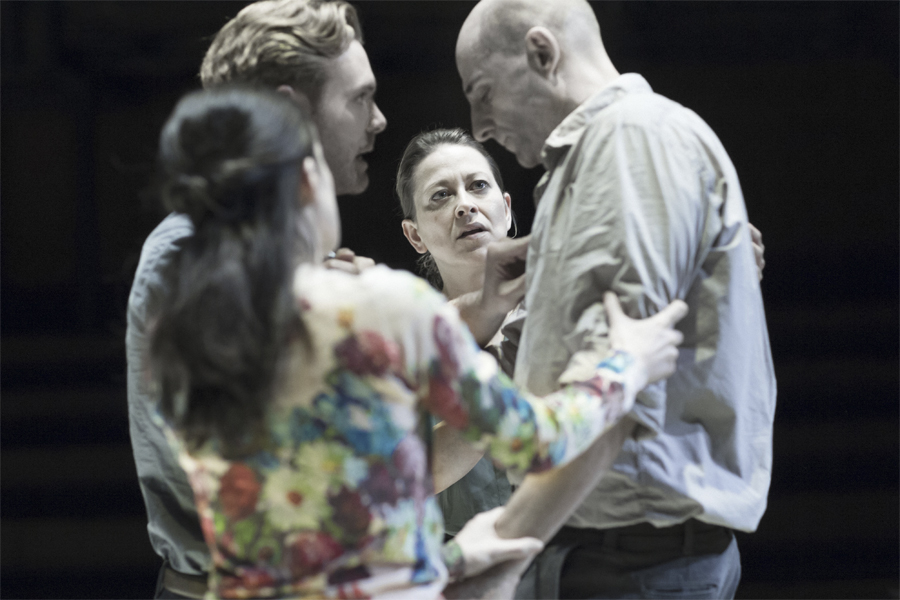
the view from the bridge 2015 © Jan Versweyveld It’s hard to imagine a more powerful – or more iconoclastic – production of Arthur Miller’s shattering meditation on family relationships gone bad and immigrants trying to make good in 1950s New York. But director Ivo van Hove comes close.

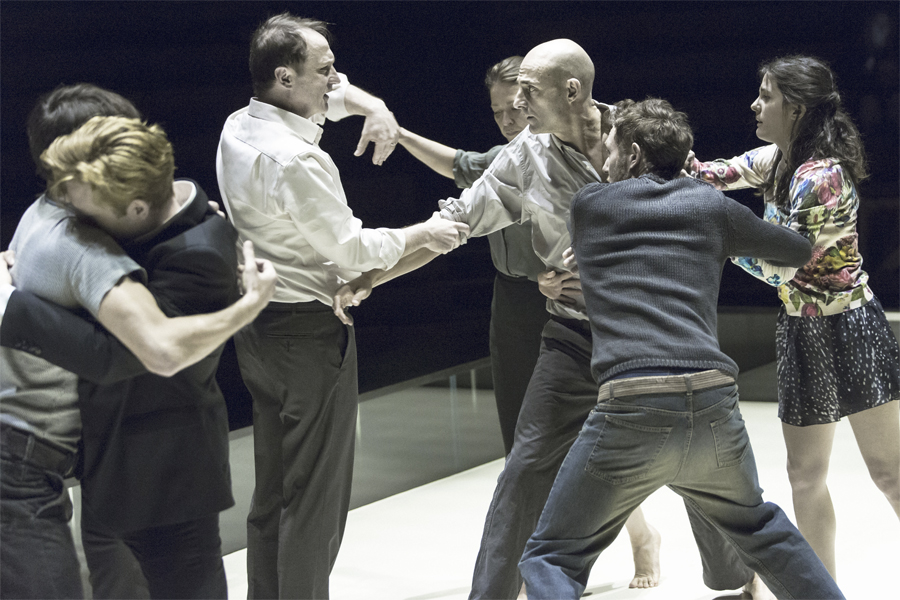
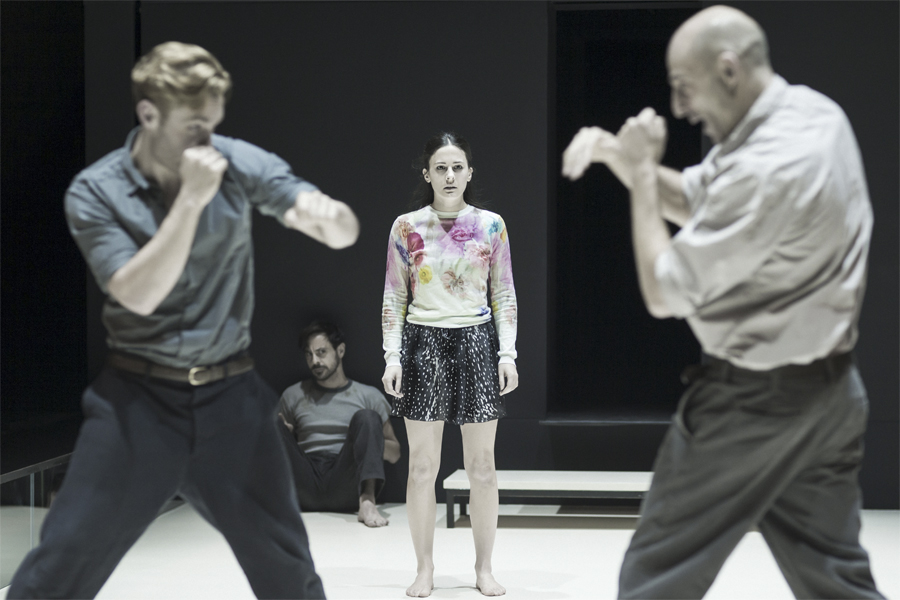
I use the word iconoclastic because more conventional productions evoke that specific 1950s setting, although they are using the specific to also evoke the general. In van Hove’s stripped down production – on designer Jan Versweyveld’s rectangular arena – the events of the play are as if under a microscope, focused by Michael Gould’s fine portrayal of lawyer/Greek Chorus Alfieri so that we the audience may observe them with growing incredulity and horror. There is an eerie timeless quality to this setting, which throws into relief the contemporary resonances of the illegal immigrants’ plight and desperation all too clearly.

Italian-American made good protagonist, Eddie Carbone (Mark Strong), reluctantly takes in his wife Beatrice’s (Nicola Walker) relatives from Sicily. Working men have been driven to leave their wives and families for years at a time because of a lack of work in the depression on their island. These illegal immigrants live with the fear of being discovered, though "shopping" your countrymen to the police is likely to bring down a worse fate on the whistle-blower. The search for a better life, the willingness to work all hours, to face up to separation from loved ones and to the pain of longing for them, applies to the Jews who made their painful way from the pogroms and persecution of Europe and to successive generations of economic migrants from Africa and Asia to Europe and the Americas as much as to these Italians.

view from the bridge 2015, scrum, © Jan Versweyveld

As it becomes apparent that the close affectionate relationship between Eddie and Catherine (Phoebe Fox), the niece he has raised as his daughter after his wife’s sister’s death is much too close for comfort on his part, and his affection becomes aggressively possessive and even abusive. Again the play becomes chillingly timely – and timeless. His not so latent homophobia, accusing the newly-arrived Rodolpho (Luke Norris) of being a pretty-boy homosexual is certainly of its time, yet still contemporary.

view from the bridge 2015, fight, © Jan Versweyveld

Timeless though the play and production may be, the actors manage to vividly evoke the 1950s, even in the plainest of costumes (by An d’Huys) and barefoot too. You can visualise Strong’s powerful Eddie working on the docks as a longshoreman, then at home as a terrifyingly insistent and intense character. He does not care who sympathises with him; yet the audience watches his self-destruction with horrified incredulity, channelled by Alfieri’s own impotence to reason with this man so out of control.

Catherine is performed vibrantly by Fox, who sets the stage aglow; first leaping into her uncle’s arms, shining with excitement about her first job, and then glowering with determination and anger as he places obstacles in her path to marriage with her young immigrant lover. Equally Walker as Beatrice conveys vividly and heartbreakingly her disappointment and discomfiture in the face of her now sexless marriage and the reason for her husband’s neglect, but also the magnificent warmth of a Sicilian matriarch, with so much to offer her husband and niece – and indeed her needy newly-arrived relatives.

view from the bridge 2015, close-up, © Jan Versweyveld

Norris is perfectly cast as the pretty blonde Rodolpho, his different and delicate good looks and sensitivity making it plausible not only that he is the object of Catherine’s affections but also Eddie’s hatred. Emun Elliott’s dark, more conventionally Mediterranean Marco is touching in his longing for home and family and determination to make good so far away from them and equally plausible in his own fiery reaction to Eddie’s actions.

My only cavil with the power and intensity of this two-hour (no interval) play is in the insistent soundtrack throughout and a visceral coup de theatre at the end. Neither increase the power or intensity as both are fuelled by the extraordinary ensemble acting acting out Miller’s shattering story. I’d like to think the audience, who rose to their feet almost as one at the end, would have given them a standing ovation even without this final stage effect.

By Judi Herman, who saw the production at the Young Vic before it transferred to the West End.

The View from the Bridge runs until 11 April. 7.45pm, 2.45pm (Wed/Sat only). £19.50-£62.50. Wyndhams Theatre, Charing Cross Rd, WC2H 0DA; 084 4482 5120. www.delfontmackintosh.co.uk

Review: Judi Herman discovers drama and comedy on a women’s cancer ward in Anat Gov’s Happy Ending

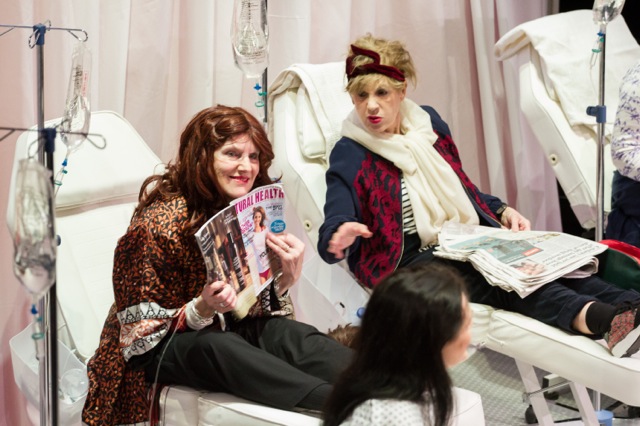
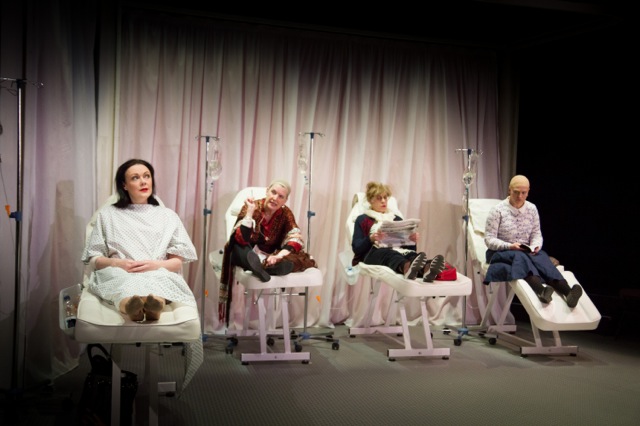
Happy Ending (3) - c Piers Foley_press2015 Entering a space equipped with hospital beds and drip-stands, you'd be forgiven for thinking you were in an operating theatre, rather than the kind with lights, action and music. But then Happy Ending is a play about women facing up to life with The Big C; cancer.

Managing it as best you can usually means coping with invasive, uncomfortable and time-consuming therapy, time spent on a hospital bed hooked up to a drip stand. Not the stuff of which musicals are made. Well, there’s a lot less blood than that shed by Sweeney Todd: The Demon Barber of Fleet Street and fewer lives lost than on the barricades manned by students in the Paris revolution of 1870 central to Les Misérables.

This is a meditation on and exploration of how we face up to cancer. There’s a lot of fighting talk at the moment in ads for cancer charities urging us to take on the disease and beat it at its own game. But the conclusion of Happy Ending is that there are different coping strategies and different outcomes – no right or wrong way to face and fight cancer – and sometimes we have to make our own choices. We may share those choices with those who care for us or we may choose not to. I say "we", as it is easy to identify with the four brave women on stage, who each embody different ways of coping and many of us have faced (or will face) their choices.

But Happy Ending is of course is a musical show and although Anat Gov’s story explores the issues from the inside (she died from cancer in 2012), she manages to be funny and uplifting en route for the "happy ending" she writes for her central character actress and minor celebrity Carrie Evans, newly diagnosed with the disease (a delicate and detailed performance from Gillian Kirkpatrick).

There are some original and unexpected dance routines – drip stands make elegant partners – there’s a Gospel chorus and even cancer itself is embodied by an attractive young man (Joe McCourt) in a steamy tango. There are killer lines too (yes, the gallows humour is catching): “There’s nothing like the smell of fresh cancer in the morning," says one patient, old hand Silvia (played by the excellent and feisty Andrea Miller). She has been fighting cancer with every treatment possible for so long that she is almost like the top dog in a prison drama (or the block elder in a camp). This lady is a survivor of Auschwitz, so how can she let cancer get the better of her?

Carrie (Gillian Kirkpatrick), Miki (Karen Archer), Silvia (Andrea Miller) and Sarah (Thea Beyleveld) gossip in the ward following Carrie’s arrival

Silvia is one of the other three women who embody different ways of coping with their cancer. Miki (the bouncy and attractive Karen Archer) is an ex-hippy who has found so many positives in her diagnosis that she almost has a new lease of life. For a start it has led to a reconciliation with the estranged daughter she neglected during her days of tuning in, turning on and dropping out. Then there’s the devout young Orthodox mother of many, Sarah (Thea Beyleveld, both touching and convincing in her fervour) who trusts in her faith in God to get her through – though she does not trust her yeshiva student husband to look after the children and the plumbing at home.

Yes they are types, but they turn in great performances, as do the supporting (literally) cast of nurses and doctors, led by cheery dedicated nurse Fiona Jodie Jacobs (perfectly channelling a type I recognise from my own recent spell in hospital) and hunky Dr Lynch (Oliver Stoney), the alpha male medic who might have stepped out of any TV hospital drama – cold and caring at the same time.

Director Guy Retallack and Hilla Bar, who adapted the story from Hebrew, have relocated the drama from Israel to North London with the odd mention of, for example, Parliament Hill. Shlomi Shaban and Michal Solomon provide songs that are more stand-out moments of exploring Gov’s theme than the score of a musical moving along the plot or illuminating the characters.

By Judi Herman

Happy Ending runs until Saturday 7 March.  7.30pm (also 3pm Wed/Sat). £12-£19. Arcola Theatre, 24 Ashwin St, E8 3DL; 020 7503 1646. www.arcolatheatre.com

Review: Bad Jews – Joshua Harmon's new play about faith, family and funnies

© Robert Workman – Bad Jews Daphna is angry. She’s back from her Ivy League college and is storming petulantly around a claustrophobically small studio apartment like a disgruntled toddler. Her cousin Jonah (Joe Coen) tries relentlessly to ignore the young tyrant as she moans about the fact that Jonah’s brother Liam (Ilan Goodman) has missed their Poppy’s (grandpa) funeral because he was skiing in Aspen with his girlfriend, who isn’t even Jewish. This opening scene sets the audience up perfectly for what’s to come – an hour and a half of increasingly un-passive aggression that’s full of belly laughs.

This new show from 31-year-old Joshua Harmon made its debut in New York in 2012 and was such a hit that in the past year it has become the third-most-produced play in America. The New York-born playwright conceived the idea for Bad Jews just over a decade ago after he attended a “depressingly unmoving” Yom Hashoah (Holocaust Memorial). The service involved grandchildren of Holocaust survivors offering up dispassionate dialogues about their relatives’ traumatising experiences. This got the budding writer considering what it means to be a young Jew in the modern world and whether we should strive to keep alive our religious beliefs and cultures in our children or work towards a religionless and nationless world. Because at the end of the day, should who we are matter?

© Robert Workman – Bad Jews

This issue, while never tackled head-on, throws up various viewpoints throughout as the characters defend their religious and familial loyalties. Daphna – a pushy, furiously sincere “super-Jew” portrayed skilfully by Jenna Augen – and Liam – incredibly bright, but atheist part-time and Jewish when it suits him – bicker and manipulate their way through scenes, ultimately fighting for Poppy’s Chai (symbol for life) necklace, which comes with a heart-breaking backstory.

Kudos must also be given to set designer Richard Kent, whose level of detail plays as huge a part in drawing you in as the actors do. The studio apartment and entrance hallway where Bad Jews takes place is solidly constructed, with minutiae, such as plug sockets, bins and even a leaflet under the neighbour’s door, that make it satisfyingly easy to forget you’re watching from a theatre seat and become fully absorbed in the fast-paced dialogue.

© Robert Workman – Bad Jews

There’s a great comic moment in Bad Jews when Gina Bramhill’s Melody, Liam’s girly gentile girlfriend coyly professes to a fiery Daphna: “It doesn’t matter to me that you’re Jewish,” in a bid to explain we’re all human after all. But it backfires and a leer of sheer disgust remoulds Daphna’s brow as she spits, “It matters to me!” This is just a snippet of Harmon’s deft penmanship – the way he can hint at importance of identity while maintaining a sense of humour. And he does well not to force his personal opinions on the audience, merely planting the seeds of ideas and leaving people to go away thinking about their own. It’s a play full of depth, quick-wit and poignancy. Bad Jews has it all.

By Danielle Goldstein

Bad Jews runs until Saturday 28 February. 2.30pm & 7.30pm. £10-£30. St James Theatre, 12 Palace St, SW1E 5JA; 084 4264 2140. www.stjamestheatre.co.uk

© Robert Workman – Bad Jews

© Robert Workman – Bad Jews

Interview: Ela Weissberger - One of the stars of the original Terezin production of Brundibár

-268d85038c4b79b9 As a brand new Mahogany Opera Group production of Hans Krása's Brundibár, the 1938 short children's opera famously performed in World War II concentration camp Terezin (German Theresienstadt), comes to the Southbank Centre's Imagine Children's Festival this February,  Ela Weissberger (pictured), who created the role of the Cat spoke to Judi Herman before she left her New York home to address the Scottish Parliament for Holocaust Memorial Day.

When did you arrive in Terezin? "I came 12 February 1942. I was one of the first children in Terezin and I stayed there three and a half years, till the end."

Did you come to Terezin with your parents? "I came with my mother because when it was Kristallnacht my father offered money to whoever would kill Hitler and they put him on a black list and the next day they came to pick him up – we never saw him again. My mother was 31 years old."

How did you get cast in Brundibár? "I was singing in a children's chorus in a synagogue in Prague, so singing for me was very wonderful. And friends of my uncle always said that I should sing, as my child's voice was beautiful for them. I didn't think so, but for them it was! When I came to Terezin, and to the children's home there [as men, women and children were quartered in different barracks], the youngest composer in Terezin was Gideon Klein. He also played the piano and played for 55 performances when I was in Brundibár. He played the piano and was also the one that was writing for us Hebrew songs. So we started singing in the children's room and the Nazis let us. We were allowed to sing and play and because of that there were some poems that were written in Terezin. Brundibár and the poems and our children's paintings with Friedl Dicker-Brandeis [the Austrian artist and educator who was killed in Auschwitz, 9 October 1944], is the only legacy of the Terezin children.

"I was chosen when Rudi Freudenfeld smuggled in the piano score of Brundibár. He was the son of the director of the Jewish orphanage in Prague. So Hans Krasa was able to redo the music for us and one day they said that if somebody knows about talented children in music we should try out for parts in Brundibár. So when it came my turn, Rafael Schaechter, who took the music in Terezin and was famous for playing Verdi's Requiem there – he knew me when I was eight years old – so when I came to try out for Brundibár, he said, 'You will be the cat'.

"My mother was a real music lover, and my father, and they went to the opera and all that before the war so she was so happy that I got the part of the cat. I came to my mother and said, 'You know, ma, I will be the cat in the opera', And my mother was wondering, 'what cat in the opera? I don't think there's an opera with a cat', so she didn't believe me! But I loved it. You know I think I was born a little show-off!"

A Terezin production of Hans Krasa's Brundibár

What costume did you wear? "I had my sister's ski pants, my mother's black sweater, and I wasn't allowed to wear shoes because the cat had to be very quiet. Also Frantisek Zelenka [the production designer] was from the National Theatre of Prague and his fantasy was something unbelievable. Somehow they didn't cut the back of my hair, but split it and made it almost like ears for me. And then he had a little box left over of black shoe polish and with that he made me my whiskers and he covered my feet a little because they were so white. He didn't understand when I told him I was having such a hard time wiping it off because we didn't have soap. Only once a month we were able to take a hot shower and this was for just five minutes with two people under the shower at once."

Everybody in the camp loved to come and watch Brundibár and understood the message – that the evil organ grinder Brundibár was a thinly disguised Hitler. Did you play to rapt audiences and give people some feeling of fighting back, of defiance? "In Terezin the people in the audience were singing with us. They used to clap and stamp their feet and we used to repeat it a couple of times with them, the Victory Song [the number in which the children and animals celebrate their victory over Brundibár]. In the Czech Republic audiences still do that. Here in America, only when I am in Los Angeles with the opera, first we are two people and when we start to clap, then others start to clap with us!"

Ela Weissberger wrote a book about her time in Terezin called The Cat with the Yellow Star, which was first published ini March 2006, but has been re-published in a new edition this month. "You know I still have my original Jewish star," she says.

By Judi Herman

The Mahogany Opera Group's production of Brundibár runs Saturday 18 - Sunday 19 April. 7pm (Sat), 3pm (Sun). £10, £8 children. Watford Palace Theatre, 20 Clarendon Rd, WD17 1JZ; 019 2323 5455. www.watfordpalacetheatre.co.uk

Watch a trailer of the show here:

https://www.youtube.com/watch?v=B2TJbNdvrt0

Review: Mark Hayhurst's debut Taken at Midnight plays a timely reminder

Taken at Midnight © Alastair Muir, Jan  2015

Jews have long lived with the idea that the Holocaust is incomprehensible in large numbers and that examination of individual stories provides greater understanding of the whole. Now there's a trend for understanding what happened in Germany through stories of individuals who supported or opposed the events at the time; think of Zone of Influence by Martin Amis, for example, a love story set in the German officers' quarters at an extermination camp. Taken at Midnight is the story of lawyer Hans Litten, one of many political prisoners bundled into "protective custody" as the Nazis consolidated their power after the Reichstag fire. Litten’s "crime" was to have called Hitler as a witness in the trial of four stormtroopers accused of murder and to have exposed the denied link between the Nazi party and SA (Sturmabteilung/Brownshirts) violence.

The dramatic device in Mark Hayhurst’s play is to see all the events through the five-year campaign of Litten’s mother Irmgard (Penelope Wilton) to get him released. Played out on an austere grey set by Robert Jones that echoes brutalist Nazi architecture, with stark lightning by Tim Mitchell and nerve-scraping music by Matthew Scott to match, we see how a mother's love and persistence attempts to save her son.

The play intercuts between Litten’s various prison camps and Irmgard’s increasingly frustrated attempts to find out what’s happening to her son. Exposition in the early scenes means the drama is slow to get going but it soon hits its stride, especially in the set pieces between Irmgard and the cool and oily Gestapo officer Conrad (John Light), where Wilton’s ability to deliver the reasonable voice of the silent majority in the face of implacable bureaucracy strikes hardest.

There's also a moving scene in Dachau between Irmgard and Hans (a redoubtable Martin Hutson) leading up to the climax of the play.Leaving the devasting court room critique of Hitler almost to the very end brings home the bravery of all those who opposed his will in any way, having seen what befell just one man and his two cell-mates, Carl von Ossietzsky and Erich Muehsam (Mike Grady and Pip Donaghy adding gallows humour).

Jonathan Church directs a fine cast with poised restraint. Everyone is chillingly reticent and this serves to highlight the contrast between words and actions, notably those of Conrad who fobs off all enquiries and the ineffectual British Lord Allen (David Yelland) visiting to enquire after the treatment of political prisoners.

We do lose track of Hans's father (Allan Corduner), a baptised Jew and holder of the Iron Cross First Class who supported Irmgard admirably but seems subsequently to have left his Christian wife, perhaps for her own sake, though that is not explicit. But it’s not the fate of the Jews that matters here, even though Litten is counted as Jewish by the Nazis.

While we learn little more about the banality of evil from this play, it's a timely reminder of the honest intentions of the many Germans who opposed Hitler in 1930 and who subsequently deserve to be named as victims of the Holocaust. And it’s a timely warning to us to heed those sounding today’s warning sirens.

By Judi Herman

Taken at Midnight runs until Saturday 14 March. 7.30pm (also 3pm Wed/Sat). £15-£59.50. Theatre Royal Haymarket, SW1Y 4HT; 020 7930 8800. www.trh.co.uk