Theatre

Review: Crossing Jerusalem with Julia Pascal proves a turbulent journey into the past for Judi Herman

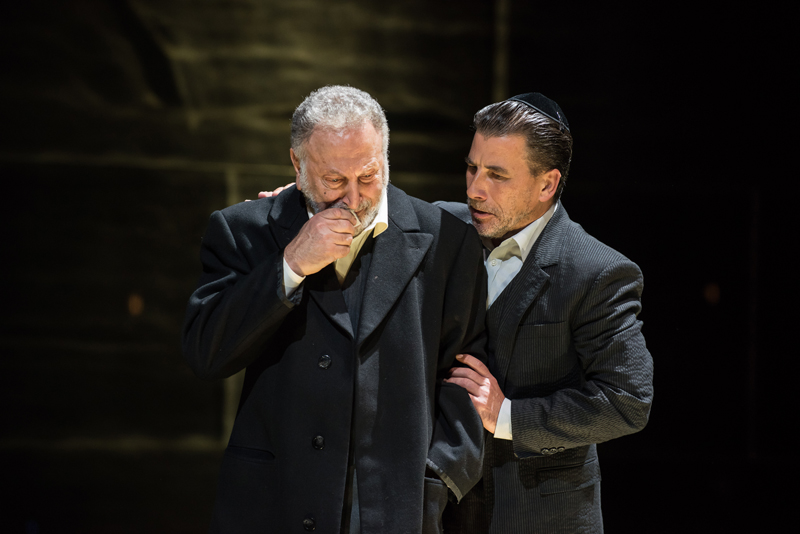
Trudy Weiss and Louisa Clein in Crossing Jerusalem at The Park Theatre © Mia Hawk Years ago I made a radio feature in Jerusalem – it doesn’t matter what it was about. I wanted to weave a soundscape that evoked the troubled city. As I walked its streets recording, a muezzin chanted the Muslim call to prayer and church bells sounded. Through the windows of a yeshiva (Jewish religious school), which were open for the heat, I could see the boys with their side locks and hear them chanting dutifully after their bearded teacher; and all the while overhead a helicopter hovered, its roar providing an ominous background to these sounds of the divided City.

Just as, sadly, my soundscape has not dated, so Julia Pascal’s 2003 play, set during the Second Intifada, still provides a careful exploration of what life is like for men and women who live on different sides of Israel’s idealistic divide; Arab and Jewish Israelis, Muslims, Christians and Jews.

She was able to research its background during time spent in Israel, when she sought to talk in depth to members of its different communities. Speaking French meant she could pass as Catholic to elicit a perhaps franker response from Israeli Arabs than if she had been overtly Jewish. She was taken aback when some spoke of their pipe dream of a Jew-free Israel. But she has duly put their words in the mouths of her younger generation of Arab citizens of the Jewish State.

Pascal's story of two families, of Jews and Arabs, has two generations of the Jewish family make the crossing of the title for a celebratory meal in what used to be their favourite Arab eaterie before the Second Intifada made the crossing so much more problematical (imagine the heightened tension in London after the July 2005 bombings continuing right though the last 10 years). The Arab family owns the restaurant – tellingly perhaps, we never meet its female members. Over the course of the play, though, Pascal paints detailed portraits of both Jews and Arabs of different generations, from those old enough to remember being teenagers during the 1967 Six-Day War to a teenager almost 40 years later, via twenty- and thirtysomethings.
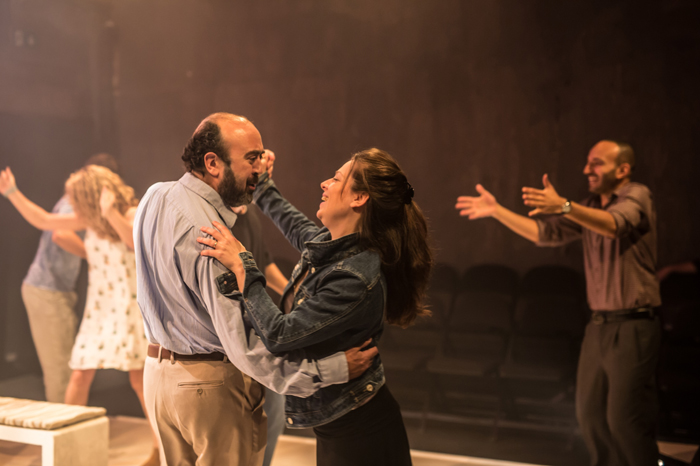
Crossing Jerusalem at The Park Theatre © Mia Hawk

Crossing Jerusalem begins with the whole cast in a spirited, apparently relaxed dance to an Israeli rap number that does indeed give way to a soundscape with helicopters, as IDF (Israeli Defence Force) snipers and Arab teenagers armed with stones exchange fire.

The playwright presents a complicated story of family life, especially in the Jewish family of matriarch Varda Kaufmann-Goldstein, her second husband, Russian émigré Sergei Goldstein, her son Gideon – currently serving in the IDF – and her daughter Liora, about to do some military service too. And that meal is to celebrate the birthday of her daughter-in-law, Yael, mother of her (unseen) five-year-old granddaughter. Sammy’s restaurant is run by the eponymous Sammy Hada, with the help of Yusuf Khallil, whose younger brother Sharif is one of those young teenagers lobbing stones at soldiers. Sharif is a hot head or a brave youngster prepared to make a stand, depending on which community you belong to – and even within his own community, to some extent opinion is divided between generations.

Pascal's interlocking family stories, though complicated, give her play a narrative drive with uncomfortable revelations that are often a microcosm of the bigger picture in Israel. It's a picture that has developed since 1948 and the difficult birth of the Jewish state, so longed for by so many but for the Arab community, "the Naqba", the disaster, through the Six-Day War and succeeding wars and uprisings, to the untenable situation today. A central motor of the plot is the idea that just as the Jews are entitled to reparations after the Holocaust, so the Palestinians might expect similar dues.
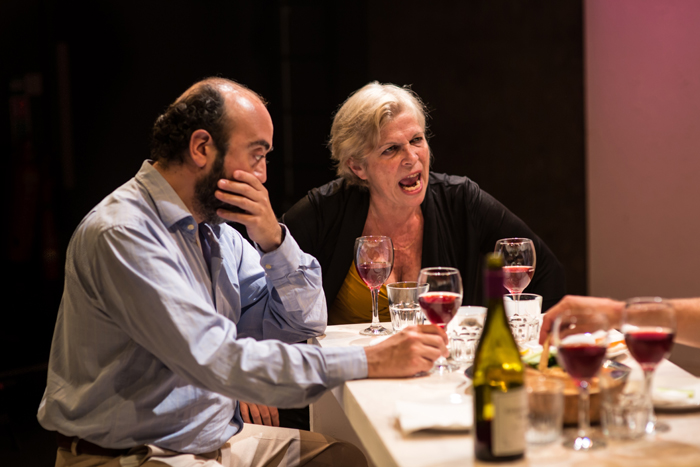
Chris Sryrides and Trudy Weiss in Crossing Jerusalem at The Park Theatre © Mia Hawk

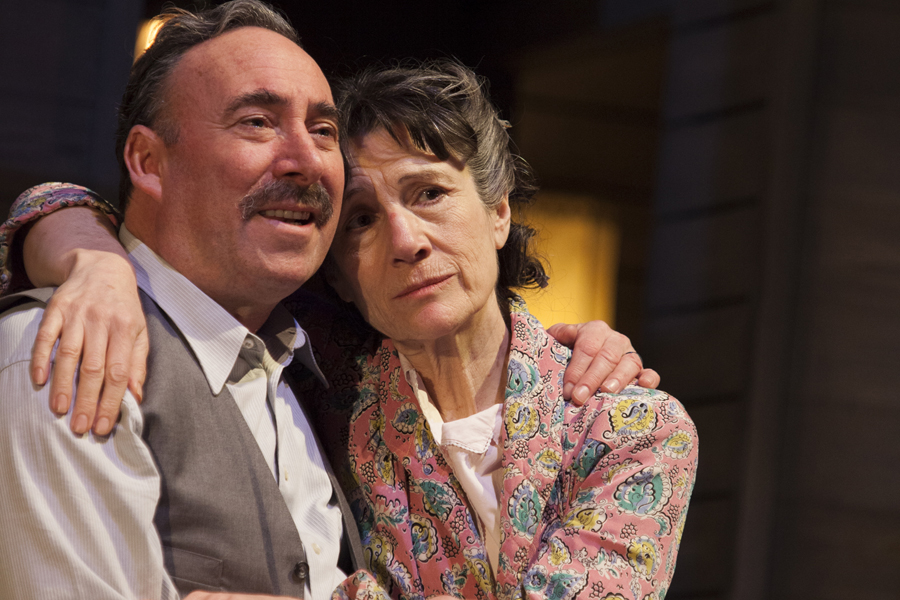
Although matriarch Varda is nominally at the centre of the story, out and proud as a still-sexy 58-year-old wife, mother and grandmother in Trudy Weiss’s big expansive performance, Pascal’s skill is to ensure that the audience gets to know each character equally well and the joys and loves, traumas and tensions that have brought them to where they are on this crucial day in 2003.

Regardless of whether you sympathise, understanding where each is coming from is a way into understanding what life is like "on the ground" in this complex, frustrating and, for so many, heart-breaking situation.

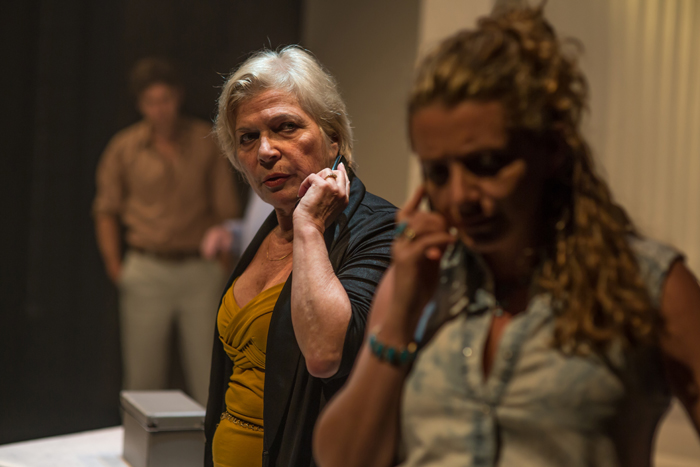
Pascal has a gift for drawing feisty women of both generations presented here warts and all. Varda’s relationships with her daughter and daughter-in-law have their upsides and downsides. Her free-spirited daughter Liora (a vivid performance from Lousia Clein) is a defiantly free spirit, with a messy love life – and a real love of the life she spends working with young people from Arab and Jewish communities towards coexistence. Daughter-in-law Yael may represent the Sephardi community in Pascal’s microcosm, but she is no cipher. She is a warm wife and mother (Israeli actor Adi Lerer has a lovely warmth), who, with her Algerian background, also professes an understanding for and with the Palestinian-Arab community. It’s easy to see why the girl might find infuriating self-centred Varda hard work. And Varda’s business interests, past and present, as a realtor and as an employer of cheap Arab labour, make for some uneasy skeletons in the cupboard. But again the particular standing for the whole does not make for a cardboard character.

Pascal also succeeds in avoiding the schematic in drawing her men. As refusenik Gideon, the solider who wants out, David Ricardo-Pearce is sympathetic, then actually heart-breaking, describing the traumatic events of conflict that haunt him and the sheer emotional demoralisation of serving in the IDF in the occupied territories. So even as the tensions within his apparently happy, sensual marriage with Yael become more evident, they become easier to understand too. Chris Spyrides’ Sergei injects humour into the tension and the audience quickly latches on to his repeated catchphrase "Sorry about that!", but he too has a story of tragedy, for as a Soviet Jew, he has lost his son in the Afghan conflict.

Waleed Elgadi and Adi Lerer in Crossing Jerusalem at The Park Theatre © Mia Hawk

The Arabs at the restaurant represent different generations too. There’s gentle peacemaker Sammy, the Christian restaurant proprietor (played by a sympathetic Andy Lucas). Waleed Elgadi is powerful as Yusuf, uncompromising in his demands for reparations for his family , finding his voice as he comes to believe in the justice of his cause, yet trying to curb his hot-headed younger brother Sharif (Alistair Toovey, convincingly turning from teenage hothead to something more dangerous at the perceived injustices perpetrated on his friends and his people).

There are also telling recollections. Gideon relives the agony of losing his best friend in the violence and Liora remembers seeing an Arab family pull up outside her house pointing at itand then realising that “our home was once their home.” Plus there are some memorable phrases, some straight from Pascal’s pen and others she has found and put to good use. A character talks of the desire “to die old in the place where your ancestors died”, which might sum up the desire of either community for the right to put down roots. “Too much history, not enough geography” and “Alzheimers, the perfect Jewish disease” are just two of the wry, self-deprecating, but neat phrases that sum up the situation from the Jewish point of view.

Although absorbing and sometimes heart-breaking, at two hours 40 minutes, including the interval, the play might perhaps have benefited from pruning this time round. Pascal directs her committed cast on Claire Lyth’s simple, versatile set with verve and depth, though it might have added new perspective to see what a fresh director made of it.

As the play previewed, the murder of a Palestinian baby as his home was firebombed by Jewish settler arsonists and the stabbing to death of a teenage girl on Tel Aviv’s annual Gay Pride march by an Orthodox activist were the headlines that underlined that sadly this is indeed a timely revival.

**Please note that since this review was written, Julia Pascal has pointed out this is indeed a fresh production for her, so that she comes fresh to her play as its director. The original production was by Jack Gold.**

By Judi Herman

Photography by Mia Hawk

Crossing Jerusalem runs until Saturday 29 August. 7.45pm & 3.15pm. £12.50-£18. Park Theatre, Clifton Terrace, N4 3JP; 020 7870 6876. www.parktheatre.co.uk

Hear writer/director Julia Pascal speaking to JR's arts editor Judi Herman about her play and her reasons for writing it – and for reviving it now. (NB: Thanks to the tube strike this interview was recorded via Skype and is not of the finest quality, but hopefully rewards the patient and persistent listener!)

Review: Mack & Mabel – Jerry Herman's love affair with the silent screen is a thrill

Rebecca LaChance (Mabel), Michael Ball (Mack) and company in Chichester Festival Theatre production of Mack & Mabel © Manuel Harlan Although I've seen two terrific small-scale productions of Jerry Herman's musical biopic, this is the first time there's been a chance to see just how this love song to early movie pioneers would work on the big stage – and with enough money to throw at it to exploit the idea of actually making and showing "tribute" film footage. And before the lights went up, I realised there was another vital element of this great big show that was going to make all the difference – a big band with a wonderfully big brassy sound! So my feeling of well-being began with the overture. A trio of big, familiar numbers at the top of the show serves as a delicious reminder of Herman's lush score – at the same time sophisticated, yet drawing on that evocative minor "Jewish" fall.

Once the lights go up on the deserted movie lot about to be vacated by studio boss Mack Sennett at the end of his career, you won't be disappointed either. For of course book writer Michael Stewart's device is to have him look back over his long career and especially to the glory days that began when fresh young Mabel Normand tripped into his studio to deliver a lunch snack. She came in an unknown delivery girl and, well, you can guess the rest.

So the production revels in recreating the glory days of Sennett's Keystone Studios, spiritual home of the silent comedy two-reeler, complete with custard pie fights (apparently invented by Normand) and yes, you've guessed it, comic Keystone Cops capers and chases. These routines and more are lovingly recreated on stage with great brio by a company of triple threats (they sing, they dance, they act, and that applies to both principals and ensemble). They are not only spectacularly choreographed by Stephen Mears, but also so well drilled in physical comedy by Spymonkey's Toby Park and Aitor Basauri that they look as if they can actually afford to revel in what they are doing too.

Jack Edwards (Fatty) and the Keystone Cops in Chichester Festival Theatre production of Mack and Mabel © Manuel Harlan

One of the greatest delights of the storytelling is the recreations of silent movie footage: frames and frames of Mabel (played by Rebecca LaChance) are eerie and touching, as well as convincing. By the time the footage reappears at the end of the story, it has earned the emotional punch it packs.

The story of Mack & Mabel, as told by Stewart and revised by Francine Pascal, is of an uneasy working relationship that soon developed into an on-off romantic relationship – the latter summed up by Herman in Sennett's gloriously unromantic romantic manifesto, 'I won't bring roses', which is probably the show's best-known number. Sennett looks back in sorrow at how he missed his chance with Mabel and lost her to rival filmmaker William Desmond Taylor, a sinister character, who is shown encouraging her drug dependency to ensure she becomes dependent on him.

Although it makes a good story, the reality, according to a revealing programme note by Film Lecturer Rebecca Harrison, is that Normand was an accomplished writer/director/ producer herself. It does seem a shame that Stewart, and especially later reviser Pascal, did not tell the story of the rather stronger more empowered woman who was the real Mabel Normand.

Michael Ball (Mack) in Chichester Festival Theatre production of Mack and Mabel © Manuel Harlan

Still it would be churlish to cavil too much, just because there is so much to enjoy here. Michael Ball is on top form as Mack Sennett, a detailed portrait of a man used to having his own way. After his last triumphant appearance at this address in Sweeney Todd with his outstanding Imelda Staunton as Mrs Lovett, it seems likely that he will follow her into the West End, where she is currently repeating her stunning 2014 Chichester success in the title role in Gypsy. Rebecca LaChance proves a fully justified American import to play Mabel, with a performance that manages to be both gutsy and ethereal at the same time.

Anna-Jane Casey, whom I had seen at the Watermill as a marvellous Mabel in their more chamber version of the show, shines again here as Lottie, the star already in residence at Keystone, who seems to have become Mabel's bosom friend. Her tap routine leading the whole ensemble in 'Tap Your Troubles Away', the show's 11 o'clock number, is simply breathtaking and joyfully life-enhancing. It's a real treat of a spectacle, entirely dressed in black and white with artful touches of scarlet. Designer Robert Jones uses the device of monochrome to great effect throughout the show to pay homage to black and white film both scenically and often with the terrific costumes too. The way he makes full use of the huge thrust of the Chichester Festival Theatre is a real joy.

There's strong support from the rest of the principals too, especially Jack Edwards as co-star of the Keystone stable Fatty Arbuckle. And then of course there is that orchestra under musical director Robert Scott, the very backbone of this great big glorious show.

By Judi Herman

Photography © Manuel Harlan

Mack & Mabel runs until Saturday 5 September. 7.30pm & 2.30pm. £8-£45. Chichester Festival Theatre, PO19 6AP; 012 4378 1312. http://cft.org.uk

Review: 5 Kilo Sugar – Gur Koren’s tale is bittersweet magic realism

5 kilo sugar So your late grandfather assumes the role of a fairly benign dybbuk (malevolent spirit) and enters the bodies of a variety of unsuspecting hosts, mostly Israeli (as we are mostly in Tel Aviv), to gee you up to right what he perceives as a historical wrong perpetrated during the 1940s in post-war Eastern Europe. It’s not quite on the same scale of the vengeance that, say, Hamlet’s father demands. All Grandfather’s co-survivor and landsman (person from the same village) has done is slope off when the pair are apprehended for trying to sell smuggled sugar on the black market, leaving Grandfather to face the music and two months in a Russian labour camp. But Grandfather is rankled in death, as in life, and now he’s spotted a chance to set the record straight, for the cowardly landsman's historian of a grandson, Yoad Riva, is writing a book about his grandfather.

This is the clever, quirky premise of Gur Koren’s moving, funny chamber piece, which opens a window onto the past, to remind us that it is always with us, particularly in the case of second and third generation Holocaust survivors, and especially for Israelis.

This is a lovely intimate piece of writing, with a hero who engages one-to-one with his audience (it’s a mockumentary, so we're cast as a TV or film audience) that gets the production it deserves by director Ariella Eshed.

The cast of four work wonderfully together and tackle the different roles that most of them get to play with relish. Tom Slatter’s Gur Koren is indeed engaging and sympathetic and gets a lot of fun out of the surreal situation of talking to people who are being ‘occupied’ by grandfather’s ghost – and explaining to them that when he addresses what is apparently the air (shades of Hamlet again) he is actually doing a monologue to camera. Spencer Cowan’s Yoad Riva is both funny and appealing, trying to trade sexual favours for that mention in the book, and Shia Forester and Micah Banai have the intriguing job of playing everything from 'bored prostitute' to 'well-read taxi driver' and 'Dostoyevsky aficionado', most of them morphing into bodies possessed by grandfather so he can engage with grandson Gur (so playing a personality within a personality – most of them expansive).

This tale has a real feel of the magic realism of Isaac Singer.  When I saw the show, it was taken to the collective heart of its hugely enthusiastic and eclectic audience, who guffawed and cheered appreciatively in this tiny (hot and sweaty) fringe theatre. Eshed’s Tik-Sho-Ret Theatre (the name means communication in Hebrew) aims to give a platform to Israeli and Jewish theatre in the UK and encourage collaborations through cultural and artistic exchange and to promote communication and co-existence. Perhaps this is the production that will achieve all that in its forthcoming run in Edinburgh, after the debacle of last year’s beleaguered shows from Israel. Unsurprisingly the Israeli version has been running since 2009.

By Judi Herman

Hear Ariella Eshed and cast members talking to Judi post-performance at London's Etcetera Theatre:

5 Kilo Sugar runs Friday 7 – Saturday 15 August. 10.25pm. £7-£9. theSpace on the Mile, Edinburgh EH1 1TH. http://tik-sho-ret.co.uk

Review: Come In! Sit Down! – Judi Herman gladly accepts the invitation

come in sit down, press 2015 On a day when the number of anti-Semitic incidents reported has risen again – and has, as usual, risen to the top of the news – it’s heartening to report on an evening that made an auditorium full of people of different backgrounds and ages laugh a lot together, as a bunch of talented Muslims and Jews mercilessly sent up both with great and good humour.

It’s good too, that this took place at the Tricycle Theatre and that the MuJu Crew is celebrating 10 years since it started life as a youth theatre group to bring together young Jews and Muslims through theatre. Indeed I remember reporting on the group’s early days myself.

One of the secrets of MuJu’s success is that they bring so many talents to create comedy – and musical comedy at that. They boast writing, clowning, improvising and composing experience on their CVs and it shows. In addition other experienced comedy creatives, including Chris Cookson and Dave Cohen (of BAFTA Award-winning Horrible Histories), were on hand with extra input. Another secret is that it’s often hard to tell who is the Muslim and who is the Jew in this talented bunch. For example, the luxuriant dark beard sported by Dominic Garfield proves equally handy to portray assorted Rabbis – and a sexy siren of a Jihadist, clad only in tight pants and velvet waistcoat, luring western women to go East.

What’s not to like about Israeli-type security checkpoints at all entrances to Brent Cross, the delectable prospect of Muslim women with four husbands to satisfy different needs (why limit it to Muslims!) and a chorus of Jihadists rendering 'Let it Go' from Frozen in a whole new way? And I did especially appreciate a sketch that sent up the Tricycle’s recent dilemmas with great good humour.

There’s hard-hitting stuff too. A white journalist captured by Jihadists claims superiority over his Arab counterpart because his execution will be high-profile with media coverage and a star executioner, while his fellow captive can look forward only to the anonymity of a mass execution in the middle of the desert.

It was good to see Daniella Isaacs, featured in Jewish Renaissance recently talking about Mush and Me, the play which she co-created and in which she also toured the UK, in a range of comedy creations – I especially liked the Jewish gap-year princess on the pull in the IDF (you had to be there, as they say). And I loved Amina Zia starring in her own sketch as that smug Muslim wife with four adoring men in attendance.

Everyone clearly had a ball creating Come In! Sit Down! And to add to the exclamation marks, what a friendly title that is!

By Judi Herman

Listen to cast members Daniella Isaacs and Ramzi DeHani talking to Judi (in the busy bar at the Tricycle after the performance): 

Come In! Sit Down! runs until Sunday 2 August. 7.30pm & 3pm. £13. The Tricycle Theatre, 269 Kilburn High Rd, NW6 7JR; 020 7328 1000. www.tricycle.co.uk

Review: Volpone – Judi Herman gets guilty pleasure from Henry Goodman’s wickedly good performance in the title role of The RSC's Volpone

Volpone, RSC, 2015 © Manuel Harlan Ben Jonson’s scabrously and cruelly comic take on greed premiered to huge acclaim in 1605, the year of the Gunpowder Plot, and has remained his most popular play. Although it shares its exotic (especially in Jacobean England) Venice setting with two other plays in the current Royal Shakespeare Company season – The Merchant of Venice and Othello – the RSC is actually pairing it with Christopher Marlowe’s The Jew of Malta (and a lesser known play, John Ford’s Love’s Sacrifice) calling them "contemporary takes on classic plays exploring the idea of the outsider".

Of course the RSC is also reviving The Merchant of Venice this season (which we reviewed), which could also be considered a classic exploring the idea of the outsider, as Shylock, though not the title role as in Volpone and The Jew of Malta,  is considered such a central character.

It is perhaps a relief that Jonson didn’t choose to cast his title character in this study of greed, the supremely greedy Volpone, as a Jew. His ruthless schemes to acquire more wealth and precious objects are based around his brilliant masquerade as a childless invalid on his deathbed seeking an heir to whom to leave his wealth. And they are, if anything, more ingenious than Barabas’s machinations in Marlowe’s play and like Barabas, he starts the play by taking the audience into his confidence. But Volpone is the wily fox not the wily Jew and pretty well everyone else in the play is as greedy and morally bankrupt as he is. Plus most of the other characters also have Italian names that flag up their types to the audience straightaway – like the greedy would-be heir, Corvino, the Crow and Mosca, Volpone’s assistant and partner in crime, The Fly.

More than 15 years ago, Henry Goodman played Shylock at the National Theatre, in a production of The Merchant of Venice by Trevor Nunn. I am not alone in considering Goodman’s Shylock to be the finest, the most complex, the most moving that I have ever seen. Now he is reunited with Nunn and actor and director find themselves back in Venice, once again in a modern dress production of a classic dark comedy. This time though, instead of playing a man who is an outsider cast in that role by his fellow citizens because of his race and religion, Goodman plays a man who is supremely comfortable in his skin. He’s positively gleeful in the Machiavellian masquerade that means he can never be himself with anyone except the circle of minions who are in his pay and in his confidence, Mosca his private secretary, and his dwarf, his eunuch and his hermaphrodite. But then his very best friends are his golden treasures and he simply can’t get enough of them.

Volpone, RSC, 2015 © Manuel Harlan

Like his earlier Shylock, this is a stellar performance by an actor at the height of his powers, working wonderfully with the director with whom he goes back such a long way. Goodman’s is a marvellously warm stage presence, with a vigorous energy and an irresistible twinkle in his eye, even if it is perhaps the glint of avarice. When he takes the audience into his confidence at the start of the play, it’s quite hard not to be bowled over by all that enthusiasm – and not to be impressed by the close tabs he keeps on the stock market, with an LED display of share prices constantly updating above his head – courtesy of Stephen Brimson Lewis. The British set designer has a spectacular sense of how to use the Swan Theatre’s roomy thrust stage with light and airy glass display cases containing the treasures and vital props and scenery, like Volpone’s sickbed, complete with drips and heart monitor, arriving smoothly and swiftly on stage as needed.

Goodman’s transformation, with the aid of his staff, from, frankly, a rather sexy millionaire clad in designer silk pyjamas and dressing gown into a pathetic, dying invalid "sans eyes, sans teeth, sans everything" is masterly – a fantastic and very funny coup de theatre.

As in The Jew of Malta, it’s hard to feel any sympathy for most of these greedy types. It’s also great to see so many members of The Jew of Malta playing almost parallel roles here. So Matthew Kelly and Geoffrey Freshwater, who played a pair of greedy clerics in Marlowe’s play, here get to play a pair of equally greedy clients and would-be heirs of Volpone. They are so unscrupulous that the one is not above prostituting his own wife when it’s implied that would further his chances to inherit and the other is prepared to disinherit his son for the same reason. Both men seem physically crooked and diminished by their lust for riches, while Volpone and his acolyte Mosca (a performance of terrifically sly and energetic intelligence from Orion Lee) seem rather invigorated by theirs.

Steven Pacy, the pusillanimous Governor of Malta, enjoys a great comic turn as the preposterous gentleman traveller in Venice, Sir Politic Would-Be, whose name speaks for himself. He is more than matched by his vacuous wife, the superbly brassy Annette McLaughlin, who's all big hair and extensions, tiny tight frocks and dizzyingly high heels, channelling Kim Kardashian and TV Reality show The Only Way is Essex followed by her long-suffering personal cameraman and girl assistants at all times. So no pearl of wisdom, no handy make up tip is lost to her Youtube followers; and with selfie stick at the ready so no photo opportunity is lost either. Again great use is made of huge onstage screens blowing Lady P up to a lot more than life-size (video designer Nina Dunn). Colin Ryan is great fun as Sir Politick’s nemesis, Peregrine (or ‘pilgrim’), a much more savvy, young American backpacker, complete with dreadlocks and iPad.

Volpone, RSC, 2015 © Manuel Harlan

Nunn and his creative team work seamlessly and wondrously together to build a production so fluid and so intelligent and so right for this time of social media and self-publicising, intrusive media scrutiny – and unbridled corporate and individual greed and inequality – that it’s hard to see how it could be bettered. There is a breath-taking moment when Volpone realises his deceptions are catching up with him. The bustling action of the court to which the invalid has been called to testify freezes around Volpone and his household, who are thrown into sharp monochrome relief by Tim Mitchell’s masterly lighting. It’s a real moment of truth and as fine as any I can remember from any of Nunn’s extraordinary body of work.

The whole is fabulously enhanced by Steven Edis’s gloriously appropriate music, directed by John Woolf on keyboards, with Andrew Stone-Fewings (trumpet), Andrew Waterson (guitar) and Kevin Waterman (percussion). In particular a speech about Pythagoras’s potentially problematical theory of the migration of souls becomes a bravura rap performed by Jon Key’s Nano the dwarf, Ankur Bahl’s Androgyno the hermaphrodite (a sexy Eurovision winner Conchita Wurst lookalike) and Julian Hoult’s Castrone the eunuch – all lovely movers! And I should finish by paying tribute to Ranjit Bolt’s sparkling script revisions which are spot on. This really is a must see.

By Judi Herman

Photography © Manuel Harlan

Volpone runs until Saturday 12 September. 7.30pm & 1.30pm. £8-£40. Swan Theatre, CV37 7LS; 084 4800 1110. www.rsc.org.uk

Review: The Trial – Judi Herman finds this updated Kafka fable suitably unsettling

Rory Kinnear as Josef K in The Trial at Young Vic, London © Keith Pattison© Keith Pattison

Franz Kafka's 1915 novella has always seemed uncannily prescient, first of life in Nazi-occupied Europe, then in the post-war Communist era. Now it assumes a whole new chilling significance in a 21st century full of mass media scrutiny, social media, online surveillance and CCTV.

Joseph K (played by Rory Kinnear) finds himself on trial for an unspecified crime. He is informed he is under arrest after a rude awakening by a pair of court officials who make off with some of his personal effects. At first it hardly affects his daily life and work, but soon righteous indignation gives way to frustration at not being able to get across his case and how it is progressing through seemingly unending layers of bureaucracy. So obsessive paranoia kicks in, fuelled by an uneasy sense of unspecified guilt, as events move inexorably – and not without a grim quirky humour – towards a dark conclusion.

The fable has proved attractive to theatre practitioners, including, notably, Steven Berkoff and now it has attracted the attention of playwright Nick Gill and director Richard Jones, himself no slouch in the staging of the dark and quirky. Together with designer Miriam Buether, costume designer Nicky Gillibrand, lighting designer Mimi Jordan Sherin and composer and sound designer David Sawer (sound also by Alex Twiselton), they have come up with a version that reflects the Kafkaesque in the era of Facebook and Twitter exactly one hundred years after Kafka wrote it.

Jones’s hugely accomplished and dedicated cast, led by Kinnear, skilfully negotiate Buether’s highly original conveyor belt set, moving between two banks of seating, casting the audience as jurors, and delivering rooms and offices as required. There’s something voyeuristic too about peering at these rooms furnished with coffee tables of family photographs, which also sits well with the paranoia. Best of all is that Kinnear’s increasingly-perspiring Joseph succumbs first gradually, and then faster and faster, to guilty feelings as he delves back through his life; starting with preschool toddler days, finding reasons to be guilty that would have done Sigmund Freud proud.

Kinnear gives an extraordinary performance, hugely intelligent and as open as a wound. Kate O’Flynn is wonderfully versatile as the young women and girls in this stage of Joseph’s life, from the what-you-see-is-what-you-get barmaid, who is everything from the girl next door, to sexy temptress and demanding adolescent. Sian Thomas shines in a terrific pair of turns as the stridently ineffective lawyer from hell and a scarily smooth doctor, and Hugh Skinner (the useless intern from TV comedy W1A) relishes two contrasting roles as a dangerously aspirational Number Two at Joseph K’s office and a terrifying example of what might be in store for K as an accused man almost at the end of the process on which he has inexorably been set. The rest of the cast are equally superb, working especially well in various incarnations of a sinister ensemble. Sarah Fahie's movement direction enhances their shifting stage pictures, raising the threat level exponentially as the conveyor belt rolls by.

Gill’s update mostly works a treat (or should that be a threat!). My only quibble is with the semaphore babble of K’s internal monologues, where verbs become imperatives with which he addresses himself, sentences and phrases lose the odd word and words lose the odd letter – "and" for example becoming "an". To quote the opening lines: “An almost woke ee up one morn – like baby innocent an bold, the great white hole, lord of all surveys, unslandered, clear of mind an hurt, future ahead an ee all indestructible – Josef K.”

These soliloquies are interestingly idiosyncratic, but they are more jarring than arresting (pun unintended).

By Judi Herman

The Trial runs until Saturday 22 August. 7.30pm & 2.30pm. £10-£35, £10 concs. Young Vic Theatre, 66 The Cut, SE1 8LZ; 020 7922 2922. www.youngvic.org

Review: The Hook by Arthur Miller – A compelling study of the ongoing struggle working man has for social justice

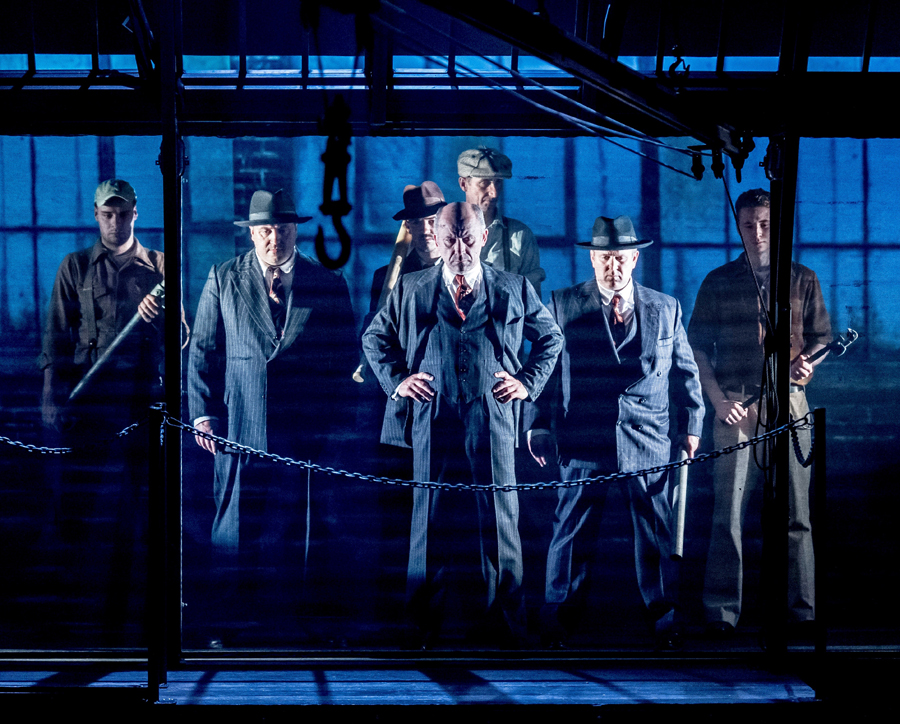
The Hook, Jamie Sives and company, 2015 © Manuel Harlan In the mid 1940’s Miller was captivated by the Red Hook neighbourhood of Brooklyn that contained so many docks and landing piers. He was fascinated by the close community of longshoremen (dockers) and their precarious life of casual day hire, unsafe working practices and exploitation by corrupt Union officials in thrall to the Mafia. Intrigued by the death of Pete Panto, a longshoreman who vanished after confronting Union corruption, Miller wrote “a play for the screen", believing that cinema could be a more democratic way of playing his story to the community he was writing about.

Miller’s Panto is Marty Ferrera, a loud-mouthed and opinionated longshoreman, complete with docker’s hook round his neck. He is also, as Miller himself wrote, that “strange, mysterious and dangerous thing” that is a “genuinely moral man…it’s as though a hand had been laid upon him, making him the rebel, pressing him towards a collision with everything that is established and accepted.” What is established and accepted on the docks is the injustice and corruption of a system that sees work awarded in exchange for bribes, making the hand-to-mouth existence of the longshoremen even more precarious. Marty makes his stand against the system when he can no longer support his wife and child, denied work even after offering his own bribe. So he decides to stand for Union President to address the issues head on.

But Marty Ferrera never reached the screen. Pressure from Hollywood executives and arm-twisting by the FBI who worried it would foment dissent in the dockyards, caused Miller to abandon the project and his director, Elia Kazan, went on to make the more acceptable On the Waterfront some five years later.

The Hook, Joe Alessi (centre) with ensemble, 2015 © Manuel Harlan

So how come the play is receiving its world premiere at Northampton’s Royal and Derngate Theatres this year? It’s down to the painstaking work the theatre's Artistic Director James Dacre has put in on realising the project. Of course his staging, a co-production with Liverpool's Everyman, coincides with the centenary of Miller's birth and Dacre says this timely play “talks about the living wage, zero-hours contracts and industrial communities on the brink of enormous change.” Together with designer Patrick Connellan, Dacre spent years collating Miller’s drafts of the play, illuminated by Miller’s own notes. But what we see has been pulled together into a more than workable script by playwright Ron Hutchinson, who proved he has a special insight into and era for Americana in his brilliant Hollywood comedy Moonlight and Magnolias (charting the painful birth of Gone With the Wind, the movie). Hutchinson was struck by the way Miller went out of his way to avoid stock characters and show just how the main protagonists are neither all good nor bad.

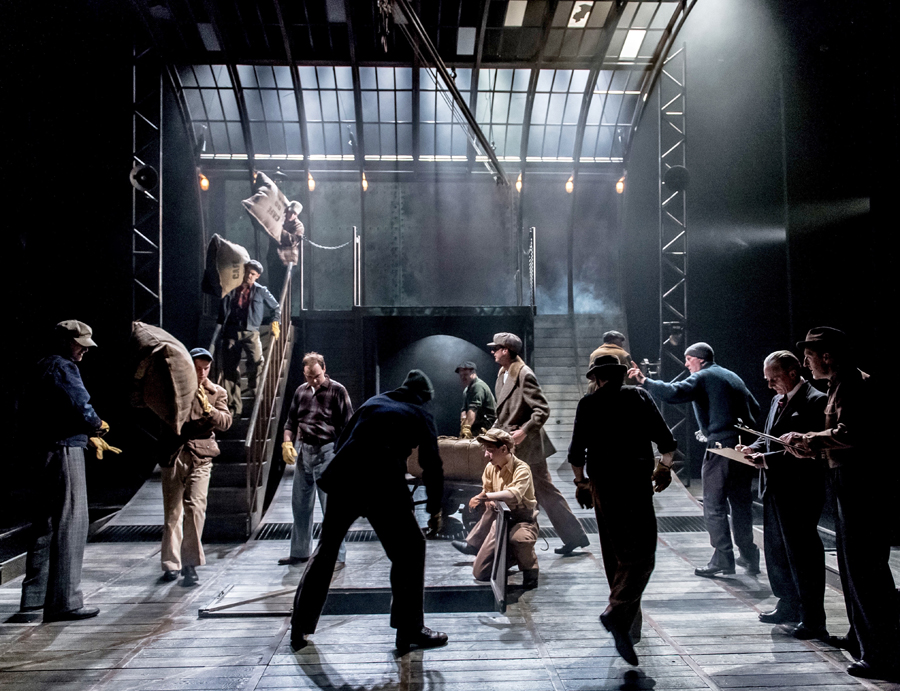
The challenge for the team has been to translate something written for the scale of the cinema into a stage production. Connellan’s brooding set, thanks to clever use of Nina Dunn’s projections and Charles Balfour’s moody lighting, is dockyards, streets, offices and homes, allowing all the cross-cutting demanded by the filmic element of the script. There is more than a nod here to film noir and the strictures of black and white lighting.

Dacre marshals his cast as if they are a vital part of the intercutting, and working with movement director Struan Leslie, choreographs the transitions between scenes with beautiful precision and speed.

The Hook, company, 2015 © Manuel Harlan

Jamie Sives as Marty Ferrera (pictured centre, at the top of the review) is suitably Brando-esque as required, yet brings out the humanity of this common man in a way Miller would have appreciated. Susie Trayling, as Marty’s passively supportive and docile wife Therese is nicely understated in a part that’s reminiscent of Linda Loman in Death of Salesman. Joseph Alessi gives a commanding performance as the ruthless Union Chief (if anyone is the man you love to hate, he is!) and the ensemble is effectively swelled by a community ensemble of local amateurs, totally convincing in the non-speaking crowd scenes. Some of the professionals, though, occasionally distract with slightly wandering New Jersey accents.

It’s not in the end as completely satisfying as Miller at his best in the plays we know and love, but it is a compelling study in treachery and probity and the ongoing struggle for social justice for the working man. It all makes for a genuinely exciting evening, with unexpected and twists and turns in a story perhaps more fast-moving yet less in-depth than in Miller’s dedicated stage plays.

By Judi Herman

Photography by Manuel Harlan

The Hook runs until Saturday 27 June. 7.45pm & 2.30pm. £10-£29. Royal & Derngate, Northampton, NN1 1DP; 016 0462 6222. www.royalandderngate.co.uk

The show then moves to Liverpool Wednesday 1 - Saturday 25 July. 7.30pm. £12-£20. Everyman, Liverpool L1 9BH; 015 1709 4776. www.everymanplayhouse.com

Another loss for the original 1968 Oliver! cast – Ron Moody will be missed

Ron_Moody_and_Lord_Dahrendorf,_1975Ron Moody (left) with Lord Dahrendorf, 1975

"My proudest moment was the number Reviewing the Situation. I suspect that, because I gave my all to the role, and because I was working with such a fine team of people, it inhibited my future career. I turned down quite a few offers afterwards because I thought the people didn't come close to those I'd worked with on Oliver! which, in retrospect, was a mistake." – Ron Moody, 8 January 1924 – 11 June 2015.

Judi Herman reports on the recent death of actor Ron moody, one of the last remaining adult actors, bar Shani Wallis, from the 1968 musical Oliver!.

Readers will no doubt have heard a great deal over the last week about the long life of Ron Moody. Of course he is best known for his creation of Fagin, unforgettable for his gleeful physicality and for his musical phrasing. He relished rolling Bart’s delicious lyrics around his tongue, something I was lucky enough to experience live when I was not quite old enough to be in Fagin’s gang.

Much later on I went with Steve, my husband, to see him live in his one-man show at the also late-lamented Mermaid Theatre in London’s Puddle Dock. Doing a shtick about Hamlet, testing the audience's knowledge about Shakespeare’s play, he barked out the question: "Where did Hamlet live?" Moody had done a lot of stuff about the East End that night and before I could stop myself, I heard my voice yelling "Tower Hamlets!" After that there was no stopping Moody, he picked on me mercilessly for the next hour and I loved every minute of it (as did the rest of the audience). A true great, apparently sprightly right up to the end – he’ll be missed!

Review: On her third helping of The Merchant of Venice, Judi Herman has a discomfiting but enthralling evening

The Merchant of Venice production photos_ 2015_Photo by Hugo Glendinning (c) RSC _MER_157

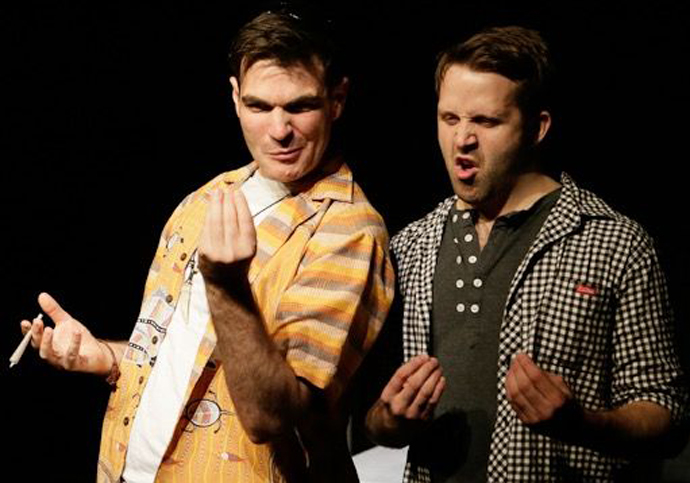
Don't let the buggers grind you down. Try to come over as laid back. They wear a strange eclectic mix of what they see as achingly trendy, or sharp city wear, set off with flamboyant footwear in bright – too bright – poster colours. So wear a dingy blouson over an old cardigan and keep your dignity, simply wipe off their spit when they show their contempt for you. This could be what's going through Shylock's mind in Makram J Khoury's finely calibrated performance, which positively radiates a relaxed gravitas.

It is to be hoped that Khoury, the popular, award-winning Palestinian-Israeli actor didn't base it too closely on his experience as a man caught between two worlds in his native country. Certainly when Christian Venice shows its contempt by spitting on Shylock's "Jewish gabardine", the gasp of horror that runs through the audience is even more of a shock wave than the similar audience reaction when this treatment is meted out to Jonathan Pryce's dignified Shylock at Shakespeare's Globe.

Khoury’s trajectory is frighteningly clear here, from distracted father outraged by his daughter Jessica’s's elopement and her profligate spending and disregard for her dead mother's ring, to vengeful would-be killer. Given the special disgust displayed towards him by Jamie Ballard's alarmingly volatile Antonio, it's hardly surprising he seizes the opportunity to whet his knife and prepare his scales in open court, now entirely indifferent to what the hostile Christians make of his behaviour.

This is the third time this year that I have seen this problematical play and each time I am struck by how little stage time Shylock shares with Jessica. Shakespeare magnifies the awkwardness of what today would be dubbed their dysfunctional relationship by showing so little of it onstage. And, in the few moments they do share together, Jessica is in turmoil over her imminent elopement and the need to deceive her father to make her escape.  Here director Polly Findlay and designer Johannes Schültz trap Scarlett Brookes’ awkward, gawky Jessica at an impossibly high window in her father’s house. So there even less connection as he leaves for the dinner with his new creditor Bassanio that will give her the window of opportunity she needs to escape with her Christian lover Lorenzo (James Corrigan), as well as her father’s jewels and ducats.

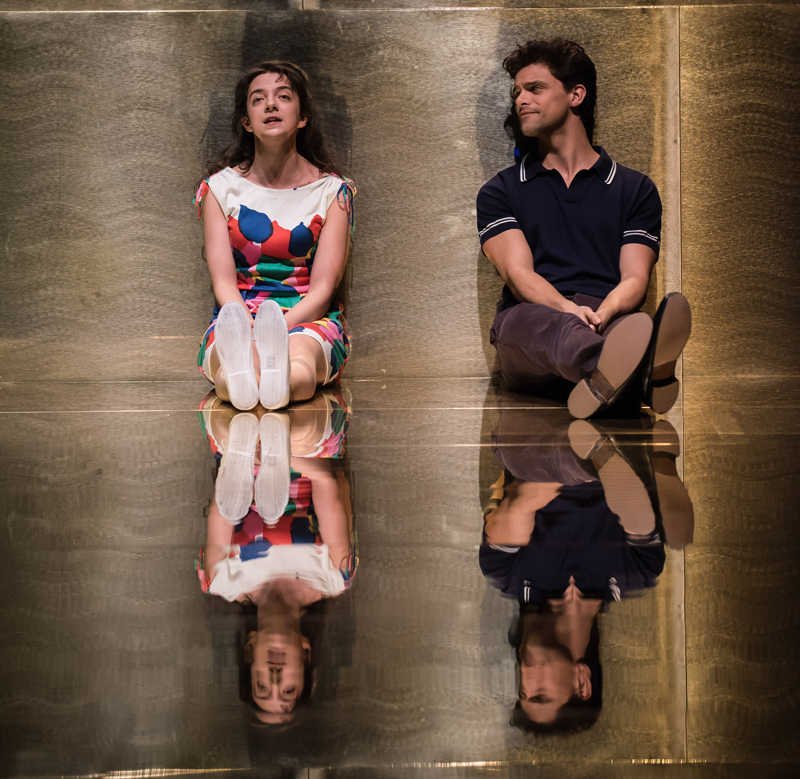
Indeed Findlay, sharing her vision with Schültz and costume designer Anette Guther, builds an especially alienating dystopic Venice, where it’s easy for the audience to share Shylock’s discomfiture. Belmont, wealthy heiress Portia‘s nearby estate, similarly offers little in the way of refuge, even to its owner and her chosen guests from the city, let alone the foreign suitors at whom this Venetian lady pokes fun. The audience is reflected in the huge brass mirrored wall atop which Jessica appears and there is nowhere to hide on a thrust stage with only a mysterious (and perhaps more distracting than hypnotic) pendulum on which to rest the eye, joined briefly later by three symbolic ‘caskets’ lowered from above.

There is certainly nowhere to hide in Venice or Belmont, from creditors in the city, from the whim of a dead father, controlling his daughter’s choice of husband from beyond the grave. And there is nothing to distract from the actors, who first take the stage from seats on Brechtian benches at the rear. If anything, Guther’s flamboyant, jarringly disparate costumes are the set dressing. Patsy Ferran’s intelligent Portia might be grateful to don sober lawyer’s garments, after the hard poster colours of the little shift dresses that seem to be current Venetian jet set fashion here.

There is, though, a shock awaiting her at court. For at the centre of Findlay’s reading of the play is what turns out to be a love triangle, where Portia sees what the audience has known from the start – she must share her new husband Bassanio (Jacob Fortune-Lloyd) with Ballard’s tortured (and I don’t mean by Shylock), depressive Antonio, who claims him with a desperate kiss as he awaits his fate. It certainly makes sense for Portia to channel her discomfiture and anger into her inspired and literally blood-chilling case against Shylock. So this ‘comedy’ becomes even more of a problem play, if Portia and Bassanio’s wedded bliss looks uncertain before their marriage is even consummated.

Meanwhile, Khoury’s now coldly focused, implacable Shylock makes the most of his day in court, almost whetting his knife on Antonio’s bare chest. No wonder Antonio screams and cringes. And though Shylock loses everything, he is perhaps more incredulous than broken and makes it clear that playing for sympathy - from court or audience – is beneath him.  Even he is upstaged by a tsunami of banknotes raining down on the court – effective but perhaps heavy-handed symbolism.

The Merchant of Venice production photos_ 2015_Photo by Hugo Glendinning (c) RSC _MER_148

By the time Portia and her faithful waiting gentlewoman Nerissa (an especially warm and literally supportive performance from Nadia Albina – these girls are close) return to Belmont, Jessica and her Lorenzo do not look entirely comfortable with each other either. Jessica seems almost aggressive as she and Lorenzo top each other with their references to pairs of mythical lovers who might have shared such an enchanted night as theirs, alone on Portia’s estate while its mistress is away at court. The magic should have been enhanced by a floor gradually lit by candle after candle filling the stage, the effect doubled by that mirror wall. But their brash brightness is too obvious a visualisation of Lorenzo’s description of "the floor of heaven thick inlaid with patines of bright gold"; the patina on the brass of that mirror would have done nicely. Perhaps the only real beauty in the evening is provided by the choristers, "young-eyed cherubim" indeed, to quote Lorenzo again, singing Marc Tritschler’s unearthly plainsong from the heights of the set. It’s a particularly discomfiting and alienating reading of this difficult play and though the creative vision is clear, it is perhaps too much of a straitjacket for the drama.

By Judi Herman

The Merchant of Venice runs until Wednesday 2 September (broadcast live in cinemas on 22 July). 7pm & 1pm. £5-£60. Royal Shakespeare Theatre, CV37 6BB; 084 4800 1110. www.rsc.org.uk

Review: The Merchant of Venice – The Globe offers a full-blooded production of a problem play

Shylock The Merchant of Venice may be considered the most problematical of Shakespeare’s problem plays, especially in the current climate of a perceived threat of heightened antisemitism, but there’s more than one Yiddish version of the story, including M. Zamler’s 1929 novel with a brand new title, Shaylock (Der Soyher fun Venedig). Tellingly it is billed as based on Shakespeare’s tragedy.

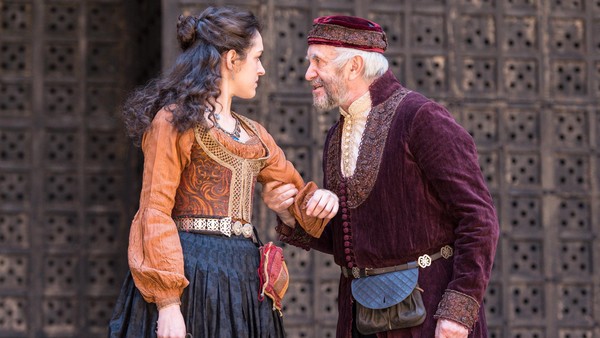
Shylock’s is not the title role in Jonathan Munby’s spirited, yet thoughtful new production for Shakespeare’s Globe, but Jonathan Pryce’s commanding, complex Shylock takes centre stage in each of the few scenes Shakespeare writes for him. In fact Shylock and his rebellious daughter Jessica (played by Pryce’s real-life daughter Phoebe Pryce) get a few more lines than usual – they first erupt on to the stage in the middle of a furious row – in Yiddish!

Pryce (a notable Fagin, but banish all thoughts of that here) has said in interview that he would love it if the audience booed him, yet by the time they watch him arriving in court armed with knife and scales to cut and weigh the famous pound of Antonio’s flesh, it’s clear how much he has had to bear from all the Christians of Venice – especially from Antonio, who really does "spit upon" his "Jewish gabardine" (with the compulsory yellow circle, forerunner of the Nazi yellow star, stitched on the breast) even as he is asking to borrow money. There’s an especially shocking moment, when Shylock’s treasured copy of the five Books of Moses (the Torah), that he clearly carries with him for constant consultation (here looking up the story of Jacob and Laban which Shakespeare has him reference), is wrenched out of his hands and contemptuously flung on the ground. And skull caps off to Munby for some nice research – when Shylock stoops to rescue it, he kisses it to restore respect, a gesture you can see in any synagogue when a prayer book is accidentally dropped.

His distress at hearing that Jessica has exchanged his late wife’s ring for a monkey is especially touching, bringing a temporary moment of quiet sympathy from the usually raucous groundlings, at least the night I saw the play.

Phoebe Pryce’s Jessica has her own awkward path to negotiate once she has broken free of her father to flee with her Christian love Lorenzo. Although wealthy heiress Portia makes the new couple welcome at her grand home and leaves them in charge of it, she causes her young guest a moment of discomfiture when she takes her place to partner Lorenzo in a formal dance that just happens to be slightly suggestive too – does it perhaps smack a little of droite de seigneur?

And usually the last the audience sees of Shylock is a broken man begging for leave to go from the court, under imminent threat of being forced to convert to Christianity. Here his last word is "credo" ("I believe") part of a Latin mass, a conversion ceremony orchestrated by Antonio – either watched or imagined by a distraught Jessica.

THE MERCHANT OF VENICE Shakespeare's Globe 2015 CREDIT: MANUEL HARLAN ... HANDOUT ...

But of course Shakespeare’s Globe is not staging Shaylock. Munby’s reading of Shakespeare’s comedy really does get laughs from the whole house, not just the delighted groundlings, two of whom get to strut their stuff onstage to some of the loudest applause that greets every bit of inspired stage business. They are roped in to help out the clownish servant Launcelot Gobbo, who deserts Shylock for a new master ahead of Jessica’s flight. Stefan Adegbola works the crowd with obvious and expert delight. It’s a pleasure to watch him at work – and so happy in it too!

Others shine in smaller roles as well. Dorothea Myer-Bennett as Portia’s waiting gentlewoman Nerissa, is wonderfully sprightly and intelligent, getting laughs from every echo of her mistress, for example as she is courted by Gratiano, man to Portia’s chosen suitor Bassanio; and even in the sometimes tedious subplot which sees both mistress and maid, disguised in male attire tricking their new husbands into yielding up the rings they gave them to plight their troth. David Sturzaker’s Gratiano is more likeable than some, despite his eager embrace of antisemitism, which is after all as endemic in Venice as anywhere else in 16th-century Europe – and despite an opening gambit that has him throwing up after a night out.

Scott Karim’s Prince of Morocco, somehow managing to be dignified and ridiculous at the same time and Christopher Logan’s wonderfully daft Prince of Arragon, straight out of Carry On Columbus, get the very most out of their cameo roles. They underline the ‘Little Venice’ prejudice of Portia and her clique, worthy of UKIP; for the young women have already ridiculed suitors from all over Europe before this brave pair dare to face the rather cruel trial that Portia’s late father has decreed for those who seek her hand.

That’s not to say that Rachel Pickup’s intelligent, even prickly Portia and Daniel Lapaine’s handsome though febrile Bassanio and Dominic Mafham’s repressed Antonio don’t hold their own throughout. It’s more a paean to the completeness and effectiveness of this production in every role.

Mike Britton’s simple stage design, letting his colourful costumes sing out, and Jules Maxwell’s delicious music, played and sung by a surprisingly small and hugely effective ensemble (singers Jeremy Avis (also musical director) and Michael Henry and Nuno Silva with Dai Pritchard on clarinets and Catherine Rimer on cello) enrich this hugely satisfying period production.

By Judi Herman

Photography by Manuel Harian

The Merchant of Venice runs until 7 June. 7.30pm & 2pm. £16-£43 seats, £5 standing. Shakespeare's Globe, 21 New Globe Walk, SE1 9DT; 020 7401 9919. www.shakespearesglobe.com