Theatre

Review: NotMoses ★★★ – Carry on taking the tablets, there's some epic fun to be had amongst the groans and jokes

Thomas Nelstrop (Moses) in NotMoses © Darren Bell Filmmaker Gary Sinyor’s irreverent retelling of the Exodus story starts with the baby left floating on the Nile when the Princess takes up Moses, a nicer baby who doesn’t cry and has a proper - er – Moses basket. NotMoses grows up a slave in Prince Moses’ shadow, until God orders both of them to lead the Israelites out of bondage – though it takes feisty Miriam to lead the Exodus. Synor’s intent was Life of Brian meets The Ten Commandments, but it’s rather more Carry On Taking the Tablets, silly humour that sends up the biblical story and religion. Like the Carry On films it could just get the audience vote and become a cult hit.

Knowledge of the Bible and its language (or the first five books anyway) certainly helps, and Synor displays his lightly, learned in cheder (religion school) and synagogue in his Manchester childhood. It all starts with a comedy canter through the stories of the patriarchs leading up to the plight of the Israelites as slaves in Egypt. The Bible lesson turns out to be an extended sermon from Leon Stewart’s well-meaning, though misguided (and anachronistic) rabbi, ministering to the Hebrew slaves. A bit of popular culture helps too as Joseph inevitably bursts into song …

You can’t fault the cast for playing the characters with sincerity as well as a knowing twinkle, for staying in character and not sending it up unless appropriate.  Greg Barnett invests NotMoses with the determination and frustration of the atheist who doesn’t believe in God, ready to lead the Children of Israel out of Egypt without anyone’s help. He is comedy paired with Thomas Nelstrop’s Moses, a preppie budding accountant at the palace who grows the beard and perfects the biblical epic lingo once he's heard God in the Burning Bush - and had his kebabs singed there (ooh, Matriarch!).

There’s the expected cast of stock characters, notably the admirable Jasmine Hyde channeling Amanda Barrie in Carry On Cleo, Niv Patel's pouting, petulant Rameses and Joe Morrow as a camp, crowd-pleasing slave driver. But Moses’ sister, Miriam, is a modern fighter for equal women’s rights in this very patriarchal world and Danielle Bird delivers the strongest and most serious speech of the evening with great compassion and conviction.

Life at number 613 (the number of commandments Jews are supposed to keep - geddit), where NotMoses lives with his slave parents, provides a send up of Jewish family life with a nod to Fiddler on the Roof, the Papa (Dana Haqjoo doubling as a legless Pharoah, squatting on his throne like a Dr Who villain or Dan Dare’s Mekon) bemoaning his lack of riches and the Mama (Antonia Davies) preoccupied with food and finding a nice Jewish girl for her son.

Dana Haqjoo (Pharoah) in NotMoses © Darren Bell

And struggling with a series of diktats heralded by thunder, the chosen people have spotted that the Divine Being is also preoccupied with food, not to mention clothing. In the light of the laws on keeping kosher and synagogue readings from of the Torah in recent weeks dwelling in detail on what priests should wear, Sinyor has a point. This is a family Being too, who has to deal with his difficult adolescent Child (presumably omnipresent rather than anachronistic), an extra dimension to ponder, voiced by 13-year-old Izzy Lee at this performance.

There are, of course, plenty more anachronisms, word jokes and double-entendres, from Jethro, Moses' future father-in-law, offering meat he says “Is-lamb” to the toilet humour of the effects of eating unleavened bread (matzah). It often smacks of student revue or something a synagogue youth drama group might come up with for a fundraiser, which does mean there are actually  real nuggets of crowd-pleasing fun amongst the groans and lamer jokes.

Synor says the project started life as a film script and this shows in the too frequent fadeouts between the many scenes, effectively salvaged though by Carla Goodman’s sparse sets and Lola Post Production’s epic visual effects creating Egyptian palaces and pyramids and an impressive divided Red Sea, to the soundtrack of Erran Baron Cohen’s matching epic music. The plague of rather realistic plastic frogs which rains down on stage and audience alike is a nice (or should that be nasty) touch.

Some years ago, the playwright Steve Waters wrote that working with a good director is rather like going into analysis – however lucid you might feel to yourself, what emerges in the production of a play exceeds your intention. “Your set might be definitive, your dream cast fixed, but your play in the hands of another often yields a far more surprising piece of theatre than you're capable of envisaging.”

It would have been interesting to see what emerged with a theatre director at the helm and without the expectations of West End opening, albeit in the intimate surroundings of the Arts Theatre, but nevertheless, it certainly gets a lot of laughs so it could prove to be that cult hit.

By Judi Herman

NotMoses runs until 14 May 2016, 7.30pm & 2.30pm, £19.50-£49.50, at Arts Theatre, Great Newport St, WC2H 7JB, 020 7836 8463. https://artstheatrewestend.co.uk

Review: Mrs Henderson Presents ★★★★ – Vintage British fun in a new musical that evokes good old wartime spirit

Mrs Henderson Presents © Alastair Muir Musical theatre doesn’t need to be ground-breaking or stuffed full of numbers that go on to become ‘standards’ to be thoroughly enjoyable. What’s needed is a compelling story, an excellent ensemble and music and lyrics that move the plot along rather than holding up the action. Mrs Henderson Presents is just that – and it’s unashamedly and eccentrically British – with a Jewish protagonist sharing top honours for good measure.

Writer and director Terry Johnson was captivated by the 2005 film Mrs Henderson Presents, the story of the Windmill Theatre in London starring Judi Dench and Bob Hoskins, and he jumped at the chance of developing a musical of the film with leading Jewish lyricist Don Black and composers George Fenton and Simon Chamberlain.

In 1930, recently-widowed Mrs Laura Henderson buys the old Palais de Luxe cinema as a creative diversion and fits it out as a tiny, one-tier theatre, renamed the Windmill. It is, of course, not profitable so she hires Vivian Van Damm to change its fortunes. Van Damm, of Dutch Jewish origin, hits on the idea of ‘Revudeville’, a programme of continuous variety with 18 entertainment acts. But this is also a commercial failure, so they add the daring dimension of nudity to create the allure of the Folies Bergère. To get round the censorship laws policed by the Lord Chamberlain’s office, Mrs H argues that since nude statues cannot be banned on moral grounds neither can living statues or tableaux vivants. Hence the ruling "If it moves, it's rude".

This is the true story ripe for transmuting into first cinema and now stage-musical gold. And Van Damm's flair for public relations created the legend of the theatre that "never closed". Newspapers carried pictures of plucky Windmill girls in tin hats on fire-watching duty, and stories of showgirls giving V-signs to German bombers. Indeed, except for a 12-day period in 1939, when all London theatres were ordered closed, the Windmill remained open throughout the Blitz.

Mrs Henderson Presents © Dewynters

The plot inevitably rests heavily on the shoulders of Henderson and Van Damm and the love interest of artiste Maureen and stage hand turned airman Eddie. Tracie Bennett suffuses doughty Mrs Henderson with an extraordinary zest for living, not least in the numbers Whatever Time I Have and Anything But Young, and she captures that marvellous British spirit of no-nonsense eccentricity. Ian Bartholomew's caring Van Damm manages to be at once authoritative and self-deprecating - and not a little surprised at how well his precarious show business is turning out. The plight of Jews in Europe is suddenly placed centre stage when he receives news of the German invasion of Holland and the rounding up of Jews by the Nazis, including his own relatives left behind. Wearing a Star of David armband in solidarity, he expresses his distress in the number Living in a Dream World. There’s fun at his expense too, when Emma Williams’ warm, feisty Maureen challenges all the men in the theatre company to reveal all first if they want the girls to strip off and Mrs Henderson, feigning surprise, exclaims drily “You are Jewish!” Williams displays a lovely dawning  realisation as a woman discovering the 'power of her own presence' as Johnson puts it, notably in her full frontal nude castigation of Mr Hitler as the bombs fall, while Matthew Malthouse's Eddie is at his best trying to 'Fred and Ginger' Maureen.

Johnson directs his own story (first seen at the Theatre Royal, Bath, last year) against Tim Shorthall's set that vividly conjures up back and front stage (and roof) of the Windmill, all backcloths and props, superbly lit by Ben Ormerod to suggest both the dinginess of backstage and the bright lights of the front. And there’s a witty single light that comes on above Mrs Henderson's head when she has her ‘lightbulb’ moment - nudity is the way out of their problems! But paradoxically, nude revues need glamorous costumes and Paul Wills comes up with some gorgeous outfits for the revues and lovely period authenticity for the workaday clothing.

It's all good-natured and corny pre-war and war-time chipperness, from the front of cloth comic ("cheeky chappie" Jamie Foreman) to the back-stage crew and dance captain (Samuel Holmes, elegant and waspish in just the right proportions). Robert Hands’s Lord Chamberlain and his secretary (Oliver Jackson) have a lot of fun with the writing team’s homage to Gilbert and Sullivan, the eponymous Lord Chamberlain’s Song. Lizzy Connolly, Lauren Hood and Katie Bernstein as the pioneering  statues baring all for raised wages of 30 bob a week are terrific throughout. They give delightful support (no pun intended)  in a nifty little number with famous paintings ‘dressing’ the set to demonstrate the high art displayed by those ample Rubens and Renoir nudes. Andrew Wright’s choreography is spot-on convincing for the period – and I guess he gets the credit for those tableaux vivants too. And the music and lyrics team of Fenton, Chamberlain and Black have been around long enough to pastiche the 40's style with panache. They give the music their own original flavour too, never allowing the music to overwhelm lyrics that do a nice job moving on the plot. There's a debate to be had as to whether the portrayal of such nudity in 2016 is inappropriately exploitative or empowering but judging by the response the night I saw the production, audiences are enjoying the fun and sharing it with the cast onstage – clothed and unclothed.

By Judi Herman

Mrs Henderson Presents runs until Saturday 18 June, 7.30pm, £10-£97.50, at Noel Coward Theatre, St Martin’s Lane, WC2N 4AU; 0844 482 5140. www.mrshenderson.co.uk

Review: Poppy + George ★★★★ – A beguiling, thought-provoking exploration by Diane Samuels of identity and possibility after the Great War

Poppy and George, Watford Palace Theatre © Richard Lakos The year is 1919. The Great War is finally over and Poppy Wright, inspired by her suffragette teacher, arrives in London from the north of England to make her mark, rather than stay in service as a nanny. In the heart of the East End, in a back alleyway, she finds work in Smith’s tailoring and costumiers’ workshop. There she meets not only Smith, the Russian Jewish tailor with a Chinese past, but also George the chauffeur and war hero and Tommy Johns, the music hall female impersonator, also back from the trenches.

This beguiling, thought-provoking play, from the writer of the hugely successful Kindertransport, explores a time of change and opportunity after the cataclysm of the First World War and the subsequent influenza flu pandemic, when all classes questioned their subsequent lives and their roles in a new, modern era. Poppy is increasingly entranced by the freedoms held out by the suffragette movement, at the same time as falling in love with George, while the supportive Smith consoles Tommy as he attempts to reconcile with a wife and child he has not seen for years.

David Holmes lighting works magic with Ruari Murchison’s open set, all brickwork and fabric storage, with costumes flying above that are flights of fancy in themselves – plus the all-important piano – to create an enchanted space in which the unexpected can happen. And perhaps taking a cue from Polonius’ saw “the clothes doth oft proclaim the man”, she explores how those garments can be used as ‘shape-changers’ to fashion an individual’s  image   The sound and composition by Gwyneth Herbert, reflecting, as she says the “bawdy music hall, the rhythm of sewing machines and shadowy, uneasy echoes" wonderfully evokes the world of possibilities in which the four characters dwell.

Poppy and George, piano, Watford Palace Theatre © Richard Lakos

Jennie Darnell directs Samuels’ exploration of gender identity and new possibilities in a changing world with a charmingly light and good-humoured touch that never preaches or lectures. Together Darnell and Samuels conjure the pathos of the fading music hall and its artistes after the Great War. Nadia Clifford’s luminous warm-hearted Poppy captures a woman starting to open her mind to those new possibilities, and teetering on the brink of exploring life with George, swaggering Rebecca Oldfield, comfortable in her skin and her chauffeur’s braces and trousers. Jacob Krichefski , an imposing bushy presence, beautifully conveys Smith’s exotic past and intriguing hinterland; and multi-talented actor/musician Mark Rice-Oxley gives an outstanding and deeply affecting performance as Tommy, believably making up tunes and lyrics on the hoof.

Twenty years after its first incarnation as Turncoat, a one-act play Samuels wrote for young people’s company Theatre Centre, in an increasingly gender blind world, she reminds us that it's still good to dare to leap into the unknown and to question our roles. And there's no better place do that than in the former music hall that is the current Watford Palace Theatre.

By Judi Herman

Poppy + George runs to 27 February, 7.30pm & 2.30pm, £12-£22.50, at Watford Palace Theatre, 20 Clarendon Rd, WD17 1JZ; 01923 225671. http://watfordpalacetheatre.co.uk

Listen to Diane Samuels on JR OutLoud discussing Poppy + George and her new oratorio, Song of Dina.

JR OutLoud: Diane Samuels talks about her play Poppy + George and her new oratorio Song of Dina

Liverpudlian playwright Diane Samuels talks to Judi Herman about identity and change from London's East End 1919 to now. These themes feature in her play Poppy + George, about Northerner Poppy Wright, who is taken on at a tailoring workshop by the proprietor Smith, a Russian Jew with a Chinese past. It's here that Poppy also meets Tommy the music hall artist and George the chauffeur, both changed by serving in the trenches.

Diane also discusses her new project (at 21:49), Song of Dina, a multimedia oratorio with music by composer Maurice Chernick, based on the story of the Patriarch Jacob’s only daughter.

Poppy + George runs to Saturday 27 February, 7.30pm & 2.30pm, £12-£22.50, at Watford Palace Theatre, 20 Clarendon Rd, WD17 1JZ; 01923 225671. http://watfordpalacetheatre.co.uk

Song of Dina launch event on Wednesday 6 April, 7.45pm, FREE, at JW3, 341-351 Finchley Rd, NW3 6ET; 020 7433 8989. www.jw3.org.uk

Read JR's four-star review of Poppy + George

Review: Battlefield ★★★★ – Peter Brook returns to the Mahabharata with a meditation on the aftermath of war that will stay with audiences

Battlefield at the Young Vic, Sean O'Callaghan, Jared McNeill, Ery Nzaramba, Carole Karemera and Toshi Tsuchitori © Simon Annand Thirty years ago, the great and influential Jewish theatre practitioner Peter Brook worked with writer Jean-Claude Carriere and a large cast from the company who had gathered around him in Paris to dramatise The Mahabharata: the Sanskrit epic of the mighty Bharata family torn apart by a great war. The result was nine hours of mesmerising epic theatre, which I was fortunate enough to see in a Glasgow tramshed transformed by red earth into the Indian subcontinent. Now aged 90, working with his long-term collaborator Marie-Hélène Estienne, he returns to just one section of the mighty epic, which they've called Battlefield.

This meditation on the sorrow and pity of war, eloquent and moving in its extraordinary simplicity, is sadly both timely and timeless as we continue to commemorate two World Wars, while the world is ripped apart and whole peoples put to flight by conflict in Syria and elsewhere. Battlefield is about the aftermath of war and especially internecine struggle within dynasties, here two great families, the Pandavas and Kauravas. The five Pandava brothers may have triumphed over their cousins the hundred sons of the blind King Dritarashtra, but for Yudishtira, oldest of the Pandavas who must now become king, it is a Pyrrhic victory. He has lost so much and so many family members and confederates lie dead on the field of battle. So he finds he has all too much in common with the old blind King he has defeated.

And so many themes and threads in this story sound as familiar as the weekly Torah portions and Haftorah readings you can hear in synagogues around the world every Shabbat. For David’s lament over Saul and Jonathan, “The beauty of Israel is slain among thy high places,” and his later raw cry over the death of his traitor son Absalom, “Oh, Absalom, Absalom, my son…” resonate with the anguish of these survivors of battle, both victor and vanquished. There is even the story of a baby pulled from a river where his mother has abandoned him floating in a basket. His rescuers are princely and he grows up to be the mighty warrior Karna.

The glory of this production, little more than an hour long, is its stunning simplicity. It is performed on a thrust stage, again covered by that orange-red dust, by four powerful performers – at the same time physical and cerebral – who morph sinuously from one role to another as necessary. Nobody is credited with the simple design, but Oria Puppo’s streamlined costumes, echoing that theme of the modern and timeless, are enhanced by huge bolts of red and orange cloth to wonderful effect, serving as robes and cloaks, rivers, the elements of fire and earth, storms and even untold riches. Philippe Vialatte’s mood-making lighting too seems like an extra character. And the whole is brilliantly underscored and orchestrated by the drumming of master musician Toshi Tsuchitori, whose rhythms eloquently enhance and alter the mood and pace.

Battlefield at the Young Vic, Carole Karemera and Jared McNeill © Simon Annand

Stories are folded within stories, and amidst that sorrow and pity there are plenty of flashes of humour, albeit dark or rueful. Each performer is singular and all work wonderfully together. Sean O’Callaghan is a huge and imposing presence, especially moving as the blind and bereaved King Dritarashtra, but ruefully comical as a worm in danger of being crushed. To Jared McNeill falls the role of the victorious Yudishtira, as graceful – and abashed – in victory, as the vanquished old King he has toppled. While Ery Nzaramba is both funny and authoritative as the wise men whose advice to the king comes in the form of those parables about a succession of animals including that worm, as well as a pigeon and a mongoose.

Stately Carole Karemera (who plays the pigeon with comic economy) is as capable of huge dignity as the queenly women caught up in the struggle, principally Yudishtira’s mother Kunti, but it is her heartrending Ganga, her terrifying cry of grief and loss at the death of her son that I shall long remember – standing for every bereaved mother indeed.

“For an idea to stick it must be burnt into our memories,” says Brook in his hugely influential meditation on theatre, The Empty Space. The singularly funny and thought-provoking tale of a king who offers more and more of his body to be weighed in the scales against that pigeon till every bone is part of the weigh-in proves to be a telling and memorable metaphor. And then one of the wise men has a parable for the new King in which a mongoose tells a rich man to give away all his riches to the poor. He begins to involve the audience, homing in on various members asking if they are rich or poor. Some fess up to being rich, others assert they are poor and are ‘rewarded’ with some of those red and orange cloths. The last of these ‘lucky’ recipients finds his lap piled so high he cannot move and can barely applaud at the end. It is the image of this discomfiture, which so perfectly embodies the ambiguity of riches – and indeed victory – that sticks in my memory. The storytelling of Brook and Estienne accrues power even as they continue to strip it bare to the bone.

By Judi Herman

Battlefield runs until Saturday 27 February, 7.30pm & 2.30pm, £10-£35, at Young Vic Theatre, 66 The Cut, SE1 8LZ; 020 7922 2922. www.youngvic.org

Review: Jeepers Creepers ★★★ – Get perhaps a bit too up close and personal with supreme Jewish comic writer/performer Marty Feldman

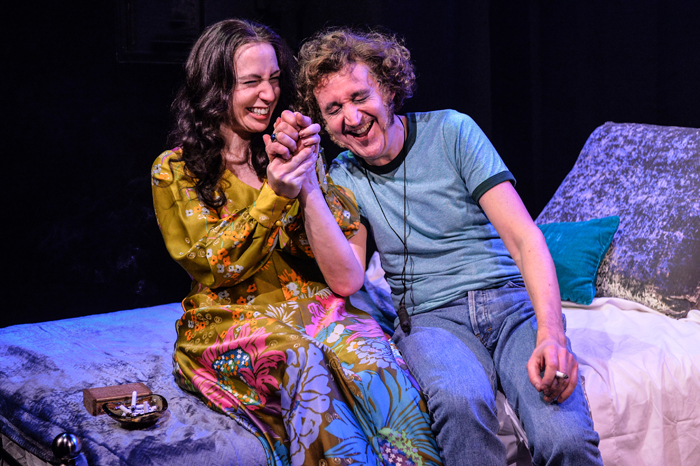
Jeepers Creepers 3 David Boyle (Marty Feldan) and Rebecca Vaughan (Lauretta Feldman) photo by steve ullathorne Marty Feldman features as the world's favourite Jewish vampire in one of my favourite sketches ever, with the punchline, “Oi, have you got troubles,” when the vampire hunter holds up his cross. He was the writer/comedian with the wild hair and staring eyes, the result of a botched operation for Graves’ disease, though they stood him in good stead as the creator of some of the funniest characters ever seen on small or big screen. Think ‘Young’ Frankenstein's hunchbacked henchman Igor in Mel Brooks' movie. Indeed he is sort of undead in Robert Ross’s new biodrama, directed by Feldman’s old mucker and lifelong admirer, Terry Jones. It opens with silent film titles on a screen at the back (in appreciation of Feldman’s appearance in another Mel Brooks film, Silent Movie), announcing ‘three years’ dead’, then two, then six months, each title accompanied by the appearance of a ghostly luminescent skull in a glass case, until Feldman is alive again and not so much kicking as contorting – for he is indeed in Igor mode, complete with hunchback prosthetic.

David Boyle’s frenetic, elastic recreation of Feldman engages with the audience – in my case one-to-one, for he lures me briefly onto the small cramped stage set up as a claustrophobic, Stateside hotel room – be ready to take part if you sit in middle of the front row!

Happily his partner on stage is Rebecca Vaughan as his life partner Lauretta Feldman. The year is 1974, Young Frankenstein is about to be released and Feldman is about to hit the big time in the USA. The couple are playing a waiting game, holed up in the hotel the night before Feldman is due to appear on a prime-time chat show. The warning in the foyer that herbal cigarettes are used in this production is not in vain. The Feldmans chain-smoke their way through the night and Marty drinks his way through it too, while Lauretta leafs through Vogue as her efforts to persuade him to get to sleep prove futile.

Jeepers Creepers 5 David Boyle (Marty Feldan) and Rebecca Vaughan (Lauretta Feldman) photo by steve ullathorne

So it’s a night of dissecting previous triumphs and disasters and for Lauretta at least, nervously anticipating what might go wrong in front of millions of viewers the next evening.

We learn that Feldman is a womaniser as well as a hard drinker (though we also learn that he knows that home is where the heart is and always goes back to Lauretta); and we are present when he has his fatal heart attack at the tragically young age of 48 in a Mexican hotel room. But I’m not sure that those who don’t already know his work (and love it, for I’m sure to know it is to love it), will pick up the references to his extraordinary back catalogue of radio and TV script writing and appearances – including co-writing Round the Horne on radio and The Army Game and The Frost Report for TV, and writing and appearing in iconic shows, such as At Last the 1948 Show and his own series Marty. But if it makes folk seek out the work then that’s no bad thing – and they can always read playwright Robert Ross’s well-reviewed biography of Feldman, Marty Feldman, The Biography of a Comedy Legend.

Meanwhile there is much to enjoy in the performances of Boyle and Vaughan (he could also tackle Gene Wilder any time he likes, for he’s a dead ringer for Feldman’s co-star in Young Frankenstein), despite their uncomfortable proximity in the confines of the tiny – and herbal smoke-filled – studio theatre.

By Judi Herman

Jeepers Creepers runs until Saturday 20 February, 7pm & 4pm, £20.50-£22.50, at Leicester Square Theatre, 6 Leicester Place, WC2H 7BX; 020 7734 2222. www.leicestersquaretheatre.com

Review: The Pianist of Willesden Lane ★★★★ – Moving pictures of a mother’s life and music glow in the warmth of a daughter’s love

Mona Golabek in The Pianist of Willesden Lane 03. Photo Credit Hershey Felder Presents. Adapted by Hershey Felder from the book The Children of Willesden Lane, by Los Angelean pianist Mona Golabek and Lee Cohen, this is the true story of Golabek's mother, Lisa Jura. As a young Jewish pianist Jura's dreams about her Vienna concert debut were shattered by the Nazis in the 1938 Anschluss like the glass of Kristallnacht, as her family bravely placed her on the Kindertransport to London.

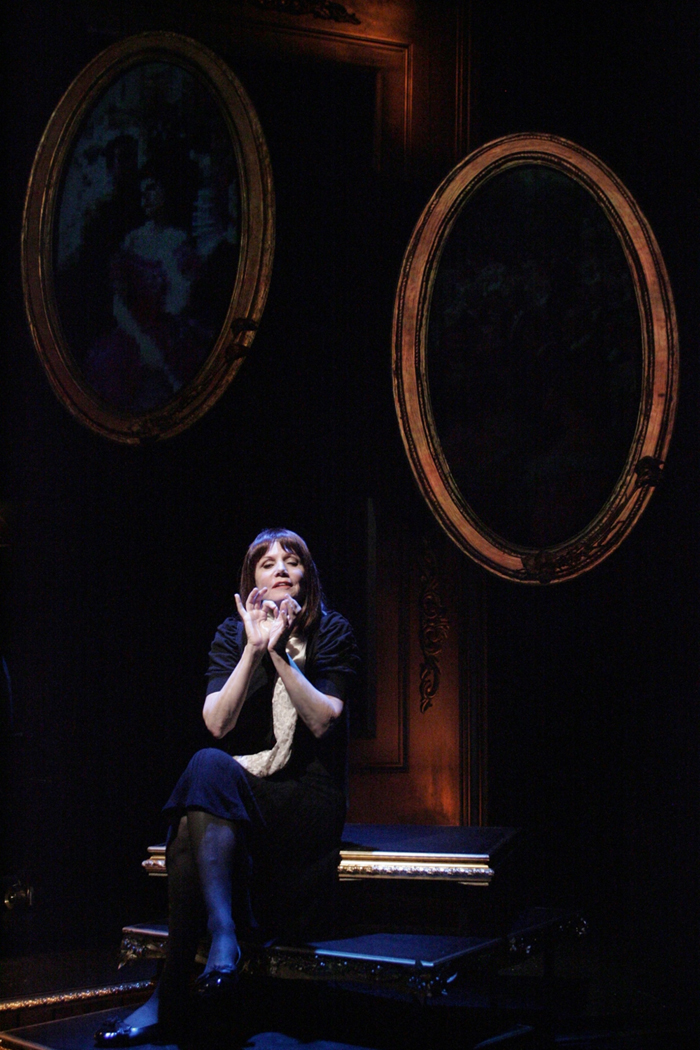
At first sight the set resembles a music salon or concert hall dominated by a magnificent Steinway grand piano, with mirrors in ornate gilded frames on the walls behind and a bank of flowers around the footlights.

Golabek, a slight red-head dressed simply in black, moves into the light on the steps and turns the warmth of her smile on her audience to address them. Soon she turns to the piano from where she will tell so much of the story about her mother. As her long elegant fingers touch the keys, she reveals one of the most potent reasons for the success of her loving tribute to her mother. Having inherited her mother’s gift, because she took in the stories about her mother's life as Jura taught her to play the piano, Golabek can perfectly time her storytelling to create a seamless weave between words and music, underscoring with great sensitivity and, when necessary, allowing words or music to breathe alone.

It’s a story at once singular and familiar – as in the end perhaps all such stories are. Every Holocaust survivor’s story reveals a family life cruelly cut short, a childhood abruptly ended, heart-breaking separation from loved ones. Jura is no different, her mutual love for her parents and sisters is quite enough to make her story heart-breaking. But her particular heartbreak – and her salvation – is her passion for the piano music she was born to play.

Jura lives for her weekly piano lessons, dreaming of making her professional debut with Grieg’s piano concerto as she crosses Vienna to see her music professor. But this is the week that he has been ordered to give up his Jewish pupils and this is just the start of the restrictions and persecutions the Anschluss and the arrival of the Nazis brings to the city’s Jews. So no sooner has Golabek evoked the rich cultural life of pre-war Vienna, the salons, cafés and concert halls (cleverly illustrated by photographs and film projected on all those mirrors by projection designer Andrew Wilder, with lighting designer Christopher Rynne), than her mother’s dreams are shattered in the glass of Kristallnacht. Jura’s father is humiliated and forced to clean the streets, but there is a chance for just one of his girls to escape on the Kindertransport. The terrible choice must be made and falls on the young pianist.

Jura’s own evocations of her life, lovingly painted for her daughter as they sat together at the piano must have been extraordinarily vivid and reinforced by constant retelling too, for Golabek’s own retelling is spellbinding, tracing her mother’s journey across Europe, her arrival in pre-war Britain, and eventually, after a sojourn in the Sussex countryside, at the hostel in Willesden Lane, filled with other young people with similar stories.

Mona Golabek in The Pianist of Willesden Lane 04. Photo Credit Hershey Felder Presents.

The welcome she receives there, how she enthrals her new friends as she is drawn to play the hostel’s piano, what befalls her during the air raids and above all the kindness of strangers as well as her fellows, is the stuff from which Golabek and director/adaptor Hershey Felder mould such a rich show.

When Jura gets work in an East End garment factory, Golabek draws a striking analogy between the notes she plays on the keys of the piano and its strings, the textures of the music she weaves and the ‘music’ of the sewing machines on which she works, weaving garments at the factory.

Golabek’s musical selection is an eclectic delight, including Beethoven, Debussy, Chopin, Bach and many more from Jura’s classical repertoire, spiced with a couple of popular songs also dear to her mother’s heart – Gershwin’s Strike Up the Band and These Foolish Things (Eric Maschewitz and Jack Strachey).

It would be a shame to reveal all of Jura’s uplifting story, but there are delightful vignettes on the way – of Myra Hess at the piano in her famous lunchtime concerts at the National Gallery during and after the Blitz; of ‘our brave boys’ at rest and play in the piano bar where she gets to play for her living, to save her fingers from being ruined at those machines; and of the folk she meets in war-torn, bombed out London, her co-workers at the factory and her peers at the hostel all showing solidarity with the young pianist and rooting for her as she triumphs at last.

There is of course romance too, but again it would be telling to reveal the story of how Jura meets the man who will be the father of the children to whom she will one day pass on her talent and her love of music and her story.

So see – and hear – this beautiful, heart-warming show for yourself. It is especially poignant that it plays here through the week of Holocaust Memorial Day; and not surprising to hear that it has sold out for months in New York and toured the USA too, where Golabek educates young people about the Holocaust with a film, as well as this theatre piece based on her book The Children of Willesden Lane.

By Judi Herman

The Pianist of Willesden Lane runs until Saturday 27 February, 7.30pm & 2.30pm, £22.50-£40, at St James Theatre, 12 Palace St, SW1E 5JA; 0844 264 2140. www.stjamestheatre.co.uk

Watch a brief extract from the show below:

To find out more about all the projects in which Mona Golabek and her family are involved, including the documentaries, I am a Pianist and Finding Lea Tickotsky, and the book The Children of Willesden Lane: Beyond the Kindertransport – A Memoir of Music, Love and Survival by Mona Golabek and Lee Cohen, visit holdontoyourmusic.org.

JR OutLoud: Judi Herman speaks to the brains behind the musical retelling of the real-life riches to rags story, Grey Gardens

Photo © Scott Rylander

In the mid-1970s Albert and David Maysles – first-generation sons of Jewish immigrants to the US from Eastern Europe – made Grey Gardens, one of their most famous films. The documentary told the story of a mother and daughter from the highest echelons of US Society, Edith and Edie Bouvier Beale, who were the aunt and cousin of Jacqueline Kennedy Onassis. The two Bouvier Beale women were discovered living as reclusive social outcasts in Grey Gardens, a dilapidated mansion overrun by cats that was so squalid the Health Department deemed it “unfit for human habitation”.

Now another creative Jewish pair, composer Scott Frankel and lyricist Michael Korie, together with book writer Doug Wright, have brought their multi-award-winning musical based on the film to London. JR’s arts editor Judi Herman, who saw Thom Southerland’s European premiere starring Sheila Hancock and Jenna Russell, was enchanted by this riches to rags story, as you’ll hear in her interview with the three writers.

Grey Gardens runs until Saturday 6 February, 7.30pm & 3pm, £25, £20 concs, at Southwark Playhouse, 77-85 Newington Causeway, SE1 6BD; 020 7407 0234. www.southwarkplayhouse.co.uk

Watch the cult documentary Grey Gardens in full below:

See Jenna Russell sing Another Winter in a Summer Town from the musical:

Mona Golabek talks about The Pianist of Willesden Lane, the moving memoir of her mother – concert pianist and Kindertransport child - that she brings to the stage for its UK premiere this January

The Pianist of Willesden play 2016 Adapted by Hershey Felder from the book The Pianist of Willesden Lane, by Los Angelean pianist Mona Golabek and Lee Cohen, this is the true story of Mona’s mother, Lisa Jura, a young Jewish pianist whose dreams about her Vienna concert debut are shattered by the Nazis in the 1938 Anschluss like the glass of Kristallnacht, as her family bravely places her on the Kindertransport to London. Golabek plays live on a concert grand in this moving one-woman show, the London run of which coincides with Holocaust Memorial Day on Wednesday 27 January. Judi Herman talks to Golabek about The Pianist of Willesden Lane to coincide with its UK premiere.

What made you decide to make the book into a one-woman play?

"My path crossed with Hershey Felder, quite a genius in his particular genre and he took me under his wing, believed in the story and adapted the book for the stage.  He helped me to find an inner voice, to inhabit the story and the characters and become my mother in a way – I do become her, imagining her in that story and taking the audience on that journey."

It’s extraordinary to play your own mother, particularly in this circumstance with this very emotional story – is that quite hard for you?

"It’s a very powerful statement to make and people ask me how I’m able to do this night after night. My answer is, this is a privilege and I think it’s become my destiny in a way. When I was a little girl my mother taught me piano and she always told me each piece of music tells a story and in those lessons she told me she told me the story of how she got out on that train and grew up in Willesden Green as a Jewish refugee and how the kindness of that community and the British people was the reason that I, as a little child, was alive.  They saved my life, these people! So I’m coming back to London to say thank you. I’m bringing the story home."

Was the Willesden Lane hostel Jewish, as the matron was a Mrs Cohen, and were all the children Jewish?

"Yes all the children in the hostel were Jewish.  There were all sorts of kids, 30 of them from different parts of Europe."

So is the play a dramatisation of the book?

"It’s an adaptation. The book follows many of the characters who landed up in Willesden Lane.  My mother of course was the primary character.  The play at 90 minutes is a condensation, with strong elements of music."

To me the idea of the music, which your mother handed on to you, sounds so powerful. You are also a very accomplished pianist, which you’ve inherited from her. How did you choose the pieces that you use in the show?

"The music was very much integral to what my mother learned along the way.  So for example the Grieg Piano concerto in A Minor that is so important in this show, this story, was the piece she dreamed of making her debut with when she was a little girl on the way to her piano lessons."

The Steinway that you’re playing in the show is spectacular – is it a special family Steinway?

"All Steinways are special to perform on, though it’s not a special instrument from that time period. It’s a great honour for me to be a Steinway artist. This is a kind of love letter to the piano and to Steinway. Because my mother was a poor refugee girl, she dreamed of playing, making her debut, on a Steinway. She went to hear Dame Myra Hess playing on a Steinway and, that was an extraordinary moment for her. She talked to me about going to hear (Dame) Myra Hess in the war years all the time.  She went to hear Clifford Curzon at the Wigmore Hall and Sir John Barbirolli."

As well the stage show, you have developed a documentary film from your book, is that right?

"Yes, that’s right. We have been shooting I am a Pianist all round America in many different cities where I bring this story to young students. They read the book and create projects around it and experience the show and we’ve been filming that and getting student and teacher reactions, bringing them the story of a Jewish teenager of 70 years ago, which we have found very relevant to young people today."

It’s wonderfully evocative for us here to have a story called The Pianist of Willesden Lane, for London Jews anyway. Willesden is a part of North West London many Jews know – it has been a rather Jewish area.  But of course that name would mean rather less to people round the world, particularly in America. As you say you are indeed bringing the story home.

"You’re absolutely right. I’ve been criss-crossing America bringing a story most people didn’t know about, the story of the Kindertransport. Holocaust education is not mandatory across America, only in certain States, New York, California, New Jersey, Illinois, for example.  So for a broad spectrum of American students in the 21st century, this was their first studying of the time period of this particular storyline. But the most important thing that I always say is that it’s a universal story. It’s being played out now again as we see the terrible movement of refugees and we’re being challenged now today, just as the British people were so extraordinary to take these children in, to give them homes and shelter."

From our point of view here in the UK it couldn’t be more timely, as your run takes in 27 January, Holocaust Memorial Day. As we lose the generation that lived through the Holocaust, the survivors themselves, you, as the second generation, sharing what’s been handed on to you is so vital. Are you an only child?

"I had the most wonderful sister in the world, Rene, but we lost her at an early age. I raised her children and they are all taking on this legacy and feel very deeply about it. One of them actually made a film in Poland about my father’s side of the family. It’s called Finding Lea Tickotsky and it’s been shown herein the USA on CBS."

Let’s go back to the play and the relationships you show in it. You never met your grandmother and yet you must feel you know her.

"Yes, I know her through my mother, and my grandmother figures in the show."

So you play her too, and your mother’s sisters, your aunts… Tell me about your father.

"That would be giving too much about the show. My mother was torn between two men…"

So there’s a lot more to it than just the story of the music. You narrate the story and play the men too?

"I do jump into some characters. The hardest thing for me is my accent. My mother had the most beautiful accent – British tinged with Viennese. I always said she was a cross between English tea and Viennese Sachertorte! I hope the British people will forgive me for my British accent – and my German accent. I hope they will understand that I’m just a daughter and a concert pianist coming back to say thank you for everything. That’s really what this is about."

By Judi Herman

The Pianist of Willesden Lane runs Wednesday 20 January – Saturday 27 February, 7.30pm & 2.30pm. £22.50-£40. St James Theatre, 12 Palace St, SW1E 5JA; 0844 264 2140. www.stjamestheatre.co.uk

To find out more about all the projects in which Mona Golabek and her family are involved, including the documentary films, I am a Pianist and Finding Lea Tickotsky, and the book The Children of Willesden Lane: Beyond the Kindertransport – A Memoir of Music, Love and Survival by Mona Golabek and Lee Cohen, visit holdontoyourmusic.org.

Is NotMoses the Exodus story, but not as we know it? Judi Herman speaks to its writer Gary Sinyor about a tale that's not so set in stone

Gary Sinyor - NotMoses 2015 Manchester-born filmmaker Gary Sinyor makes his theatre debut with NotMoses, an irreverent retelling of the Exodus story – starting with the baby the Princess leaves floating on the Nile when she spots Moses, a nicer baby. NotMoses grows up a slave in Prince Moses’ shadow, until God orders both of them to lead the Israelites out of bondage – though it takes feisty Miriam to actually lead the Exodus. Think Life of Brian meets The Ten Commandments, which Sinyor says is a comparison he hears often.

"I think it's because there is only one other biblical comedy, Mel Brooks’ History of the World. But it is more like The Life of Brian because History of the World went through the ages and this is very much centred on the Exodus from Egypt."

Might this do for Moses what The Life of Brian did for Jesus?

"This started life as a film script and I may make it as a film at some point in the future. Unlike The Life of Brian where you’ve got one character, I sort of knew I needed to have Not Moses and Moses. In a sense, philosophically as well, I knew I wanted to have God in the play. So I knew there were certain things and a couple of scenes that I wanted to do from the off. And then I just had a huge amount of fun writing it. It’s not quite a parody of The Ten Commandments but if you take that film, which has Moses, the Princess, Pharaoh, Rameses, you’ve got certain obvious characters that come to mind. And I knew that I wanted to have Not Moses, a slave in the background of the story in Bible terms, very much in the foreground of the story in this play. You’re looking at the story of the Exodus from the point of view of those slaves in the background, not from the point of view of Moses, who was at the Palace enacting things with Pharaoh. So it’s that dichotomy of having two different families, the slave family in the foreground with the Moses story on the side."

So how did it get to be a play in the theatre rather than a film, when you’ve always been a filmmaker?

"About a year ago someone said to me 'you should do it as a play' and I thought, you’re right! I’m constantly going to the theatre, it’s such an exciting medium, always sold out and quite often people are laughing uproariously. And quite often I go to the cinema and there’s no one sitting in there two weeks after the film has opened. And it goes to DVD and it’s on Netflix very quickly and you’re not experiencing the same amount of fun. You see theatre shows  like The Book of Mormon and Spamalot that have longevity, and for me this story was too funny and too interesting - and potentially a bit challenging – to see disappear after a couple of weeks in a cinema."

It sounds as if you’re going to want to be there every night so you can hug yourself when the audience laughs…

"I was planning on it but I’ve been told in no uncertain terms that the actors would not be jumping up and down to have the director there every night. I may well have to go in disguise. But it’s an extraordinary experience to be in a cinema or a theatre and hear the audience responding to something. So although I am sure I won’t be there every night, I might dress up in disguise on occasions."

My mind is boggling, what will you dress up as? If Moses – or NotMoses – you would be noticed! So it’s a bit like Stoppard’s play Rosencrantz and Guildenstern are Dead, where two minor characters from Hamlet take centre stage and Hamlet himself soliloquises away in the background?

"The Moses story is there. I shouldn’t call it a bastardisation, a clear retelling or reinvention of the Moses story is there but for me it was important to have a Not Moses – he’s like an atheist, he doesn’t believe in God and he wants to lead the Children of Israel out of Egypt without the help of anyone else. He says ‘we should just get out, go!’ and no one listens to him because people are waiting for God to perform miracles. So, if you like, he’s the rebel slave hanging around in the background of the biblical story. Because I am sure there were people saying ‘let’s get the hell out of here during those two hundred odd years. People rebel and that was one of the things I wanted to tackle. The Bible is itself really weird on this. We have a point of view of what these slaves were doing and what they looked like almost from art and the film. The truth is they left with gold and silver and they seemed to have flocks and cows and it’s difficult to get a handle on what kind of slaves these were."

It’s obvious you’ve read the Torah, checked out the portions. Did you have the sort of upbringing where that’s a given?

"We come from a Sephardi background and we used to go to Synagogue every Shabbat. And I used to read that portion from the Hertz Chumash in English year after year until I was 16 or 17. So it sort of engrained itself. And when I started going again when I was older, I read it again. And at times I read it with an uncritical eye. At one point I did a Project Seed thing and was sold on what they’re trying to do (‘Seed provides adult and family Jewish education across the UK through formal study and informal experiences. We aim to strengthen the family through positive Jewish encounters and by sharing the richness of Jewish life, learning and values’ – from Project Seed website) I thought okay I’ll take that leap of faith and then I undid that leap of faith and now when I go to synagogue I do look at it with a more critical eye."

Your God is emphatically He with a capital H, but then Miriam is not just playing a supporting role, she’s playing a leader’s role. Tell me more about her. It sounds as if God and Miriam are the partnership leading the Children of Israel out of Egypt.

"Miriam comes into the play more and more as it goes on but she is a feminist – not even a feminist, she is just a fighter for equal women’s rights in a very patriarchal world. And even the other women in it are like; ‘shut up and make the soup’. She is very much - and I stress this is a comedy - an early forerunner of the fight for women’s rights, within not just religion but generally. And she probably has the strongest speech towards the end of the play, which lays out a position, more or less in front of God. People do challenge God. There are scenes where Moses does that in the burning bush story in the Bible. He says ‘who am I?’ and I have just taken that a lot further."

I love that you take it seriously as well, though the press have stressed the comedy and irreverence. It sounds as if there are a lot of laughs but it’s not just sending it up.

"No, in a weird way it’s very difficult. You have children and you like the idea of bringing them up in the Jewish religion. We’re caught up in incredibly difficult times and I want my children to be brought up with a cosy, Jewish, lovely warm environment, which offers  a two-year old and a nine-month old Hannukah and it’s marvellous and the memories one has (of Festivals) from Passover to Sukkot are all amazing. But I think if one’s talking about the truth behind these stories, then I certainly think that some of that is challenged by the context of the play."

Do you belong to a synagogue?

"We belong to New North London but because I am Sephardi I also go to the Persian Community at Kinloss. So we alternate between the two, if I go out of the house and turn left I go to New North London, if I go right it’s Kinloss."

You’ve said the audience has a role to play in your show as the Children of Israel…

"When I adapted it from a film into a play, it was a joy. For example in the film I’d been talking to people about how you create 600,000 0r three million people, so there was that whole CGI thing and I was having conversations very seriously about how to make it as a film. When I came to the play I thought, how am I going to do that? I’ll just turn the audience into the Children of Israel! They will experience, for example being harangued by a taskmaster and the 10 plagues will be experienced in some way shape or form that I am not going to go into …! So there is that inclusive quality that theatre offers you and at some points the fourth wall will be broken. I did have a couple of read-throughs previously, after doing workshops on it with the cast and it was extraordinary. We had 20 people who were laughing uproariously. So the idea of having 350 is even better. And I think it will be cinematic as well, it’s not a static play. It has nine members in the cast, down from 600,000."

The Arts Theatre has a good track record of getting lots of people laughing at Jewish humour, with Bad Jews for example, doesn't it?

"It’s a really lovely theatre and they’ve got Ruby Wax coming there in January, which is interesting as well; and more than anything else they are just so enthusiastic to have the play there and give it a ten-week run, which for a new play is really quite extraordinary."

Jews are good at laughing at themselves – I guess they can laugh at religion too?

"I think we can, but I’d be mortified if Christians and Muslims and atheists didn’t come along as well. It’s not like only Christians went to see The Life of Brian. There is something underneath this which well, is just funny, but hopefully it applies to people across the Abrahamic faiths and beyond. It won’t be a solely Jewish cast and it won’t be a solely white cast. So we are doing our best to make it appeal across the board and make a point at the same time."

You’re playing over Purim and Passover – it’ll be like a Purimspiel for Purim.

"Yes we are playing over Purim which will be an exciting night I think. And I have said to the theatre that they should kashrut the bar over Pesach (Passover) and they should certainly be selling matzah sandwiches of some sort. And I haven’t pointed it out to them but they certainly won’t be selling many beers. And yes it’s certainly playing over Purim. Seder night will be difficult, certainly the first night. I think they’ll be marketing to anyone except the Jewish audience that night. Who knows about the second night…"

Second night Seder at your play perhaps?

"There is a Seder in the play as well, the leaving from Egypt."

Actually it might have quite a resonance because it’s so timely, as it’s playing at the right moment running over Passover.

"Yes, it’s the best slot I could have hoped for. Well, I could have hoped for it about five years ago, that would have been good as well."

Manchester does seem to be a hotbed of Jewish creativity, what with Nick Hytner Howard Jacobson and Jack Rosenthal, to name but three.

"I think there is something about Manchester that is very different from London. My children are being brought up in London. Every time I go back, which I do four or five times a year, it does remind you you’re outside of it in a way you’re not in London. In fact the Jewish family in Not Moses that Not Moses is brought up in are going to be talking with Manchester accents."

So they’re 'provincial’ in other words. You must be saying it’s a plus factor too?

"Oh it gives you creative inspiration.  I lived in Los Angeles for a while, where they’re only going to come up with stories about valet parking – they have no angst to build on. Angst is a crucial part. And there’s more angst in Manchester than in London I think – or there could be more in Leeds – I wouldn’t want to claim the crown."

By Judi Herman

NotMoses runs Thursday 10 March – Saturday 14 May, 7.30pm & 2.30pm, £19.50-£69.50, at the Arts Theatre, Great Newport St, WC2H 7JB. http://notmosesonstage.com