Another loss for the original 1968 Oliver! cast – Ron Moody will be missed

Ron_Moody_and_Lord_Dahrendorf,_1975Ron Moody (left) with Lord Dahrendorf, 1975

"My proudest moment was the number Reviewing the Situation. I suspect that, because I gave my all to the role, and because I was working with such a fine team of people, it inhibited my future career. I turned down quite a few offers afterwards because I thought the people didn't come close to those I'd worked with on Oliver! which, in retrospect, was a mistake." – Ron Moody, 8 January 1924 – 11 June 2015.

Judi Herman reports on the recent death of actor Ron moody, one of the last remaining adult actors, bar Shani Wallis, from the 1968 musical Oliver!.

Readers will no doubt have heard a great deal over the last week about the long life of Ron Moody. Of course he is best known for his creation of Fagin, unforgettable for his gleeful physicality and for his musical phrasing. He relished rolling Bart’s delicious lyrics around his tongue, something I was lucky enough to experience live when I was not quite old enough to be in Fagin’s gang.

Much later on I went with Steve, my husband, to see him live in his one-man show at the also late-lamented Mermaid Theatre in London’s Puddle Dock. Doing a shtick about Hamlet, testing the audience's knowledge about Shakespeare’s play, he barked out the question: "Where did Hamlet live?" Moody had done a lot of stuff about the East End that night and before I could stop myself, I heard my voice yelling "Tower Hamlets!" After that there was no stopping Moody, he picked on me mercilessly for the next hour and I loved every minute of it (as did the rest of the audience). A true great, apparently sprightly right up to the end – he’ll be missed!

Review: On her third helping of The Merchant of Venice, Judi Herman has a discomfiting but enthralling evening

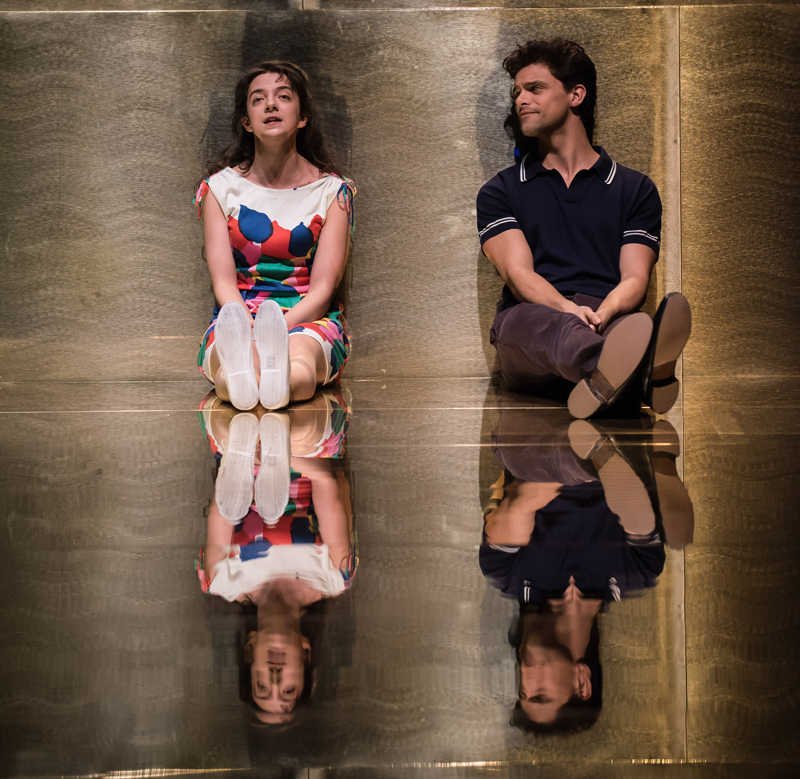
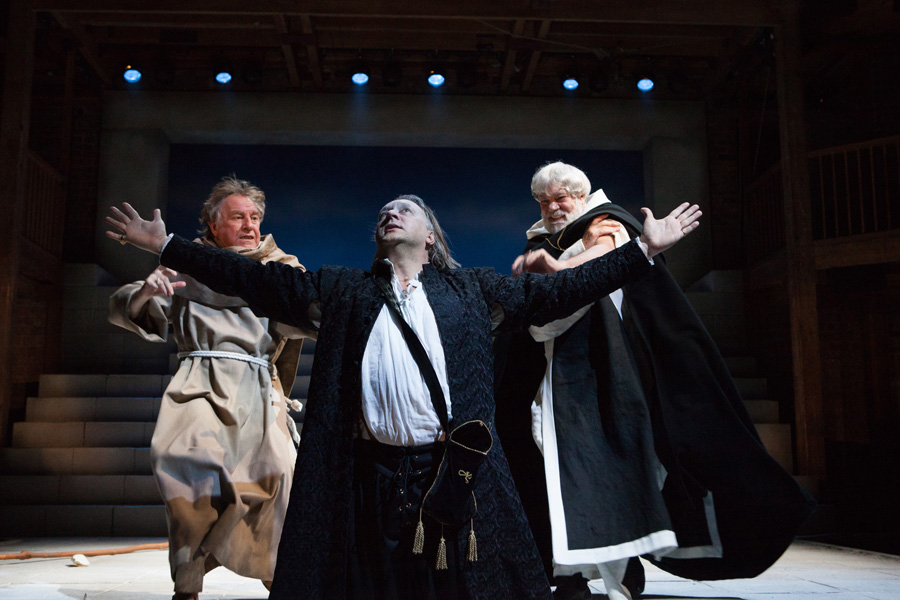
The Merchant of Venice production photos_ 2015_Photo by Hugo Glendinning (c) RSC _MER_157

Don't let the buggers grind you down. Try to come over as laid back. They wear a strange eclectic mix of what they see as achingly trendy, or sharp city wear, set off with flamboyant footwear in bright – too bright – poster colours. So wear a dingy blouson over an old cardigan and keep your dignity, simply wipe off their spit when they show their contempt for you. This could be what's going through Shylock's mind in Makram J Khoury's finely calibrated performance, which positively radiates a relaxed gravitas.

It is to be hoped that Khoury, the popular, award-winning Palestinian-Israeli actor didn't base it too closely on his experience as a man caught between two worlds in his native country. Certainly when Christian Venice shows its contempt by spitting on Shylock's "Jewish gabardine", the gasp of horror that runs through the audience is even more of a shock wave than the similar audience reaction when this treatment is meted out to Jonathan Pryce's dignified Shylock at Shakespeare's Globe.

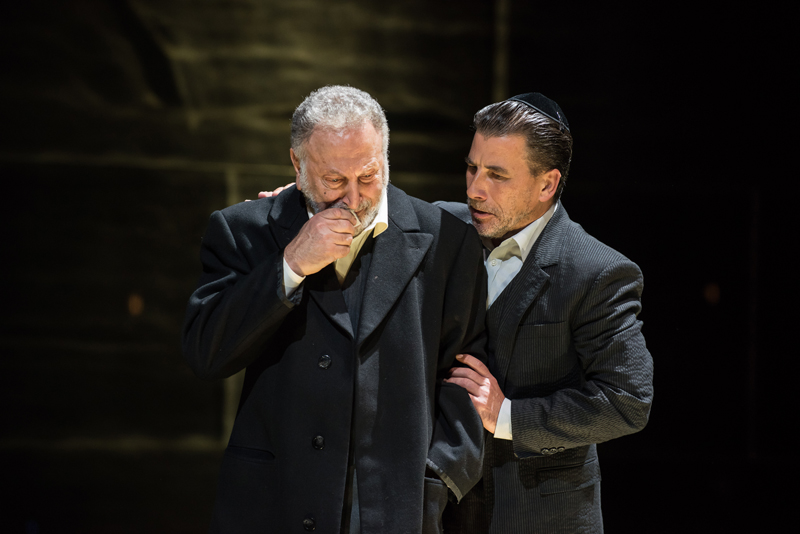
Khoury’s trajectory is frighteningly clear here, from distracted father outraged by his daughter Jessica’s's elopement and her profligate spending and disregard for her dead mother's ring, to vengeful would-be killer. Given the special disgust displayed towards him by Jamie Ballard's alarmingly volatile Antonio, it's hardly surprising he seizes the opportunity to whet his knife and prepare his scales in open court, now entirely indifferent to what the hostile Christians make of his behaviour.

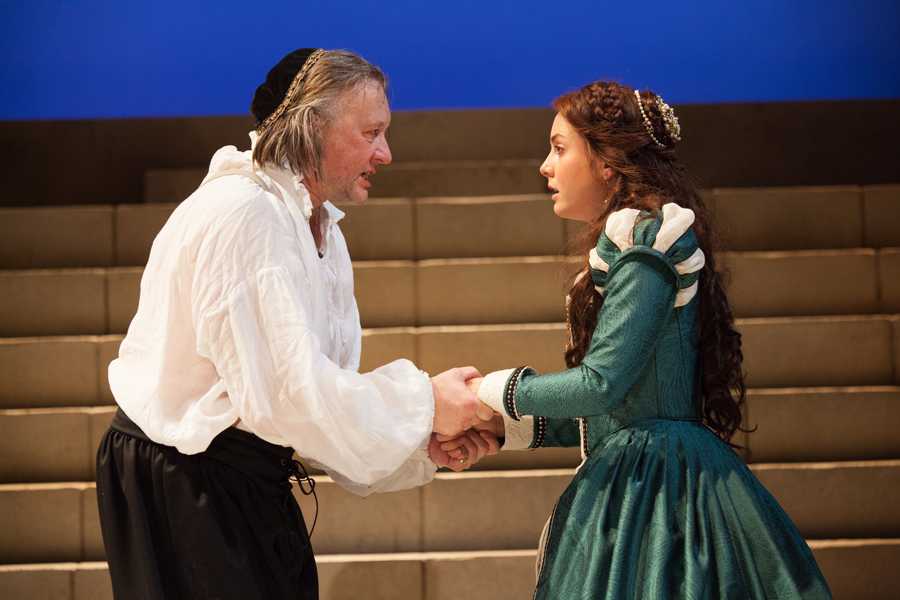
This is the third time this year that I have seen this problematical play and each time I am struck by how little stage time Shylock shares with Jessica. Shakespeare magnifies the awkwardness of what today would be dubbed their dysfunctional relationship by showing so little of it onstage. And, in the few moments they do share together, Jessica is in turmoil over her imminent elopement and the need to deceive her father to make her escape.  Here director Polly Findlay and designer Johannes Schültz trap Scarlett Brookes’ awkward, gawky Jessica at an impossibly high window in her father’s house. So there even less connection as he leaves for the dinner with his new creditor Bassanio that will give her the window of opportunity she needs to escape with her Christian lover Lorenzo (James Corrigan), as well as her father’s jewels and ducats.

Indeed Findlay, sharing her vision with Schültz and costume designer Anette Guther, builds an especially alienating dystopic Venice, where it’s easy for the audience to share Shylock’s discomfiture. Belmont, wealthy heiress Portia‘s nearby estate, similarly offers little in the way of refuge, even to its owner and her chosen guests from the city, let alone the foreign suitors at whom this Venetian lady pokes fun. The audience is reflected in the huge brass mirrored wall atop which Jessica appears and there is nowhere to hide on a thrust stage with only a mysterious (and perhaps more distracting than hypnotic) pendulum on which to rest the eye, joined briefly later by three symbolic ‘caskets’ lowered from above.

There is certainly nowhere to hide in Venice or Belmont, from creditors in the city, from the whim of a dead father, controlling his daughter’s choice of husband from beyond the grave. And there is nothing to distract from the actors, who first take the stage from seats on Brechtian benches at the rear. If anything, Guther’s flamboyant, jarringly disparate costumes are the set dressing. Patsy Ferran’s intelligent Portia might be grateful to don sober lawyer’s garments, after the hard poster colours of the little shift dresses that seem to be current Venetian jet set fashion here.

There is, though, a shock awaiting her at court. For at the centre of Findlay’s reading of the play is what turns out to be a love triangle, where Portia sees what the audience has known from the start – she must share her new husband Bassanio (Jacob Fortune-Lloyd) with Ballard’s tortured (and I don’t mean by Shylock), depressive Antonio, who claims him with a desperate kiss as he awaits his fate. It certainly makes sense for Portia to channel her discomfiture and anger into her inspired and literally blood-chilling case against Shylock. So this ‘comedy’ becomes even more of a problem play, if Portia and Bassanio’s wedded bliss looks uncertain before their marriage is even consummated.

Meanwhile, Khoury’s now coldly focused, implacable Shylock makes the most of his day in court, almost whetting his knife on Antonio’s bare chest. No wonder Antonio screams and cringes. And though Shylock loses everything, he is perhaps more incredulous than broken and makes it clear that playing for sympathy - from court or audience – is beneath him.  Even he is upstaged by a tsunami of banknotes raining down on the court – effective but perhaps heavy-handed symbolism.

The Merchant of Venice production photos_ 2015_Photo by Hugo Glendinning (c) RSC _MER_148

By the time Portia and her faithful waiting gentlewoman Nerissa (an especially warm and literally supportive performance from Nadia Albina – these girls are close) return to Belmont, Jessica and her Lorenzo do not look entirely comfortable with each other either. Jessica seems almost aggressive as she and Lorenzo top each other with their references to pairs of mythical lovers who might have shared such an enchanted night as theirs, alone on Portia’s estate while its mistress is away at court. The magic should have been enhanced by a floor gradually lit by candle after candle filling the stage, the effect doubled by that mirror wall. But their brash brightness is too obvious a visualisation of Lorenzo’s description of "the floor of heaven thick inlaid with patines of bright gold"; the patina on the brass of that mirror would have done nicely. Perhaps the only real beauty in the evening is provided by the choristers, "young-eyed cherubim" indeed, to quote Lorenzo again, singing Marc Tritschler’s unearthly plainsong from the heights of the set. It’s a particularly discomfiting and alienating reading of this difficult play and though the creative vision is clear, it is perhaps too much of a straitjacket for the drama.

By Judi Herman

The Merchant of Venice runs until Wednesday 2 September (broadcast live in cinemas on 22 July). 7pm & 1pm. £5-£60. Royal Shakespeare Theatre, CV37 6BB; 084 4800 1110. www.rsc.org.uk

Greetings from Israel! Raphael Gee reports on Limmud Tel Aviv

The Two Rafis - Raphael Gee (R) and Rafi Zarum (L) at Limmud Tel Aviv, 2015

The Two Rafis - Raphael Gee (R) and Rafi Zarum (L) at Limmud Tel Aviv, 2015

The two Rafis: Raphael with Rafi Zarum, the dean of the London School of Jewish Studies, who presented sessions on James Bond and 7 levels of laziness

"Just back from the two-day inaugural Limmud Tel Aviv. I am not certain how many attended but those who did were a mixture of Israelis and olim from many countries including the UK, France, Italy, Turkey, the USA, South Africa and Australia. There were sessions in both Hebrew and English. Of the English sessions, topics included leadership, a talk by a retired Israeli intelligence agent (his name was not given but when he got up to speak, I recognised him from previous UK Limmud conferences, so his cover was effectively blown), Nidda (Jewish family law), Israeli innovation for developing countries, water co-operation and Jewish origins of value investing. There were also some journalists from the Jerusalem Post and The Media Line."

By Raphael Gee

For future Limmuds, visit their Tel Aviv or UKwebsites.

Review: The Merchant of Venice – The Globe offers a full-blooded production of a problem play

Shylock The Merchant of Venice may be considered the most problematical of Shakespeare’s problem plays, especially in the current climate of a perceived threat of heightened antisemitism, but there’s more than one Yiddish version of the story, including M. Zamler’s 1929 novel with a brand new title, Shaylock (Der Soyher fun Venedig). Tellingly it is billed as based on Shakespeare’s tragedy.

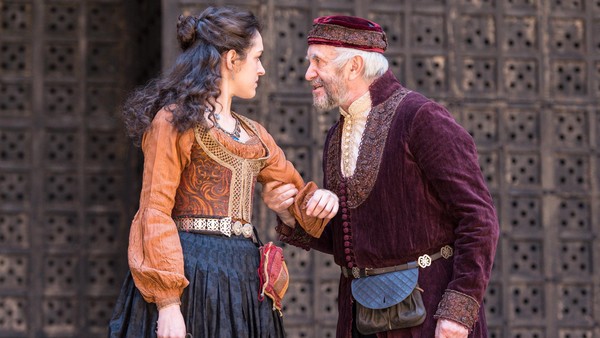
Shylock’s is not the title role in Jonathan Munby’s spirited, yet thoughtful new production for Shakespeare’s Globe, but Jonathan Pryce’s commanding, complex Shylock takes centre stage in each of the few scenes Shakespeare writes for him. In fact Shylock and his rebellious daughter Jessica (played by Pryce’s real-life daughter Phoebe Pryce) get a few more lines than usual – they first erupt on to the stage in the middle of a furious row – in Yiddish!

Pryce (a notable Fagin, but banish all thoughts of that here) has said in interview that he would love it if the audience booed him, yet by the time they watch him arriving in court armed with knife and scales to cut and weigh the famous pound of Antonio’s flesh, it’s clear how much he has had to bear from all the Christians of Venice – especially from Antonio, who really does "spit upon" his "Jewish gabardine" (with the compulsory yellow circle, forerunner of the Nazi yellow star, stitched on the breast) even as he is asking to borrow money. There’s an especially shocking moment, when Shylock’s treasured copy of the five Books of Moses (the Torah), that he clearly carries with him for constant consultation (here looking up the story of Jacob and Laban which Shakespeare has him reference), is wrenched out of his hands and contemptuously flung on the ground. And skull caps off to Munby for some nice research – when Shylock stoops to rescue it, he kisses it to restore respect, a gesture you can see in any synagogue when a prayer book is accidentally dropped.

His distress at hearing that Jessica has exchanged his late wife’s ring for a monkey is especially touching, bringing a temporary moment of quiet sympathy from the usually raucous groundlings, at least the night I saw the play.

Phoebe Pryce’s Jessica has her own awkward path to negotiate once she has broken free of her father to flee with her Christian love Lorenzo. Although wealthy heiress Portia makes the new couple welcome at her grand home and leaves them in charge of it, she causes her young guest a moment of discomfiture when she takes her place to partner Lorenzo in a formal dance that just happens to be slightly suggestive too – does it perhaps smack a little of droite de seigneur?

And usually the last the audience sees of Shylock is a broken man begging for leave to go from the court, under imminent threat of being forced to convert to Christianity. Here his last word is "credo" ("I believe") part of a Latin mass, a conversion ceremony orchestrated by Antonio – either watched or imagined by a distraught Jessica.

THE MERCHANT OF VENICE Shakespeare's Globe 2015 CREDIT: MANUEL HARLAN ... HANDOUT ...

But of course Shakespeare’s Globe is not staging Shaylock. Munby’s reading of Shakespeare’s comedy really does get laughs from the whole house, not just the delighted groundlings, two of whom get to strut their stuff onstage to some of the loudest applause that greets every bit of inspired stage business. They are roped in to help out the clownish servant Launcelot Gobbo, who deserts Shylock for a new master ahead of Jessica’s flight. Stefan Adegbola works the crowd with obvious and expert delight. It’s a pleasure to watch him at work – and so happy in it too!

Others shine in smaller roles as well. Dorothea Myer-Bennett as Portia’s waiting gentlewoman Nerissa, is wonderfully sprightly and intelligent, getting laughs from every echo of her mistress, for example as she is courted by Gratiano, man to Portia’s chosen suitor Bassanio; and even in the sometimes tedious subplot which sees both mistress and maid, disguised in male attire tricking their new husbands into yielding up the rings they gave them to plight their troth. David Sturzaker’s Gratiano is more likeable than some, despite his eager embrace of antisemitism, which is after all as endemic in Venice as anywhere else in 16th-century Europe – and despite an opening gambit that has him throwing up after a night out.

Scott Karim’s Prince of Morocco, somehow managing to be dignified and ridiculous at the same time and Christopher Logan’s wonderfully daft Prince of Arragon, straight out of Carry On Columbus, get the very most out of their cameo roles. They underline the ‘Little Venice’ prejudice of Portia and her clique, worthy of UKIP; for the young women have already ridiculed suitors from all over Europe before this brave pair dare to face the rather cruel trial that Portia’s late father has decreed for those who seek her hand.

That’s not to say that Rachel Pickup’s intelligent, even prickly Portia and Daniel Lapaine’s handsome though febrile Bassanio and Dominic Mafham’s repressed Antonio don’t hold their own throughout. It’s more a paean to the completeness and effectiveness of this production in every role.

Mike Britton’s simple stage design, letting his colourful costumes sing out, and Jules Maxwell’s delicious music, played and sung by a surprisingly small and hugely effective ensemble (singers Jeremy Avis (also musical director) and Michael Henry and Nuno Silva with Dai Pritchard on clarinets and Catherine Rimer on cello) enrich this hugely satisfying period production.

By Judi Herman

Photography by Manuel Harian

The Merchant of Venice runs until 7 June. 7.30pm & 2pm. £16-£43 seats, £5 standing. Shakespeare's Globe, 21 New Globe Walk, SE1 9DT; 020 7401 9919. www.shakespearesglobe.com

Geraldine Auerbach reports on the tragic death of two giant figures in Britain's Jewish music scene

Ronald and Miriam Senator, died 30/04/15. Photos © www.complete-music.co.uk and Brickman Family via www.timesunion.com© Complete Music and the Brickman family via Times Union

Composer Ronald Senator and his wife, pianist Miriam Brickman, tragically died in a fire in their home in Yonkers, New York on Thursday 30 April. Geraldine Auerbach, the founder of the Jewish Music Institute in London, explains how important they were in the world of Jewish music in Britain.

I am not sure how I first met Miriam and Ronnie Senator – but they were pivotal to the first Bnai Brith Jewish Music Festivals. Miriam was a real catalyst, putting (or pulling) ideas, people and programmes together in most creative ways that always led to something special and to lasting and developing relationships. She would always come up with something innovative and spectacular.

To the very first festival on 24 June 1984 she brought a super chamber concert in the Purcell Room with herself on piano and Stanley and Naomi Drucker, clarinettists from the New York Philharmonic, and her friends Sybil Michelow and Malcolm Williamson who had formed a piano and voice duo. For the second festival in 1986 she brought another chamber concert, which included bassoon and viola players from the Nash Ensemble. The programmes were always exciting, introducing new works of Jewish interest by new composers and as always, there were pieces by Ronnie Senator in the concert.

Miriam also brought me something much more remarkable. It was Ronnie Senators' 'Kaddish for Terezin’, a huge oratorio he had written in memory of his first wife who had been incarcerated in Auschwitz. It involved an orchestra, choir and children’s choir, a cantor and a narrator. Something much bigger than I had ever contemplated. But I thought it was important – and, impressed by her enthusiasm, I was inspired to make it happen – in a special setting. The Director of CCJ, the wonderful Rev Marcus Braybrooke suggested it could be ideal for Canterbury Cathedral – and that he would broach the subject with the Dean, with whom he was having lunch next day. It transpired that the Deanery in Canterbury had housed Jewish refugees and that he had wanted a Holocaust memorial (but not a statue) so this fitted the bill.

That set the most amazing activities in motion. Malcolm Singer stepped up to the podium to provide and conduct the orchestra and choirs and had a friend with a superb children’s choir.  I felt Rabbi Hugo Gryn, who himself had been in Terezin, should be the narrator. Louis Berkman cantor of Belsize Square – the synagogue created by Holocaust survivors or escapees – should be the soloist. This amazing premiere was broadcast live on BBC Radio London with interviews with Hugo and other survivors during the interval.

But that wasn't all. When Dr David Bloch, of Tel Aviv University, who was presenting a concert of Israeli contemporary music at the festival, heard about the Terezin Project and suggested we invite two musicians – pianist Edith Kraus from Israel and bassist Karel Berman from the Prague National Opera – who had last performed together in Terezin. He suggested an amazing film of music in Terezín for us to show and also suggested we invite Josa Karas who had just published a book about it. All of which we did.

And so it was that all day while Jewish choirs and a cantor and Rabbi rehearsed in Hebrew and blew a shofar in the Cathedral, the film was showing over and over in the school hall – and recitals (two of them) took place in the recital hall – which just happened to be the old Synagogue in Canterbury. Then after a reception in the Chapter House with the Archbishop of Canterbury the cathedral was filled with Jews and Christians listening to Ronald Senator’s Holocaust Oratorio. A film was made of the day focusing on Edith and Karel and shown on national television on Remembrance Sunday in November 1986, which also happened to be the commemoration of Kristallnacht.

With this auspicious beginning, Miriam went on to have performances of Ronnie’s Kaddish for Terezin mounted in other special places such as St John the Devine in New York, the Vatican in Rome and in Terezin itself.

It was not only the heavy stuff. For the next Festival in 1988 Miriam brought Klezmer to the UK. She introduced me to Giora Feidman the astonishing clarinettist who wowed London at the Logan Hall then and again in 1990, as well as in later festivals. In the ’88  festival Miriam also put together another innovative chamber concert, this time called Echoes of Jewish Poland at St John's, Smith Square with Sybil singing as well as Simon Fisher on Violin, Antonio Lysy on cello and Rivka Golani on viola, who premiered Ronald Senator’s Dance Suite for viola solo.

It was also in 1988 that Miriam introduced me to Isabelle Ganz who delighted everyone with her group Alhambra in a concert of Sephardi Life Cycle songs at the Almeida Theatre and presented the delightful Sacred and Secular music of the Sephardi Jews at the Purcell Room, Supported by Nitza and Robin Spiro.

It was always exciting to be in the presence of Miriam and Ronnie. Especially Miriam, who was so enthusiastic and brimming over with ideas and suggestions that were helpful to all.

Miriam Brickman and Ronnie Senator brought true riches in Jewish music and musicians to greatly enhance the Bnai Brith Jewish Music Festivals and thus Jewish music in the UK. The last time that Miriam and Ronnie were with us I think was at the Bloch Conference in Cambridge in 2007 where she performed in the concert.

They were always together – flitting between homes in London and New York – often catching a lift on the QE2 where Miriam would entertain on the piano and Ronnie would give lectures that enthralled the passengers. He was 89 and Miriam 81. Their health was failing. Despite this shocking news of the fire at their home, there may be something comforting or poignant that in their last moments they were also as one, and like Elijah were taken together up to heaven in a fiery embrace. Always innovative and spectacular.

JR OutLoud: An audio tour of the Jewish Museum's exhibition For Richer For Poorer: Weddings Unveiled

With exactly a month left to go and see this glorious exhibition, Judi Herman takes listeners on an audio tour with curator Elizabeth Selby to whet appetites. There are dresses from different decades – Edwardian, flapper and home-made wartime austerity. There are invitations, menus and even dance cards. There’s a range of ketubot (Jewish marriage certificates) from different eras and from plain to highly decorated. There’s a gallery of glamorous photo portraits of happy couples by Boris – the doyen of wedding photographers – and of course his giant camera is on display too. There’s even a chance to stand under the chupah (Jewish wedding canopy)! Judi Herman got to do just that, as she and Elizabeth Selby explored the fascinating history of weddings within the Jewish community from the 1880s to the mid-20th century. So even if you can't make it to the exhibition, this tour will make you feel as if you too have been invited to the wedding!

By Judi Herman

See pictures from For Richer For Poorer – Weddings Unveiled.

For Richer For Poorer: Weddings Unveiled runs until 31 May and Your Jewish Museum: Love runs until 19 April. Jewish Museum, 129-131 Albert Street, NW1 7NB; 020 7284 7384. www.jewishmuseum.org.uk

Review: I Wish to Die Singing – Judi Herman is moved by this shocking and timely documentary

I Wish to Die Singing – Siu-see Hung © Scott Rylander© Scott Rylander

The January issue of Jewish Renaissance highlighted the life and work of Czech writer Franz Werfel, who played a significant part in bringing the Armenian genocide to the notice of both Europe and America after he came across survivors living in desperate conditions in Damascus in the late 1920s. He also wrote a devastating novel, based on a defiant stand by Armenian survivors, The Forty Days of Musah Dagh. Nonetheless, a century later, the terrible massacres that began in 1915 are still not universally recognized as genocide, to stand alongside the Holocaust and the Rwandan genocide in the record of atrocities inflicted by humankind on their fellows.

If you walk through the Armenian Quarter in Jerusalem’s Old City, you will find, as I did, the memorial to the Armenian genocide. If you read celebrity pages in newspapers, it’s hard to avoid the Kardashians, currently probably the most famous bearers of one of those distinctive Armenian surnames. They came together last week as the Jerusalem memorial became the focus of protests demanding the recognition of the Armenian genocide, 100 years after it began; and Kim, the most renowned Kardashian, visited the memorial in Yerevan, Armenia’s capital, to pay her respects and play her part in raising world awareness of the genocide that inspired Hitler. And Kardashian and Hitler come together in Neil McPherson’s documentary drama which also plays its part in demanding recognition for the annihilation of 1.5 million men, women and children.

How do you tell the story of a genocide when the basic facts are unknown to most? How best to convey the attempt by the Ottoman Government to systematically exterminate all its Armenian subjects? Holocaust plays often work by letting the story of the one or the few stand for the story of the many, so that the wider picture emerges from the narrative. But, when no one knows the narrative and there is an ongoing story to tell, how can you convey the scale, the politics, the disputed facts and the personal stories?

Neil McPherson employs documentary drama, and to shocking effect, charting the history of wholesale killings, massacres, forced labour and death marches to the Syrian desert. Eye-witness testimonies give chilling evidence of what happened in 1915 and the cast take on the challenge of playing many roles. The convention of delivering verbatim texts proves extraordinarily powerful and just occasionally constraining.

Cleverly, MacPherson frames the events with an illustrated lecture, complete with slides, narrated with lucid authority by Jilly Bond who guides and links up the scenes. She first grabs attention with portraits of well-known personalities of Armenian heritage (Kim K for one) and Hitler’s chilling quote, “Who after all speaks today of the annihilation of the Armenians?” Bond points up other parallels with the Jews of Europe and their fate. The Armenian community was a Christian minority in a Muslim society. Many earned their living as bankers. They became “second-class citizens”.

Director Tommo Fowler steers his dedicated cast through a chilling 90 minutes on Phil Lindley’s appropriately minimalist set. Rob Mills brooding lighting and Max Pappenheim’s intricate soundscape add to the atmosphere of menace, after a brief moment of sunshine, light and laughter as the Armenian community celebrates Easter 1915 with song and dance.

Bruce Yadoo and Tom Mansfeld turn in strong performances playing the older men, from victims to perpetrators - and outside observers. One of these observers is Henry Morgenthau, the US’s Jewish ambassador to the Ottoman Empire, who, like Werfel, saw all too clearly the fate of the Armenians. His writings are just one the many sources for McPherson’s thorough research.

Delivering child testimonies, Tamar Karabetyan, Siu-See Hung (pictured above) and Bevan Celestine movingly convey the child-like direct observation that represents so much sorrow. It’s all the more moving because the three also represent different cultural backgrounds, a reminder, along with programme notes on the eight stages of genocide  (from a briefing paper at the US State Dept), of how the celebration of cultural diversity and the dehumanization of the other might be different  sides of the same coin.

The wrap-up between surviving grandmother (Kate Binchey) and unschooled granddaughter alone would have provided a fine ending but the story does not finish there.

Poignantly, press night was Friday 24 April, the date the Turkish government placed under arrest over 200 Armenian community leaders in Constantinople, which is therefore regarded as the date of the start of the genocide. Today, most of the world’s governments, including Turkey, the USA, the UK and, surprisingly, Israel, still refuse to use the “g-word", preferring euphemistic terms like “tragedy” in the game of geo-political friendships.

While there’s all too much information to communicate in limited time, McPherson and the Finborough, where he is artistic director, must be congratulated on playing their part in demanding long overdue recognition for the terrible fate of those 1.5 million Armenians as genocide.

By Judi Herman

I Wish to Die Singing – Voices from the Armenian Genocide runs until Saturday 16 May. 7.30pm & 3pm. £18, £16 concs. Finborough Theatre, 118 Finborough Rd, SW10 9ED; 084 4847 1652. www.finboroughtheatre.co.uk

JR OutLoud: Good shtick on Bad Jews from two of the stars of Joshua Harmon's hit comedy, Jenna Augen and Ilan Goodman

In New York in a bachelor pad high over the Hudson River, cousins Liam and Daphna go head-to-head over a treasured heirloom left by their beloved grandfather, Poppy. Emotions are raw as they mourn his recent death and feelings run high – sometimes shockingly so – for at stake is not just Poppy’s Chai (a neck chain with the Hebrew letter that symbolises life), but a whole set of issues about family and identity and faith. Liam’s brother Jonah and his fiançée Melody don’t just watch from the sidelines either, but enter the fray as it becomes more scabrous and the battle more physical. Thus unfurls the dangerous, yet funny debut play by Joshua Harmon, which is now enjoying its third successful run – the second in London – at the Arts Theatre. Judi Herman caught up with cast members Jenna Augen (Daphna) and Ilan Goodman (Liam) to talk about battling it out live on stage.

By Judi Herman

Bad Jews runs until Saturday 30 May. 7.30pm & 2.30pm (Thu/Sat ony). £20-£49.50. Arts Theatre, Great Newport St, WC2H 7JB; 020 7836 8463. www.artstheatrewestend.co.uk

Read our review of Bad Jews.

Review: Death of a Salesman – The RSC's production is a highlight of Arthur Miller's centenary year

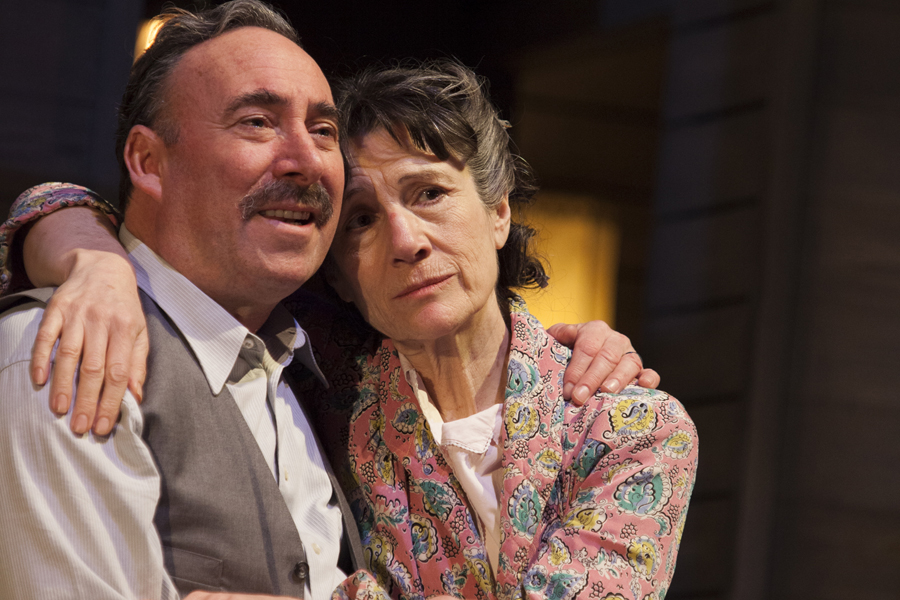
Death of a Salesman: L-R - Alex Hassell (Biff), Harriet Walter (Linda Loman), Antony Sher (Willy Loman) and Sam Marks (Happy), 2015 © RSC Director Gregory Doran is in no doubt that Arthur Miller's Death of a Salesman is the greatest American play of the 20th Century, addressing not only the heartbreaking conflicts within a family, but also bigger issues of national values and uncritical acceptance of the American Dream.

After a life of honest toil, Willy wants to stop travelling, pay off the mortgage and bask in the success of his two sons. But he can’t come to terms with the fact that his life and the lives of his boys are so different from his dreams of wealth and triumph. Miller explores the tragedy of what happens to a man who does not have a grip on the forces of life, as he puts it, whose career is disintegrating and the toll this takes on relationships between family members.

Miller was the son of Austrian-Jewish immigrants. His father worked his way up in New York's Lower East Side garment industry to become a wealthy man. The family lived in Manhattan until they lost it all in the depression and withdrew across the bridge to Brooklyn. As a teenager Miller worked to help supplement the family income with a bread delivery round before school. And he saw at first hand men like his salesman uncle Manny who sold not so much their product as their personality. Indeed, Miller is careful not to reveal what products Willy sells, leaving each audience member to furnish their own and make a closer connection to this everyman left battered and broken by capitalism.

Part of the challenge of the play comes from Miller’s extensive use of what he calls the continuous present – not quite flashbacks but simultaneous layers of memory. This means the actors have to shift almost instantaneously into playing a range of different ages and psychological states, and the production too must find ways of mirroring the layers.

Antony Sher is outstanding as the weary, manic-depressive Willy, from his iconic entrance – “tired to the death” – lugging his two heavy sample cases, through to the man who “realised that selling was the greatest career a man could want”, to the sad soul who opines that "After all the highways and the trains and the appointments and the years, you end up worth more dead than alive.” Sher’s performance brings out the contradictions in Willy that make him an irritating noodge (insistent bore) and a man whom it is hard not to pity.

Harriet Walter’s Linda is extraordinary. She gives a wonderfully nuanced account of Willy's doting wife, a woman with complete and blinkered devotion to her husband, who simply refuses to see through Willy’s lies and resignedly accepts whatever the "American Dream" throws at her. In a finely restrained performance, Walter seamlessly transitions between younger and older Linda, her face apparently visibly ageing and then losing its lines again. She is heartbreaking as she pleads on his behalf: “I don't say he's a great man. Willy Loman never made a lot of money. His name was never in the paper. He's not the finest character that ever lived. But he's a human being, and a terrible thing is happening to him. So attention must be paid. He's not to be allowed to fall in his grave like an old dog. Attention, attention must finally be paid to such a person.”

Death of a Salesman: Antony Sher (Willy Loman) and Harriet Walter (Linda Loman), 2015 © RSC

Father/son relationships are at the heart of the play. Alex Hassell as Bif, Willy’s older son (Hal to Sher’s Falstaff in Henry IV, so the bond between the two actors is palpable) creates a portrait of a flawed man, haunted by his signal failure to fulfil his early promise as a sportsman, unable to hold down a job, a thief who has stolen from his employers and even been to jail. Yet he still manages to be likeable, perhaps because he values simple pleasures over the rat race. Like his father, he is at once infuriating and touching. Sam Marks is equally convincing as womanising younger brother Happy, as a young version of Willy, reframing situations so they are more acceptable to him. Again, both actors display remarkable ability to switch convincingly between playing younger and older.

Set designer Stephen Brimson Lewis makes clever use of the Royal Shakespeare Company’s thrust stage to deliver people and furniture for the scenes in Willy’s head against a backdrop of high-rise Brooklyn, all fire escapes and windows. Tim Mitchell cleverly lights the semi-transparent set to reflect the transitions between memory and reality.

Miller originally conceived the play to be happening entirely in Willy’s head and Gregory Doran’s production blends time and space so the audience finds itself at the same time both in the film directed by Willy’s mind and in the ‘real world’ of the play. Perhaps the message of Miller’s play is that the American Dream is as much an expression of the internal movie each of the characters runs as the external idea of a life of personal happiness and material comfort.

Unsurprisingly this production, another highlight of Miller’s centenary year, is to transfer to London’s West End as soon as it finishes its run in Stratford-on-Avon.

By Judi Herman

Death of a Salesman runs until May 2 in Stratford-on-Avon and May 9 - July 18 in London. 7.15pm & 1.15pm. £2.50-£70. Royal Shakespeare Theatre, CV37 6BB; 084 4800 1110. www.rsc.org.uk 7.30pm & 2pm. £12.25-£59.75. Noël Coward Theatre, St Martin's Lane, WC2N 4AU; 0844 4825140. www.noelcowardtheatre.co.uk

JR OutLoud: As Hans Krása’s concentration camp opera, Brundibár, prepares to show on the Watford Palace stage, Judi Herman caught a rehearsal and spoke to the cast

Mahogany Opera Group’s critically-acclaimed production of Hans Krása’s Brundibár – the 1938 short children’s opera famously performed in the World War II concentration camp Terezin (German Theresienstadt) – heads to Watford Palace Theatre this weekend. So Judi Herman sat in on a rehearsal and met with the director Frederic Wake-Walker, conductor Alice Farnham and two of the 40-odd talented children recruited for these performances; nine-year-old Erin Daniels, who plays Aninku and 14-year-old Ethan George, who plays her brother Pepíček. Brundibár the evil organ grinder thwarts them in their attempt to raise money by busking to buy milk for their sick mother – until some clever animals come to their aid, enlisting the help of the town’s children. It’s a story of the triumph of the poor and powerless over the big, strong and ruthless that resonated throughout the camp – which is just as powerful today.

By Judi Herman

Brundibár runs Saturday 18 – Sunday 19 April in Watford and Sunday 28 June in Norwich. 7pm (Sat), 3pm (Sun). £10, £8 children. Watford Palace Theatre, 20 Clarendon Rd, WD17 1JZ; 019 2323 5455. www.watfordpalacetheatre.co.uk 2pm. £10, £6 concs. Norwich Playhouse, NR3 1AB; 016 0359 8598. www.norwichplayhouse.co.uk

For more on Brundibár, read Judi Herman's interview with Holocaust survivor Ela Weissberger, who created the role of the Cat in the original production in Terezin.