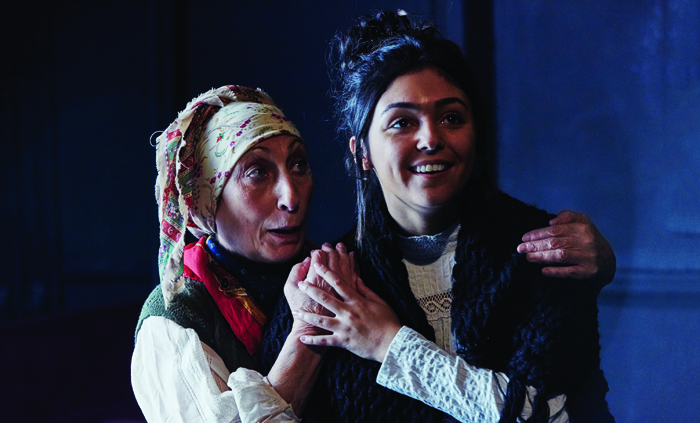
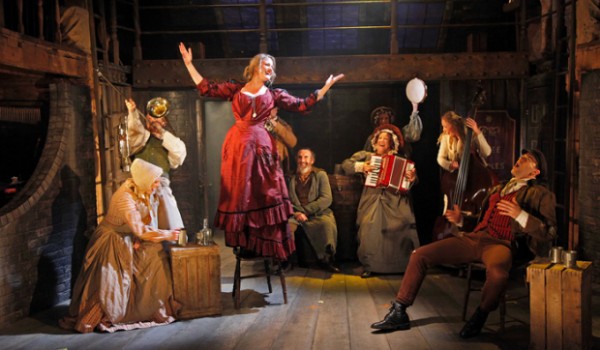
JR OutLoud: Arthur Smith talks to Judi Herman about his show, a love of Leonard Cohen and his mother

In the October issue of Jewish Renaissance, Arthur Smith gives Judi Herman the not so sweet lowdown on his show, Arthur Smith Sings Leonard Cohen, with which the gravel-voiced wit makes his debut at JW3 in December. Here you can hear an extended version of his conversation with Judi. The two share a love of Leonard Cohen and they compare notes on their mothers, both of whom are living with dementia – indeed Arthur’s mother Hazel has become a vital part of his show.

Keep reading to see Smith's poem about his mother and to listen to him reciting it.

Oh Hazel is Arthur Smith's moving poem about his mother's dementia, which you can read and listen to below. You can read more about Arthur Smith Sings Leonard Cohen – The Extended Remix, the show in which he recites the poem live, in the October 2015 edition of Jewish Renaissance.

Oh Hazel

Pulling up late after the party, they see her, their neighbour, standing in the street.

She is looking, she says, for a lift to London. She needs to get home. ‘Hazel,’ they tell her, ‘This is your home – ‘you live here, in this house. London is 30 miles away.’

The door is open. They take her in and see she has packed a bag (if a jumper and a packet of biscuits count as packing).

Oh Hazel, It is 35 years since you left London to live, as you liked to say, ‘in the shires’.

But there she still is that grammar school girl from Camberwell Green kissing sailors and dancing In Trafalgar Square. It is VE day and the rest of the century Is yours.

Oh Hazel also appears on the Alzheimer’s Research UK blog.

Arthur Smith Sings Leonard Cohen – The Extended Remix is on Thursday 3 December. 7.30pm. £16-£20. JW3, 341-351 Finchley Rd, NW3 6ET; 020 7433 8988. www.jw3.org.uk

Review: Pure Imagination ★★★★ – Judi Herman enters the tune-fuelled world of Leslie Bricusse

© Annabel Vere If like me, you relished the toothsome trip round Willie Wonka's Chocolate Factory in the 1971 movie musical of Roald Dahl's dark and delicious children's classic, you'll have no problem identifying the title of this equally moorish compilation of the words and music of Leslie Bricusse.

Gene Wilder's pitch-perfect Willie Wonka sang the song like a silky caress in the film and, as the programme informs us, it's been covered by stars including Michael Feinstein, Sammy Davis Jr, Jamie Cullum and Mariah Carey, and featured on TV shows ranging from Glee to Family Guy.

The joy of the man's genius, as explored and celebrated in this warm hug of a compilation show, is not just the range of fine singers attracted to Bricusse's work – it's the range of the work itself. The palpable delight in the auditorium comes as much from surprise at the rediscovery of yet another all-time favourite from the composer/lyricist's extraordinary back catalogue, as from the execution and charm of these five well-chosen performers.

Think Bond themes ‘Goldfinger’ and ‘You Only Live Twice’ (written with John Barry and Anthony Newley); cheerful, upbeat numbers like ‘On a Wonderful Day Like Today’ and ‘Out of Town’ (Housewives' Choice memories anyone?); inspirational anthems like Nina Simone's spine tingler ‘Feeling Good’ and Sir Harry Secombe's feel-good hit ‘If I Ruled the World’. There are also comedy novelty numbers, including Oscar-winning ‘Talk to the Animals’ from Dr Dolittle and ‘My Old Man's a Dustman’, which topped the charts on three continents; and of course there are the love songs, often with a specific original context, such as ‘Can You Read My Mind?’, the love number from the film Superman.

It’s good to be reminded not just of the man's music but also of his musicals. Bricusse seems to have a penchant for Victoriana and the Edwardian age, for his musicals on stage and screen include the Julie Andrews vehicle Victor/Victoria, Dr Jekyll and Mr Hyde and Dickens adaptations Scrooge and Pickwick. Then there’s Sherlock Holmes – The Musical, which yields a great excuse for a jolly old Cockney knees-up with showstopper 'Down the Apples 'n' Pears'.

But this show is stuffed with showstoppers and wonderful curiosities. Did you know that Bricusse wrote clever lyrics to Henry Mancini's Pink Panther Theme? It's wonderfully realised here as a segue from ‘Talk to the Animals’, where designer Tim Goodchild thinks pink and lithe Giles Terera glides round the stage lashing his tail while pursued by the rest of the company – complete with raincoats and magnifying glasses of course. The man writes lyrics to die for – perhaps literally in ‘Goldfinger’  – "He's the man, the man with the Midas touch, a spider's touch, such a cold finger … For a golden girl knows when he's kissed her, it's the kiss of death from Mister Goldfinger".

© Annabel Vere

Happily all five members of the company – Terera as the Joker (a character from The Smell of the Greasepaint – The Roar of the Crowd), Dave Willetts as the Man (adding a lovely depth of emotion and gravitas in numbers including ‘Who Can I Turn To’ and ‘Once in a Lifetime’), Siobhan McCarthy as the Woman, Niall Sheehy as the Boy and Julie Atherton as the Girl – make sure their audience can hear every precious word. And they all manage to work up a head of emotional steam in the brief connections they have with each other, song on song. Versatile Terera is not just a performer with emotional depth (as seen during the number ‘What Kind of Fool Am I?’) and a lovely sense of fun (‘The Candy Man’) but a lovely mover too and Matthew Cole sets numbers around him to give him his head (or should that be feet!).

The powerful six-strong band, arranged to the side of the stage, feels like part of the cast and does Bricusse’s wonderful range of styles proud. MD Michael England, while at, and occasionally away from, the piano takes centre stage, generously sharing his stool with the performers.

So although designer Tim Goodchild has provided a swirling backdrop that can frame video and still images and morphs usefully to suggest the Bond credits, he has wisely kept the scenery simple to frame the talents of the cast – a swirl of music round the edge of the stage floor, reflecting the backdrop, to suggest the size of the composer’s oeuvre, and angular chairs in different styles and poster colours.

The evening aroused my curiosity about early shows such as The Smell of the Greasepaint… along with Stop the World – I Want to Get Off, surely due for a revival. And it’s great to report that the man is still writing. I’m just as curious to know more about his as yet unperformed new musical Sunday Dallas after enjoying the fun of ‘Hollywood Wives’, a number from the show that evokes the late great Jackie Collins, as it’s staged here featuring a Hollywood Diva and her claque, pursued by adoring males seeking selfies with her. I'm also happy to say that Bricusse’s 2009 biographical musical Sammy, about his friend and fine interpreter of so many of his songs, Sammy Davis Jr, is bound for London. Meanwhile there is this chance to get to know and enjoy a terrific selection from Bricusse’s songbook – even though it does not feature his 1973 song ‘Chutzpa’!

By Judi Herman

Pure Imagination runs until Saturday 17 October. 7.30pm & 2.30pm. £15-£50. St James Theatre, 12 Palace St, SW1E 5JA; 084 4264 2140. www.stjamestheatre.co.uk

If I were a rich girl… As Yiddish gem Treasure is unearthed at Finborough Theatre, Judi Herman polishes up on its backstory

© Richard Lakos What do The Dybbuk, The Golem and Fiddler on the Roof have in common? Their stories were all originally written in Yiddish. From Franz Kafka to Danny Kaye, the influence of Yiddish theatre is far reaching. Four years before the first professional production in Yiddish took place in a Romanian wine garden in 1876, one of its most influential writers, David Pinski, was born into a cosmopolitan Jewish family in Mohilev, Russia (now Belarus). He moved to Warsaw, Switzerland, Vienna and Berlin before emigrating to New York in 1899, where he lived for 50 years. While there he was an active member of Jewish cultural and political life and was president of the Jewish National Workers’ Alliance from 1920-22, and president of the Jewish Culture Society from 1930-53. Finally, in 1949, the committed left-wing Zionist moved to Israel, where he lived until his death in 1959.

Pinski wrote over 60 plays and there were novels too. His subject matter ranged from stories of the lives, struggles and dreams of the ordinary Jewish folk to Biblical themes, including both King David and King Solomon, their wives, and the coming of a future Messiah.

Treasure is arguably his comic masterpiece, revived here in a brand new adaptation by Colin Chambers. The play premiered in 1912 and remained popular in the Yiddish repertoire until the 1940s (with a production in the Vilna Ghetto in 1943), was staged in German by Max Reinhardt in 1919 and in English on Broadway in 1920. The story follows poor gravedigger’s daughter Tille, who must decide whether or not to keep a pile of gold coins her brother finds at the graveyard. Should she hand it in and remain in a life of drudgery or use it to turn her world around?

Its latest incarnation in a production at London’s Finborough Theatre is directed by Alice Malin. What drew her to Pinski’s comedy? “It’s a story of female emancipation and it has real wow factor. Tille seeks freedom by using found money for her own ends and that wowed me. Plus it’s resonant today in how humanely it treats poverty and approaches the subject of inequality. Its dirt poor protagonists are united by the same goals, being free and visible and having enough money to live. It’s really funny and outrageous, part farce, part tragedy.” Not to give too much away, as occupants of the graveyard come to life, it sounds as if Pinski’s story is magic realism. Alice agrees and adds that it’s “a strange surreal expressionist drama, judiciously nipped and tucked by Colin Chambers.”

Malin is confident the audience will share her enchantment with the “wry, witty heroine with chutzpah". She explains that "Tille is in her late teens and so poor that she has no prospects of marriage till her brother finds the treasure. She takes a massive gamble and going on the journey of its consequences is really intoxicating . She takes a massive punt buying clothes to make herself look genuinely rich so that potential husbands will consider her – not because she is vain and wants to look pretty, but to seize the chance of a better life. The whole community, especially the traditional menfolk, descend on the graveyard and demand that she be put back in her place, but she refuses and manages to keep one step ahead of them. Her mother Jachne Braine is constantly coming back with sarcastic comments, on the one hand terrified of the money and everyone wanting something from her, but on the other overwhelmed by the possibilities. The production boasts a cast of 15, with three Jewish cast members – Olivia Bernstone as Tille, Fiz Marcus as Jachne and Felicity Davidson as a town gossip. Malin assures that there will be dancing too, because “klezmer music and dance is really important.”

Treasure runs from Tuesday 20 October to Saturday 14 November. Finborough Theatre, 118 Finborough Rd, SW10 9ED; 0844 847 1652. www.finboroughtheatre.co.uk

The Millenium Awards 15 years on – Geraldine Auerbach traces four of the lives it changed

MAS sophie solomon The millennium was a time of fireworks and celebrations, but it also marked a moment for Jewish music to benefit enormously. The Jewish Music Institute (JMI), in partnership with the music department at SOAS, was fortunate to win £240k from the Millennium Commission to give away in grants to enable individuals to achieve their dream projects in Jewish music. Fifteen years on, we can see how significantly awareness of Jewish music – and lives – were changed.

Exciting proposals flew in from across the country. The 63 successful candidates were paired with mentors and monitors to ensure fruitful outcomes. Each project needed an end product that would benefit a community. The money could be spent on travel, training, equipment, performances and publications to help attain their aims.

Awardees arranged choral festivals and conferences, produced CDs, wrote musicals, oratorios and even a novel. Concerts, cabarets and dance workshops were held in schools, concert halls and hospitals around the country and even in prisons. Subjects included Jewish jazz, medieval poetry, Torah chanting, Argentinean tango, Israeli piano music and even music originally suppressed by the Nazis.

Because of the experience, award winners went on to great success. Such as Meg Hamilton, a classically trained violinist who has become a key player in both Jewish classical and folk music; Michael Etherton now directs several Jewish Choirs; and Vivi Lachs went on to complete a PhD in London Yiddish songs and recently announced she is starting the London Yiddish Parade, which includes a marching band and Yiddish chorus.

Looking back over the many exciting programmes during my 28 years at the helm of JMI, I believe that this one has had the greatest impact. Not only did it introduce a wide range of Jewish music and culture to hundreds of people of all ages around the UK, but it allowed artists to flourish. Best of all it equipped and encouraged highly talented young men and women to take up a career in Jewish music, many of who are household names today as teachers and performers, holding prestigious positions in our institutions.


Benjamin Wolf

MAS Ben Wolf 4 (1)

Conductor, pianist, singer and composer Benjamin Wolf acknowledges that it was the Millennium Award that steered him towards a career, not in the city or law, but in Jewish music. “The award to complete my piano concerto L’Chaim was a turning point for me”, he elaborates. “It was soon after I graduated from Oxford and without it I probably wouldn’t have pursued my interests in traditional Jewish melodies so thoroughly. There is no doubt that it helped me to obtain early jobs in Jewish music, and because of these, my interest in and knowledge of the subject has continued to develop.” Today Ben is the music director of London’s prestigious Zemel Choir and of Belsize Square Synagogue where he arranges music and connects for both the professional and community choirs. Ben has gone on to compose a cello concerto on Jewish themes and has orchestrated several pieces by Jewish composers. His orchestra, the Wallace Ensemble regularly performs concerts of Jewish music. He regularly runs Jewish choral workshops in London and arranges international choral festivals that bring together Jewish choirs from Berlin, Paris, Prague, Rome and Israel, amongst other places, to perform and work with his choirs in London. He has also set up his own Jewish a cappella quartet, bOYbershop.


Ilana Cravitz

MAS ilana cravitz

Ilana Cravitz, like Ben Wolf, says the Millennium Award came at a very important stage in her musical journey. “It enabled me to study in America with some of the most prominent figures in the klezmer world, supported me in developing my research, teaching and networking skills, and provided a basis for me to implement ideas with willing participants.” Ilana, who set up and leads the outstanding London Klezmer Quartet, which has made several CDs and toured the UK, Europe and Australia, also runs Hopkeles (Yiddish dance parties) for organisations or individuals and arranges regular monthly klezmer workshops at a London pub. She adds: “Without the help of the award, I doubt that I would have been invited to write Klezmer Fiddle – A How-To Guide for Oxford University Press or become the professional klezmer performer and teacher that I am today.”


Louise Taylor

MAS Louise Taylor

Louise Taylor hand-picked eight players to train weekly at JMI with legendary klezmer clarinettist Merlin Shepherd and the result was She'Koyokh. The klezmer ensemble are now one of Europe’s leading klezmer bands, playing concerts, festivals and Jewish ceremonies all over the world, and of course they have a special place to come back to and perform at JMI’s Klezmer in the Park every summer. The group’s clarinettist, Susi Evans (pictured), explains how fundamental the award was to her career: “At the time I was a student at the Royal Academy of Music training for a future in classical music, so my teachers were not at all keen. I’m sure I was the first student in the Academy’s history to perform with an eight-piece klezmer band in my final recital. Happily, the examiners loved it. I learned how to play by ear and improvise and have gone on to study other Eastern European styles, leading to theatre work, session work and performing with the Jocelyn Pook Ensemble and the London Klezmer Quartet. I’ve run klezmer workshops as far afield as Australia and taught on the faculty at JMI Klezfest 2015. Studying klezmer with the award has empowered me greatly as a musician.”

Sophie Solomon (pictured above)

Sophie Solomon, who co-founded fusion group Oi-Va-Voi while studying at Oxford, won funding to make The HipHopKhasene – a CD of music that reimagines a Yiddish wedding in a hip-hop style, including Yiddish freestyle rapping. She told us that the Millennium Award was a "pivotal moment" in her career. "It enabled me to develop as an artist and a producer and to work with the some of the most celebrated names in the Yiddish music revival. It funded this hip-hop album, which afterwards won an award, and also sparked off a real-life hip-hop Jewish wedding where we all performed in a whisky distillery in Toronto complete with rapping Badkhn (comedian).” Sophie subsequently formed a solo band, which recorded for Decca Records, and she has composed music for the National Theatre. Sophie is now the esteemed artistic director of JMI where she is taking the organisation to exciting new heights. She has commissioned new works and initiated stimulating Jewish music education programmes in schools. She continues to expand the annual JMI Klezmer in the Park festival each September in Regent's Park and, while preserving and enhancing JMI’s summer schools in Yiddish language and song, she has revived the JMI KlezFest training programme in London. Both Sophie and Jennifer Jankel, the current JMI chairman, hope that the Jewish Music Institute’s current creative programming will continue to inspire future careers in Jewish music.

By Geraldine Auerbach

Words of art: Неrе, Oh Israel – Hear! A poem by Marlene Sutton

Joseph, Lily Delissa, Self-Portrait with Candles "I recently visited the Ben Uri exhibition at Somerset House and saw again the self-portrait of Lily Delissa Joseph. I had first seen it at a Ben Uri show 20 years before in Bristol, at the launch of DAVAR (the Jewish Cultural and Educational Institute in Bristol and the South West), and am sending the poem I wrote after that event. Clive Lawton gave the inaugural address." – Marlene Sutton

Read Marlene Sutton's 1995 poem in its entirety by clicking here

Out of Chaos: 100 Ben Uri Works for 100 Years runs until Sunday 26 February at Laing Art Gallery, Newcastle, NE1 8AG. 0191 278 1611. https://laingartgallery.org.uk

Vienna’s Jews and the Ringstrasse

Ringstrasse at Jewish Museum Vienna Vienna’s famous boulevard, the Ringstrasse, was a thriving hub for Jewish bourgeoisie in 19th century Austria. David Herman reviews Ringstrasse: A Jewish Boulevard which accompanies an exhibition on the street at Vienna’s Jewish Museum.

Fin-de-siècle Vienna has become a source of fascination for cultural historians over the past forty years. There are several reasons. It was one of the birthplaces of 20th century art and ideas:  writers such as Schnitzler and Hofmannstahl, painters such as Klimt and Kokoschka, great figures of Modernism from Freud to Schoenberg. “In almost every field of human thought and activity,” writes Ray Monk in his biography of Wittgenstein, “the new was emerging from the old, the twentieth century from the nineteenth.”

However, there is also the fascinating link between cultural creativity and historical crisis: the collapse of liberalism, the break-up of the Habsburg Empire, inflation and then the rise of Austrian fascism. Finally, Jews were at the centre of both the explosion of creativity and the rise of antisemitism. Many of the great creative figures of the turn of the century were Jewish and thousands of Vienna’s Jews were killed by the Nazis or driven into exile, many of them to enrich post-war culture in every field in Britain and America.

What is immediately striking about the exhibition, Ringstrasse: A Jewish Boulevard, is that there are virtually no references to the great names of fin-de-siècle Vienna. No Schoenberg or Wittgenstein. Four references to Stefan Zweig, two to Klimt and Freud, one to Schnitzler. Instead the dominant figures here are the great families of the new Jewish haute bourgeoisie such as the Ephrussis, the subject of Edmund de Waal’s The Hare with Amber Eyes (2010). This is partly a story of architecture, town planning and grand hotels, but more a story of Jewish financiers, bankers and industrialists, the new urban haute bourgeoisie who lived in the great palaces of the Ringstrasse. On the Ringstrasse, writes Gabriele Kohlbauer-Fritz in her chapter ‘Family Stories’, “the who’s who of Vienna society gathered in their drawing rooms,”  “industrialists mingled with artists, bankers, and writers, politicians, and actors, Jews and non-Jews, men and women.”

It was the young Emperor Franz Joseph who decided to demolish Vienna’s medieval fortifications and develop the land into a magnificent new boulevard of apartment buildings and major administrative and cultural buildings, the symbols of Stefan Zweig’s “world of security” in his memoir, The World of Yesterday. In 1860 the sale of Ringstrasse lots began. Members of the imperial household, high aristocracy and the Jewish upper middle class were the first occupants. However, it was not until the late 1860s and 1870s that the Ringstrasse reached its highpoint and by then a very different class of buyer was moving in.

Perhaps the most fascinating essay is on “Jewish real estate ownership in the Vienna city center and the Ringstrasse area until 1885” by Georg Gaugusch which tells the story of how Jews won the right to buy property in Vienna in the mid-19th century. What happened subsequently was a social revolution. For the first time Jews lived near the centre of Vienna. The Ringstrasse symbolized the rise of a new wealthy class of Jewish industrialists, bankers and financiers. In 1853 Jews owned 17 houses in the old town centre. By 1885 Jews owned 155 buildings on the Ringstrasse. Just as fascinating, few of these new buyers came from Vienna. Almost half came from Moravia, Pressburg, or western Hungary and another large group came from major urban centres in Bohemia or Germany.

This influx of Jews to Vienna and the rise of a new Jewish upper middle class were not welcomed by non-Jews in Vienna. Already around 1869 one anti-Semitic journalist wrote of “A brand new Jerusalem of the East”. In 1870 Franz Friedrich Masaidek wrote of “The Ringstrasse – the Zion Street of new-Jerusalem”. The rise of the Ringstrasse and Vienna’s Jews coincided with the rise of a new virulent anti-Semitism which played such a huge part in Austrian politics for the next seventy-five years. A dark story looms large over the later chapters and it is hard to read this catalogue without a sense of foreboding.

Ringstrasse: A Jewish Boulevard runs until Sunday 18 October at Vienna Jewish Museum. www.jmw.at 

Review: Patrick Marber’s National Theatre Hat Trick – Judi Herman cheers on the writer/director from the touchline

Timothy-Watson-Jane-Booker-Pearce-Quigley-Amy-Morgan-Molly-Gromadzki-and-Nicholas-Khan_The-Beaux-Stratagem It’s been years since Patrick Marber has written  for the theatre, so it’s good to be able to report that on his return he has scored a triumphant hat trick. Already the author of hugely successful plays Dealer’s Choice and Closer (both premiered at the National Theatre), as well as being scriptwriter and a performer with Steve Coogan on the TV hit Alan Partridge, Marber is now reconquering London's National Theatre. He's written a football drama, The Red Lion, has directed his own adaptation of Turgenev’s A Month in the Country – now Three Days in the Country – and he's worked as a dramaturg on subtly streamlining George Farquhar’s glorious Restoration comedy, The Beaux’ Stratagem (pictured above). You can see The Beaux' Stratagem in cinemas from Thursday 3 September as part of NTLive, but read our reviews of all three right here in one place.

The Beaux Stratagem ★★★★★

Irish playwright George Farquhar sets The Beaux’ Stratagem in the city of Lichfield and there’s something especially attractive and intimate about the way Marber and director Simon Godwin realise that provincial setting. The rackety beaux Aimwell and Archer have fled London to escape gambling debts and seek their fortunes, preferably through marriage to money. At each coach stop they take it in turns to don the guise of master and servant and in Lichfield it is Aimwell’s turn to play the elegant gentleman and Archer’s to serve as equally well-turned-out man. There are nice twists in Farquhar’s tale. Unsurprisingly the pair of hopefuls light on Dorinda, a delightful and attractive unmarried heiress, but there’s an equally tempting prospect, the vivacious Mrs Sullen trapped in a loveless marriage to Dorinda’s aptly-named boorish brother.  Samuel Barnett’s Aimwell and Geoffrey Streatfield’s Archer are attractive and resourceful (almost) rogues – and of course they prove honourable in the end. They also prove they can cut a very pretty caper – Streatfield almost stops the show. Susannah Fielding and Pippa Bennett-Warner make a pair of lively and intelligent, independent-minded gentlewomen, clearly more than a match for any man who dares enter their lives. Not to give too much away, Farquhar has an innovative take on the chances of separation of consenting parties in a loveless marriage, which would have gone against the law of the times, but which actually chimes pretty well with the Jewish divorce process, the get.

Although the delicious amatory encounters and negotiations between these four are at the heart of the action, there’s an intriguing parade of well-drawn characters from various strata of society, all with their own agendas in a series of cleverly linked sub plots. Farquhar’s well-drawn characters are wonderfully brought to life by a superb cast under Godwin’s spot-on direction. Timothy Watson’s French officer, a prisoner-of-war enjoying his provincial confinement, and Jamie Beamish’s Foigard, a dodgy "French" priest betrayed by his Irish twang, ensure that the comedy mounts. Chook Sitain’s Gibbet is as rascally a highwayman as his name suggests, ably abetted by henchmen Hounslow and Bagshot (note the place names) Mark Rose and Esh Alladi. Lloyd Hutchinson is expansive as mine host and Amy Morgan luscious and resourceful too as his daughter Cherry. And gorgeous Molly Gromadzki manages to be comically sultry as the equally well-named ladies’ maid Gypsy.

Godwin has a fine eye for stage pictures on designer Lizzie Clachan’s evocative, versatile two-storey set, playing both inn and country house. Her stunning costumes glimmer and swish, especially to movement director Jonathan Goddard’s exhilarating measures. MD Richard Hart’s terrific ensemble play and everyone sings Jonathan Goddard’s gorgeous music (which pays subtle tribute to Farquhar’s Irish origins) and the whole production is extraordinarily inclusive and life-enhancing. It should work especially well in cinemas too. Highly, and warmly, recommended.

The Beaux' Stratagem runs until Sunday 20 September. 7.30pm & 2pm. £15-£35. National Theatre, South Bank, SE1 9PX; 020 7452 3000. www.nationaltheatre.org.uk

The Red Lion ★★★★

Calvin-Demba-as-Jordan-in-The-Red-Lion.-Image-by-Catherine-Ashmore

Before the final whistle (apologies in advance, it’s hard to resist the football terminology), Marber skilfully heads his own winner into the goal. I’m not the biggest fan of the beautiful game, though I’m married to one avid Arsenal supporter and the mother to another. Both consented to take their (supportive) football widows to this one and I for one was a bit apprehensive. At times the language is as colourful as I’m warned it is on the terraces, so do also be aware if you’re easily shocked by certain four-letter words. Like Marber’s hugely successful earlier play Dealer’s Choice, football here is the gateway into exploring the (male) relationships of an inwardly-focused self-selected group.

The Lions are hardly a legend in their own half time – a down-at-heel South of England soccer club, their glory days long gone. Backstage in the dressing room, Yates the kit-man is an ex-star player, hanging on in there, devoted to the game and the team, win or lose. Manager Kidd walks the walk and talks the talk of strategy on and off the pitch, but in reality he knows he too is hanging on by his fingertips. Then suddenly the prospect changes completely with the advent of a possible saviour in the lithe and muscled form of young Jordan, surely a future star that any club would fight to sign. The older men do battle for him, each seeing him as a chance for reflected glory. Do they simply want to take him under their wing or does either of them have a dodgier endgame? As a committed Christian, Jordan would probably deplore being referred to as saviour – but are his own tactics entirely ethical?

It’s fascinating to watch the seesaw of the power struggles between the older pair over the younger man. The shifting balance of power between three men in an enclosed space is sometimes reminiscent of Harold Pinter’s The Caretaker. Here you are always aware of the world of the pitch – and of the management – just outside the dressing room door.

All three actors perform well in this game. Peter Wight’s Yates and Daniel Mays’ Kidd are not afraid to "let it all hang out" so we see the difference between the bodies of the older men and the younger, extraordinarily fit (in all senses of the word) Jordan, played by Calvin Demba. Mays has an wonderfully mobile face and can roll his eyes for England. He commands sympathy for his predicament, just as he evokes a measure of disgust for his tactics – and his loud mouth. But Wight is just great at making you think he is all altruism and bluff kindliness, while suggesting he too has something to hide. And Demba truly is (relatively anyway) the promising newcomer in a totally convincing performance, both physically and emotionally. Watching him handling a ball I could almost appreciate the poetry and exactly why the game is deemed beautiful. In the end it’s not just a case of youthful idealism set against the more cynical pragmatism of the older men and it is both all the more delicate and demanding for that.

The Red Lion runs until Wednesday 30 September. 8pm & 3pm. £15-£55. National Theatre, South Bank, SE1 9PX; 020 7452 3000. www.nationaltheatre.org.uk


Three Days in the Country ★★★★
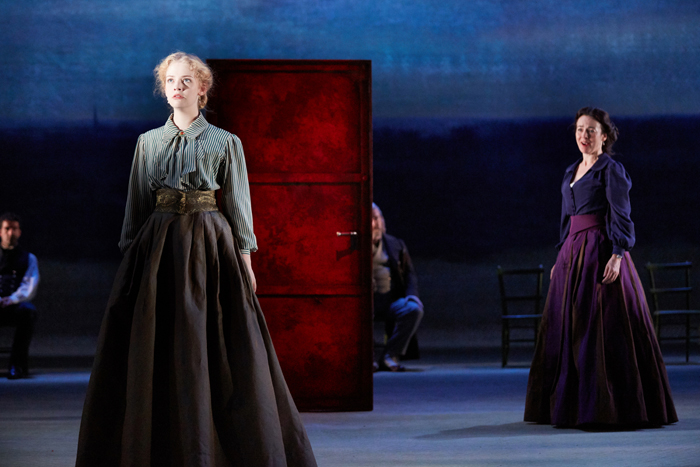
Three Days in the Country by Patrick Marber, after Turgenev at The National Theatre

Marber’s adaptation of Turgenev’s great play also takes place in the provinces, this time on a country estate in 19th-century Russia, home of another ill-matched pair, Arkady the landowner and his wife Natalya. Marriage intrigues are in the air here too and although for some it’s just a matter of negotiation for practical gain of wealth or securing companionship, in a febrile atmosphere it seems almost every woman young enough to attract his attentions has fallen for Belyaev, new tutor to the couple’s young son Kolya.

Natalya’s tempestuous, illicit passion for the young man contrasts with her 17-year-old ward Vera’s fresh, idealistic first love and the fiery, straightforward sexuality of Katya, the maidservant. Natalya has her own long-standing admirer, Rakitin, stoically bearing the burden of his unrequited love. And Vera has attracted the attention of Bolshintsov, a rich neighbour, who is patently too old for her. Add Shpigelsky, the family doctor with his own marital aspirations, and Lizaveta, companion to Arkady’s doughty mother Anna, a feisty spinster resigned to taking snuff to dull the exquisite ennui of her life, and Kolya’s elderly German tutor Schaaf, and you have the full complement of lives in this seemingly quiet Russian country landscape. You could say nothing much happens and in the end the status quo simply shifts a little – or that the emotional landscape is subtly altered by the end, so there is no going back.

Either way it’s hard not to warm to Marber’s own funny, emotionally intelligent production with lovely performances all round and some real stand-out performances.  It’s hard to understand how Natalya can be blind to the quiet charisma of John Simm’s Rakitin. Mark Gatiss proves his comic versatility and timing in spades as self-confessed rather bad physican Shpigelsky. He’s perfectly matched by Debra Gillet’s drily intelligent, quietly witty Lizaveta in a wonderfully unorthodox wooing scene, the funniest in the production, which has the audience rocking with delighted laughter. The night I saw the production, understudy Cassie Raine got well-deserved extra applause, standing in for an indisposed Amanda Drew.

Marber’s production on Mark Thompson’s clever set, evoking both the enclosed lives in this landscape and the vistas beyond, has characters sit erect and listening in on high-backed chairs at the back of the stage when they are not taking part in a scene – suggesting also that there is no privacy on an estate that depends on the interlocking lives of masters, mistresses and servants. We see only the tip of the iceberg, but landowner Bolshitsov declares that he has at least 320 serfs on his estate. The revolution, though, is not even a cloud on the horizon. There is also an intriguing red door that at first is flown behind and above the action, but as yearnings descend into demonstrations of physical passion, so it descends to ground level so that they can take place in a deceptive privacy that it actually barely affords, thanks to those intent watchers behind it.

Three Days in the Country runs until Wednesday 21 October. 7.30pm. £15-£55. National Theatre, South Bank, SE1 9PX; 020 7452 3000. www.nationaltheatre.org.uk

By Judi Herman

Review: You Won’t Succeed on Broadway if You Don’t Have Any Jews – ★★★

You Won’t Succeed on Broadway if you don’t have any Jews, St James Theatre, 2015★★★ After the recent success of Bad Jews, you'd be forgiven for thinking that you won’t succeed in getting a show at St James Theatre if it doesn’t have the word "Jews" in the title, because now comes You Won’t Succeed on Broadway if You Don’t Have Any Jews. This compilation show is fresh from its own successful run in Tel Aviv, complete with a cast of 18 – most of whom are  talented young triple threats (they sing, they dance, they act) – and featuring Jackie Marks, an original cast member of Les Mis and one of the first to play Fantine (the audience loved her singing 'I Dreamed a Dream'). For those who follow The X Factor, it also features Lloyd Daniels, sixth season finalist and headliner on a sell-out X Factor tour.

“As Dorothy Parker once said,” roughly in her words (though not to her boyfriend as Cole Porter has it in the opening line of ‘Just One of Those Things’), “this is the kind of thing that will appeal to people who like this kind of thing.” The idea of a canter through the considerable contribution that Jewish composer/lyricists have made to the Broadway musical is alluring and raises expectations with that witty title taken from a show-stopping comedy number in Monty Python’s Spamalot (penned by non-Jewish partnership Eric Idle and John Du Prez). It’s just that here the story is told by a rather portentous voice-over, while a screen is lowered with visual aids, some old photos and deft cartoon sketches  of those creatives, often at the piano. Each decade gets its own voice-over and image montage.

The narrative is confusing too; touching on songs and whole musicals from which we’ll hear nothing in the show, but mentioning others that will feature, without segueing logically from the last subject of the narrative into the next song and dance. After a while you learn to control the expectation created and go with the flow, but I was disappointed that Sondheim, for one, despite being hailed for his extraordinary range of creations from Company to Sweeney Todd and so much more, was restricted to just the lyrics of ‘Everything’s Coming Up Roses’ and one number of his own, ‘Getting Married Today’, undeniably a brilliant and intricate patter song, but not exactly representative of the man’s genius.

And if it had been left to that 18-strong cast to tell the story, I think it would all have moved a lot more smoothly and swiftly. There is much to enjoy, especially where the context of the number is evident. I may have found it hard to appreciate a mash-up of Lerner and Loewe’s 'I Could Have Danced all Night' from My Fair Lady and 'Lusty Month of May' from the pair’s Camelot, but  I fell in love with the ruthlessly self-deprecating, witty 'Four Jews in a Room' from William Finn’s March of the Falsettos and would love to get to see the whole show.

I did appreciate the chance to enjoy 'All Good Gifts' again from Stephen Schwartz’s Godspell, the bittersweet songs from Jonathan Larsson’s Rent and a number from Parade that nicely illustrated the deeply troubling drama of Jason Robert Brown’s story of racial hatred in America’s Deep South. And watching the parade of Jewish musical genius was a reminder of how many successful Jewish songwriting partnerships there have been and still are.

The company execute Chris Whittaker’s rather literal choreography with style, enthusiasm and panache, and musical director Inga Davis-Rutter’s band of nine produce a rich, plangent sound with dominating strings providing that “Jewish” echo, thanks to Davis-Rutter’s own orchestrations. As a programme note recalls, Cole Porter is indeed claimed to have said “The secret to success on Broadway is to write Jewish songs” and this show testifies to that. And judging by the applause, laughter, clapping along and even standing ovations the night I saw it, it is the kind of thing that appeals to a lot of folk.

By Judi Herman

You Won’t Succeed on Broadway if You Don’t Have Any Jews runs until Saturday 5 September. 7.30pm & 2.30pm. £15-£35. St James Theatre, 12 Palace St, SW1E 5JA; 084 4264 2140. www.stjamestheatre.co.uk


Review: Oliver! ★★★★★ – Judi Herman says "beg, borrow or pick a pocket for a ticket!"

oliver, watermill, 2015★★★★★ Lionel Bart’s glorious musical is an extraordinary mixture of the dark and the life-enhancing. It’s as if he’s channelling Dickens in his words and music to retell the genuinely thrilling and affecting story of the young orphan’s adventures in the cruel world of 19th-century London.

See it as you’ve probably never seen it before, in an intimate space that brings you right into the workhouse and Fagin’s den, here wonderfully suggested by a veritable ceiling of handkerchiefs.  Bart of course rises magnificently to the challenge of creating the character of Fagin, the "kind old gentleman" so intent on of giving street urchins a useful trade. And the Watermill’s Cameron Blakely magnificently rises to the challenge of both following in the tradition begun by the late, great Ron Moody and making Fagin his own. It’s fascinating to notice though, that in his  (worryingly sympathetic) “Reviewing the Situation”, he does not use the Jewish "questioning" fall for the line, “So at my time of life I should start turning over new leaves?" I’m guessing it might be because he thinks that was Moody’s way with the line and he should not copy it, rather than a question built in by Bart. But go see for yourself – if you can beg, borrow or pick a pocket for a ticket!

By Judi Herman

To read more about this glorious production,  its multi-talented cast and the joy of joining in with "Oom Pah Pah" see Judi Herman's full review at Whatsonstage.com.

Oliver! runs until Saturday 19 September. 7.30pm & 2.30pm. £17.50-£30. The Watermill Theatre, Bagnor, RG20 8AE; 016 354 6044. www.watermill.org.uk

Review – Love, Loss and What I Wore ★★★★ – Judi Herman enjoys the laughter of recognition at this funny, touching show about the memories evoked by what we wore

love loss and what i wore★★★★ Because this funny, touching, rousing celebration of women and the relationships between the generations and the sexes through the memory filter of clothing is written by the Ephron sisters, it’s perhaps not surprising that there are vivid Jewish threads in its fabric. Ilene Beckerman, on whose memoir it is based, is personified with huge affection in the show as Gingy, whom we first meet in childhood, with her adoring Jewish mother (a lovely sketch from Rula Lenska). Together they evoke 1950s and ’60s childhoods with images of those poplin frocks with smocking bodices and tied with a bow at the back.

After her mother’s untimely death, her bereaved father takes his sad little daughter to Altman’s Store shopping for party dresses for her 13th birthday, presumably for her Bat Mitzvah. It’s an immensely touching scene, as Gingy (excellent Louise Jamieson) agonises over  the choice between two frocks and of course her father indulges her by buying both.

This show was hugely successful in the States and worldwide and is now receiving its UK premiere with five great women onstage (Rachel Fielding, Louise Jameson, Sarah Lawrie, Rula Lenska and Cleo Sylvestre) and, incidentally, women directing and designing. The clothes are brilliantly evoked both onstage (in bright scarlet) and in monochrome photos and montages to the obvious pleasure of the audience (both men and women).

By Judi Herman

To read more about Jewish mothers, bra fittings, impossibly high heels and "the archaeology of the purse", read Judi Herman's full review for Whatsonstage.com.

Love, Loss and What I Wore runs until Saturday 26 September. 8.15pm. £42.50. The Mill at Sonning, RG4 6TY; 011 8969 8000. http://boxoffice.millatsonning.com