Kapunka – small but perfectly proportioned at only 12 minutes

The tale of crafty Shmulik – who sees his way round the rabbinate law of shmita that decrees land be left fallow every seven years – is timely for this is that seventh year. Shmulik’s solution to sell his land temporarily to Changrong, his senior Thai worker, with the idea of buying it back when the year is up, inevitably goes spectacularly wrong. And I do mean spectacularly! To reveal more would be a shame, but director Tal Greenberg’s abrasively funny film may well remain a unique opportunity to marvel at a Thai temple sprouting in an Israeli field like Jack’s beanstalk. Greenberg’s cinematography is gorgeous, colouring a vivid landscape, the Spaghetti Western score is spot on for a comic confrontation on the land and the actors are wonderfully matched. It’s great to see the significant community of Thai workers in Israel given space too. Greenberg is definitely one to watch. By Judi Herman

Kapunka is screened with What's in a Name in London on the following dates:

Wednesday 11 November 6.30pm, Odeon Swiss Cottage, 96 Finchley Rd, NW3 5EL; 033 3006 7777. 6.45pm, JW3, 341-351 Finchley Rd, NW3 6ET; 020 7433 8988 (as part of an evening of comic shorts). 8.30pm, Odeon South Woodford, 60-64 High Rd, E18 2QL; 087 1224 4007.

Saturday 14 November 6.45pm, JW3, 341-351 Finchley Rd, NW3 6ET; 020 7433 8988.

Find further info at www.ukjewishfilm.org

Hill Start - Judi Herman reviews a fine tragicomedy from Israel showing at the UK Jewish Film Festival

hill start, israeli film, seret 2015 It's no wonder this engrossing tragicomedy has been a box-office comic sensation in Israel says Judi Herman

What will you make of the Geva family – Jerusalem’s finest? Father and son, who work together at the sharp end of cosmetic surgery, make their first appearance intently drawing lines on the naked flesh of their next client – a young woman who looks pretty shapely already. There is some professional disagreement and it’s soon clear that father Micha (Shlomo Bar-Aba) is pulling rank on son Ari (Itay Tiran) when it comes to enhancing those curves against his better judgement. Ari knows his own mind when it comes to his chosen bride, mouthy private detective Reli (Romi Aboulafia), despite Micha’s disapproval and the consternation of the women in his family. His mother Ora (Idit Teperson) is a super-fit gym teacher and half-marathon winner, and  sister Shlomit (Mali Levi Gershon) teaches Arabic in schools, using the romantic films of her crooner idol Ahmed as a teaching aid and setting writing the diary of a Palestinian schoolchild as a homework assignment.

There may be a touch of social snobbism about the Gevas – Reli is from the Sephardi community – but there’s no doubt that alcohol makes her behaviour pretty challenging. The trouble is that she and Ari drink more than a few premature toasts on their wedding day before the ceremony, and Reli's inability to hold her drink sets off a chain of events that means Ari never gets to break a glass under the wedding canopy that day. The only glass that smashes is the windscreen of Micha’s car as he has a terrible accident driving the whole family to the ceremony.

It’s the rebuilding of bodies, dreams and lives shattered that day in unexpected ways that is the meat of this unusual, quirky tragicomedy. I’d say "you couldn’t make it up", but writer and director Oren Stern and his co-writer Riki Shulman have, of course, done exactly that!

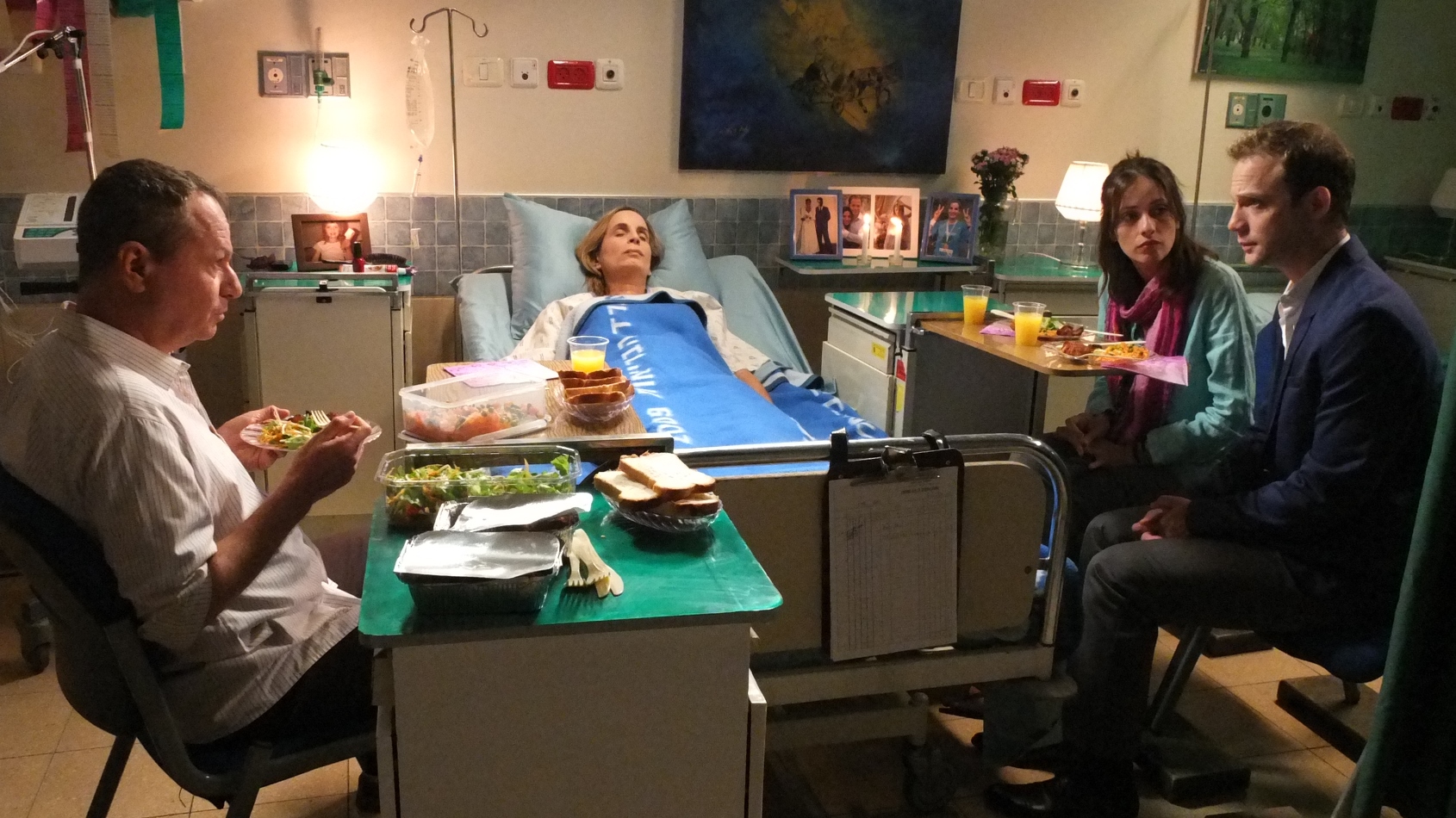
Ora loses the most, for she is left in a coma, unaware that she is surrounded by her  family, who take to meeting for meals at her bedside. Despite Micha’s fury, Ari has to try to find the courage to stick to Reli and reschedule the wedding lest he lose her. Micha himself has to find the courage to get back behind the wheel and retake his driving test or face a life-long driving ban. Thanks to a chance meeting with a pretty driving instructor who moonlights as a yoga instructor (Romi Aboulafia) this apparently insensitive man (he can’t help pointing out physical flaws with a practised plastic surgeon’s eye) learns some valuable life lessons.

Shlomit gets to meet not one, but two potential significant others, thanks to her decision to run the next half marathon through Jerusalem’s streets in honour of her mother. She trains with Motti, the wheelchair-using gym teacher who replaces Ora; and finds the bed next to her occupied by the mother of matinee idol Ahmed, who's played with relish by real-life Arab star Yousef (Joe) Sweid.

Will Ora wake from her coma? Will Shlomit follow in her mother’s springy footsteps and win the marathon? Will she find love with Motti or Ahmed? Will Ari find his courage so that Reli can get her man in the end? And will self-centred Micha learn to centre himself? You’ll have to see this funny, sometimes abrasive film to find out. And if you do, you’ll enjoy some wonderfully rounded comic performances from some of Israel’s top acting talent and find out why it’s done so well at festivals around the world.

By Judi Herman

Hill Start screens in London on Saturday 14 November. 9.15pm. JW3, 341-351 Finchley Rd, NW3 6ET; 020 7433 8988.

Then moves to Didsbury on Sunday 15 November. 6.30pm. Cineworld, M20 5PG; 087 1200 2000.

Leeds on Sunday 15 November. 4pm. MAZCC, LS17 6AZ; 011 3268 4211.

Glasgow on Tuesday 17 November. 7.30pm. CCA, G2 3JD; 014 1352 4900.

South Woodford on Saturday 21 November. 7pm. Odeon, E18 2QL; 087 1224 4007.

Find further info at www.ukjewishfilm.org

Review: Treasure ★★★ – Pinski’s parade of shtetl shnorrers would do Gogol’s Government Inspector proud, says Judi Herman

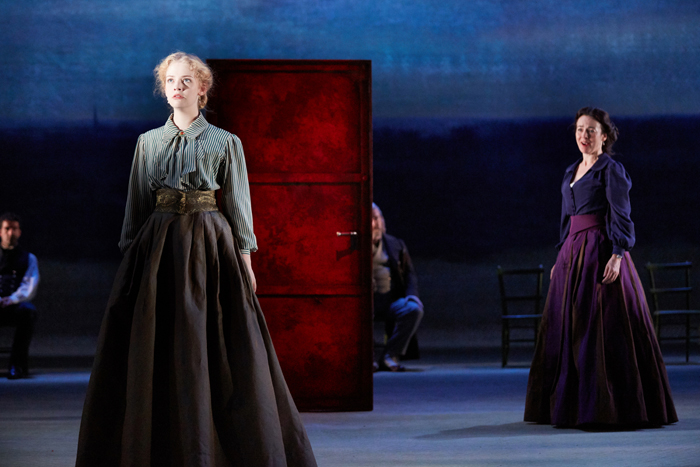
© Richard Lakos Could Pinksi be the Jewish Gogol? His story certainly follows in the great tradition of The Government Inspector. It makes you wonder if he could possibly know the writings of that 16th-century sceptic Ben Jonson, whose citizen comedies Volpone and The Alchemist also depend on wily antiheroes pulling the wool over the eyes of a succession of greedy, gullible types for whom you have no sympathy at all.

Chone the gravedigger’s affable idiot son Judke brings home a stash of gold coins. He’s dug them up in the corner of the graveyard where he’s buried his beloved dog. Trouble is, he can’t remember exactly where that is, so there’s no way of knowing how much more there is, if any. His pretty, resourceful sister Tille seizes on as the opportunity of a lifetime, with a clever ruse to use the money to buy a premature ‘trousseau’ to convince folk (especially marriage brokers and prospective bridegrooms) that there’s a fabled amount more where that came from. Her gloomy, grasping parents though, see the coins – and her ruse – as a threat rather than an opportunity, which will just attract all the wrong sort of attention. In a way both are correct, you could see the glass as half full or half empty.

The delicious Tille, (truly scrumptious, in Olivia Bernstone’s glowing performance) does indeed attract a matchmaker to her door straightaway. But he is followed by a parade of ever more grasping and opportunistic denizens of the shtetl, from the President of the synagogue to the previous owner of the field where Judke is presumed to have found the coins.

Pinski’s comedy descends into potentially uproarious farce as the villagers themselves descend on the graveyard on their frantic treasure hunt. Yet he also builds in moments of quiet storytelling – a small chorus of children exchanging moral tales. And the climax of the play even takes in magical realism, for the residents of the graveyard rise to compare notes on the eventful night when the living literally trample on their graves, in their obsession with what is transitory, material.

As discussed in the current issue of JR and elsewhere on this blog, Pinski’s play was extraordinarily popular and remained in the Yiddish repertoire over 30 years, until the Shoah, when it was even performed in the Vilna Ghetto.

© Richard Lakos

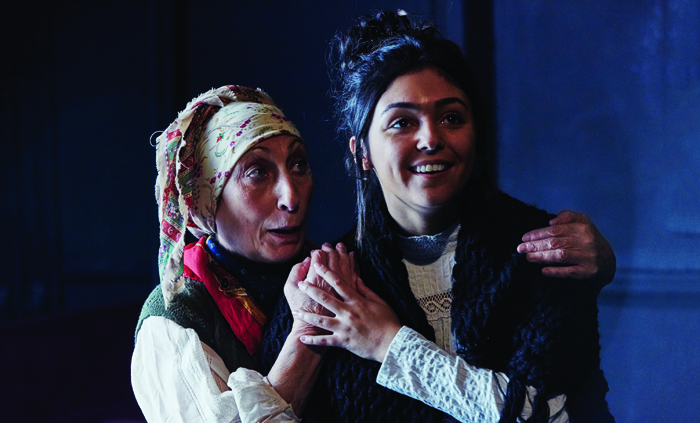
On the strength of Alice Malin’s production at the Finborough Theatre, the main attraction must be Pinski’s heroine, an extraordinarily outspoken and sensual young woman, rising like the phoenix above the strictures of life, especially for a woman, in this small, claustrophobic Jewish community. So obviously in command of the situation is she, that the visiting marriage broker soon realises that it makes sense to deal directly with her, cutting out her mother, the middle woman. She is inspired, intoxicated by the coins that represent a way out of poverty if she plays her cards right. That of course is in the writing but Bernstone revels in Tille’s ingenuity and sheer spunk!

The contrast with her mother, Jachne-Braine’s (Fiz Marcus) constantly downturned mouth and disapproving voice and mien, is obviously important. The clue is in her name for Jachne can suggest a woman is not just a gossip and busybody but also coarse or shallow.

Meanness seems to run in the family, for so poor are the gravedigger and his wife that they are prepared to fight their children for the coins. This is hardly the archetypal Jewish mother looking out for her child and the money gets in the way of Chone's (James Pearse) paternal feelings too. Luckily for Sid Sagar’s touchingly gangling and awkward Judke, he and Tille do look out for each other and there is a sweetnesss in the bond between them.

Adaptor Colin Chambers a prolific theatre writer. Indeed, his book Other Spaces was an inspiration for me at university. His translation includes some useful nips and tucks, though for my money, he could have made a few more. Those children telling tales have been left to their own devices by parents who have only treasure hunting on their minds. I guess Pinski deliberately changes pace and slows down the momentum here, but this interlude of Brechtian moralising from these precocious infants (the young actors acquit themselves very well, but their characters are perhaps a little priggish) is not entirely successful. And each hopeful, acquisitive visitor to the apparently nouveau riche household rather out stays their welcome, once they have established their characters and motives.

Chambers’ translation, with its carefully-chosen words has that ‘old-fashioned’ feel that gives a sense of a different time and place, though it does perhaps feel a trifle self-conscious. Alice Malin directs her large (19-strong) cast with a larger-than-life playing style to match, which again would work even better if the scenes were shorter. Fiz Marcus’ Jachne-Braine in particular and James Pearse’s Chone to a lesser extent, adopt facial masks and find a trope and a note for their characters, though again, both would be even more effective if the scenes were shorter.

Designer Rebecca Brower’s dark all-wooden set plays its part in creating the lost world of the shtetl. It’s about as spacious as I have seen in the Finborough’s tiny space, which is just as well with such a large cast of villagers. Happily Fiddler on the Roof without the music it is not (although there is music for atmosphere and to link scenes, it is not live or specially composed, which is perhaps a missed opportunity). But it throws light on a fascinating writer and his vital contribution to the body of popular Yiddish literature.

By Judi Herman

Treasure runs until Saturday 14 November. Finborough Theatre, 118 Finborough Rd, SW10 9ED; 0844 847 1652. www.finboroughtheatre.co.uk

Pioneering Jewish historian David Cesarani passed away aged 58 this week – JR editor Rebecca Taylor recalls their first meeting

David Cesarani 2015 We were so sad to hear of the death of the pioneering historian David Cesarani on October 25. He contributed over the years to Jewish Renaissance, but here JR editor Rebecca Taylor recalls her first meeting with him at the legendary Kosher Luncheon Club in London's East End.

I first met David Cesarani in the late-1980s. I must have been about 20-years-old and was writing my final-year dissertation for my English degree at Cambridge University. I had chosen a geekily obscure area of literature to focus on – a body of work with political leanings that emerged from the Jewish East End in the 1930s. It focused on novels such as Simon Blumenfeld's Jew Boy and William Goldman's East End My Cradle, which grappled with relating the immigrant experience alongside experimenting with the new forms of modernist writing, and pitched all this against a background of political debate about how the 'working class' should best be represented artistically.

David suggested we meet at the Kosher Luncheon Club canteen on Whitechapel's Greatorex Street. With its mix of customers in cloth caps or kippah, brusque waiters and sky blue paper tablecloths, the canteen was an East End institution – and something of an eye-opener for a girl from the deepest depths of south London.

Over plates of fried fish I explained to David what I wanted to explore and he patiently and kindly listened. Already at the forefront of work with the All-Party Parliamentary War Crimes Group that was investigating Nazis who had come to live in the UK, and a leading figure in Holocaust education, he was just about to take up the post of director of the Weiner Library. But he treated my half-formed theories and un-focused questionswith absolute seriousness.

He had already written an insightful essay on the East End background to Blumenfeld's Jew Boy, which had appeared in the London Journal, and he was a wealth of information on the period (his excellent book, The Making of Modern Anglo-Jewry appeared soon after we met), but more than that he encouraged me to interview the writers – Willy Goldman was still alive at that time – and speak to others such as the historian Professor Bill Fishman who had also lived the period. He was generous with his ideas and contacts, afterwards sending memos and notes with follow up information. Looking through my old college folders recently I found a detailed list that David had carefully written up for me of books and archives that I should pursue, as well as contacts for historians such as Ken Worpole and Brian Cheyette.

And arranging the meeting in the canteen was genius – the perfect antidote to long days of locking myself away in the university library, picking through treatise on social realism in yellowing 1930s copies of the Left Review. Like all the best historians, David knew how to bring the past to life – and just in time – the canteen closed down a few years after our fried fish meal.

I only encountered David again years later when I became involved in JR in 2014. He had written for the magazine on a number of occasions on subjects such as funding for Jewish studies, and the Jewish involvement in World War I. But he was one of the first people I commissioned for the magazine, when I asked him to write about the rise of the far right in Europe in 2014. As ever he was the voice of reason and rationality, refusing to take the knee-jerk reaction that European antisemitism was unequivocally on the rise.

His last piece for us was an eloquent and affectionate obituary in April's issue following the death of Bill Fishman. I never imagined that I would soon be writing one for David. He will be sadly missed by the Jewish community and far beyond.

By Rebecca Taylor

You can read more about the life and work of David Cesarani on The JC, Guardian and Forward websites.

The Book And The Believer: Are Catholics, Jews And Muslims Still Outsiders In British Society

ruths blog copy

ruths blog copy

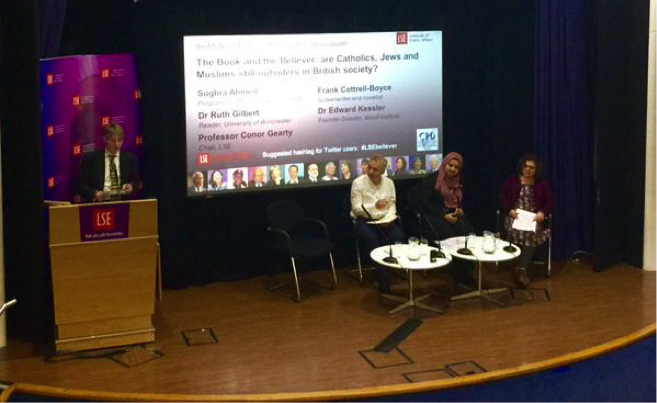
On 15 October the Institute of Public Affairs at the London School of Economics (in partnership with the Pears Foundation and the Woolf Institute, Cambridge) hosted an interfaith discussion on the theme The Book And The Believer: Are Catholics, Jews And Muslims Still Outsiders In British Society. The evening was part of a series of events to mark the 175th anniversary of the publication of Tablet Magazine.

I was one of three panellists. The others were Sughra Ahmed, from the Woolf Institute in the Centre for Policy and Public Education, and Frank Cottrell-Boyce, screenwriter and novelist who, alongside his many creative achievements, was the writer for the 2012 Summer Olympics opening ceremony and for sequels to Chitty Chitty Bang Bang.

I started out by commenting that, when I was first asked to speak at the event, I wondered if it was a joke. Something along the lines of ‘a Catholic, a Jew, and a Muslim walk into a lecture theatre…’ It was a throwaway comment but it also signalled my apprehension about being asked to in any sense speak for, or represent, Jews in today’s Britain. I could only give my own perspective.

As it was, we each presented personal responses based on our very different perceptions and experiences. Then three excellent LSE student respondents added their own views. After that we took questions from the audience and an intelligent, lively and good-natured debate ensued. This was chaired with considerable charm and pace by Professor Conor Gearty. Animated discussion carried over into the reception that followed.

In the end, the answer to the opening question seemed to be, ‘yes… and no’, but also ‘no… and yes’. So, of course, we didn’t reach any clear conclusion; but it was a great privilege to be part of such a rich conversation.

Dr Ruth Gilbert is Reader in English Literature at the University of Winchester. She is author of Writing Jewish: Contemporary British-Jewish Literature (2013) and co-convenor of the British Jewish: Contemporary Cultures network.

Don't miss Arthur Miller season on BBC Radio 3, 4 and 4 Extra

miller  

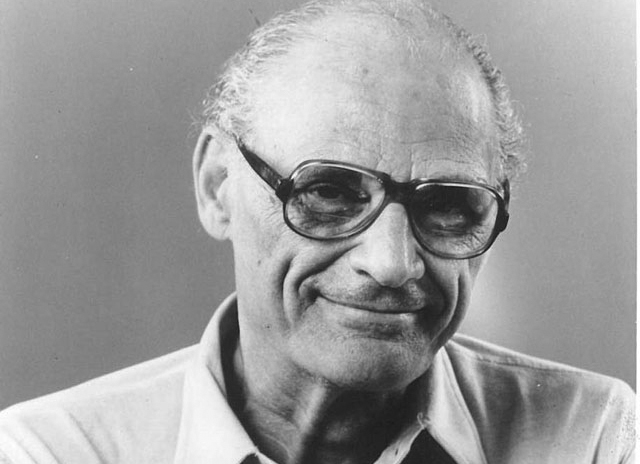
This month BBC Radio has joined in the celebrations of Arthur Miller’s centenary (he was born 17 October 1915) with a terrific season of dramas and documentaries exploring his life and work on Radio 3, 4 and 4 Extra – including the broadcast world premiere of The Hook, which had its world premiere on the stage earlier this year, as reported in Jewish Renaissance. Read on for all the necessary details, and if you miss/have missed any of the programmes, they will be available on BBC iPlayer for a month after broadcast.

Coming up this Saturday 17 October on Radio 4…

2.30-4.15pm Unmade Movies: Arthur Miller's The Hook The world broadcast premiere of Arthur Miller's unproduced screenplay tells the story of a 1950s Brooklyn longshoreman who is fired for standing up to his corrupt union boss, but decides to fight back by standing for union president.

8-9pm Archive on 4: Attention Must Be Paid – Arthur Miller's Centenary   "Attention must be paid to such a person," says Linda of Willy Loman in Arthur Miller's 'Death of a Salesman'. Miller himself spent his long life paying close attention to the society and times in lived in. He scrutinised the American Dream in 'Salesman', in 'The Crucible' revealed its hysteria and in 'All My Sons' its corruption. One hundred years, to the day, after the birth of Arthur Miller his biographer, Christopher Bigsby, mines the BBC's and his own archives, tracing the life and work of this towering American figure. There are contributions from Dustin Hoffman, Warren Mitchell and Brian Dennehy, who all played Willy Loman, and Ying Ruocheng, who played the role in Beijing. Henry Goodman speaks about working on his late play, 'Broken Glass'. We hear from Harold Pinter, Nicholas Hytner and John Malkovich. And there is previously unbroadcast material from Miller's brother and sister, and his wife, the photographer, Inge Morath.

Still available to catch up on…

The Essay: Staging Arthur Miller on Radio 3 To mark the centenary of Arthur Miller's birth (17th October 1915), in five 15-minute programmes on Radio 3, playwrights, directors and an actor, reflect on what his work means to them and describe their personal connection with the playwright and his work. They are first broadcast from Monday to Friday 12 to 16 October at 10.45pm

The Life and Times of Arthur Miller on Radio 4 Four 45-minute biographical dramas broadcast in Radio 4’s Afternoon Drama slot from 12 to 15 October

Fame on Radio 4 Extra three short stories by Miller under the title ‘Fame’ on Radio 4 Extra

Arthur Miller: The Accidental Musical Collector on Radio 4 Extra Playwright Arthur Miller taped Blues and spiritual songs of North Carolina's poor in 1941. With Christopher Bigsby. From February 2005.

Playing the Salesman on Radio 4 Extra Christopher Bigsby analyses the role of Willy Loman, the central character in Arthur Miller's Death of a Salesman. Contributors include Dustin Hoffman, Warren Mitchell, Brian Dennehy and Alun Armstrong, all of whom have played the role.

By Judi Herman

Review: The Merchant of Venice ★★★★ – Judi Herman finds funny girls on top form in Anna Niland’s pithy UK premiere of Tom Stoppard’s abridged version

© Helen Maybanks The 500th anniversary of the Venice Ghetto might take place in 2016, but I feel as if I’ve already spent some time with its embattled Jewish community, at least as seen through Shakespeare’s eyes, as I watch The Merchant of Venice for the fourth time this year.

I guess this might be in contrast to the excited, noisily appreciative, mostly young audience at the National Youth Theatre's sparky and sparklingly funny production. Even if they are studying the play at school, this might be the first time they've seen it, so it’s good to be able to report how much they enjoyed a comic treat. The play is after all dubbed a comedy, even though it also presents huge problems and not just for the Jews in the audience.

The young cast is not afraid to hit those problems head on. The NYT originally performed this version by Tom Stoppard in China in 2008 with a cast made up of both young British and Chinese actors. This was the year of the Beijng Olympics, so they experienced artistic censorship “heightened by human rights controversy”, writes director Anna Niland in a programme note. Despite this, she continues, “the play’s themes of persecution, racism and inclusion rang true to local audiences and our young international cast.

"With Italy experiencing an immigration crisis that brings these themes to the fore, I have decided to set the play in modern Venice. However, I also think it’s crucial to hang onto a semblance of the historic Venice Shakespeare was writing about.” She goes on to talk about exploring the play through the eyes of Shylock the ‘alien’ and posits that the production “will ask how much has really changed for those considered alien today.”

The production sets out its stall before the play begins, with establishing shots – silent face-offs between the main protagonists, much of it to the gorgeous accompaniment of composer and musical director Tristan Parkes’ setting of 'In Belmont lives a lady…' perfect for Grace Surey's smoky voice. She is surely a future jazz star. The Christians may exchange meaningful glances, perhaps to establish the possibly homoerotic relationship between Antonio and Bassanio, but all of them glare at Shylock. Andrew Hanratty’s Antonio has a gravitas beyond his years and Jason Imlach’s Bassanio sports a useful beard which gives him maturity too. Add to this Luke Pierre’s tall, rather elegant Shylock and it’s easy to take all three very seriously indeed.

And just because Pierre’s Shylock is so dignified, the contempt in which he is held by Antonio and Bassanio, and later his humiliation and ruin by Portia in court, have the power to shock.  True, Shylock and Antonio gingerly shake hands, which is more contact than I’ve seen in other productions this year, but then the eponymous merchant does indeed ‘spit upon’ Shylock’s ‘Jewish gabardine’. I’ll assume the couple of titters evoked by those Jew-baiters and haters Salerio and Salanio (a vicious double act from Oliver West and Conor Meaves) thrusting the pig-head masks they are wearing at Shylock, were down to discomfort.

The gabardine in question is made rather a colourful affair by the addition of coloured ribbons at the waist, evoking tzitzes (the prayer fringes of the Orthodox Jew) with the colours perhaps also suggesting the Spanish origins of this Sephardi Jew.

© Helen Maybanks

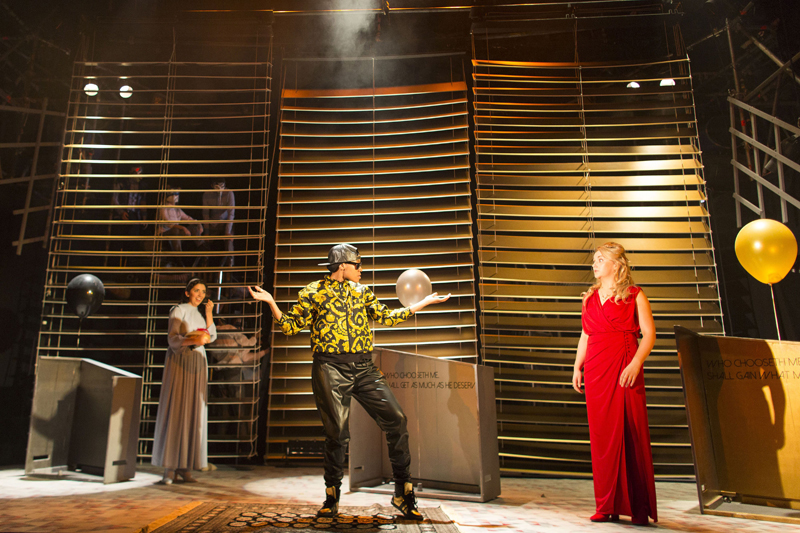
Cecilia Carey's striking costume and design are a vital part of Niland's bold concept. Her Carnival-time Venice is exuberantly, edgily stylish but in its own almost eccentric way. True the Carnival masks are traditional, but Alice Feetham's poised, intelligent Portia is a lady in red with a style and sexy panache all her own. It's in eye-catching contrast to Jessica's black and pink pleats beneath a clever cape which becomes a hood when she pulls it over her head, as a modest Jewish maiden should, to go outdoors.

But the apogee of her costume design is surely the extraordinary confection sported by Lauren Lyle's wildly funny Prince of Arrogan (their spelling - possibly Stoppard's - not mine!). Lyle brilliantly exploits its slinky contours and purple sash to create her comically androgynous suitor and relishes sashaying on impossibly high platforms, as she quite literally feels up each of the 'caskets' as if it were Portia herself! Before I leave the clever cross casting in the comedy roles that ensures jobs for the girls, let me make honourable mention of Paris Campbell's equally ardent Prince of Morocco; and Megan Parkinson's Lancelot Gobbo, the cheekily insouciant servant leaving Shylock's service for Bassanio's, together with versatile Grace Surey as Old Gobbo, his parent, here transformed into Old 'Mother' Gobbo - rather a fine below stairs double act.

This all matches Carey's equally quirky stage design, simple and versatile. The action takes place against a backdrop of huge Venetian (naturally) blinds and those three 'caskets' are actually three wooden structures that work separately or together to create steps, beds and the witness boxes in the courtroom scene.

Their quirkiest use though, is as those caskets, each flying a balloon of the relevant colour, gold, silver and of course lead! But happily there’s no way the so-called casket scene goes down like the proverbial lead balloon! The wickedly playful ‘Team Belmont’ of Feetham’s Portia and Melissa Taylor’s cheerful, wise-cracking Nerissa have a great time sending up the suitors Portia must entertain; and Nerissa’s gleeful rendering of a relevant musical number for each casket – e.g. ‘Hi Ho Silver Lining’ for the silver casket  - goes down a treat with the audience, who joined in and sang along. Mistress and waiting gentlewoman work up an authentic tension as Bassanio rejects each wrong casket in turn and Portia and Bassanio achieve a touching tenderness as they fall into each other’s arms in relief.

Meanwhile, the tension in the home life of Shylock and Jessica is a much darker affair. Though again the production achieves a touching moment – for me perhaps the most telling. At the climax of the very few lines they share, it’s actually a mute moment. In one of the most moving gestures of the production, Francene Turner’s Jessica, about to leave her father forever, cannot go without giving him a last desperate, lingering hug – a hug that clearly takes him by surprise and moves him too. It's all the more poignant because he does not know its significance. When he learns it though, his rage is all the more understandable, so he earns sympathy when Oscar Porter-Brentford’s supportive Tubal reports that the errant Jessica has given away her late mother’s engagement ring in exchange for a monkey.

Given that a female Doge (stately Ellise Chappell) presides over Venice's court, it might be considered an anomaly that Portia has to disguise herself as a man to appear as a lawyer, but, if anything, in this modern setting it genuinely raises eyebrows that she has to do so, perhaps just because it reminds the audience of the realities of life for women in some countries today. Of course though, for the comedy to work, Bassanio and Gratiano must not recognise their brand new wives, so disguise is a given. Cole Edwards’ Gratiano achieves the brash comedy in his role and displays the casual racism written into his character and Gavi Singh Chera is a Lorenzo as interested in his bride as in her fortune.

Although I’m not entirely convinced that the production draws the parallels with today’s immigration crisis, I am sure that this fresh reading of the play ensures that those who have seen it before take a fresh look at it and those who are new to it will have a clear idea of the comedy and the problems – and what all the fuss is about.

By Judi Herman

The Merchant of Venice runs until Wednesday 2 December. 7.30pm & 2.30pm. £12-£19.50. National Theatre, South Bank, SE1 9PX; 020 7452 3000. www.nationaltheatre.org.uk

JR OutLoud: Arthur Smith talks to Judi Herman about his show, a love of Leonard Cohen and his mother

In the October issue of Jewish Renaissance, Arthur Smith gives Judi Herman the not so sweet lowdown on his show, Arthur Smith Sings Leonard Cohen, with which the gravel-voiced wit makes his debut at JW3 in December. Here you can hear an extended version of his conversation with Judi. The two share a love of Leonard Cohen and they compare notes on their mothers, both of whom are living with dementia – indeed Arthur’s mother Hazel has become a vital part of his show.

Keep reading to see Smith's poem about his mother and to listen to him reciting it.

Oh Hazel is Arthur Smith's moving poem about his mother's dementia, which you can read and listen to below. You can read more about Arthur Smith Sings Leonard Cohen – The Extended Remix, the show in which he recites the poem live, in the October 2015 edition of Jewish Renaissance.

Oh Hazel

Pulling up late after the party, they see her, their neighbour, standing in the street.

She is looking, she says, for a lift to London. She needs to get home. ‘Hazel,’ they tell her, ‘This is your home – ‘you live here, in this house. London is 30 miles away.’

The door is open. They take her in and see she has packed a bag (if a jumper and a packet of biscuits count as packing).

Oh Hazel, It is 35 years since you left London to live, as you liked to say, ‘in the shires’.

But there she still is that grammar school girl from Camberwell Green kissing sailors and dancing In Trafalgar Square. It is VE day and the rest of the century Is yours.

Oh Hazel also appears on the Alzheimer’s Research UK blog.

Arthur Smith Sings Leonard Cohen – The Extended Remix is on Thursday 3 December. 7.30pm. £16-£20. JW3, 341-351 Finchley Rd, NW3 6ET; 020 7433 8988. www.jw3.org.uk

Review: Pure Imagination ★★★★ – Judi Herman enters the tune-fuelled world of Leslie Bricusse

© Annabel Vere If like me, you relished the toothsome trip round Willie Wonka's Chocolate Factory in the 1971 movie musical of Roald Dahl's dark and delicious children's classic, you'll have no problem identifying the title of this equally moorish compilation of the words and music of Leslie Bricusse.

Gene Wilder's pitch-perfect Willie Wonka sang the song like a silky caress in the film and, as the programme informs us, it's been covered by stars including Michael Feinstein, Sammy Davis Jr, Jamie Cullum and Mariah Carey, and featured on TV shows ranging from Glee to Family Guy.

The joy of the man's genius, as explored and celebrated in this warm hug of a compilation show, is not just the range of fine singers attracted to Bricusse's work – it's the range of the work itself. The palpable delight in the auditorium comes as much from surprise at the rediscovery of yet another all-time favourite from the composer/lyricist's extraordinary back catalogue, as from the execution and charm of these five well-chosen performers.

Think Bond themes ‘Goldfinger’ and ‘You Only Live Twice’ (written with John Barry and Anthony Newley); cheerful, upbeat numbers like ‘On a Wonderful Day Like Today’ and ‘Out of Town’ (Housewives' Choice memories anyone?); inspirational anthems like Nina Simone's spine tingler ‘Feeling Good’ and Sir Harry Secombe's feel-good hit ‘If I Ruled the World’. There are also comedy novelty numbers, including Oscar-winning ‘Talk to the Animals’ from Dr Dolittle and ‘My Old Man's a Dustman’, which topped the charts on three continents; and of course there are the love songs, often with a specific original context, such as ‘Can You Read My Mind?’, the love number from the film Superman.

It’s good to be reminded not just of the man's music but also of his musicals. Bricusse seems to have a penchant for Victoriana and the Edwardian age, for his musicals on stage and screen include the Julie Andrews vehicle Victor/Victoria, Dr Jekyll and Mr Hyde and Dickens adaptations Scrooge and Pickwick. Then there’s Sherlock Holmes – The Musical, which yields a great excuse for a jolly old Cockney knees-up with showstopper 'Down the Apples 'n' Pears'.

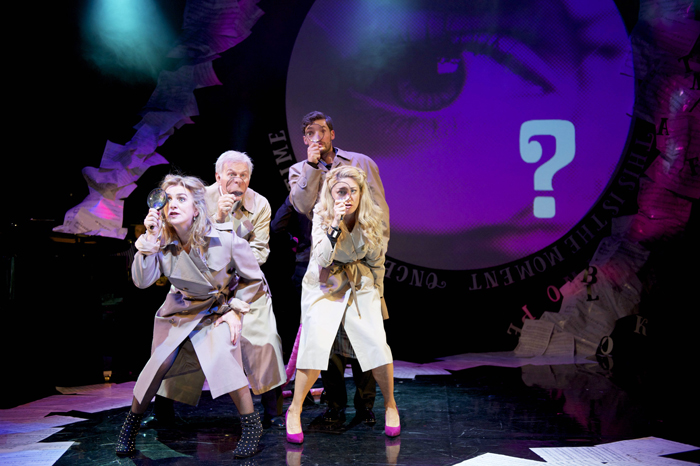
But this show is stuffed with showstoppers and wonderful curiosities. Did you know that Bricusse wrote clever lyrics to Henry Mancini's Pink Panther Theme? It's wonderfully realised here as a segue from ‘Talk to the Animals’, where designer Tim Goodchild thinks pink and lithe Giles Terera glides round the stage lashing his tail while pursued by the rest of the company – complete with raincoats and magnifying glasses of course. The man writes lyrics to die for – perhaps literally in ‘Goldfinger’  – "He's the man, the man with the Midas touch, a spider's touch, such a cold finger … For a golden girl knows when he's kissed her, it's the kiss of death from Mister Goldfinger".

© Annabel Vere

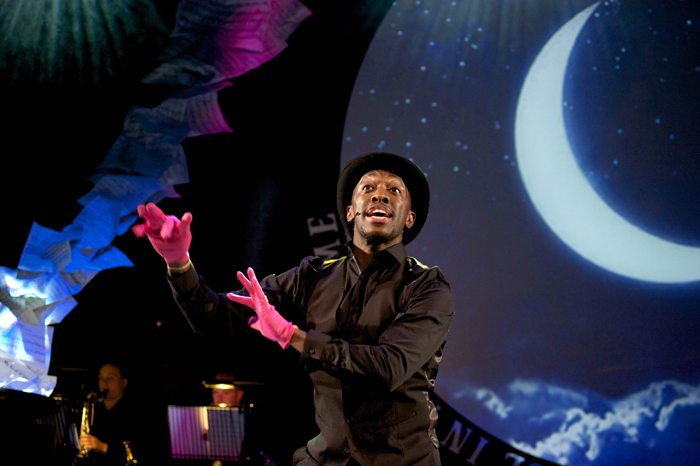
Happily all five members of the company – Terera as the Joker (a character from The Smell of the Greasepaint – The Roar of the Crowd), Dave Willetts as the Man (adding a lovely depth of emotion and gravitas in numbers including ‘Who Can I Turn To’ and ‘Once in a Lifetime’), Siobhan McCarthy as the Woman, Niall Sheehy as the Boy and Julie Atherton as the Girl – make sure their audience can hear every precious word. And they all manage to work up a head of emotional steam in the brief connections they have with each other, song on song. Versatile Terera is not just a performer with emotional depth (as seen during the number ‘What Kind of Fool Am I?’) and a lovely sense of fun (‘The Candy Man’) but a lovely mover too and Matthew Cole sets numbers around him to give him his head (or should that be feet!).

The powerful six-strong band, arranged to the side of the stage, feels like part of the cast and does Bricusse’s wonderful range of styles proud. MD Michael England, while at, and occasionally away from, the piano takes centre stage, generously sharing his stool with the performers.

So although designer Tim Goodchild has provided a swirling backdrop that can frame video and still images and morphs usefully to suggest the Bond credits, he has wisely kept the scenery simple to frame the talents of the cast – a swirl of music round the edge of the stage floor, reflecting the backdrop, to suggest the size of the composer’s oeuvre, and angular chairs in different styles and poster colours.

The evening aroused my curiosity about early shows such as The Smell of the Greasepaint… along with Stop the World – I Want to Get Off, surely due for a revival. And it’s great to report that the man is still writing. I’m just as curious to know more about his as yet unperformed new musical Sunday Dallas after enjoying the fun of ‘Hollywood Wives’, a number from the show that evokes the late great Jackie Collins, as it’s staged here featuring a Hollywood Diva and her claque, pursued by adoring males seeking selfies with her. I'm also happy to say that Bricusse’s 2009 biographical musical Sammy, about his friend and fine interpreter of so many of his songs, Sammy Davis Jr, is bound for London. Meanwhile there is this chance to get to know and enjoy a terrific selection from Bricusse’s songbook – even though it does not feature his 1973 song ‘Chutzpa’!

By Judi Herman

Pure Imagination runs until Saturday 17 October. 7.30pm & 2.30pm. £15-£50. St James Theatre, 12 Palace St, SW1E 5JA; 084 4264 2140. www.stjamestheatre.co.uk

If I were a rich girl… As Yiddish gem Treasure is unearthed at Finborough Theatre, Judi Herman polishes up on its backstory

© Richard Lakos What do The Dybbuk, The Golem and Fiddler on the Roof have in common? Their stories were all originally written in Yiddish. From Franz Kafka to Danny Kaye, the influence of Yiddish theatre is far reaching. Four years before the first professional production in Yiddish took place in a Romanian wine garden in 1876, one of its most influential writers, David Pinski, was born into a cosmopolitan Jewish family in Mohilev, Russia (now Belarus). He moved to Warsaw, Switzerland, Vienna and Berlin before emigrating to New York in 1899, where he lived for 50 years. While there he was an active member of Jewish cultural and political life and was president of the Jewish National Workers’ Alliance from 1920-22, and president of the Jewish Culture Society from 1930-53. Finally, in 1949, the committed left-wing Zionist moved to Israel, where he lived until his death in 1959.

Pinski wrote over 60 plays and there were novels too. His subject matter ranged from stories of the lives, struggles and dreams of the ordinary Jewish folk to Biblical themes, including both King David and King Solomon, their wives, and the coming of a future Messiah.

Treasure is arguably his comic masterpiece, revived here in a brand new adaptation by Colin Chambers. The play premiered in 1912 and remained popular in the Yiddish repertoire until the 1940s (with a production in the Vilna Ghetto in 1943), was staged in German by Max Reinhardt in 1919 and in English on Broadway in 1920. The story follows poor gravedigger’s daughter Tille, who must decide whether or not to keep a pile of gold coins her brother finds at the graveyard. Should she hand it in and remain in a life of drudgery or use it to turn her world around?

Its latest incarnation in a production at London’s Finborough Theatre is directed by Alice Malin. What drew her to Pinski’s comedy? “It’s a story of female emancipation and it has real wow factor. Tille seeks freedom by using found money for her own ends and that wowed me. Plus it’s resonant today in how humanely it treats poverty and approaches the subject of inequality. Its dirt poor protagonists are united by the same goals, being free and visible and having enough money to live. It’s really funny and outrageous, part farce, part tragedy.” Not to give too much away, as occupants of the graveyard come to life, it sounds as if Pinski’s story is magic realism. Alice agrees and adds that it’s “a strange surreal expressionist drama, judiciously nipped and tucked by Colin Chambers.”

Malin is confident the audience will share her enchantment with the “wry, witty heroine with chutzpah". She explains that "Tille is in her late teens and so poor that she has no prospects of marriage till her brother finds the treasure. She takes a massive gamble and going on the journey of its consequences is really intoxicating . She takes a massive punt buying clothes to make herself look genuinely rich so that potential husbands will consider her – not because she is vain and wants to look pretty, but to seize the chance of a better life. The whole community, especially the traditional menfolk, descend on the graveyard and demand that she be put back in her place, but she refuses and manages to keep one step ahead of them. Her mother Jachne Braine is constantly coming back with sarcastic comments, on the one hand terrified of the money and everyone wanting something from her, but on the other overwhelmed by the possibilities. The production boasts a cast of 15, with three Jewish cast members – Olivia Bernstone as Tille, Fiz Marcus as Jachne and Felicity Davidson as a town gossip. Malin assures that there will be dancing too, because “klezmer music and dance is really important.”

Treasure runs from Tuesday 20 October to Saturday 14 November. Finborough Theatre, 118 Finborough Rd, SW10 9ED; 0844 847 1652. www.finboroughtheatre.co.uk