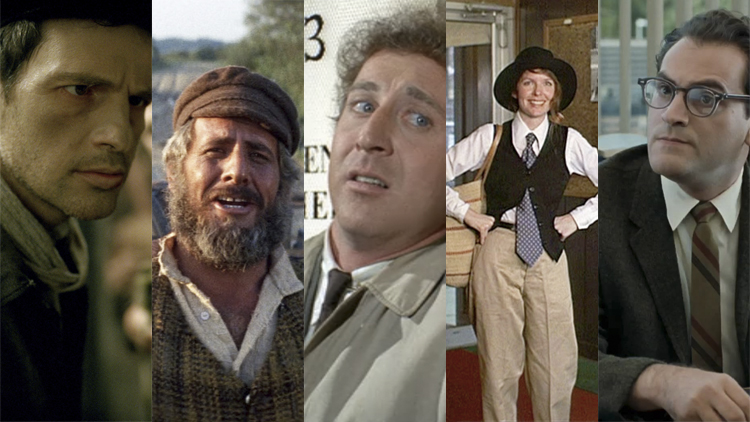
Review: Lunch and The Bow of Ulysses ★★★ – Steven Berkoff coupling on fine form

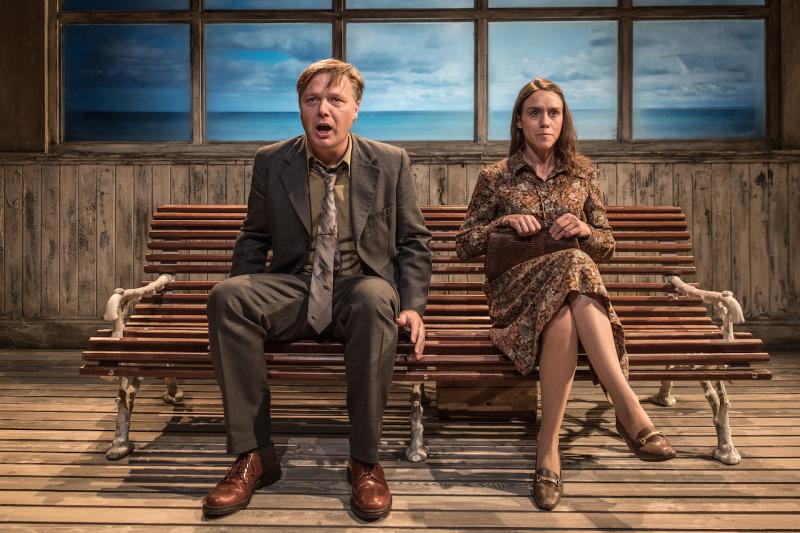
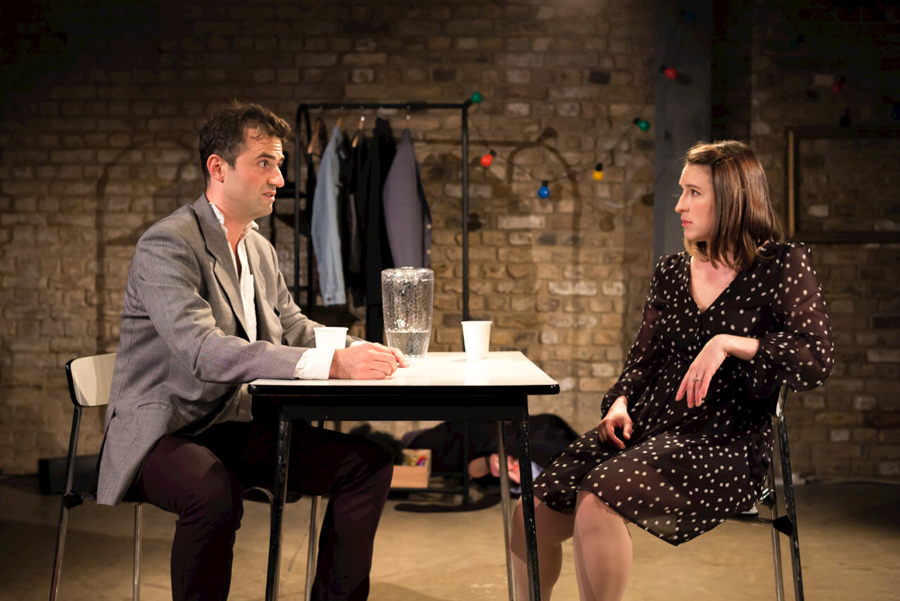
lunch-1-shaun-dooley-and-emily-bruni-photo-marc-brenner I’ll always be grateful to Steven Berkoff. Back in my days as drama lecturer, blown away by his 1983 play West, his second foray into life on London’s gangland manors, I wrote to him via his agent to ask if I might borrow the unpublished script. The hard copy arrived almost as fast as an email might now, by return with a friendly invitation to keep it. My students adored playing the scabrously ornate muscular verse and the body language it demanded.

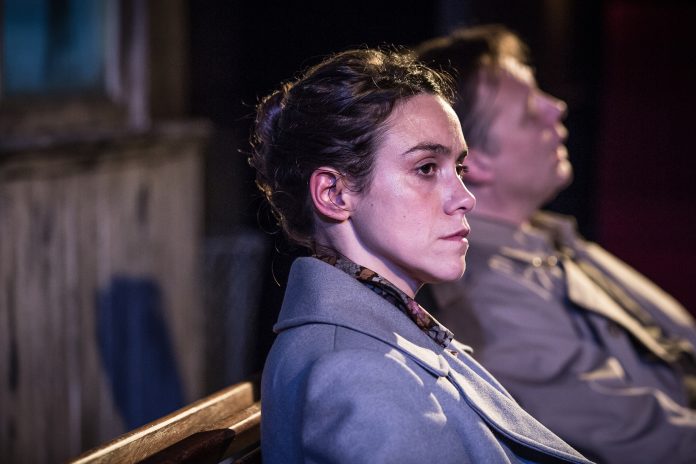
Lunch dates from 1983, too and although it is prose, the language is often as extravagant – and as bracingly sexual. A man and a woman share a seaside bench at lunchtime. He confides lustful thoughts that she arouses, which make Trump’s ill-judged bragging look prim, and it’s in-yer-face in this intimate space, too. He is yearning, rather than boasting, with every muscle and fibre in Shaun Dooley’s extraordinary performance. Emily Bruni’s woman is equally physical – at first sight primly upright and uptight, but actually coiled like a spring ready to snap – or catch him in those coils...

Thanks also to Nigel Harman’s direction and movement director Alistair David, what follows is a masterclass in physicalising Berkoff’s language that would have enthralled my students. They prowl around each other like courting cats, he wiping from his brow real drops of sweat with a real hanky. At this proximity, audience members might also sweat uncomfortably as the couple eventually end up adjusting their dress at our feet.

lunch-marc-brenner

But it’s their relish of the language that carries you along, the taste of it on the tongue – even when his chat-up line is trying to interest her in the space he sells for a living “electro-type on quarto double weight” (yes, space on paper, not online, Lunch is of its time) he enunciates alluringly in his attempt to melt “an ice lolly in a whirlwind.” “You’re not looking for me, you’re looking for it, you canine groper,” is her riposte (this comes more like a chat-up line before that apparent tumble behind the beach shelter).

That’s just a taste of what’s to come in the Bow of Ulysses, set (and indeed written) 20 years later and as many years into a marriage on the rocks. Rather than trading bracing insults, though, the estranged couple express themselves in longer, bitter monologues, downbeat this time. It was good to see these short companion pieces together, though strangely the first, as a real period piece, seemed less dated than its sequel. Ben and Max Ringham provide an evocative seaside soundscape and designer Lee Newby has a great eye for shades of brown that match at least the dress of this ill-matched pair in a seaside shelter that’s the only restful element in an unsettling evening.

By Judi Herman

Photos by Marc Brenner

Lunch and The Bow of Ulysses  runs until Saturday  5 November, Monday to Saturday 7.45pm Thursday and Saturday 3pm, £19.50-£35, at Trafalgar Studios 2, 14 Whitehall, SW1A 2DY; 0844 871 7632. www.atgtickets.com

Help fund the UK's first ever Jewish farm

jr-sadeh-farm Next month Sadeh Farm in Kent is set to open its gates. This may not seem like news in itself, but Sadeh (field in Hebrew) is a unique kind of farm: a Jewish farm. Founded by Talia Chain and co, who have already begun work in the grounds of Skeet Hill House, Sadeh aims to reconnect people with their faiths and each other by working together on the land to grow vegetables. "Here Jewish people of all ages and backgrounds can connect with our rich tradition of Jewish farming and be inspired by a religion based in agriculture," they promise in their mission statement. While the group are almost set up, they still need financial help to acquire polytunnels, sheds, tools, marketing and legal help and more. Visit their Chuffed crowd-funding page for more info and to donate.

By Danielle Goldstein

www.sadehfarm.co.uk

Arnold Wesker tribute: The playwright still packed them in at the Royal Court in an affectionate and celebratory look at his life

jr-arnold_wesker “He shone with the sun”, lilted singer Rosie Archer in a soaring paean that took place as part of many poignant moments during an afternoon of tributes to the playwright Arnold Wesker, who died age 83 on 12 April 2016.

Held at the Royal Court Theatre, Wesker's spiritual home despite the theatre having turned down Chicken Soup with Barley (it premiered in 1958 at Coventry’s Belgrade Theatre), the evening was filled with warm memories of the late playwright from luminaries across the arts world.

Mike Leigh spoke of his delight in his teens at discovering this East End working-class dramatist. “What a hero he was. We sought out his plays and read them avidly,” recalled Leigh, reading from a piece based on an article first published in the July 2016 issue of Jewish Renaissance. Later in the Royal Court’s bar, Leigh told me that he had been approached to participate in the event after Wesker’s wife Dusty had shown the organisers the piece.

David Edgar spoke of Wesker’s groundbreaking representation of “political disillusion”; director Fiona Laird remembered her surprise at finding the playwright “charming,” instead of the curmudgeon she had been led to expect. A frail looking Bernard Kops, one of the last of those ‘angry young men’, recalled Wesker’s desire to broaden the reach of culture with his Centre 42 project.

There were some great performances too: Samantha Spiro’s delivery of Sarah Kahn’s final speech (she played Kahn in the Royal Court’s revival of Chicken Soup in 2011) brought tears to my eyes, although puzzlingly she omitted the ultimate rousing imperative, “You've got to care, you've got to care or you'll die!” Ian McKellen performed an excerpt of Chips with Everything with gusto, and Henry Goodman made a mischievous Shylock in a speech from the 1976 play of the same name. Finally, Jessica Raine, who played Beatie in the Donmar Warehouse’s 2014 production of Roots, movingly reprised that character's astonishing final speech.

And there were surprises: who knew Wesker had written lyrics for a Eurovision Song Contest entry? Sadly, Jonathan King rejected Shone With the Sun as “too classical”, otherwise Britain’s Eurovision history might have told a different story. He had been a talented artist too, said set-designer Pamela Howard, who presented several of his fine ink drawings.

As the audience left, speakers played Aaron Copeland’s Fanfare for the Common Man, a favourite with the playwright, and a reminder of the compassion at the heart of Wesker’s own art.

By Rebecca Taylor

CLICK HERE to read Mike Leigh's tribute to Sir Arnold Wesker from our July 2016 issue

Review: Fagin’s Twist ★★★★ - The exhilarating dance drama gives a thought-provoking twist on a familiar tale

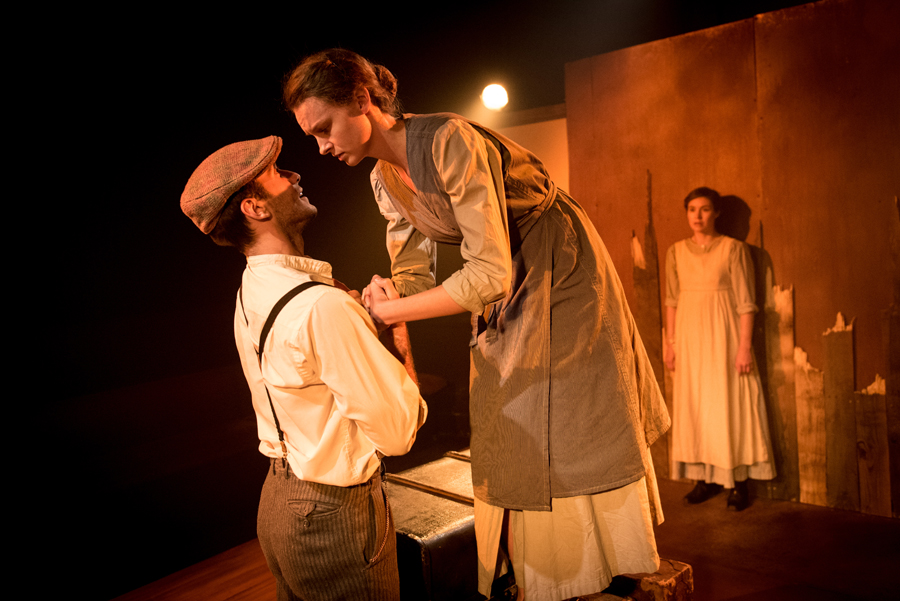
8-fagins-twist-photo-by-rachel-cherry You'll recognise the battered toppers, silk handkerchiefs and the pocket watch, but will you recognise the characters you thought you knew and loved (or hated)? Young orphan Fagin, resourceful and charismatic, escapes the workhouse with his best mate Bill Sykes to build an underground empire, a refuge for the likes of Sykes's girl Nancy and the Artful Dodger. Then they stumble upon young Oliver Twist.…

Fagin’s Twist is a breathtaking synthesis of dance, words, music and design, which succeeds brilliantly in finding – or fashioning – the fully-rounded humanity of Dickens’ characters we think we know so well already from the page, stage and screen.

Writer Maxwell Golden has dared to add his gloss to Dickens to tell those back stories – for Bill Sykes, Nancy, the Artful Dodger and of course Fagin himself. Aaron Nuttall’s Dodger narrates as niftily as he moves, so that Golden lives up to his name – his script sounding direct, fresh and as muscular as the dance itself.

Exploring the dark side of London in Dickens’ time and indeed right now, Tony Adigun’s restless, shape-shifting choreography is complemented by the constant morphing of Yann Seabra’s angular wooden slats lit with extraordinary versatility by Jackie Shemesh, to evoke alleys and streets and the sinister interiors of workhouse and thieves’ den.

3-fagins-twist-photo-by-rachel-cherry

A dark and thrilling eclectic score, both found and original, ranges from strings, piano and harp to music to blast you into submission, but even when it’s ‘in yer ears’ it earns its place there, thanks to sound designers Brian Hargreaves and Seymour Milton.

The performers crown this glorious synthesis by tackling both the dance and drama with energy and brio. Ensemble and soloists are equally at home in the breathlessly fast-moving routines and changing tableaux (sleight of hand looks like it comes naturally to this gang), as well as the escape over London's sinister roofscape; and the more measured duets and solos that explore the burgeoning relationship between Lisa Hood’s passionate Nancy and Dani Harris-Walters’ virile Bill. Joshua James Smith is an intriguingly complicated Fagin, a damaged youth using the cards fate deals him to find his golden opportunity in the gang leader’s swinging pocket watch. He’s a fine lithe figure in his swirling coat with fur tippet, cleverly evocative of Victoriana and yet cutting a more timeless dash like all Seabra’s costumes. Plus there’s Jemima Brown’s little orphan Oliver, working hard on tugging at Nancy’s heartstrings with his efforts to find his niche ...

There’s also an intriguing exhibition in the theatre bar of George Cruikshank’s illustrations for Oliver Twist, complete with correspondence from Dickens. Add some sly quotations from Lionel Bart’s Oliver in Golden's script and it all makes for an unexpected twist on Dickens.

By Judi Herman

Photos by Rachel Cherry

Fagin's Twist runs until Saturday 15 October, 8pm & 2pm, £18, £12 concs, at The Place, 17 Duke's Rd, WC1H 9PY; 020 7121 1100. www.theplace.org.uk

Then on tour at the following places:

Monday 17 October, 8pm, £10, at Gloucester Guildhall, GL1 1NS; 01452 503050. www.strikealightfestival.org.uk

Thursday 20 & Friday 21 October, 7.45pm, £12, at Birmingham Hippodrome, B5 4TB; 0844 338 5010. www.birminghamhippodrome.com

Tuesday 25 October, 7.30pm, £15, £10 concs, at Nottingham Lakeside, University of Nottingham, NG7 2RD; 0115 846 7777. www.lakesidearts.org.uk

Friday 28 October, 7.30pm, £14, £11 concs, at Barbican Plymouth, PL1 2NJ; 01752 267131. www.barbicantheatre.co.uk


Read more theatre reviews and interviews

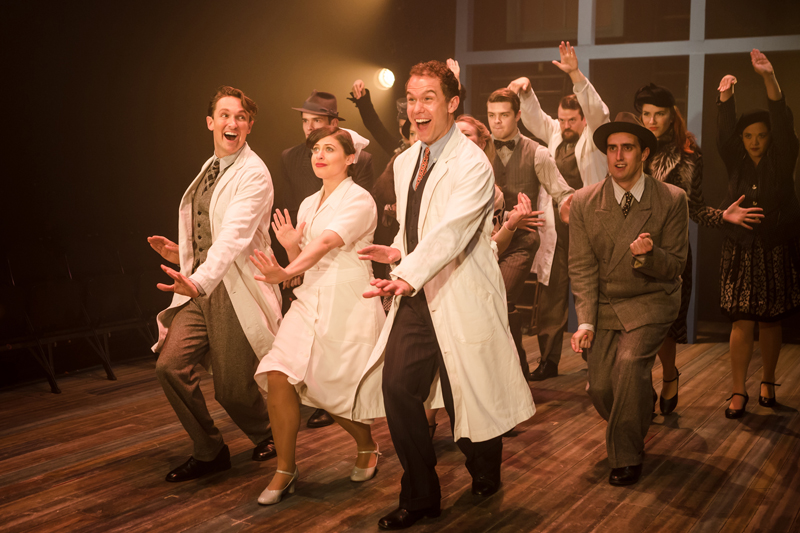
Review: Adding Machine: A Musical ★★★★ - An enthralling account of a life lived by and for numbers

adding-machine-c-alex-brenner-1 What’s the difference between a musical and an opera? One definition might be that in opera the drama is largely generated by the music, in a musical it is largely defined by the text. And of course there are the honourable blends exemplified by Kurt Weill's Street Scene, adapted from Jewish writer Elmer Rice’s play.

Seeing Street Scene prompted Jason Loewith to attempt a similar musical adaptation based on Rice’s 1923 play The Adding Machine. Joshua Schmidt composed the music, as well as writing the libretto and book together with Loewith for a 2007 American opening.

The storyline makes a play of two halves. The first is a stifling, all too real account of the life of white-collar worker Mr Zero, exploited at work and hen-pecked at home till he snaps and murders his boss when he is let go in favour of the new-fangled adding machine. The second half is a surrealist journey into the Elysian Fields of the afterlife (complete with swimming pool in the confined playing space in the Finborough), where even Zero and a fellow condemned prisoner might join other souls offered another chance.

Kate Milner-Evans’ Mrs Zero powers the opening, her singing deploring her unhappy life and worthless husband stark, challenging and in-yer-face in this tiny space, her emotional expression transcending what language alone can communicate. The ensemble respond with an intricate mix of movement and song about numbers, perfectly setting up the claustrophobic atmosphere of a life where people are given numbers according to their social standing. Mr Zero – excellent Joseph Alessi – conveys the burden and boredom of a zero, trapped adding numbers day in day out, incapable of escape and unable to liberate himself (as well as performing the feat of devouring ham and eggs as he sings). There’s excellent support from James Dinsmore as a believable Boss here and in the hereafter, from Edd Campbell Bird as Shrdlu, another murderer, in both worlds and from Joanna Kirkland as the girl of Zero’s dreams.

The music was originally scored for just three instruments, Schmidt explaining that he approached the task with this combination in mind and tried to create a full blown, challenging score for three instruments. “It’s not a matter of compensating for instruments that aren’t there." His music sometimes recalls Kurt Weill, but he has a style and punch all his own and Ben Ferguson (Musical Director), Tristan Butler (percussion) and Hamish Brown (synth) give a full account of the enterprise. Chi-San Howard’s movement direction beautifully fuses actions, movements and words with the musical intent on Frankie Bradshaw’s clever transverse set. Direction by Josh Seymour intelligently contrasts the two halves of the show and seamlessly integrates drama, music, spoken word and movement.

By Judi Herman

Photos by Alex Brenner

Adding Machine: A Musical runs until Saturday 22 October, 7.30pm & 3pm, £20, £18 concs, at Finborough Theatre, 118 Finborough Rd, SW10 9ED; 0844 847 1652. www.finboroughtheatre.co.uk

Read more theatre reviews and interviews

From The Producers to Borat: the best Jewish films of all time

jr-best-jewish-films-ever This autumn the UK International Jewish Film Festival marks its 20th anniversary. To help celebrate the rich smorgasbord of films it has offered over the years, as well as giving us a chance to revel in the world of film, JR asked you to vote for your favourite Jewish film. We can now announce the results! And below our panel of filmmakers and critics have chosen their own favourites.

The best Jewish films of all time; here's how you voted…

1 FIDDLER ON THE ROOF (1971) dir Norman Jewison 2 SCHINDLER’S LIST (1993) dir Steven Spielberg 3 ANNIE HALL (1977) dir Woody Allen 4 THE PIANIST (2002) dir Roman Polanski 5 AU REVOIR, LES ENFANTS (1987) dir Louis Malle 6 A SERIOUS MAN (2009) dir Ethan Coen, Joel Coen 7 SHOAH (1985) dir Claude Lanzmann 8 EXODUS (1960) dir Otto Preminger 9 CROSSING DELANCEY (1988) dir Joan Micklin Silver 10 YENTL (1983) dir Barbara Streisand 11 BLAZING SADDLES (1974) dir Mel Brooks 12 THE GREAT DICTATOR (1940) dir Charlie Chaplin 13 THE PRODUCERS (1967) dir Mel Brooks 14 THE PAWNBROKER (1964) dir Sidney Lumet 15 USHPIZIN (2004) dir Gidi Dar 16 SON OF SAUL (2015) dir Laszlo Nemes 17 WALTZ WITH BASHIR (2008) dir Ari Folman 18 CHARIOTS OF FIRE (1981) dir Hugh Hudson 19 THE FRISCO KID (1979) dir Robert Aldrich 20 THE BAND’S VISIT (2007) dir Eran Kolirin

And an honourable mention to other films you noted which weren’t on our list: Wish I Was Here (2014), Once Upon A Time In America (1984), A Kid For Two Farthings (1955).

jr-au-revoir-les-enfants

Jason Solomons JR film editor; BBC film critic; author Woody Allen Film by Film

Au Revoir Les Enfants (1987) dir Louis Malle Louis Malle’s tale of three Jewish boys secretly enrolled at a Catholic boarding school in rural France during Nazi occupation is as heartbreaking as it is beautifully observed. Themes of identity, chilling snobbery and institutional betrayal unfold under a school regime that mirrors the turbulence outside as well as sheltering the boys from it. This film is nevertheless imbued with fondness and tenderness, told with a childlike innocence that is rudely shattered in the final devastating moments.

The Producers (1968) dir Mel Brooks Mel Brooks’ epochal, taboo-smashing comedy features Broadway charlatan (Zero Mostel) and nervous accountant (the late Gene Wilder) as they try to put on the worst play ever, only to see the bad-taste musical Springtime for Hitler become a camp smash hit. Barely 20 years after the event, only Jews could have got away with playing the Holocaust for laughs.

Crimes and Misdemeanors (1989) dir Woody Allen Woody Allen’s most mature and most Jewish work, balances comedy, tragedy, family and guilt with masterly skill. Martin Landau is outstanding as the paterfamilias troubled by a mistress who threatens his reputation; Allen plays a documentary maker having to film a flattering portrait of his odious TV producer brother-in-law.

jr-young-frankenstein

Judi Herman JR arts editor, BBC broadcaster

Young Frankenstein (1974) dir Mel Brooks Which Mel Brooks film to chose: Blazing Saddles or Young Frankenstein? Gene Wilder, Madeleine Kahn and Marty Feldman, making a trio of much-missed Jewish performers, swing it for me. Evocative monochrome, clever, self- referential plotting, running jokes (‘Fronkensteen’ and ‘Eyegor’), fun with beloved standard musical numbers: “Pardon me boy is this the Transylvania station?” – and not forgetting that monster Schwanzstück . . .

Ushpizin (2004) dir Gidi Dar Dateline Jerusalem, the Festival of Succot. Devout couple Moshe and Mali face impoverishment – and her infertility. Miraculously an unexpected gift and a Succah (the booth they need to celebrate the festival) appear. Another miracle: acquaintances from Moshe’s past arrive, gratefully accepted as ‘ushpizin’ (holy guests). But these boorish men are prison escapees . . . I choose Ushpizin for its honest insight into Orthodox life as well as its humanity and light comic touch.

Salomea’s Nose (2014) dir Susan Korda This gemlike tragicomedy twists and turns to delicately navigate the experience of 20th-century European Jewry – in just 23 minutes. The lush period-feel palate, Jasmin Reuter’s witty, plangent score, clever and unexpected camera angles all result in perfection!

jr-a-serious-man

Andrew Pulver Film editor, the Guardian

A Serious Man (2009) dir Ethan and Joel Cohen Until A Serious Man, the Coen brothers hinted only obliquely at their Jewishness (“I don’t roll on Shabbos!” as Walter Sobchak says in The Big Lebowski). However, A Serious Man, an unarguable masterpiece, not only draws copiously from their memories growing up in 1960s Minnesota, but also has all the dramatic heft and thematic brilliance of Saul Bellow or Philip Roth. A multilayered nest of stories (including a prologue that comes on like a Yiddish zombie flick), this film is as mysteriously elegant as it is moving.

Chariots of Fire (1981) dir Hugh Hudson Released in 1981, as Thatcherism got up its head of steam, Chariots of Fire has been somewhat unfairly been bracketed with that era’s resurgent British patriotism. However, the film is really about the forces that brought about the end of the empire. The Jewish half is devoted to sprinter Harold Abraham, who resented the Edwardian amateurism of British athletics and pushed for meritocracy. The film remains one of the few accounts of British Jewry’s attempt to assimilate and is a genuinely stirring story to boot.

Borat (2006) dir Larry Charles Borat is not ‘about’ Jews in the conventional sense, but Sacha Baron Cohen’s creation is so concerned with Jewishness it deserves a special Oscar for cultural self-mockery. From the epic ‘running of the Jew’ scenes in Borat’s home village, to the insults Borat whispers at his Jewish B&B hosts, to the garbled Hebrew that Baron Cohen passes off as Kazakh, the satire of intolerance has never been more deadly. Borat has wider concerns than simply Jewishness, but as one of the best films of the millennium so far, it deserves Jewish respect.

jr-watermarks

Judy Ironside Founder and President of UK Jewish Film

Watermarks (2004) dir Yaron Zilberman Champion women swimmers of the legendary Jewish sports club Hakoah Vienna in the 1930s stage a reunion with the help of director Yaron Zilberman. They travel from across the world and once again swim in the same pool in Vienna, 65 years after they last swam there together. When these elegant Austrian women enter the water there is a powerful and hugely poignant sense of their survival.

Lemon Tree (2008) dir Eran Ricklis A Palestinian widow (Hiam Abass) must defend her lemon tree field when it is threatened with being torn down by her new neighbour, Israel’s defence minister, who views the grove as a security threat. There are complex layers to the story as an alliance forms between the minister’s wife and the widow. Eran Ricklis brings his experience as one of Israel’s top directors to this highly effective story.

Fugitive Pieces (2007) dir Jeremy Podeswa This is a sensitive Canadian drama about a Greek archaeologist who rescues a Polish child, Jakob, from hiding after his family has been murdered during the war. The archaeologist returns with the child to bring him up at his home on a Greek island. Throughout his life Jakob obsessively returns to his memories and struggles to live his new life to the full.
jr-hester-street

Mike Leigh Film and theatre director

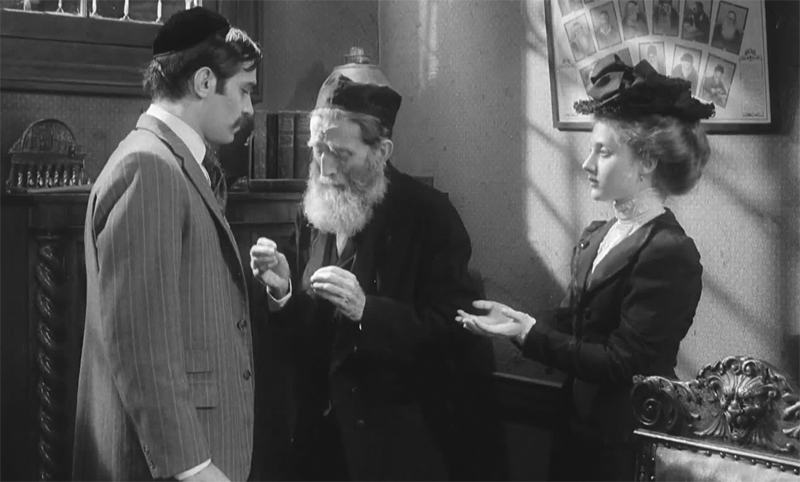
Hester Street (1974) dir Joan Micklin Silver Healthily free from sentimental Hollywood Jewish schmaltz, this beautiful, honest, low-budget, independent black-and-white film is a masterpiece. Set in 1896 in New York’s Yiddish-speaking Lower East Side, it is a warm-hearted, yet perceptive, study of the immigrant experience, and of the tensions between Orthodox tradition and assimilation. There is wonderful acting, especially from Carol Kane as the bewildered sheitl-wearing young wife, newly arrived from the Old World.

Radio Days (1987) dir Woody Allen Apart from being Woody Allen’s best film by far, ‘Radio Days’ gives us the most real, the warmest and the most accurate portrait of lower middle-class Jewish family life of any movie in the canon. Seen in parallel with the exotic world of the radio programmes they endlessly listen to, an impeccable ensemble of Jewish character actors takes us through the trials and tribulations of the 1930s and 40s. Funny, nostalgic and sometimes profoundly moving.

Kadosh (1999) dir by Amos Gitai This bleak, heightened and relentlessly oppressive Israeli film looks unflinchingly at the appalling misogyny of the charedi (ultra-Orthodox) Jewish community in Jerusalem’s Mea Shearim. Two adult sisters suffer mental, psychological, physical and sexual abuse at the hands of the unbending male religious culture. No praise is too high for the brave courage of Amos Gitai and his crew. Spectacular and essential viewing.


The UK International Jewish Film Festival runs from Saturday 5 - Sunday 20 November. See www.ukjewishfilm.org for info.

Former Israeli president Shimon Peres has died aged 93 - Colin Shindler pays tribute to one of the giants of Israeli politics

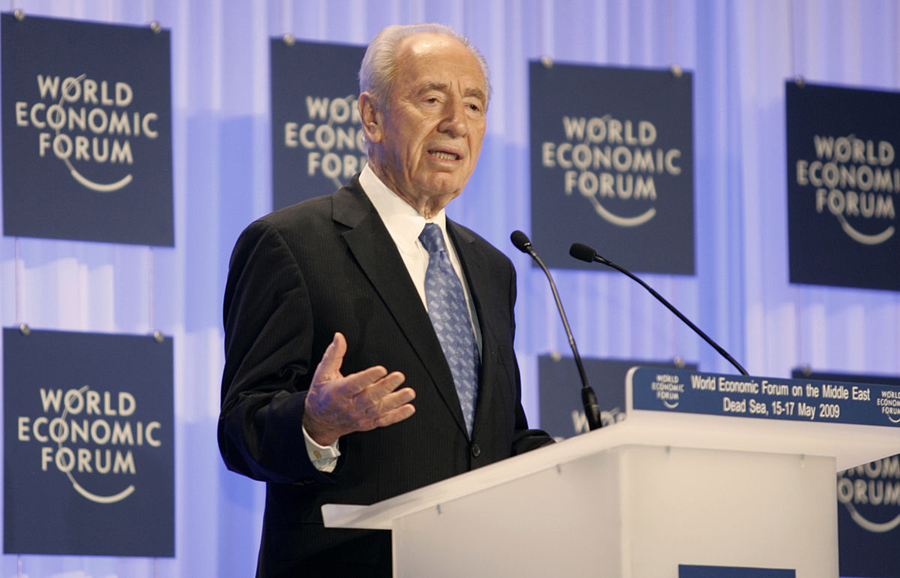
jr-shimon_peres_-_world_economic_forum_on_the_middle_east_2009 Shimon Peres was the ‘almost’ man of Israeli politics who was expected to win, but always lost. He was prime minister for a few months in 1977 after Yitzhak Rabin’s resignation and then for a similar period following Rabin’s assassination in 1995. His longest time in office as prime minister was in the national unity government with the Likud from 1984-86. He was expected to succeed Yitzhak Shamir in 1990 but then was thwarted by a last minute about-turn by Charedi politicians on orders from their rebbes. He was then expected to defeat Netanyahu in 1995, but the advent of Hamas’s suicide bombers put paid to that hope. Even when he stood for president in 2001, the walkover never happened and Moshe Katsav succeeded to the post instead. Peres only became president in 2007. Such an unprecedented string of disappointments would have crushed most politicians.

In his late 20s, Peres became deputy director-general of the Ministry of Defence and was instrumental in persuading France to supply arms to Israel amidst a widespread embargo – including the UK – in the run-up to the Suez war in 1956. He was also present at Sèvres when the collusion pact was agreed between Britain, France and Israel prior to the Suez campaign.

Peres was elected to the Knesset in the 1959 election as a candidate for Mapai, the forerunner of the Labour party. He aligned himself immediately with Ben-Gurion and sided with him when he broke with Mapai in 1965 to form Rafi.

Rafi was the party of the Mapai princes and included Moshe Dayan, Teddy Kollek, Chaim Herzog and many others who saw themselves as future leaders of the country. Peres essentially organised Rafi on Ben-Gurion’s behalf with little funding. He made the first contact with Menachem Begin’s Gahal to investigate whether they had common political interests. Although such contacts were low key, this was the precursor to the defection of this faction of the labour movement to the Right.

Rafi only achieved 10 seats in the 1965 election while Mapai triumphed. For Peres and Dayan this was a disaster since it severely reduced their opportunity of becoming a future prime minister. In 1968, Peres opted with the rest of the Rafi MKs to join the newly established Labour party. Ben-Gurion refused to return and led the rump of his party, now called the State List, which later became one of the founding components of the Likud.

Peres and Dayan led the hawkish wing of Labour and were strongly opposed by Abba Eban and Pinchas Sapir. They wished to integrate the West Bank into Israel’s economy and were often reluctant to offer constructive territorial concessions. This acute factionalism in Israeli Labour meant that there could be no meaningful peace initiatives. With the debacle of the Yom Kippur war in October 1973 with over 2500 dead and up to 8000 wounded, the Agranat Commission’s findings on culpability led to the resignations of Golda Meir and Moshe Dayan. In 1974 Yitzhak Rabin narrowly defeated Peres for the party leadership – and this initiated a 20 year-long rivalry.

As Defence Minister in the first Rabin government, Peres continued to be a standard bearer for the Right and adopted an accommodating position towards the West Bank settlers in cabinet discussions. This was integral to his ongoing war of political attrition against Rabin. His visit to the settlement of Sebastia in December 1975 was seen as a statement of his being amenable to the settlers’ demands.

Following the increase in oil prices, the Arab states used this weapon to isolate Israel. Many countries in the developing world now broke off diplomatic relations with Israel due to Arab pressure. With limited options, Peres paid a clandestine visit to apartheid South Africa in November 1974 and offered to sell the Chalet missile to Pretoria. While the Likud exuded no qualms of conscience, the Labour party did so with great reluctance – and Peres was its chosen candidate to implement this task.

Rabin’s attempts to cure the Labour party of corruption and sloth met with limited success – and he himself resigned when his wife was found to possess an unlawful foreign bank account in Washington. Peres took over as caretaker prime minister and went down to a resounding defeat by Menahem Begin in the 1977 election a few months later.

Peres continued as leader of the Labour party, welcoming the Camp David agreement and peace with Egypt. Yet a late comeback by Menahem Begin in the 1981 election allowed the Likud to pip Labour at the post. Begin’s second government was far more radical than his first and ended in the ill-fated invasion of Lebanon in 1982. During this period Peres turned from the Right to the Left and now aligned himself with Israeli doves. Following the massacre of Palestinians by Christian Phalangists in the camps of Sabra and Shatilla at the end of the war in Lebanon, 400,000 Israelis demonstrated in Tel Aviv – including Shimon Peres.


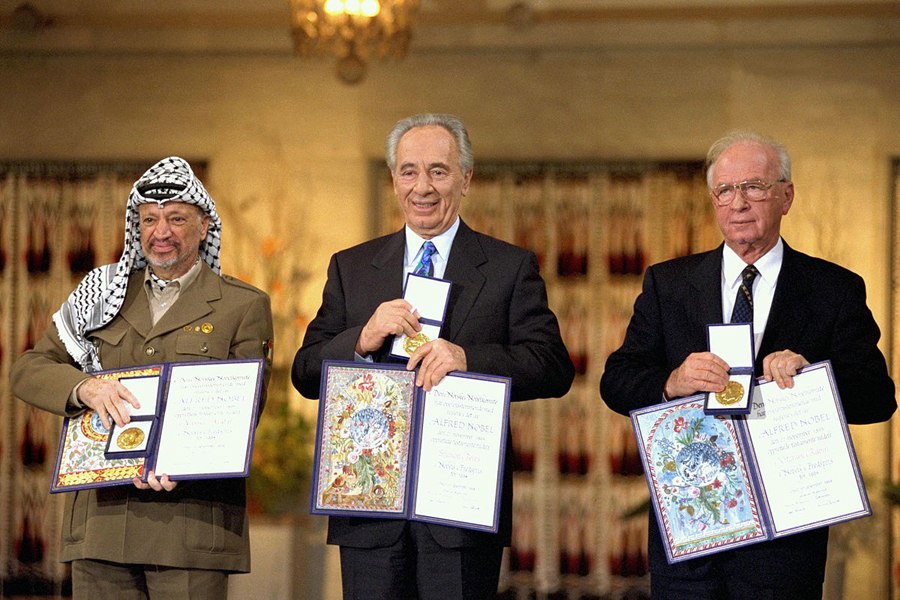
Yitzhak Rabin, Shimon Peres and Yasser Arafat receiving the Nobel Peace Prize © Saar Yaacov/Government Press Office

The electorate in 1984 was divided in their allegiance and this led to the ‘rotation government’ of a Labour-Likud coalition. Peres was prime minister from 1984-86 with Shamir succeeding to the post to serve a further two years. Peres proved to be a very capable leader, withdrawing the troops from Lebanon and fixing a badly damaged economy. It was also a period when Israel moved from a command economy, based on long-held socialist principles to a globalised capitalism – and Peres adjusted to this prospect with great ease.

During Shamir’s premiership, Peres forged the London agreement in 1987 with King Hussein during secret negotiations at the home of Lord Mishcon which was later vetoed by a critical Shamir. Peres expected to become prime minister once more in 1990 with the defeat of the Shamir government in a vote in the Knesset. Haredi backpedalling produced another failure for Peres, but this was a defeat one too many for Labour members and soon he was replaced by the more electable Rabin. As history records, the Labour government, led by Rabin with Peres as Foreign Minister, signed the Declaration of Principles – the Oslo Accord – with Yasser Arafat on the White House lawn in September 1993. Peres significantly appeared far more confident in clasping Arafat’s hand than the reticent and startled Rabin.

The peace process was perhaps the pinnacle of Peres’s career with his vision of a New Middle East and it earned him a Nobel Peace Prize together with Arafat and Rabin.

With his unexpected defeat in 1996 and the election of Netanyahu, Peres’s career seemed to be over. He held secondary positions within Labour and he and his Oslo colleagues were marginalised when Labour returned to power under Ehud Barak in 1999. Peres held the nondescript post of Minister of Regional Cooperation.

At the beginning of the 21st century, the al-Aqsa Intifada and its toll of Israeli victims, targeted by Islamist suicide bombers, persuaded the electorate to bring back Ariel Sharon to protect them. Peres was brought in as Foreign Minister, but he differed fundamentally with Sharon in that he wanted to negotiate with Arafat and to utilise his good relationship with him. Sharon, however, repeatedly commented that there could be no negotiations while the violence continued. A new generation of Labour politicians finally displaced the octogenarian Peres in 2005 and he lost its leadership for the last time.

Peres and Sharon were both disciples of Ben-Gurion and members of Mapai in the 1950s. While Peres led the right wing of Labour and eventually became a dove, Sharon became a founder of the Likud in 1973. Neither were attached to keeping Gaza and the West Bank for either ideological or religious reasons. Peres could therefore easily support the unilateral withdrawal from Gaza in 2005 and to leave Labour to join Sharon’s new party, Kadima.

In 2007 he left formal party politics to finally become president. His inspiring and confident statements in the depths of adversity chimed with Diaspora and western sentiments, but clearly grated on the nerves of the Likud and parties on the far Right. After seven years at the helm, he retired from the presidency in 2014.

Peres was a cultured man who spoke several languages and wrote poetry. Like Abba Eban, he was seen as ‘foreign’ and, for some, untrustworthy. Yet he managed to survive in the bear-pit of Israeli politics and to weather every twist and turn of fortune. His charm and sophistication will be missed in diplomatic circles. His transformation from Szymon Perski from Vishnyeva in Belarus into Shimon Peres, builder of the Hebrew republic, is a reflection of how the Jews have moved from the margins of history to its mainstream after two millennia of dispersion. Israel has lost a unique voice.

By Colin Shindler, an emeritus professor at SOAS, University of London

Review: My Family: Not the Sitcom ★★★★ – David Baddiel finds the funny in losing his parents

david-baddiel-c-marc-brenner Often at shiva prayers it strikes me how much the late-lamented might have enjoyed the gathering of nearest and dearest, but would they have enjoyed the eulogies? Might they not have confessed (or complained) “that’s not the real me, warts and all”? David Baddiel goes further in his scurrilous tribute to his late mother, who died suddenly in 2014. He confides in his audience that Sarah Baddiel loved not only being centre stage, but also a bearded, pipe-smoking golf salesman for 20 years – apparently unnoticed by her husband, even wangling him an invitation to David’s bar mitzvah. Seriously, he’s there in the photo album.

If you think that this might make for uncomfortable laughter, don't worry. Sarah herself gives posthumous sanction, caught on camera delighted at being the centre of attention as a volunteer audience member in a TV comedy panel game starring Baddiel and Frank Skinner. To her son’s visible discomfiture she pulls focus by writing something on the board that offers far too much information about her sex life – his mortification is complete when he feels he must correct her spelling of an unmentionable word to boot.

What follows is an exasperated and affectionate no-holds-barred exposé, not just of the nuts and bolts of her grand passion, but also of her foibles. Her lover sold golfing memorabilia, so, presumably working on the theory that imitation is the sincerest form of flattery, she set up a rival business.

She would send inappropriate emails to her lover, copying in her sons, perhaps so they could share her facility with misplaced inverted commas. I found myself weeping - with laughter. Sarah would surely have loved sharing the joke too.

Baddiel is wonderfully at home alone onstage, on a set (production design by Declan Randall) decked out like a Jewish rococo living room, surrounded by family photos in frames of every shape and on every surface including the back walls, underfoot a black-and-tan Persian-style carpet.

Baddiel’s father Colin survives Sarah, but perhaps his son is in mourning for him too, for he has dementia – a particularly difficult form called Pick’s disease, which makes him extraordinarily foul-mouthed, aggressive and – you’ve guessed it – prone to sexually inappropriate behaviour. Baddiel gets laughs when he responds to the neurologist’s explanation of the symptoms: "Sorry, does he have a disease or have you just met him?" He gets guffaws when he shares the Daily Mail’s shock-horror headline: "David Baddiel’s agony amid fears he is contracting dementia". And he gets my sympathy and admiration for finding and sharing the funny in losing his parents.

By Judi Herman

My Family: Not the Sitcom runs from Tuesday 28 March - Saturday 3 June. 8pm, 3pm (Wed & Sat only), from £23.50, at Playhouse Theatre, WC2N 5DE. www.playhousetheatrelondon.com

Suitable for ages 16+ as the show contains mature language and subject matter

Review: King Lear ★★★★ – Antony Sher is every inch a king in Gregory Doran's mighty production

king-lear-production-photos_-2016_2016_photo-by-ellie-kurttz-_c_-rsc_202088 Antony Sher's performance is literally towering at the opening of the play, directed by his husband, RSC Artistic Director Gregory Doran. Lear is borne in on a huge platform above the glittering monochrome of his court (designer Niki Turner), wrapped in fur cloaks that make him larger than life, his every pronouncement accompanied by thunderous chords to make of him a primitive demigod. He may look "every inch a king", as he says ironically later in the strange lucidity of his madness on the cliffs at Dover, but he is equally a very foolish old man, as he also refers to himself later. His rejection of youngest daughter Cordelia (Natalie Simpson, all quiet resolution in white) is especially cruel, arbitrary and yes, senile, simply because of that god-like build up.

But it is the reaction of oldest daughter Goneril (excellent Nia Gwynne, an auburn-plaited Saxon princess in russet jewel-encrusted gown) that is most startling. Foreboding at the impropriety of his asking his daughters how much they love him turns to horror on Goneril's face, as her father turns the full force of his cruel rage on Cordelia for her honest reply. Goneril’s fears are well-founded of course, for later he curses her womb, and the physicality of Sher's spite as he grabs hold of her in a cruel travesty of an embrace and her momentary hopeful and needy response to it are all the more shocking.

Doran also gives Lear several of the hundred knights demanded to keep for his retinue to carouse with him around his daughter's table, and a downright noisy boorish shower they are too, so that to start with it's hard not to sympathise even with Kelly Williams's vivid scheming middle daughter Regan.

king-lear-production-photos_-2016_2016_photo-by-ellie-kurttz-_c_-rsc_202354

This engaging of sympathy for a child who will ultimately prove unnaturally cruel is echoed in the relationship between David Troughton's exceptional Gloucester and his bastard son Edmund (Paapa Essediu, a villain with a fine sense of irony), clearly nursing a 'legitimate' grievance as his father introduces him to Kent with that well-worn tactless joke about the "sport" he had conceiving him.

The brilliance of both Sher and Troughton is in their ability to engage sympathy once they are changed by what they endure. Sher sloughs off the layers of clothing that make him imposing from the outside, as he gradually gets to know himself and understand reality and, for the first time, other people. If he is touching in his  madness on those cliffs, it's because he is content – even happy – in that altered state (in the way that dementia patients often present  for example). The audience learns to love him as he learns himself and is truly reunited with Cordelia.

The parallel reunion between Gloucester, who only sees clearly once he has lost his sight, and his true loving son Edgar, forced to disguise himself as a mad beggar when Edmund convinces his father he’s the villain, is equally moving thanks to Oliver Johnstone's resourceful Edgar, proving ultimate filial devotion as his father, like Lear, achieves closure at life's end.

By Judi Herman

Photos by Ellie Kurttz © RSC

King Lear runs until Saturday 15 October, 7.15pm & 1.30pm, £16-£70, at the Royal Shakespeare Theatre, Stratford-upon-Avon, CV37 6BB; 01789 403493. Then at the Barbican Theatre, London, ECY2Y 8DS; 020 7638 889, 10 November to 23 December, 7.15pm & 1.30pm £25-£55 . In cinemas from 12 October.

www.rsc.org.uk

Review: How to Date a Feminist ★★★★ – Samantha Ellis does it in style in this fast and funny comedy

how-to-date-a-feminist-at-the-arcola-c-nick-rutter-2016-2 Ah, the F word again. No surprises there. But it's the man who's the feminist in Samantha Ellis’s fast and funny spin on Hollywood screwball romcoms, billed as "a romantic comedy turned upside down".

Kate is a journalist who happens to be Jewish. She also happens to have a fatal attraction to bad men, both on the page (Heathcliff) and in the all too solid flesh (her ex is her promiscuous editor). Then there's Steve, a man who happens to be a feminist. His mum brought him up at Greenham Common Women's Peace Camp, while Kate's dad is an Israeli brought up in a refugee camp. She wants to be swept off her feet and into bed. Steve probably wants to sweep the floor for her first. Can they get (and keep) it together despite their prejudices, their predilections and their parents?

Ellis has huge fun turning our preconceptions on their heads, giving artisan baker Steve all the PC lines (his marriage proposal begins, “I want to apologise for the patriarchy”) and Kate the, er, balls.

how-to-date-a-feminist-at-the-arcola-c-nick-rutter-2016-3

With delicious wit, Ellis follows the pair's rocky road from meeting at a fancy dress party – she "symbol of female power" Wonder Woman, he "brilliant ethical hero" Robin Hood  (the quotes are Steve's seals of approval - Kate's opening quip is "Are those ladders in your tights or stairways to heaven?") – to very cold wedding day feet at a yurt in Greenham, not the hall in Hendon favoured by Kate's dad, though there is a rabbi to bless the couple and a glass to stamp on.

Ellis zigzags back and forth in time with panache and Matthew Lloyd directs the dynamic duo of Sarah Daykin and Tom Berish with matching brio. Thanks to designer Carla Goodman's clever costumes and some artful velcro, they win our hearts with their onstage lightning changes, morphing into his mum and her dad and their exes in the wink of an eye, literally, as they revel in sharing the fun.

Ellis has some real points to make about those preconceptions and a fine skill at suggesting the emotional hinterlands of her lovers and their parents. And the icing on the cupcake (even though Steve doesn't approve of those either) is that it really works as a romantic night out, too.

By Judi Herman

Photos by Nick Rutter

How to Date a Feminist runs until Saturday 1 October, 8pm & 3.30pm, £17, £14 concs, at the Arcola Theatre, 24 Ashwin St, E8 3DL; 020 7503 1646. www.arcolatheatre.com

The show then tours to Stephen Joseph Theatre, Scarborough on Friday 21 & Saturday 22 October, www.sjt.uk.com; and Watford Palace Theatre on Friday 4 & Saturday 5 November, http://watfordpalacetheatre.co.uk