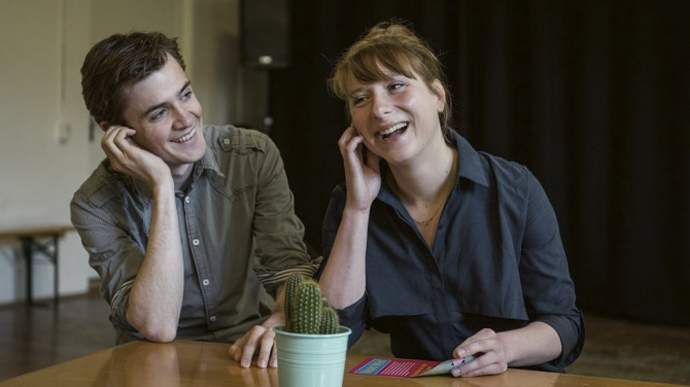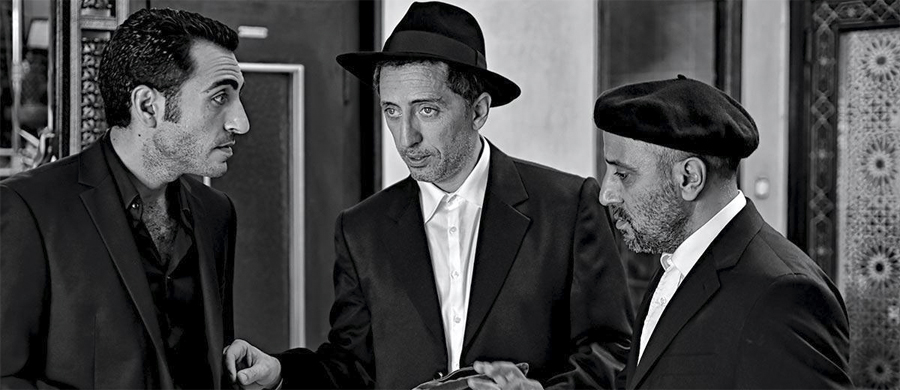
Review: Luv ★★★★ - Lots to love in this surreal 60s love-in

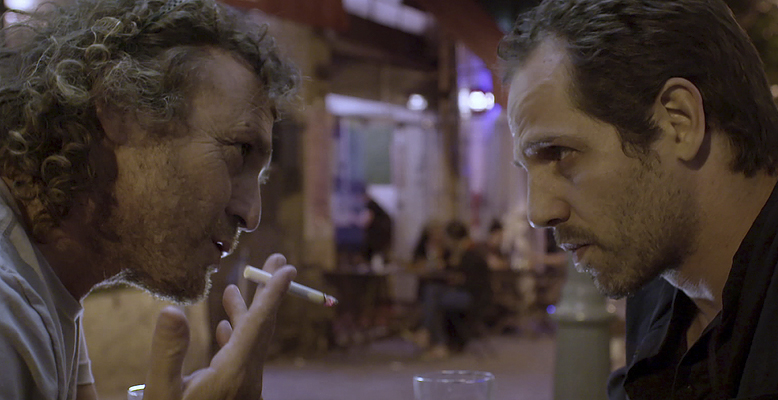
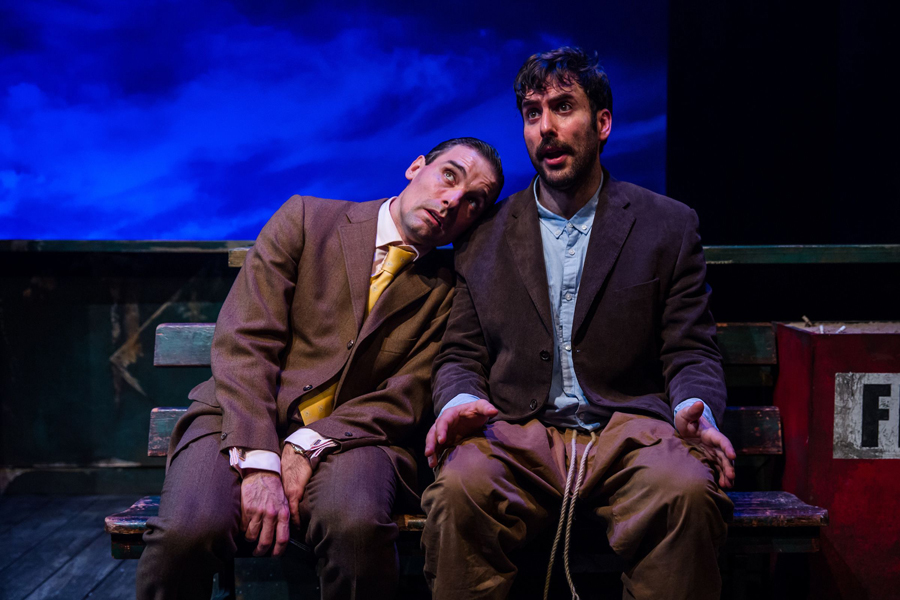
theatre_luv_nick-barber-milt-harry-charles-dorfman-in-buckland-theatre-companys-luv-at-park-theatre-credit-the-other-richard Reviving Murray Schisgal’s 1964 show, unashamedly a mix of absurdist humour and traditional Broadway comedy, is a gamble, especially given our current perspectives on matters of love, sex and the human condition. In lesser hands the gamble might not have paid off, but director Gary Condes has a fine understanding of the material and nudges his cast to find just that right blend between reality and cartoon that made the play a hit over 50 years ago.

The plot is straightforward and the end predictable, but the fun lies in the way we get there. Mercenary Milt encounters his old college friend, boho loser Harry, as Harry is about to jump off a bridge. As they talk, we learn that both men are equally unhappy, thanks to a wonderfully daft vaudevillian exchange as to who has had the harder life (reminiscent of Monty Python’s four Yorkshire men living in a shoe box). Milt wants to marry his mistress and he hits on the idea of offloading his current wife, Ellen, onto Harry, who has never experienced love.

theatre_luv_ellen-elsie-bennett-in-buckland-theatre-companys-luv-at-park-theatre-credit-the-other-richard

Charles Dorfman’s lugubrious Harry catches the pathos of the character, but never lets the comedy get away. His foil, Nick Barber, equally balances the brightness of conniving Milt with real sadness. Elsie Bennett finds both steel and warmth in Ellen and the trio play up the pastiche combinations of realism, humour and farce that you also find in plays by fellow New York Jewish playwright Neil Simon, to great comic effect.

Designer Max Dorey evocatively creates the suicide bridge against a changing sky with lighting by Christopher Nairne subtly underlining the changing pace the text demands. It fits like a glove in the Park Theatre's intimate studio space.

(Baseball) caps off to the cast for maintaining the verisimilitude of period New York accents throughout and to Dorey for his Swingin' Sixties costumes. Buckland Theatre Company and Gary Condes deliver a satisfying send up of both 60s experimental theatre and Broadway in this delightful, witty revival.

By Judi Herman

Photos by The Other Richard

Luv runs until Saturday 7 January. 7.45pm (Tue-Sat), 3.15pm (Thursday & Saturday). £14.50-£18. Park Theatre, N4 3JP. 020 7870 6876. www.parktheatre.co.uk

Read our interview with actor Charles Dorfman

Review: Once in a Lifetime ★★★ - Sophisticated fun set in Hollywood at the birth of the talkies

ONCE IN A LIFETIME by Hart, , Writer - Moss Hart and George S. Kaufman, Director - Richard Jones, Design - Hyemi Shin, Costume - Nicky Gillibrand, Lighting - Jon Clark, Sound - Sarah Angliss, Choreography - Lorena Randi, The Young Vic Theatre, London, UK, 2016, Credit - Johan Persson - www.perssonphotography.com / When witty Jewish writing duo George Kaufman and Moss Hart wrote this back-of-the-movie-lot comedy, set at the birth of the talkies, neither had been to Hollywood, but they knew enough about the goings-on in the movie business to know it would suit their satirical wise-cracking style. Kaufman co-wrote The Cocoanuts and Animal Crackers for the Marx Brothers and this witty habitué of the Algonquin Round Table never lost his sense of sarcasm. He said about one play: "I saw it under adverse conditions; the curtain was up!" The plotlines in their collaborations were primarily Hart’s while Kaufman focused on the witty, sarcastic dialogue.

It's 1928 and The Jazz Singer, the first all-talking picture, is a sensation.  Three struggling vaudevillians, sardonic May Daniels, smooth-operator Jerry Hyland and their stooge George Lewis, the "best deadpan feeder in the business", head west to present themselves as elocution experts, hoping to teach movie stars to speak on screen. With help from gossip columnist Helen Hobart, they’re hired by megalomaniac film mogul Herman Glogauer (Harry Enfield making his theatrical debut), who is trying to come to terms with talking pictures. "Things were going along fine. You couldn't stop making money – even if you made a good picture, you made money."

The three encounter a proverbial dumb blonde wannabe actress and her pushy mum, a playwright driven to distraction and then a sanatorium by studio bureaucracy, a silent-screen beauty with a screeching voice, and Glogauer’s faithful put-upon receptionist.

Glogauer hails dimwit George as a visionary genius, when he is the only one to tell him to his face that he turned down the VitaPhone sound film system. Glogauer makes him head of production and it all goes wrong – or right? – from there…

ONCE IN A LIFETIME by Hart, , Writer - Moss Hart and George S. Kaufman, Director - Richard Jones, Design - Hyemi Shin, Costume - Nicky Gillibrand, Lighting - Jon Clark, Sound - Sarah Angliss, Choreography - Lorena Randi, The Young Vic Theatre, London, UK, 2016, Credit - Johan Persson - www.perssonphotography.com /

Director Richard Jones
 and designer Hyemi Shin set the action on a clever revolve, with lightning-fast set changes rolling through train carriages, offices and studios. The plot gains momentum as the action hots up. Claudie Blakely’s lightly acerbic May sparks off Kevin Bishop’s laid-back Jerry and John Marquez’s increasingly confident and funny George. Lucy Cohu’s wondrously-clad grande-dame columnist exudes authority, Amy Griffiths’ silent-screen star is literally a scream and Lizzy Connolly is deliciously dumb and dumber in a succession of wigs and gowns (all hail costume designer Nicky Gillibrand). And Amanda Lawrence’s receptionist steals scenes without pulling focus – her physicality, the mobility of her face, her comic delivery – she is simply riveting.

Harry Enfield’s Glogauer is curiously understated, though he delivers wonderful lines such as "That's the way we do things here – no time wasted on thinking" with (dare I say it) Trump-like panache.

And more please of that joyous sense of insanity and frenzy demanded by the plot, the lines and the built-in wise-cracking from a Marx Brothers scriptwriter. Richard Jones successfully populates the studio lot with a substantially smaller cast than in the original show. As his production gains pace, it will zip along in the gleeful and effervescent way the silly ploy and vivacious dialogue demand. It’s already a fun evening in the theatre with lots of laughs to be had in the run up to Christmas and a happy New Year.

By Judi Herman

Photos by Johan Persson

Once in a Lifetime runs until Saturday 14 January, 7.30pm (Mon-Sat) & 2.30pm (Wed & Sat only), note there are no performances 24 & 31 Dec, £10-£35, at Young Vic Theatre, SE1 8LZ; 020 7922 2922. www.youngvic.org

JR OutLoud: An Imam, a Rabbi and a Priest walk into a comedy club… and debut as stand-up comics. They tell us more…

Imam Dr Muhammad Al-Hussaini, Rabbi Debbie Young-Somers and Reverend Steven Young tell Judi Herman about their hopes and fears for their very first comedy gig. An Imam, a Rabbi and a Priest Walk into a Comedy Club is taking place as part of JW3’s third annual UK Jewish Comedy Festival. And for an extra treat, hear Imam Muhammad demonstrate his prize-winning singing in Gaelic at the end of his chat with Judi!

An Imam, a Rabbi and a Priest Walk into a Comedy Club (with Q&A) is on Sunday 4 December, 5.30-6.30pm, £12, at  JW3, London NW3 6ET; 020 7433 8988. www.jw3.org.uk/comedy

Listen to more JR OutLoud interviews

JR OutLoud: Lawyer turned comic Jeremie Bracka discusses his new show Thank you for Flying Hell-Al

Australian-Israeli comedian, actor and human rights lawyer Jeremie Bracka will be making his London debut on night one of JW3’s UK Jewish Comedy Festival (1-4 Dec). Here he talks to Judi Herman, JR’s arts editor, about life in the Middle East and Down Under, as well as his latest one-man show, Thank you for Flying Hell-Al, in which he uses storytelling, stand-up, character comedy and mockumentary to explore life in Israel and the experience of making Aliyah.

Thank you for Flying Hell-Al is on Thursday 1 December, 8.30pm, £15, at JW3, NW3 6ET; 020 7433 8989. www.jw3.org.uk

Review: All My Sons ★★★★ - Miller packs an emotional punch in Michael Rudman’s finely calibrated production

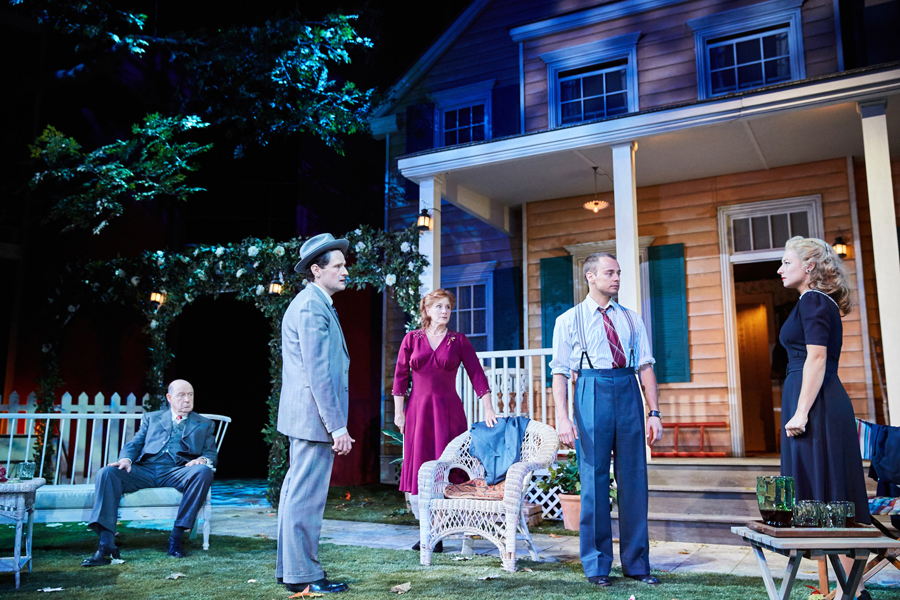
all-my-sons-at-the-rose-theatre-kingston-company-photo-by-mark-douet How strangely Miller’s first great hit resonates with today, in ways no one could have predicted. This beautifully measured play opens with shots of laidback family life in a typical American small town where everyone knows one another. Comfortably-off factory owner Joe Keller’s backyard is a focal point, where he and the neighbouring doctor are reading the papers. “What’s today’s calamity?” jokes David Horovitch’s amiable Joe. Cue gales of ironic audience laughter, with the US election so raw.

For a play that unfolds like a Greek tragedy, it’s surprising how much laughter is built into these opening scenes. But that’s the point: drama, and especially tragedy, is an interruption of routine.

Director Michael Rudman worked extensively with Miller himself, notably directing an award-winning production of Death of a Salesman starring Dustin Hoffman. So Rudman brings a huge depth of insider knowledge, as well as a sure directorial instinct for the pace of the story and the complex relationships between its protagonists. There’s a terrific cast here too and designer Michael Taylor’s unusually realistic set – cosy front porch leading onto a verdant garden – works especially well too  for a story that is all too authentic.

Keller is the father at the heart of Miller’s story, set in 1946. His younger son Larry is MIA in World War II and faulty aircraft parts manufactured in his factory caused the loss of other fathers’ sons. His deputy Steve Deever, who took the rap, remains in prison and although it’s known in the community that Joe is equally guilty, the Kellers’ lives seem unaffected on the surface. His wife Kate refuses to accept Larry is dead and his surviving son Chris wants to marry Larry’s girl Ann – daughter of Steve. And the Deevers used to live next door in what is now the doctor’s house, so those relationships are complex and uneasy indeed.

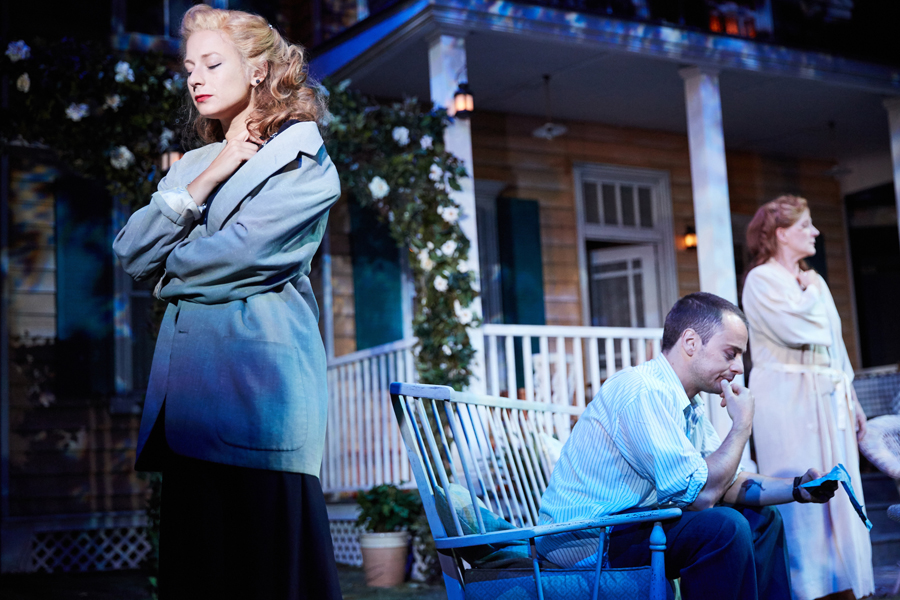
all-my-sons-at-the-rose-theatre-kingston-francesca-zoutewelle-ann-deever-alex-waldmann-chris-keller-and-penny-downie-kate-keller-photo-by-mark-douet

Horovitch’s Joe is all bluff heartiness, demanding to be liked and in pole position in both family and community, his guilt buried deep until events unravel. Penny Downie’s Kate is brittle in her bonhomie, steely in hope, her grief and guilt making her seem vulnerable, drifting almost wraith-like in long housecoats. Their relationship is clearly still physical. Like Claudius and Gertrude, they enjoy the fruits of a calamitous deceit and like the heroes of Greek tragedy they must be undone.

You can see why Francesca Zoutewelle’s enchanting Ann has fallen for Alex Waldmann’s intelligent Chris from the moment she skips into the yard like a breath of fresh air. He has a sense of humour and a conscience – a combination that would bode well for them as soulmates in any other circumstance. But Edward Harrison’s dark, angry George is an all too credible avenging fury.

Rudman told his cast: “Don’t sell the play to the audience. Make them come to you”. It’s a tactic that works wonderfully as the story reaches its tragic climax over the course of a day. Not simply a Greek tragedy, or an all-American one, but a human tragedy from one of America’s greatest Jewish playwrights given a production of which he would surely have approved.

by Judi Herman

Photos by Mark Douet

All My Sons runs until Saturday 19 November, 7.30pm matinees Thursday and Saturday 2.30pm, £8-£35, at Rose Theatre Kingston, 24 – 26 High St, KT1 1HL; 020 8174 0090. www.rosetheatrekingston.org

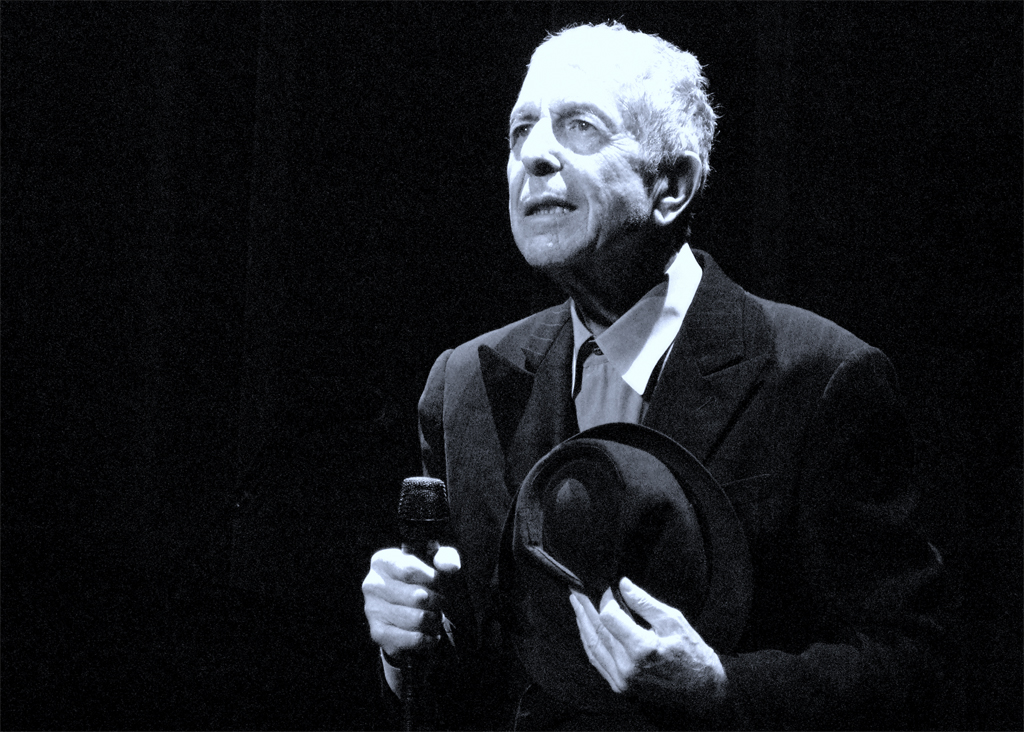
Leonard Cohen: A personal response from JR's arts editor Judi Herman

leonard_cohen_wiki_c_roland-godefroy This is not where you will read erudite analysis or an account of a life, or even of the work. I am simply asking myself and others like me why we have been so profoundly affected by Leonard Cohen's words, music and life.

For a time now, aware that the man who told us all "I'm your man" was an octogenarian, I have been confiding that I hoped he would live to a great age because the world would be a poorer place without him. It was a better place with him in it. I think I feel this way because of the arc of his life, with its many pathways, both sacred and profane, as shared through his music, confided to me and so many others through his gorgeous, elegant poetry and lyrics.

The devout Jew engaged in an honest "I-Thou", one-to-one relationship with the God with whom he wrestles and may, like me, doubt, is also the apparently cheerful, though silent Buddhist. He was also the sublime lover, the dirty lover and the unfaithful lover; but a lover who was always as honest with his earthly lovers as with his God. I never met him but I'm convinced that he would have been the best of companions – despite the fug of tobacco smoke.

Returning to his Judaism, famously self-evident in Hallelujah and If It Be Thy Will, look closer and you will see how often he quotes not just from the scriptures (Old and New Testament) but also from prayers and writings central to the faith into which he was born. Who by Fire picks up powerfully, almost playfully – even blasphemously some might say – on “U-n’ tanneh tokef”, “Let us proclaim the holiness of this day”, an ancient liturgical poem describing the Day of Judgement, an important part of the High Holy Days Liturgy recited at Yom Kippur, the Day of Atonement, when God decides “who shall live and who shall die … who shall perish by water and who by fire…”.

And quoting the opening words of the Kaddish (prayer of mourning) in the title track of You Want it Darker, the album released shortly before his death, “Magnified, sanctified, be thy holy name”, is as much a part of his message that he is ready for imminent death as the words he repeats as a refrain, “Hineini, hineini I’m ready, my lord”. These words, which echo through the Torah from Genesis to Isaiah, are picked up by the cantor at his Montreal synagogue to end the song with a heart-stopping echo. How like Cohen not to go without leaving one last great legacy.

I hope to go into this in more detail in the next issue of Jewish Renaissance, comparing Cohen's lyrics with Nobel Laureate Dylan. But for now, rest in peace Leonard Cohen; z”l (zichrono livrakha – may his memory be a blessing)". You may have reached the age of 82, but for me, as for so many more, your death was untimely, though I'm sure you met it with your usual great grace, ready for this last new experience that you have written about with such beauty.

Review: The Merchant of Venice ★★★★ - Tchaikowsky’s opera builds brilliantly on Shakespeare’s play and receives a stunning UK premiere by the WNO

theatre-the-merchant-of-venice-c-johan-persson Andre Tchaikowsky’s opera is my fifth Merchant of Venice in little more than a year ... and somehow it seems entirely appropriate to end this, Shakespeare's quarcentenary year, with a new work of art inspired by one of his best-known plays.

The opera closely follows the play's narrative, shedding a couple of minor characters, notably Lancelot Gobbo, Shylock's servant and purveyor of comic relief, and Tubal, Shylock's confidant and the only other Jew in the Shakespeare canon, apart from Shylock himself and Jessica, his daughter.

John O'Brien's libretto skilfully weaves Shakespeare's words into effective lyrics for Tchaikowsky's stirring, challenging music. Composer and librettist work seamlessly together to do more. For opera can sometimes deliver something different. The exchanges in a duet are all the more intense because the characters sing simultaneously, but the words and music they sing can be different. This works especially well when Quentin Hayes excellently acerbic and magisterial Shylock orders his daughter Jessica (feisty Lauren Michelle) to lock herself in and not to listen to the sounds of merriment in the streets when he goes out to dinner with the Christians he despises. Moreover, in opera performers can and do repeat the same line to great effect, for example, Shylock repeats “I will have my bond!”, emphasising the inevitability and enormity of the revenge he intends to take for his daughter’s elopement with her Christian lover Lorenzo - and with so much of his worldly goods. Such repetition in a production of the play would almost certainly simply seem laboured.

theatre-the-merchant-of-venice-2-c-johan-persson

Composer and librettist also make the effective decision to show Shylock’s rage and fury at what he sees as Jessica’s betrayal on stage, rather than have it reported by the gleefully anti-Semitic Salerio and Salanio, so Shylock gets to exclaim “Oh my ducats, oh my daughter!” . And to build this into a real coup de theatre, Shylock’s wrongs are magnified as he is baited by a baying mob, engaged in looting his house, carrying away armfuls of his possessions, including the eight-branched candlestick he would use at the Festival of Chanukah.  Another effective decision is to transpose the aria that is Shylock’s “Hath not a Jew eyes?” speech to the courtroom scene, where it packs a huge punch, especially after all we have seen him endure.

Keith Warner places the action in early 20th century Europe, his Shylock is a wealthy financier. He directs a cast of consummate singer/actors on designer Ashley Martin-Davis’ telling set – stark monochrome angles, tall walls and street corners, for Venice, with an interior of rows of money-lenders' desks like a cross between a stock exchange floor and a bank; which bursts into colour, especially the fun of lush greenery and an exuberant maze, as we are wafted away to Belmont, where Portia and Nerissa (wonderfully complementary Sarah Castle and Verna Gunz) lounge on sunbeds, in their Edwardian bathing dresses sipping cocktails.

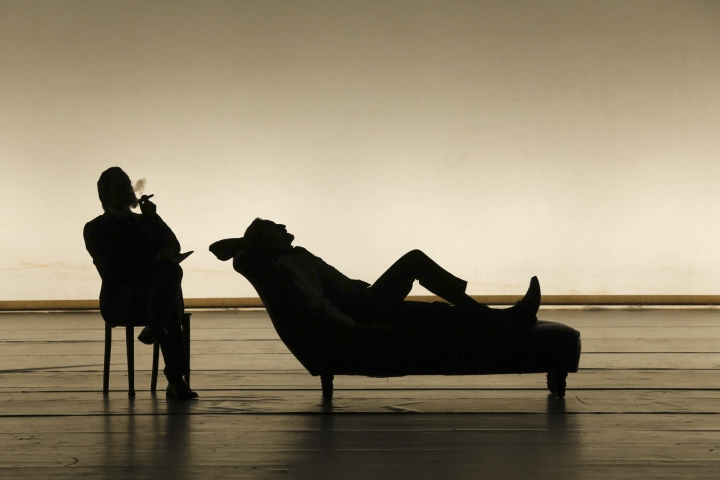
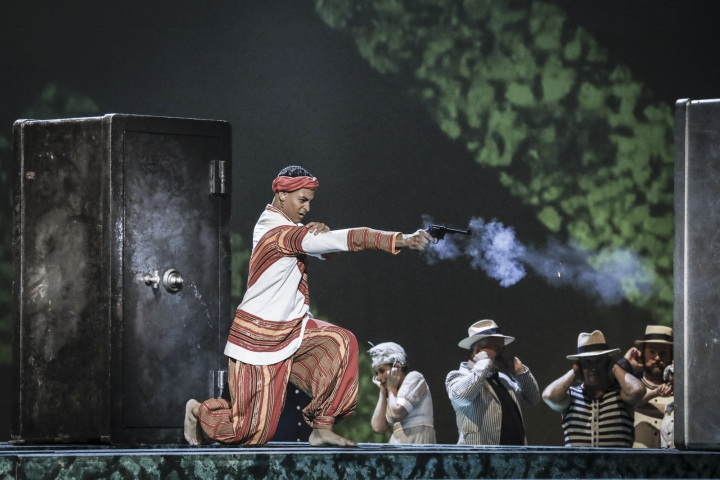
There’s fun with the caskets as Wade Lewin’s brigand of a Prince of Morocco, a dancer rather than a singer, bounds across to shoot the lock off his choice of gold. And back in Venice, the trial scene, which leaves the broken Shylock covered by a shroud-like cloth, is, unusually, apparently held in camera rather than in open court. A telling directorial touch has Shylock haunting the final scene in Belmont, as Jessica and Lorenzo exchange lovers’ conceits, but disappearing as Antonio appears, as if he cannot share the terrain with his vanquisher. And the inspired idea of framing the action with Antonio on the psychiatrist’s couch chimes perfectly with Tchaikovsky and O'Brien's vision– and it works brilliantly for that telling first line “In sooth I know why I am so sad”, delivered to his psychiatrist – Sigmund Freud himself of course!

By Judi Herman

Photos by Johan Persson

The Merchant of Venice runs on Tuesday 22 November, 7pm, £10-£40, at Venue Cymru, Llandudno, LL30 1BB. www.wno.org.uk/event/merchant-venice

And on Wednesday 19 & Thursday 20 July, 7.30pm, at Royal Opera House, Bow St, WC2E 9DD; 020 7304 4000. www.wno.org.uk

Review: The Writer ★★★★ - A guide for the perplexed from the writer of hit Israeli TV series Arab Labour

film-the-writer More reviews from the 20th UK International Jewish Film Festival. This time looking at two films from Israel giving insights into Arab/Israeli relations, featuring this mockumentary written by Sayed Kashua and directed by Shay Capon.

If you loved Arab-Israeli writer Sayed Kashua’s Arab Labour and you’re into Larry Davidson, this meta-reality TV series, which has its first three episodes screened at the Festival, is for you. But don’t expect to get the belly laughs or even the cynical giggles you got from Larry and Arab Labour’s genial, narcissistic anti-hero Amjad (who finds celebrity when he wins a TV reality show). Kashua’s writer Kateb (wonderfully perplexed Yousef Sweid) is his fictional alter ego, an Arab-Israeli TV writer who has achieved celebrity status with his hit TV series called – yes you’ve guessed it – Arab Labour.

But Kaleb is uneasy about his celebrity – is he merely the acceptable face of Arab-Israeli culture – the creative who makes Israelis feel liberal when they laugh with him at his clever take on life on the other side of the cultural divide? And despite – or perhaps partly because of his success, he’s having a mid-life crisis. Is he really living the dream or is he increasingly alienated from his admittedly demanding wife and teenage daughter as he ineffectually juggles the life/work balance with increasingly chaotic results? And then there’s his insecure pre-teen son, terrified by his father’s altercation with a black-garbed, Orthodox Jew complete with sidecurls as the pair go head to head over a parking space. Will their overreaction lead to violent repercussions or will an apology go some way towards rapprochement between these members of two communities living uneasily side by side?

His attempt to answer these questions leads him to announce a sabbatical from making a new series of Arab Labour – instead he proposes a series based on a character much like himself, going through just the sort of life experiences he is experiencing. See what I mean about meta-reality? This one really does have as many layers as an onion. So the laughs are subtle and the questions posed about Israeli society promise to continue to be telling in the rest of the series of ten episodes. With Fauda – the hit action series about an Israeli undercover unit operating in Palestinian territory that has proved a runaway success with both Palestinians and Israelis – about to come to Netflix, I’m optimistic that I’ll find out – I just hope I don’t have to wait too long!

By Judi Herman

The Writer screens on Sunday 20 November,  4pm, at JW3, NW3 6ET.

http://ukjewishfilm.org


Review: Disturbing the Peace ★★★★ - Searing testimony from fighters for co-existence in Israel/Palestine

film_disturbing-the-peace More reviews from the 20th UK International Jewish Film Festival. This time looking at two films from Israel giving insights into Arab/Israeli relations, starting with Stephen Apkon and Andrew Young's documentary, Disturbing the Peace.

For a searing insight into the wounds inflicted on both sides by the situation and into a group that has earned the right to work towards trying to heal them, I urge you to see this hard-hitting documentary. Even-handed filmmakers Stephen Apkon and Andrew Young take no prisoners and no sides. They give equal screen-time to the bravely candid members of Combatants for Peace from both the Israeli and Palestinian communities who speak directly to camera to tell their stories, backed up by documentary footage and reconstructions, as well as tense actuality of unfolding events.

These men and women really have earned the right to fight for peace and co-existence over the ten years since they were established. There’s the Palestinian woman who kissed her little daughter goodbye, explaining that she would not see her again as she intended to blow herself up. Apprehended and in an Israeli prison, it’s the humanity of her female jailers that helps her to listen to the narrative of the other. Another Palestinian activist, a man this time, learns to understand the other literally as well, as he learns Hebrew in prison. And equally, it’s impossible not to hear the narrative of both ‘sides’ as the film reveals the sort of punitive action that makes men and women come to the conclusion that taking such desperate action is the only way – houses demolished leaving weeping families on the street, a younger pre-teen brother gunned down for trying to go 50 yards down the street to a cousin’s house during a punishingly early curfew. I am reminded of the coming together of bereaved family members from both communities in the Bereaved Families Forum, who also speak of listening to the narrative of the other.

For every bit of footage showing desperate Jews trying to get to Palestine or emaciated bodies in the camps, there’s equally shocking footage of the bodies left behind after the massacres in Sabra and Shatila. As one of the combatants (and tellingly I cannot remember from which community) says “Blood is blood – it doesn’t have two colours” – and another “Every act of violence causes pain”. The plangent beauty of oud music on the soundtrack makes these scenes and statements all the more poignant.

It’s heartening and moving to see Israeli members of Combatants for Peace, who present at first as 'hardened' soldiers from elite units, taking blankets to Palestinian families whose houses have been demolished. Equally though, it is worrying to see the military presence (and the tension that engenders) that accompanies their peaceful rallies, almost reminiscent of 1960s hippies or the Greenham Common women, though these Combatants for Peace have experienced pain and violence at first hand. One of the most telling images in the film is a mock tomb with the message “We don’t want you here” carved on it. For me that says it all.

By Judi Herman

Disturbing the Peace screens on Tuesday 15 November, 6.30pm, at Odeon Swiss Cottage, NW3 5EL.

http://ukjewishfilm.org

Canadian singer-songwriter Leonard Cohen has died, age 82

leonard-cohen On Monday 7 November, one of music’s most eloquent and able songwriters passed away. Leonard Cohen was 82 when he died peacefully at his home in southern California earlier this week. His son Adam said touchingly in an interview with Rolling Stone, “My father passed away peacefully at his home in Los Angeles with the knowledge that he had completed what he felt was one of his greatest records. He was writing up until his last moments with his unique brand of humour."

The record Adam is speaking about is You Want it Darker, which was recently released (21 Oct) and effused the sincere, gravelly tones and orchestral movements he was so well known for. 

Born in Westmount, Quebec on 21 September 1934, Cohen grew up in a middle-class Jewish family. Marsha Klonitsky, his mother, was the daughter of a rabbi, while his father, Nathan Cohen, had Polish heritage – his father Lyon Cohen having emigrated from Poland in 1871 and later founding the Canadian Jewish Congress.

While at high school Cohen picked up an appreciation of poetry and by age 20 had published his first poems in a magazine called CIV/n. It wasn’t until the 60s, however, that Cohen began life as a musician. In 1967 he moved to New York, befriended Andy Warhol and penned the song Suzanne, which was to be his first successful foray into the world of music.

Despite a prolific, 60-year career, Cohen never charted highly in the mainstream. His highest ranking song in Canada, Closing Time, reached Number Five, while in the UK it was only the reissue of Hallelujah that ever charted at position 36.

Originally released in 1984, Hallelujah has become the song Cohen is most renowned for. The singer never had much success with it himself, but it was remarkably covered over 300 times, most notably by the late US singer Jeff Buckley, who scored a Number One hit with it.

As well as music, Cohen was also known as an accomplished author. Over the years he published two novels – The Favourite Game (1963) and Beautiful Losers (1966) – and 13 anthologies of poetry. 

Eleven albums down the line, in 2005, Cohen was in the public eye for something other than his art after his close friend and manager Kelly Lynch was exposed for misappropriating over $5m from Cohen’s accounts. This hefty loss formed a big part of Cohen’s reasons for writing new music and touring again.

Earlier this year Cohen’s former lover Marianne Ihlen died. She was the Marianne of the song So Long, Marianne, which Cohen wrote about her when the pair dated and lived in Hydra, Greece for much of the 60s. Shortly before Marianne passed Cohen penned her a heartfelt letter saying: “Marianne it’s come to this time when we are really so old and our bodies are falling apart and I think I will follow you very soon. Know that I am so close behind you that if you stretch out your hand, I think you can reach mine.”

The world has lost a truly talented spirit that will live on in Leonard Cohen’s songs, poetry and legacy.

By Danielle Goldstein