Review: How to Succeed in Business Without Really Trying ★★★ - Guys and Dolls meets Mad Men in musical satire on big business

New Yorkers Abe Burrows (Borowitz), Willie Gilbert (Gomberg) and Jack Weinstock did not invent the title of their 1961 musical satire on big business. It’s actually based on this best-selling lampoon of contemporary office life in 1950s USA, disguised as a self-improvement handbook. Clutching the book he consults on every step of the corporate ladder he climbs from window cleaner to chairman of the board, their anti-hero J Pierrepont Finch really lives up to the book’s subtitle, "The dastard's guide to fame and fortune". Burrows had worked with Frank Loesser on Guys and Dolls and the marriage of witty, amoral book with jaunty music and slick lyrics ensured the show’s award-winning success.

So what’s not to like? Amoral corporate greed and ruthlessness is a hardy perennial and even company boss, JB Biggley’s name sounds like a topical joke trumping the adverb coined by the businessman who won America ‘bigly’ himself.  Well, time is a cruel master and the sensibilities of the 1960s don’t easily translate. Just as with Promises Promises, revived earlier this year, the sexism may be satirised, but it’s still hard to swallow. These gals with cinched-in waists emphasising their curves are reduced to wives-in-waiting, whiling away time as secretaries (and occasionally mistresses).
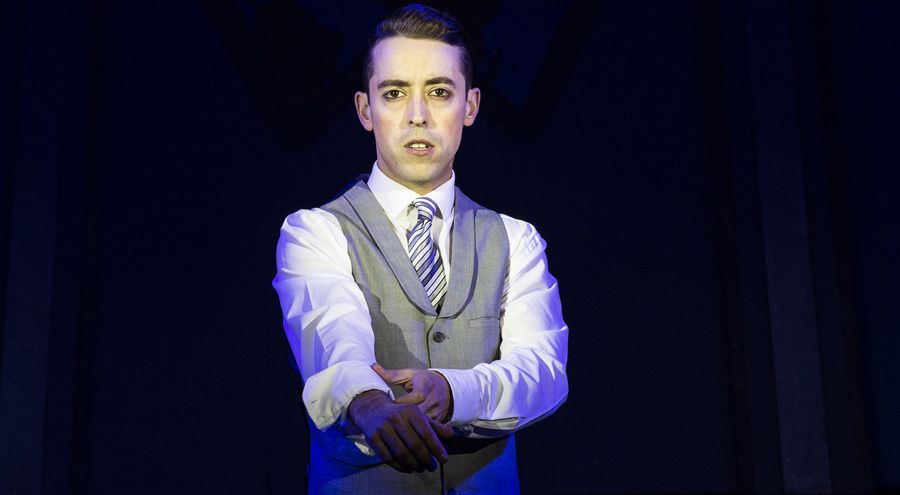
Pneumatic blonde, Hedy La Rue, a career ‘bit on the side’ played to the hilt by Lizzii Hills, does not share the ambition of Mad Men’s aspiring copywriters: it’s an LA perfume counter or marriage for her. And while Andrew C Wadsworth perfectly captures the cynical charm of Biggley himself, a fun creation who secretly knits for relaxation in his top-floor executive suite, Marc Pickering’s gleefully ruthless Finch is a real Richard III. Still, anti-heroes can be compelling and indeed Hannah Grover’s sunny Rosemary, the perfect secretary, manages to swallow her reservations and put her resourcefulness at his disposal, even as he puts his naked ambition before his love for her.

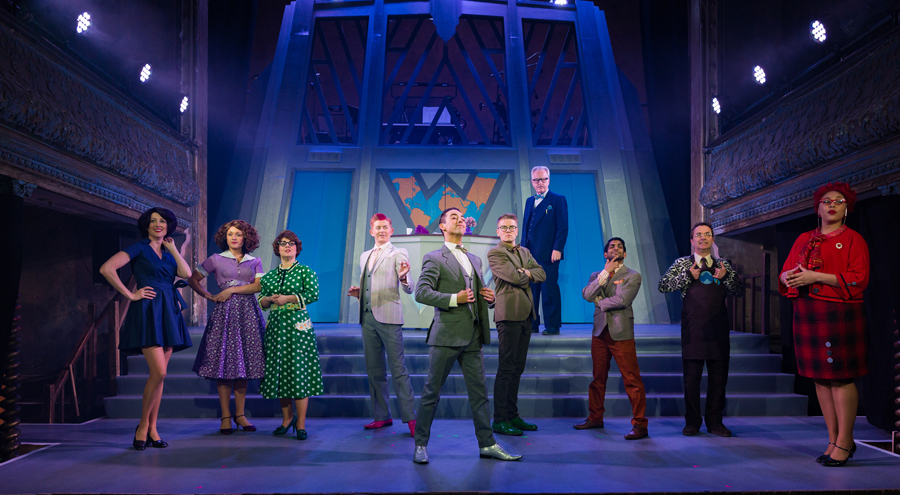
Director Benji Sperring’s almost cartoonish performing style works with the material, matched by Lucie Pankhurst’s choreography and Mike Lees’ pastiches of 60s corporate clothing, complete with wonderful fluorescent coloured shoes. Lee’s art deco design – steps leading to matching lift doors – provides an appropriate backdrop for the frenetic comings and goings of these stock characters. MD Ben Ferguson’s excellent small band ignites Loesser’s music, instantly appealing but not particularly memorable, with the exception of the now standard number 'I Believe in You'.

This is as fine a version of this collectors’ item as you are likely to see, a great showcase for its 10-strong cast and all involved, but maybe the catch is that a modern audience does not want to see the Finches of this world actually succeed in business without really trying.

By Judi Herman

Photos by Darren Bell

How to Succeed in Business Without Really Trying runs until Saturday 22 April. 7.30pm, 2.30pm (Wed & Sat only). Wilton's Music Hall, E1 8JB. 020 7702 2789. www.wiltons.org.uk

Click here to read more theatre reviews.

Review: Filthy Business ★★★★ - Sara Kestelman keeps it in the family in Ryan Craig’s new Jewish comedy

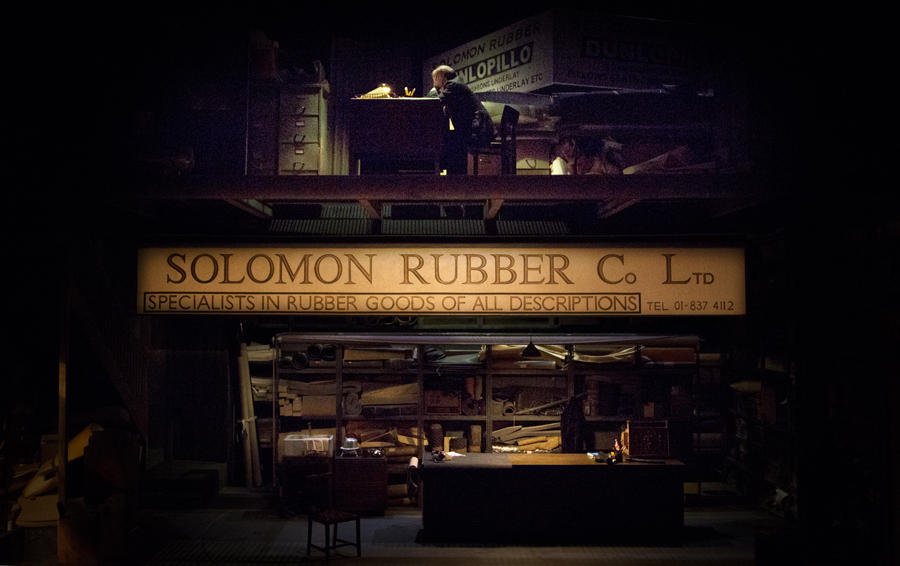
Families – can’t live with 'em, can’t live without 'em. Matriarch Yetta Solomon has no intention of allowing a single member of her family to escape from Solomon Rubber. Craig's title is clever - rubber is self-evidently a filthy business. You can almost smell the huge bales and coils of the stuff looming from every shelf downstairs and off every table upstairs on Ashley Martin-Davis’s towering two-tier shop set. Yetta is not afraid of playing dirty either, from reeling in a reluctant phone customer with the promise of "a special one-time-only deal" (actually almost double the asking price) to micro-managing a Machiavellian insurance scam, with violence thrown in that almost makes this feel like Yiddishe (as against Scandi) noir.

Craig’s drama is rooted in the reality of his own upbringing. It turns out that "lolloping about" in the mattress, bed and foam-rubber shop his Dad painstakingly built up from off-cuts collected working as a tyre fitter, was time well spent. The action spans a quarter century, from 1968 to 1982. There’s a marvellous sense of place and time in Edward Hall's sprightly production, especially when the 60s are swinging and the grandchildren yearn to be part of the action. Callum Woodhouse’s appealing grandson Mickey aspires to be a trendsetting Teasie Weasie hairdresser and Callie Cook’s sunny-natured granddaughter Bernice has already got a bouncy  bouffant.

Like my own, Craig’s antecedents made it to London from Russia long before the Holocaust. Sara Kestelman’s magnificently malevolent Yetta is self-avowedly moulded by the cruelty of Jew-hating Cossacks and the hardships of escape and life in London. She repeats her well-rehearsed saga in English peppered with Yiddish: the boychiks (sonny-boys) and ganovim (thieves) deployed by my great-grandmother.

So however loudly and violently her warring sons  Nat and Leo (nicely-sustained virulence from Louis Hilyer and Dorian Lough) feud with her and each other and scheme to strike out alone, it’s clear she’ll stop at nothing to keep the family together - in the business and under her thumb. It’s a large family, too, eight of the 13-strong cast gather round the family dinner table.

The warring family of nations toiling at Solomons extends to Nigerian immigrants represented by hard-working machinist Rosa (feisty Babirye Bukilwa). Yetta effortlessly sees off the man who claims the money Rosa owes for the citizenship he’s provided with a sham marriage. The xenophobia suffered by "blackies" and "Yids" alike has telling contemporary resonance.

Her fellow machinist, put-upon young Monty Minsky (Edmund Derrington, terrific) , blinking as he ascends from the basement machine room into the comparative light of the showroom, reminded me of Willie Mossop, the worm who turns in Hobson’s Choice – that early 20th-century classic comedy about a Northern family warring over their shoemaking business. It’s a good omen that Craig’s comedy could become a Jewish classic for our time.

By Judi Herman

Photos by Dominic Clemence

Filthy Business runs until Saturday 22 April. 7.30pm, 2.30pm (Wed only), 3pm (Sat only). £10-£35. Hampstead Theatre, NW3 3EU. 020 7722 9301. www.hampsteadtheatre.com

Click here to read more theatre reviews.

Allons enfants de la Patrie! France during and after WWII provides fertile soil for rich drama, music and art this year

What links London’s latest hit musical An American in Paris, a revival of Incident in Vichy – an Arthur Miller drama not seen in this country for 50 years – and the centenary of the young German artist Charlotte Salomon, who continues to enchant more than 70 years after she perished in the Holocaust?

The clue is in the titles of the theatre pieces. Arthur Miller's Incident in Vichy concerns the fate of 10 men detained in Vichy, France, at the height of World War II in 1942, when Vichy became notoriously synonymous with the French government of Marshal Pétain that collaborated with the Nazis. An American in Paris, freshly adapted from the much-loved Gershwin movie musical, is reimagined with a story set in the City of Light in 1945, in the immediate aftermath of the war. The heroine is a young Jewish ballerina safely hidden by Parisians, while her parents have disappeared in wartime Provence. And the young German artist Charlotte Salomon, escaping Nazi Germany to take refuge in the South of France, was herself arrested in Villefranche in September 1943 aged just 26 – within a month she had been murdered on arrival in Auschwitz.

Salomon was born 100 years ago this April and in the April edition of Jewish Renaissance, which will reach subscribers just before Passover, I explore the continuing allure of her life and work as expressed in the 765 autobiographical series of gouaches that make up her Life? Or Theatre?, in the company of the co-creators of a new play with music telling her story "in three dimensions".

I have just had the good fortune to marvel at the glorious evocation of the newly-liberated City of Light in American in Paris – a show that adds depth to the light-as-air story of the much-loved film musical without losing any of its charm and vitality, thanks to a fresh plot with Jewish protagonists at its heart. Find out more in my American in Paris review.

My most recent review is of an extraordinarily well-cast and tightly-directed revival of Arthur Miller's Incident at Vichy. The production successfully ratchets up the tension of Miller’s 90-minute morality play examining the different responses and fates of those 10 men picked off the streets of Vichy by a Nazi regime intent on rounding up Jews for deportation. It continues at London's Finborough Theatre until Saturday 22 April.

By Judi Herman

Click here to read all of our theatre reviews.

Review: Incident at Vichy ★★★★ – Rarely-performed Arthur Miller is 90 minutes of mounting tension in wartime France

Set in the detention room of a Vichy police station in 1942, Miller’s drama explores the ways paranoia among those detained by the Nazis could descend so easily into guilt and fear, making it all too easy for the perpetrators of the Holocaust. Ten men wait to be called. At first, the strained and nervous discussion is about why they might be there (a random pick up, routine check on their papers), but it soon emerges that some (or most) are Jews who have fled German-occupied northern France for the southern, ‘unoccupied’ Free Zone.

The play examines the various characters (some not even given a name: Gipsy, Waiter, Boy, Old Jew) and how they react to the increasingly frightening circumstances in which they find themselves. Some hope against hope that it will all turn out alright, even after communist railway worker Bayard (powerful Brendan O’Rourke) warns of cattle trucks full of people going to Poland to rumoured death camps. Others urge direct action, by the able-bodied at least. Are there ‘bad’ Germans and ‘passive’ Jews? In this classic morality play laying out the choices of good and evil between man and man and particularly within man himself, there are serial confrontations that reveal just how many points there can be on the so-called moral compass.

Previous, rare, productions of this Arthur Miller play suffered from trying to crank in dramatic action to beef up the morality statement, risking pre-empting the play’s climax, which does offer the promise of redemptive action (the ‘incident’). Here, director Phil Willmott makes the wise decision to let the words speak for themselves by focusing on designer Georgia de Grey’s white banquette within a white box that works brilliantly (literally) in the Finborough’s limited space. His superb line up of detainees are arranged on or around it in shifting poses as eloquent as Da Vinci’s Last Supper. Above them looms their eerie shadows, sharply-defined by Robbie Butler’s lighting.

From Lawrence Boothman’s painter, eyes eloquent with terror, to PK Taylor’s wonderfully infuriating actor, apparently in denial about his predicament; from Edward Killingback’s conscience-ridden Austrian nobleman (authentically tall and blonde) to Gethin Alderman’s French (Jewish) army doctor presenting Miller’s moral dilemma; this is a faultless and generous ensemble, perfectly cast to flesh out Miller’s selection of ‘types’ and to invest his rhetoric with humanity and pathos. And among the German captors, Timothy Harker, chillingly embodying the Nazi professor who revels in flushing out Jews, and Henry Wyrley-Birch’s conflicted Major, his war wound rendering him terrifyingly unpredictable, contribute to 90 minutes of almost unbearable tension.

The questions Miller poses are relevant today and this is an exceptional opportunity to see a rarely performed play in a production that Miller would surely have adored.

By Judi Herman

Photos by Scott Rylander

Incident at Vichy runs from Wednesday 7 – Sunday 25 June. 7pm (Tue-Sat only), 2.15pm (Sat & Sun only). £19.50-£25, £16 concs. King's Head Theatre, N1 1QN. 020 7226 8561. www.kingsheadtheatre.com

Click here to read more theatre reviews.

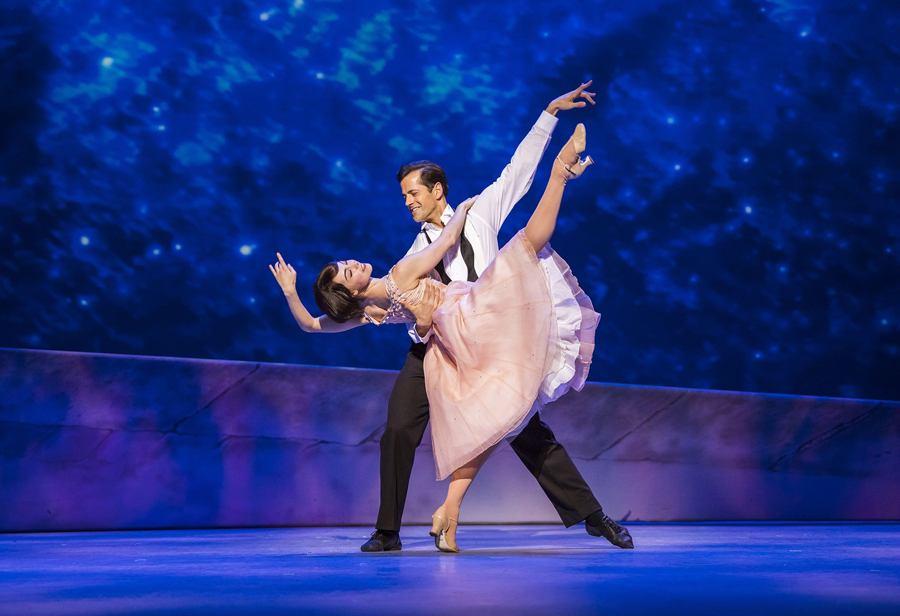
Review: An American in Paris ★★★★★ – A glorious evocation of the City of Light illuminates the stage

A lone figure limps into the light on a bare stage. Wounded in action, GI Adam Hochberg, confides his life, loves, hopes and fears and takes the audience back to newly-liberated Paris, 1945. David Seadon Young’s sardonic, worldly-wise American Jew in Paris is the first surprise in a show that adds depth to the light-as-air story of the much-loved film – without losing any of its charm and vitality.

Director and choreographer Christopher Wheeldon and book writer Craig Lucas collaborated to develop the story – Hochberg is one of three young men who become comrades – the ’Three Musketeers’ – all sharing one beloved object, gifted ballerina Lise Dassin (equally gifted ballerina, Royal Ballet principal Leanne Cope, proving she can sing and act, with all the delicate vulnerability of the film’s Leslie Caron). She too is Jewish, surviving the war hidden by the cultured family of her second admirer Henri Baurel (Haydn Oakley, all Parisian charm), though she hides her personal tragedy: her parents are missing after the Holocaust. Aficionados of the film will guess the third admirer is the American of the title, ebullient demob-happy GI Jerry Mulligan – breath-taking triple threat Robert Fairchild doing rather more than making the Gene Kelly role his own.

The creative team build on the film’s glorious ballet and lush Gershwin brothers’ score, with daring extended dance sequences performed by this multi-talented 18-strong ensemble, peopling a hopeful Paris striving for normality after the traumas of occupation. Alongside the joyful expression of freedom, there’s a telling moment, the shaming of a woman accused of sleeping with the enemy, all without a word of dialogue. Lucas’s book is wonderfully witty, though, and his rounded characters are a gift to actors such as Jane Asher, who is superb as bossy matriarch Madam Baurel, and Zoë Rainey, a revelation as the irresistible force that is Milo Davenport, socialite arts patroness extraordinaire (based on real-life inspirational Jewish art collector Peggy Guggenheim).

The numbers are subtly staged to reveal plot and character. Take the complementary numbers, one in each act, featuring that trio of musketeers yearning after Lise. They get to sing first '‘S Wonderful' and then 'They Can’t Take That Away from Me' and for each the lyrics mean something different and personal. Just 15 versatile musicians realise Bill Elliott’s expansive orchestrations.

The performers inhabit the extraordinary evocation of Paris conjured by designer Bob Crowley’s 3D streets, buildings and landmarks (realised by 59 Productions Projection Design), the City of Light living up to its name thanks to lighting designer Natasha Katz’s palate of complementary glowing colour. Crowley dresses everyone with lovely period detail, especially the ensemble – gorgeous glamour for those essential Parisian showgirls and sophistication for Asher and Rainey. A ravishing, life-affirming joy.

By Judi Herman

Photos by Johan Persson

An American in Paris is currently booking until Monday 30 October. 7.30pm (Mon- Sat), 2pm (Sat, Wed). £17.50-£125. Dominion Theatre, W1T 7AQ. 0845 200 7982. www.anamericaninparisthemusical.co.uk

Click here to read more theatre reviews.

Review: A Dark Night in Dalston ★★★ - A night of discovery at Park Theatre that will keep you guessing

Some years back, I interviewed Rabbi Jonathan Black for radio, making a cameo appearance in EastEnders conducting a Jewish wedding. Not already a viewer, I duly researched by watching an omnibus edition and learned how you ‘gotta talk’. Jewish (non-Orthodox) playwright Stewart Permutt did his research by consulting a Charedi friend. So there’s a real authenticity about his protagonist Gideon – what brands of bread and crisps he can eat (Kingsmill and Walkers) and what he cannot drink from (glass).

Permutt has form when writing strong female characters, often for well-known TV stars, including Lesley Joseph, Celia Imrie and the much-missed Miriam Karlin.

His latest play was specially commissioned by EastEnders and Coronation Street star Michelle Collins, who was born in Hackney. Collins' maternal grandfather was a Belgian Jew who moved to Wales to escape the Holocaust. Having played the confused mother Evelyn in Diane Samuels' Kindertransport, Collins sought another dramatic stage role and proactively commissioned a play with a juicy part for herself.

The resulting two-hander is a present-day drama set in the East End flat of Collins’ character Gina, a feisty, friendly ex-nurse living on a Dalston council estate, whose days are filled caring for her partner, who's been bed-bound after a stroke. When young Orthodox Jew Gideon (Joe Coen) is beaten up one Friday night on her doorstep, Gina takes him in. But Shabbat has begun and this strictly observant Jew can’t travel home to Stanmore, so is forced to spend the night with her, a night during which they find themselves drawn to each other as regrets about their lives emerge.

Tim Stark directs this dark comedy exploring the “madness of the human condition”, as he says, with a sensitive ear for dialogue so that the evolving emotional conflict is genuinely involving. Simon Shaw’s set beautifully evokes (now ex) council flats, with their signature external landings. However, it’s a challenge to sustain dramatic tension over a scenario that doesn’t evolve sufficiently during its playing time, so it might benefit from losing a few of its 105 minutes.

Collins and Coen admirably inhabit their characters despite gaps in their development over the drama’s duration. Collins convincingly captures the conflicted Gina, and her small-screen acting is well suited to the intimate Park90 space. Coen, fresh from The Mighty Walzer and Bad Jews, invests Gideon with that curious mix of self-righteousness and self-knowing often seen in the ultra-orthodox of any religion. Their final scenes together are touching, bringing out the common bonds shared by the characters and the chemistry between the actors.

A Dark Night in Dalston is a good night out, given enough good will and patience to discover Gina and Gideon’s deep-seated hopes and needs.

By Judi Herman

Photos by Helen Murray

A Dark Night in Dalston runs until Saturday 1 April. 7.45pm (Mon-Sat), 3.15pm (Thu & Sat only). £18, £16.50 concs. Park Theatre, N4 3JP. 020 7870 6876. www.parktheatre.co.uk

Click here to read more theatre reviews.

Review: TAU film students’ shorts are long on talent and originality at the 10th anniversary showcase

Roads by Lior Geller This was the 10th anniversary of the Tel Aviv University (TAU) Trust’s gala UK showcase for students of The Steve Tisch School of Film & Television. Almost every Israeli film produced in the last 10 years has been made by alumni of the school and the evening gives an opportunity for four aspiring filmmakers to show their developing talent in a series of shorts.

This year the chosen films represent not only life in contemporary Israel for both Arabs and Jews, but also a documentary and a surrealist feature. There’s no doubting the creativity and originality of the work and it’s not surprising that previous entries and their directors have gone on to be recognised internationally.

Lior Geller’s Roads holds the Guinness World Record as the most highly-decorated student film of all time, and earned Lior an Academy Award nomination for Best Foreign Student Film. The story follows 13-year-old Ismayil, who is searching for a new life for himself and his younger brother outside the Arab slums of the city of Lod. When a traumatised Israeli ex-soldier comes to the neighbourhood looking for drugs to escape his own reality, an unusual opportunity arises. Geller spares no one in this bleak look at life in the underbelly of Israel.

Maya Sarfaty received a gold medal at the US Academy Awards for her documentary The Most Beautiful Woman. Beneath the appealing title lies the story of a love affair between an SS guard and a young Jewish woman at Auschwitz death camp. It's based on the true story of Franz Wunsch, a guard who fell in love with Helena Citronova, a prisoner from Slovakia. In return for Helena’s affection, Wunsch saved the young woman and her sister Rosa from certain death, though he could not save Rosinka’s two children. Sarfaty  documents with tact and empathy the heart-breaking choices faced by the sisters and the effects on them over the decades; and with equal tact and great tenderness the surprising relationship between Wunsch’s daughter and the children of Helena and Rosa as she shares their meeting in Israel. She captures beautifully and poignantly the bravery of these women as they look into their joined past.

Keys is the modern-life comedy offering by Hadar Reichman. Aziz and his sister live in the mixed Jewish-Arab city Lod, where Aziz tries to teach his sister not to be afraid of Jews. On Saturday two Jewish neighbours ask Aziz to act as their Shabbas Goy (a non Jew who performs an action forbidden to a Jew on the Sabbath) and move their blocked car. Aziz wants to teach his sister not to be afraid of Jews, but the Jewish wife is afraid to give the keys to an Arab. Neither side comes out well from the exchange.

The Egg by Nadav Direktor

Finally, Nadav Direktor's The Egg explores the surreal experience that Noa undergoes to become a mother. When her husband leaves on a business trip, she thinks she is having a miscarriage. Too afraid to tell her husband the bad news, Noa nurses a strange egg into a beastly hatchling. Is it all in her mind or is there something more sinister going on? You may have to look away even as you choke back horrified laughter, but the originality of this rich little short, which includes a brilliantly designed and manipulated puppet in its cast, proves that Direktor lives up to the nominative determinism of his name.

"Pursuing the unknown" is TAU Trust's tag line and this 10th anniversary showcase certainly lives up to that aspiration.

By Judi Herman

http://tau-trust.co.uk

Click here to read more film reviews.

JR OutLoud: Debbie Chazen, the only Jewish Calendar Girl, talks about her new musical The Girls

First it was a play, then a film and now Calendar Girls has been made into a musical – already nominated for several Olivier Awards – with book and lyrics  by Tim Firth, who wrote the play and co-wrote the film script (with Juliette Towhidi), and music by Gary Barlow.

The Girls tells the true story of members of a Yorkshire branch of the Women’s Institute who had the idea of posing for a nude calendar to raise money for Leukaemia Research, when the husband of one of the girls became ill and died from the disease.

As all the girls of the title are nominated jointly for an Olivier Award, Judi Herman spoke to Debbie Chazen, who has the distinction of being the only Jewish 'girl', as well as the only one who appeared in the original stage play.

Photo by Matt Crockett, Dewynters

The Girls runs until Saturday 15 July. 7.30pm (Tue-Sat), 2.30pm (Thu & Sat, plus Tue from 25 Apr). £29.50-£69.50. Phoenix Theatre, WC2H 0JP. 0844 871 7627.        www.phoenixtheatrelondon.co.uk

Click here to listen to more interviews on JR OutLoud.

JR OutLoud: Bulgarian-born Dora Reisser tells her life story, from child refugee to prima ballerina and beyond

It’s Dora Reisser’s ability to reinvent herself – from child refugee to prima ballerina, actor, screen star and fashion designer – and in such nail-biting circumstances, that makes her memoir, Dora’s Story, so gripping.  Judi Herman visited Reisser at her remarkable London home (it used to be a railway station) to hear more of the stories behind her book, which begins with the little-known history of how Bulgaria’s Jews survived the Holocaust; and about her life in the UK and Israel, including an eye-opening account of how she started her Reisser fashion house – just one of the many new stories Reisser has that could fill a sequel.

Dora's Story by Dora Reisser is out on Troubador. £9.99. www.troubador.co.uk

Click here to listen to more from JR OutLoud.

Review: The Wild Party ★★★★ - Loud, lively and lovely, The Wild Party lives up to its name

What better way to open The Other Palace (formerly St James Theatre) than with a wild party? Michael John LaChiusa’s musical takes on Joseph Moncure March’s 1920s poem and paints an unglamorous picture of the dissolute decade with a cast of unsympathetic and pitiless characters. Guys and Dolls it ain’t!

The story follows vaudeville dancer Queenie (aka Frances Ruffelle, the magnificent Jewish musical theatre star, the original Eponine in Les Mis) and her tempestuous relationship with vaudeville clown Burrs (mighty-voiced John Owen-Jones, who has played Jean Valjean more than anyone else in Les Mis’s history). One Sunday, after a fight, Burrs suggests they throw a party and invite "all the old gang". Eagerly they prepare for a wild party fortified by bathtub gin, cocaine and sex.

Director/choreographer Drew McOnie’s winning formula is his powerful casting of a parade of wild guests, led by Chorus Line legend Donna McKechnie as fading star Dolores and Victoria Hamilton-Barritt’s scary alpha female Kate, Queenie's best friend and rival, with Simon Thomas, striking as her arm candy, Black, who is eyeing up Queenie – you get the picture.

There are two eye-catching double acts. Oscar and Phil D'Armano, a gay couple/brother act are actually played by two terrific women, Genesis Lynea and Gloria Obianyo, playing hookie with their sexuality. The Jewish interest lies in a matching pair of wannabe Broadway-bound theatre producers, Gold and Goldberg. That’s also the title of their number, which has Sebastian Torkia’s jaunty Gold working on Goldberg (an assertive Steven Serlin, the Rabbi from The Infidel) to change his name to Golden, hoping that playing down their Jewishness will help them strike, well, gold. They’re no match for predatory Dolores who plays the pair like a snake when she realises they could be her ticket to Moving Uptown (a deliciously witty, sexy number).

Moncure March’s poem has a driving repetitive rhythm, great for narrative but impossible to sustain in lyric and libretto. LaChiusa translates that into the show’s equally relentless freneticism, especially in the longer, louder first half, with most of the show’s almost 40 numbers following in quick succession.

Happily McOnie moves his nattily–dressed (designer Soutra Gilmour) party animals to create sophisticated stage pictures on Gilmour’s glitzy levels, dominated by MD Theo Jamieson’s fine eight-strong orchestra, on show on high, doing justice to LaChiusa’s challenging mix of 20s pastiche, vaudeville, jazz and more contemporary musical style.

The shorter second half comes as a relief, slowing the pace to allow for plot, pathos and some more intense numbers as melodrama takes over.

It makes a promising start to this new venture from Andrew Lloyd Webber and artistic director Paul Taylor-Mills offering a central London home and breeding ground for musicals in development.

By Judi Herman

Photos by Scott Rylander

The Wild Party runs until Saturday 1 April. 7.30pm (Mon-Sat), 2.30pm (Sat only). £10-£65. The Other Palace, SW1E 5JA. 084 4264 2121. ww.theotherpalace.co.uk

Click here to read more theatre reviews