
A stirring interdisciplinary drama that hits the heartstrings just as much as the funny bone
Seder is a powerful beast. We're not just talking about the weight of rituals that encapsulate the annual Passover dinner, but the multimedia performance by Adam Kammerling. The London-based poet and interdisciplinary artist tells of tradition – both learned and crafted – of trauma, and of the sweet spot where heavy metal and Jewish culture collide. “What do death metal and rollmops have in common?” He asks. “Lots of scales.” A flippant remark to set up two pertinent memories: one of his first taste of pickled herring; the other his introduction to heavy rock music – both, we discover, acquired tastes.
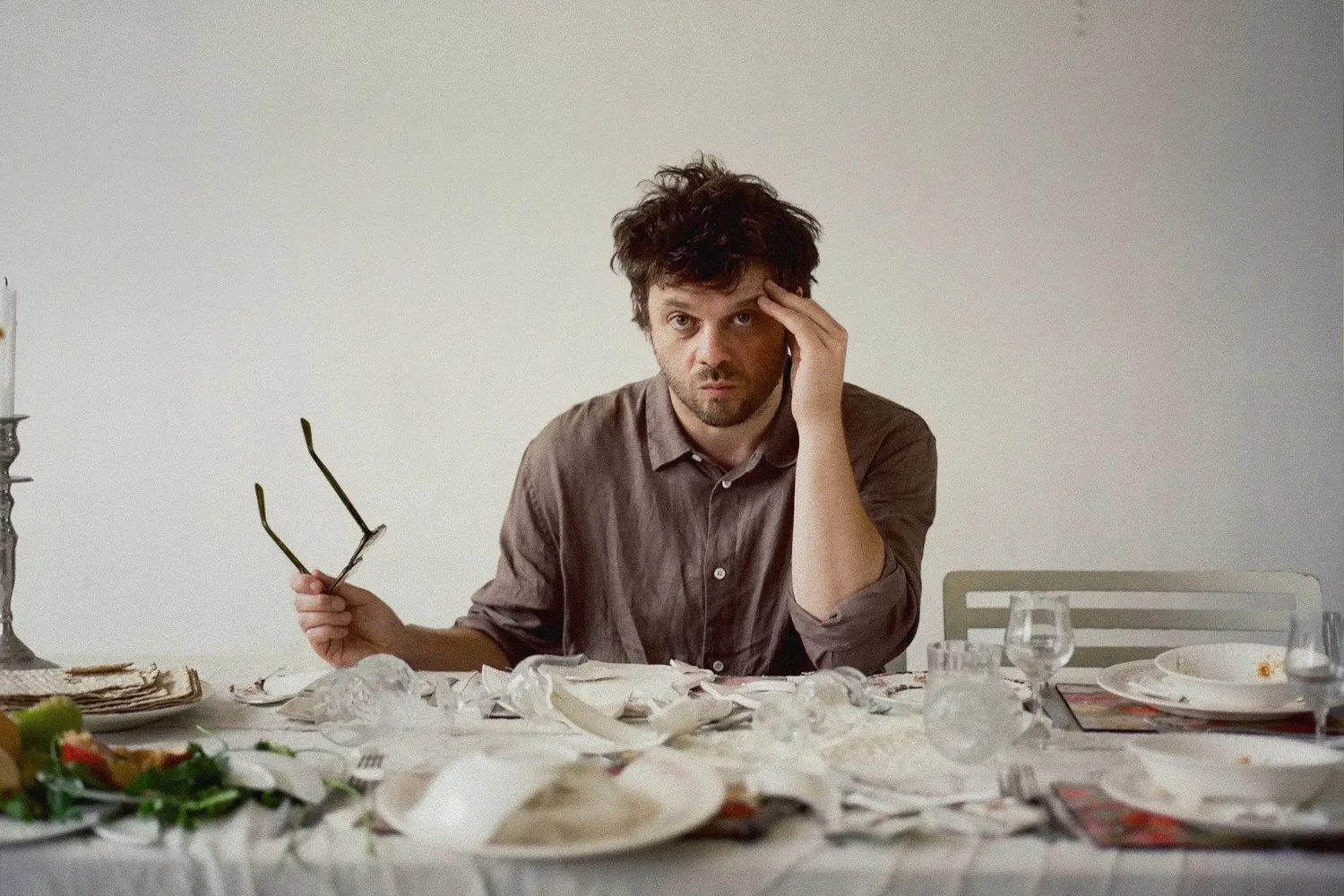
Based on his debut collection of poetry of the same name, which was a finalist in the 2020 National Jewish Book Awards, Seder melds spoken word, storytelling, live music and interpretive dance. It opens on the floor of the venue, a sparsely dressed performance area containing a pile of plastic patio furniture surrounded by scattered shoes (bringing to mind the memorial, Shoes on the Danube Bank), plus a a guitar, microphone, drum kit and harp. "Hi, sorry about the mess," says Kammerling brightly as he enters the stage in a dishevelled brown shirt and black trousers, hopping on one foot as he struggles to pull on one of the lone shoes from the floor. Five fellow cast members follow him, putting on the remaining shoes and setting up the table and chairs, while Kammerling explains the concepts of Seder, like how to make charoset (a paste of fruit, nuts and spices) – and how not to confuse it with concrete.
Crumbs of humour are laid as he variously speaks, sings and plays abrasive guitar riffs. Drummer Antosh Wojcik commands the dynamic deftly, alternately caressing cymbals or bashing out a beat, while harpist Marysia Osu applies a similar dexterity. She manoeuvres with ease from dreamlike plucking into a dissonance resembling nails scraping down a chalkboard. Add to that the sinuous, sensuously writhing bodies of Si Rawlinson, Elisabeth Mulenga and Jay Yule, and the scenes are very much set. Never has a satsuma falling from a tree been so expressly executed as through the contortions of these three dancers, nor a goldfish gliding through the murky depths of a watery underworld.
To say Seder is beautiful would be selling it short. It's so much more. It is sincerity, history, grief, anger, passion and quick wit. Kammerling shares moving memories, from his own to his family's. A Slovenian rock festival, for instance, at which he cried guttural, deep-from-within sobs because he arrived off the back of a 10-day research trip that included stops at Auschwitz, Theresienstadt and Krakow. Or stories of his grandfather's childhood in Nazi-occupied Austria and "the fear of inheritance" that kind of suffering can bring. Or even the anxieties brought on by the thought of history repeating itself – a heaviness that kept Kammerling from getting out of his car one day – a memory aided by a soundtrack of news reports on the rising death toll in Gaza since 7 October. Seder may not plough a new furrow – after all, intergenerational trauma is an oft-visited theme in Jewish culture – but it is discerning and shown through a unique lens that is at once timely and enduring.
By Danielle Goldstein
Adam Kammerling: Seder runs Tuesday 17 February. 7pm. £20. JW3, London, NW3 6ET. adamkammerling.co.uk
This review was of the Norwich Arts Centre performance on Sunday 8 February.