

Kapoor's pops of pigment provide a surprising insight into his life and career at this NYC exhibition
In markets in Jerusalem and elsewhere in Israel, you can find shops displaying all kinds of spices, sometimes in discreet piles, sometimes packed into pyramids of the brilliant crimson and scarlet of sumac, smoked paprika, Aleppo pepper, golden-yellow hawaj, shimmering piles of black salt and Urfa Biber pepper. Walking into the scattered shapes of colour in Anish Kapoor’s Early Works show at the Jewish Museum, NYC, is reminiscent of those spice market stacks and bowls, perhaps owing to the three years of his life that he spent in Israel as a young man.
Kapoor was born in India in 1954 to an Iraqi Jewish mother and a secular Hindu hydrographer, whose profession of mapping oceans often kept him at sea. Kapoor, one of three brothers, spent most of his childhood in India but, as teenagers, he and another brother were sent to Israel where he worked on a kibbutz and garnered an interest in art and object making. In following years, he travelled across Europe, then landed in art school in London where, after being rejected from Jerusalem’s Bezalel Academy, he was accepted into Hornsey College of Art.

Early Works explores the evolution of his career: how the footprints of his cultural influences are present in the saturated colours and minimalist forms of his sculpture and drawings, from the artisanal craftsmanship found both in ceremonial and everyday objects, to the brilliance of Indian textiles, as well as the use of pigment during Holi Festival. When Kapoor returned to England from India in 1979, he began uniting pigment with sculpture, rather than relegating vibrancy to the flat picture plane.
The most striking objects in the exhibition are his drawings and sketchbooks: rehearsals for sculptures and installations. The scattered shapes displayed on the floor and attached to the walls are formed of red, yellow and blue pigments, bound together by the use of plaster. Unseen support structures underneath, made from wood, resin, or polystyrene, enable the pigment to take the form of peaks, cones, hearts and other objects that look like fir trees, sandcastles and the Coronavirus’s molecular structure.
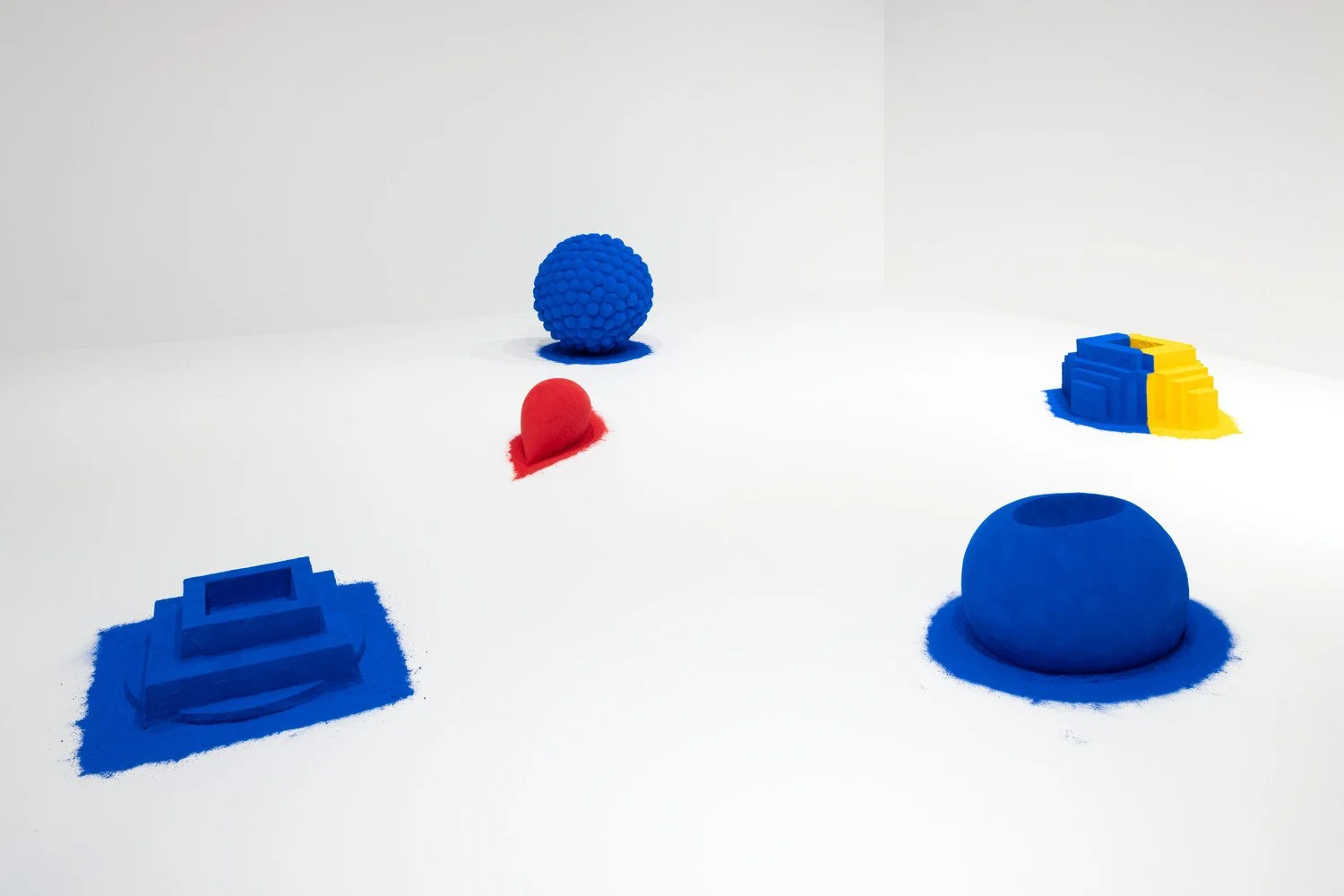
The visual language of Kapoor’s work appears at once humorous and sharply serious. The viewer is asked to imagine the relationships, the dialogues, between forms in each grouping. The artist has said that in these installations he was interested in representing binaries: male and female, earth and spirituality, light and dark, powdery as opposed to solid. In later years the groupings gave way to a focus on increasingly larger individual objects.
There are several pieces that employ the controversial Vantablack – the blackest black, possibly the world’s darkest material, made of microscopic “vertically aligned nanotube arrays”. It has been deemed dangerous to work with, as it absorbs all light, and is used mainly for industrial purposes: objects sent into space or coating the inside of telescopes. Kapoor attracted controversy in 2016 when he scored exclusive use of the colour – a move that maddened the art world. Among the works made of Vantablack is a diamond that looks flat straight on, but is actually pyramidic when viewed from the side. Like his coloured installations, the black pieces resemble things that look familiar, but aren’t what they seem.
Besides his interest in ritual, Kapoor has said he’s concerned with objects that have “metaphoric potential”. The drawings, sculpture and installations pull from different identities, with a variety of illusions and what Kapoor calls “fundamental transformation.” The ordinary is pushed beyond the everyday, loses its identity and becomes a rarified, essentiality of itself, pared down until only shape and pure colour remain.
By Susan Daitch
Photos courtesy of The Jewish Museum New York
Anish Kapoor: Early Works ran Friday 24 October 2025 – Sunday 1 February 2026 at the Jewish Museum New York. thejewishmuseum.org