
The newly restored Borges Labyrinth welcomes visitors to mark 40 years since the death of the Argentinian author who inspired it
After months of renovation, this week the Borges Labyrinth on the island of San Giorgio Maggiore in Venice reopened to the public. Originally planted in 2011, the maze was designed by British diplomat and labyrinthologist Randoll Coate, who was inspired by The Garden of Forking Paths, a short story by Argentinian writer Jorge Luis Borges.
The original Borges Labyrinth was constructed in San Rafael, Argentina, in 2003. At the behest of the author’s widow, Maria Kodama, the Venetian maze was proposed, at a fourth of the size, within the grounds of San Giorgio Maggiore basilica. The design, when viewed from above, resembles an open book, with Borges’ name on the ‘pages’ and symbols including a walking stick, hourglass and giant question mark.
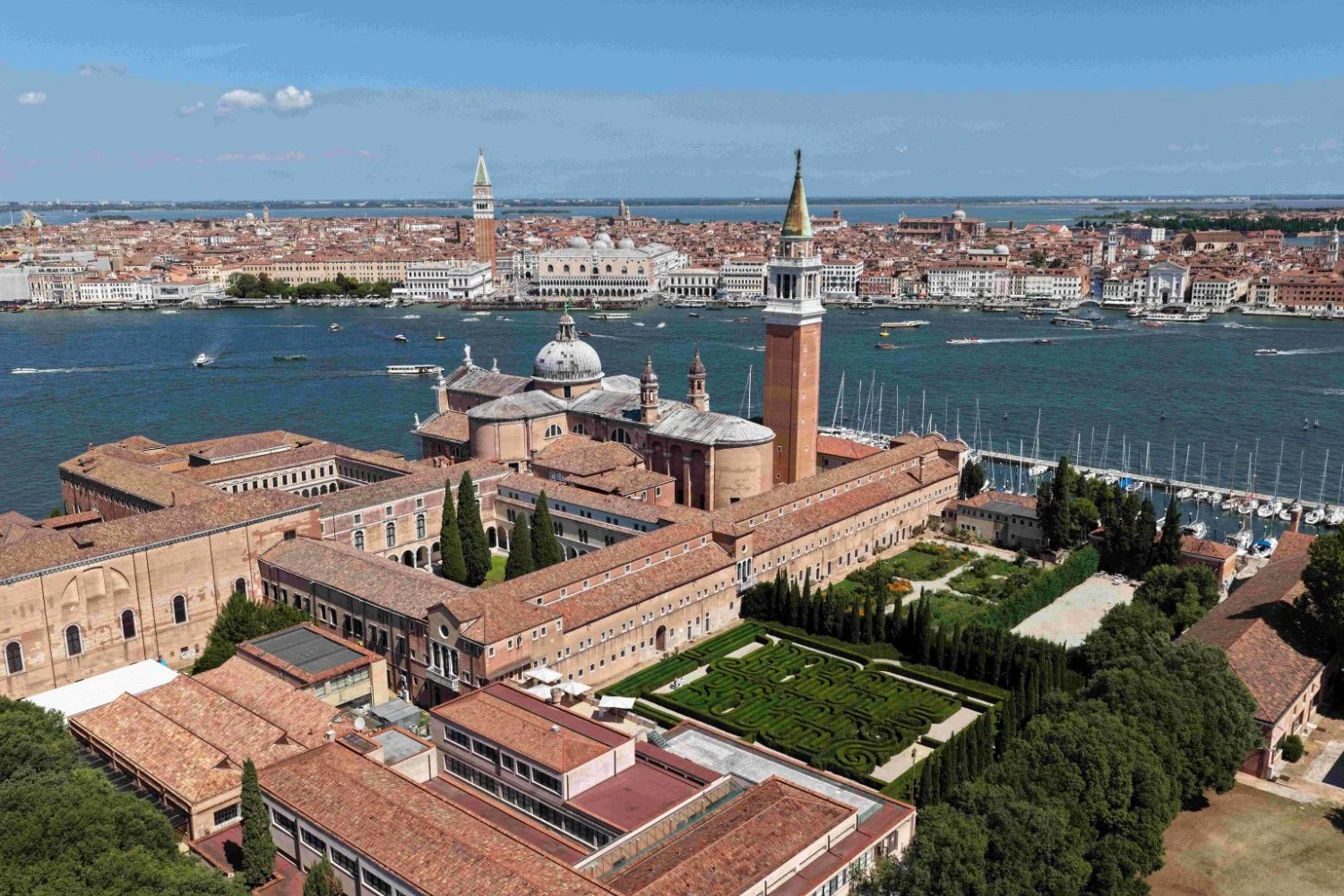


Managed by the Giorgio Cini Foundation (GCF), the restoration involved the replacement of 165 dead or damaged buxus plants (used to create box hedges), repair of the irrigation system, introduction of fresh soil and weeding by hand. “The restoration of the Borges Labyrinth is a particularly significant project,” said Giovanni Andrea Toselli, president and CEO of PwC Italia, the main sponsor of the renovation, “because it combines heritage protection, cultural enhancement and accessibility. [It makes] a place of great artistic and symbolic value more accessible and open to diverse audiences, while respecting the unique context of the island.”

Borges, who died in 1986, aged 86, struggled with his eyesight for most of his life and eventually lost his vision at the age of 55, so it was important for the GCF to ensure that the refurb made the labyrinth easier for those who are visually impaired to enjoy. One of those improvements was the installation of a braille map, created in partnership with the Italian Union of the Blind and Visually Impaired. The entrance and 1km labyrinth path have also been levelled out. “The beauty of places contributes so much to people’s well-being,” said Renata Codello, secretary general of the GCF. “People have different ways of appreciating artistic venues. Offering a positive experience that can be shared with others is an important aspect of inclusion.”

Jorge Luis Borges and Maria Kodama on San Giorgio Maggiore, 1984 © Graziano Arici
Born in Palermo, Buenos Aires, in 1899, Borges is best known for his dream-like fiction writing and for publicly defending the Jewish community during World War II. In 1934, extreme right-wing Argentinian nationalists in thrall to Hitler accused Borges of being a Jew. In response, he wrote the the essay Yo, Judío (I, Jew), in which he states that he would be proud to be Jewish and that someone of Castilian heritage (such as his mother) undoubtedly comes from an ancient Jewish ancestry anyway. He continued to publish essays throughout the Holocaust, speaking out against the Nazi Party and Germany’s “chaotic descent into darkness”. In his lifetime, Borges was nominated for numerous Nobels, though never won, awarded an honorary British OBE and, in 1971, received the Jerusalem Prize.
By Danielle Goldstein
Images courtesy of Fondazione Giorgio Cini
Borges Labyrinth is available to visit from Thursday 16 July. Booking essential. visitcini.com