
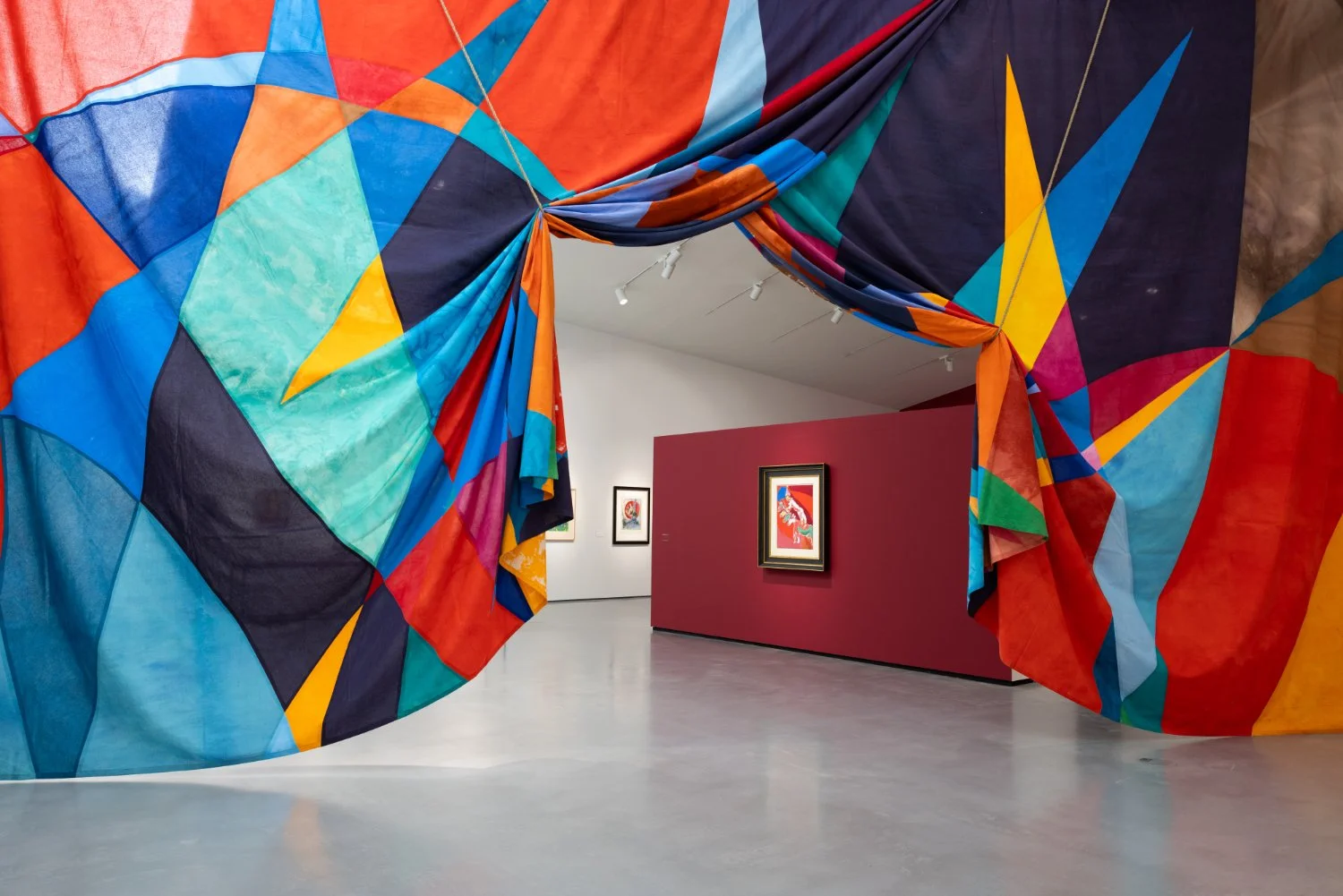
Uncover the life and work of the Russian-French modernist in The Hepworth's beguiling new exhibibiton
Two curtains, pulled back with rope and painted with triangles in bright colours, as if shot through with searchlights, welcome visitors into the circus ring at The Hepworth Wakefield’s new exhibition. Marc Chagall: The Circus, on view until April next year, is the first institutional exhibition devoted to this master of 20th-century painting in the UK in over a decade. With more than 50 works spanning 60 years, it is an illuminating look at a hitherto neglected aspect of the Belarusian-French painter’s imagination.
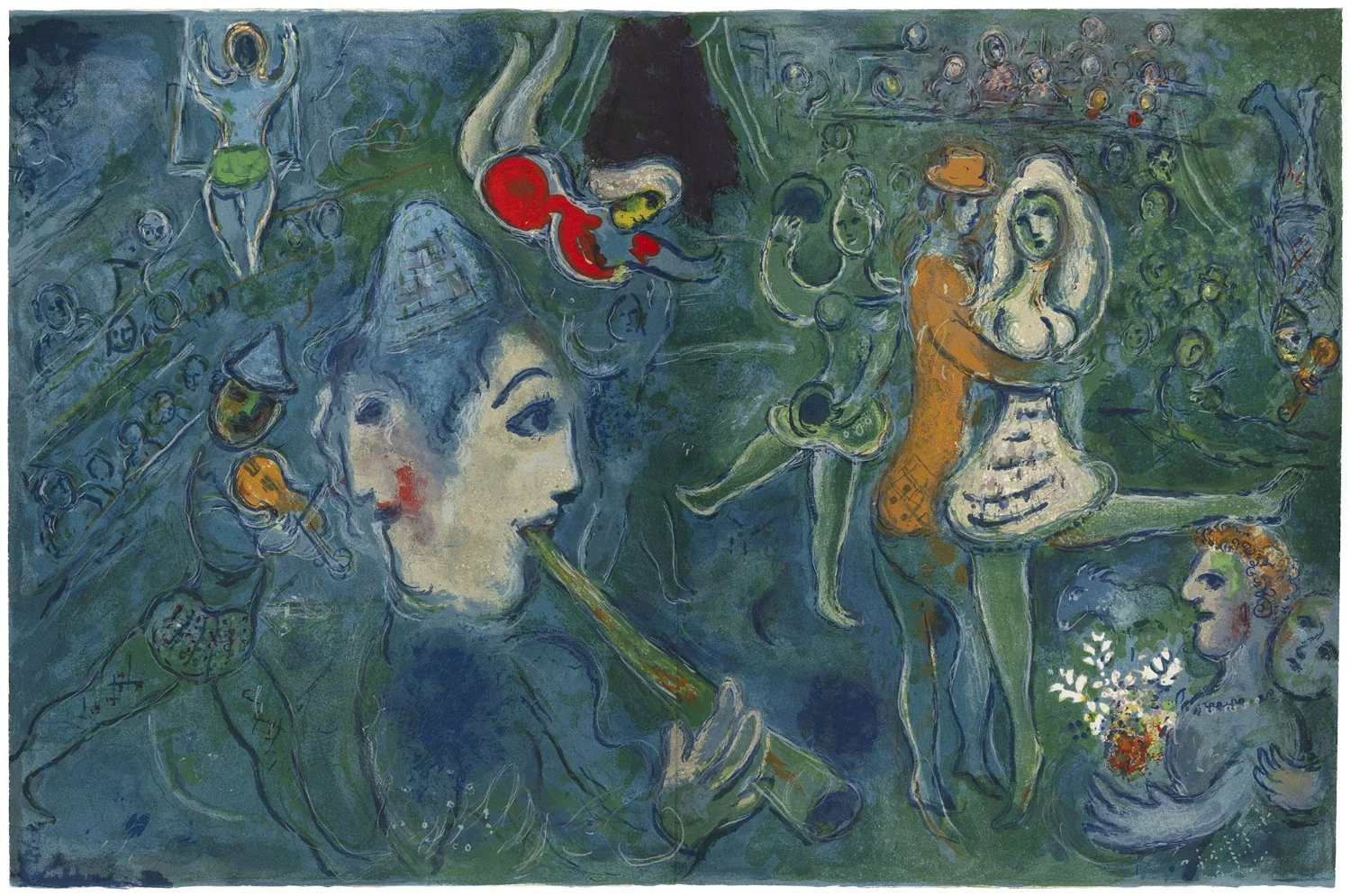
Le Cirque by Marc Chagall, 1967. Colour lithograph on Arches paper. Collection of Kunstmuseum Pablo Picasso, Münster. Donation from Meret Meyer, 2024 © 2026 ADAGP, Paris and DACS, London
The show centres on Chagall’s 1967 artist book Cirque, a collection of prints and an essay, which has passages of prose interspersed with poetry. For the first time, Chagall’s essay has been fully translated into English. The initial room hosts Cirque’s lithographs, while headphones play a French-accented reading of the text, reminiscent of Chagall’s voice. Evoking the mixture of prose and poetry, the audio of the artist’s words describes life as a circus, covered “in the words / of Kafka’s Trial”, with the clown as philosopher-sage, weeping and laughing at once. In his images, suffused in deep blues and reds, acrobats, horseback riders, clowns and trapeze artists figure in fantastical scenes; there are golden, glowing fish, crescent moons, four-headed creatures, horns and hoops, and an almost-faceless audience. These circus figures were to dominate Chagall’s imagination, with the clown becoming a shorthand for the artist; he writes: “This clown – he is he and I.” With Cirque opening the show, visitors can trace these motifs throughout Chagall’s life.
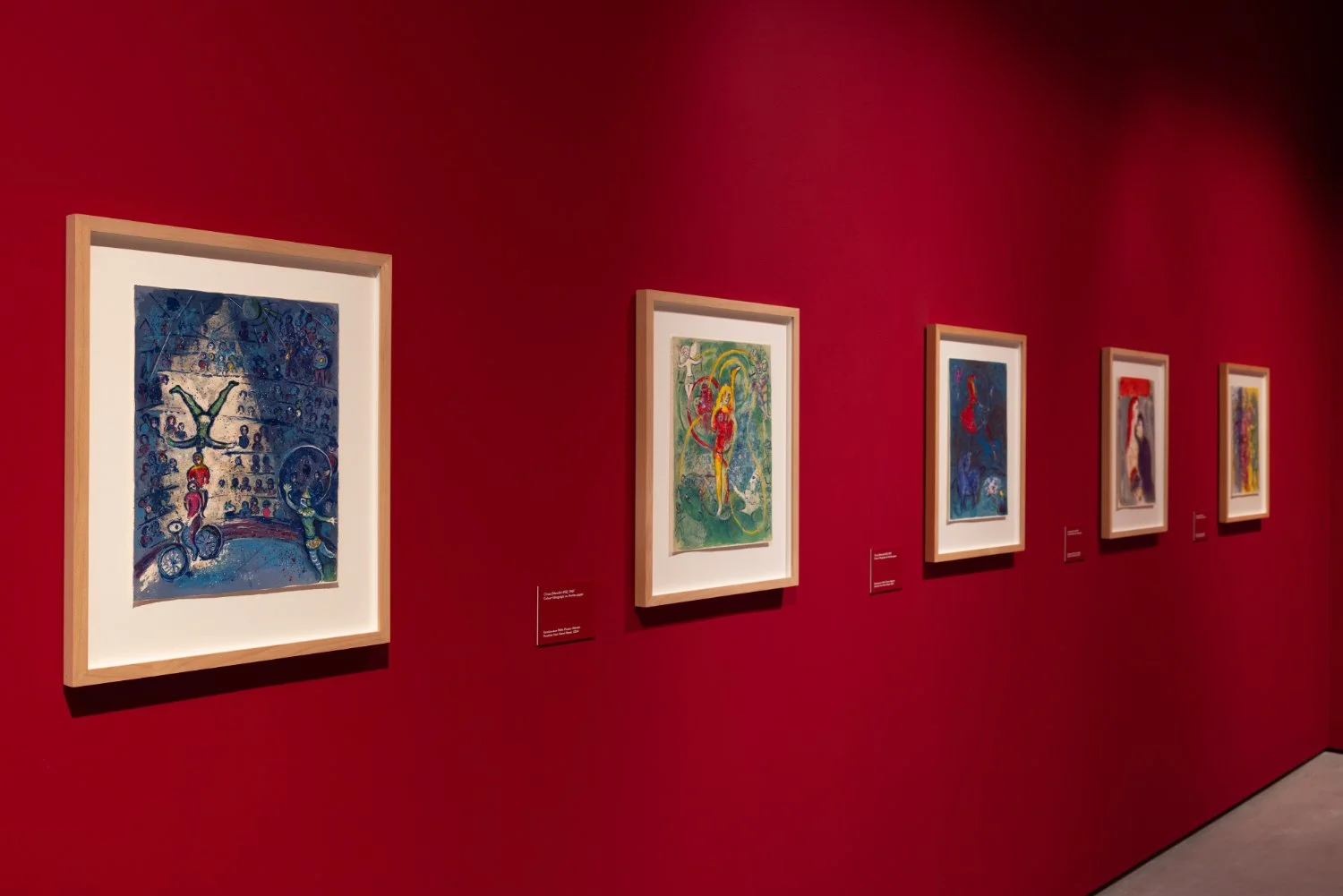
Installation image of Marc Chagall: The Circus, The Hepworth Wakefield, November 2026 © Anya Fiáine-Fox, courtesy The Hepworth Wakefield
Born Moishe Shegal in 1887 to a Chasidic family in Vitebsk, present-day Belarus, Chagall encountered street performers as a youngster, and circus scenes seem a portal to childhood memory. Later paintings show Vitebsk’s wooden rooftops merging with Parisian landmarks. Chagall moved to Paris in 1911 and returned twice: in 1923 after leaving Soviet Russia, and in 1948, after exile in New York. The circus for Chagall stages not only the political turmoil of the 20th century, but the joys and tragedies of Jewish life. There is an acrobat in tefillin; circus performers stand in for biblical figures. Chagall writes that caged beasts are like creatures in Noah’s ark, with Noah as lion-tamer and King Solomon as ringmaster. In Cirque, he muses on the pain of one living in exile: “Am I the other Moses / Who did not enter his Jerusalem?”
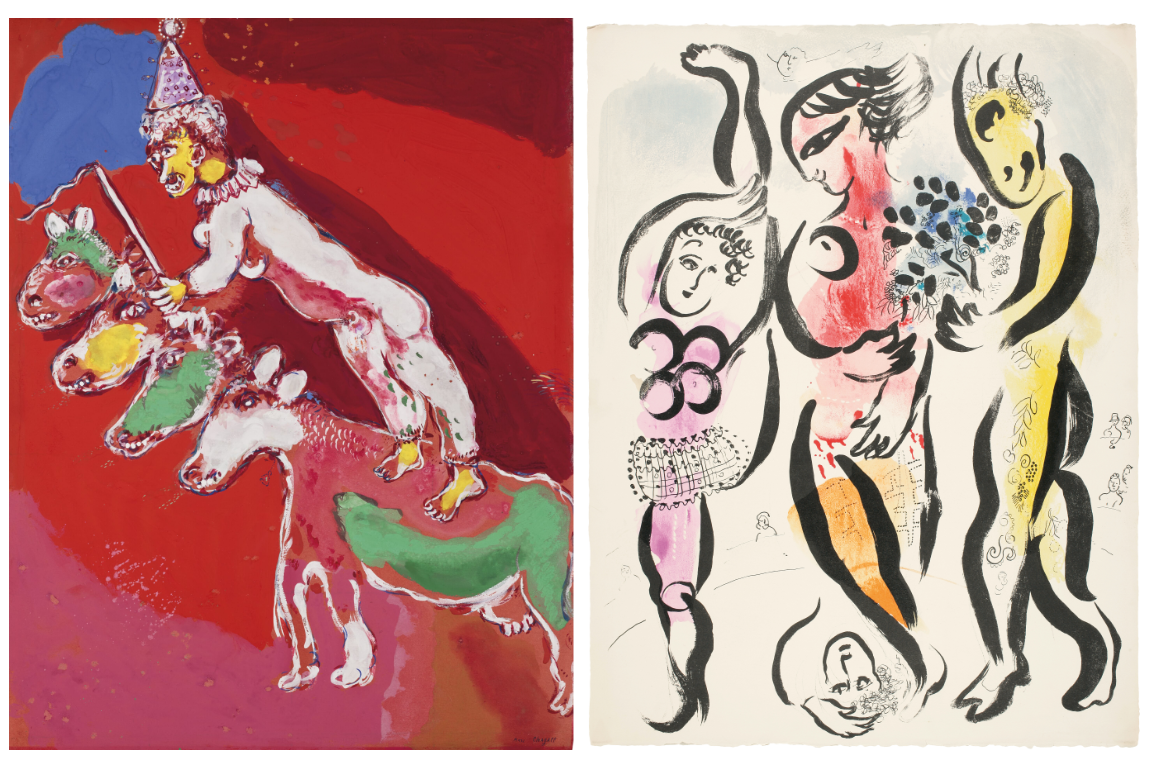
(Left) Les quatre têtes by Marc Chagall, 1927. Gouache and coloured ink on red paper. Alon Zakaim Fine Art
(Right) Les trois acrobats by Marc Chagall, 1957. Colour lithograph. Collection of Kunstmuseum Pablo Picasso, Münster. On permanent loan from Sparkasse Münsterland Ost
© 2026 ADAGP, Paris and DACS, London
The exhibition displays gouaches Chagall painted from dealer Ambroise Vollard’s box in the Cirque d’Hiver in Paris, alongside archival footage of this real-life circus. It also gathers Chagall’s theatrical collaborations, such as his last major work in Russia, a 1920 mural for the Jewish State Theatre in Moscow, and oils from a 1967 Metropolitan Opera production of The Magic Flute, for which he designed over 120 costumes. These works reveal the dazzling breadth and prolific output of Chagall’s career, and the circus dancing through it.
There is much to wonder at in this surreal, radiant spectacle, even if one wishes more were devoted to the Jewish elements of Chagall’s circus. Still, we find Chagall’s figures leaping through the decades, through famine, war and exile, their chorus of legs and arms a Gesamtkunstwerk, the circus as Chagall’s own “great art”.
By Natalie Perman
Header photo: Installation image of Marc Chagall: The Circus, The Hepworth Wakefield, November 2026 © Anya Fiáine-Fox, courtesy The Hepworth Wakefield
Marc Chagall: The Circus runs until Sunday 25 April 2027. The Hepworth Wakefield, Yorkshire, WF1 5AW. hepworthwakefield.org