Review: 5 Kilo Sugar – Gur Koren’s tale is bittersweet magic realism

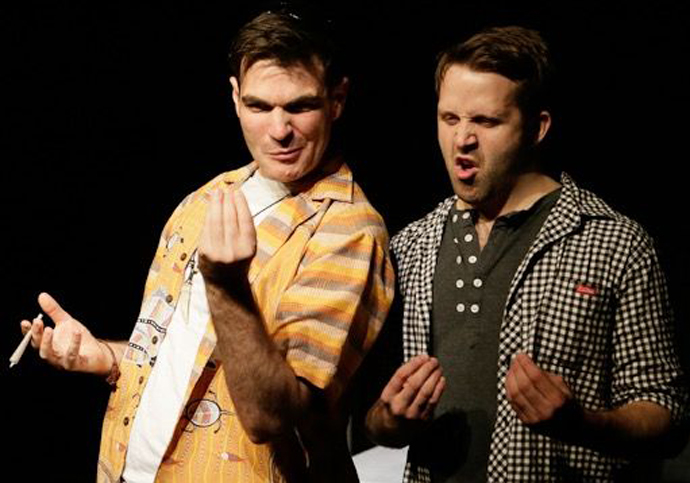
5 kilo sugar So your late grandfather assumes the role of a fairly benign dybbuk (malevolent spirit) and enters the bodies of a variety of unsuspecting hosts, mostly Israeli (as we are mostly in Tel Aviv), to gee you up to right what he perceives as a historical wrong perpetrated during the 1940s in post-war Eastern Europe. It’s not quite on the same scale of the vengeance that, say, Hamlet’s father demands. All Grandfather’s co-survivor and landsman (person from the same village) has done is slope off when the pair are apprehended for trying to sell smuggled sugar on the black market, leaving Grandfather to face the music and two months in a Russian labour camp. But Grandfather is rankled in death, as in life, and now he’s spotted a chance to set the record straight, for the cowardly landsman's historian of a grandson, Yoad Riva, is writing a book about his grandfather.

This is the clever, quirky premise of Gur Koren’s moving, funny chamber piece, which opens a window onto the past, to remind us that it is always with us, particularly in the case of second and third generation Holocaust survivors, and especially for Israelis.

This is a lovely intimate piece of writing, with a hero who engages one-to-one with his audience (it’s a mockumentary, so we're cast as a TV or film audience) that gets the production it deserves by director Ariella Eshed.

The cast of four work wonderfully together and tackle the different roles that most of them get to play with relish. Tom Slatter’s Gur Koren is indeed engaging and sympathetic and gets a lot of fun out of the surreal situation of talking to people who are being ‘occupied’ by grandfather’s ghost – and explaining to them that when he addresses what is apparently the air (shades of Hamlet again) he is actually doing a monologue to camera. Spencer Cowan’s Yoad Riva is both funny and appealing, trying to trade sexual favours for that mention in the book, and Shia Forester and Micah Banai have the intriguing job of playing everything from 'bored prostitute' to 'well-read taxi driver' and 'Dostoyevsky aficionado', most of them morphing into bodies possessed by grandfather so he can engage with grandson Gur (so playing a personality within a personality – most of them expansive).

This tale has a real feel of the magic realism of Isaac Singer.  When I saw the show, it was taken to the collective heart of its hugely enthusiastic and eclectic audience, who guffawed and cheered appreciatively in this tiny (hot and sweaty) fringe theatre. Eshed’s Tik-Sho-Ret Theatre (the name means communication in Hebrew) aims to give a platform to Israeli and Jewish theatre in the UK and encourage collaborations through cultural and artistic exchange and to promote communication and co-existence. Perhaps this is the production that will achieve all that in its forthcoming run in Edinburgh, after the debacle of last year’s beleaguered shows from Israel. Unsurprisingly the Israeli version has been running since 2009.

By Judi Herman

Hear Ariella Eshed and cast members talking to Judi post-performance at London's Etcetera Theatre:

5 Kilo Sugar runs Friday 7 – Saturday 15 August. 10.25pm. £7-£9. theSpace on the Mile, Edinburgh EH1 1TH. http://tik-sho-ret.co.uk

Review: Come In! Sit Down! – Judi Herman gladly accepts the invitation

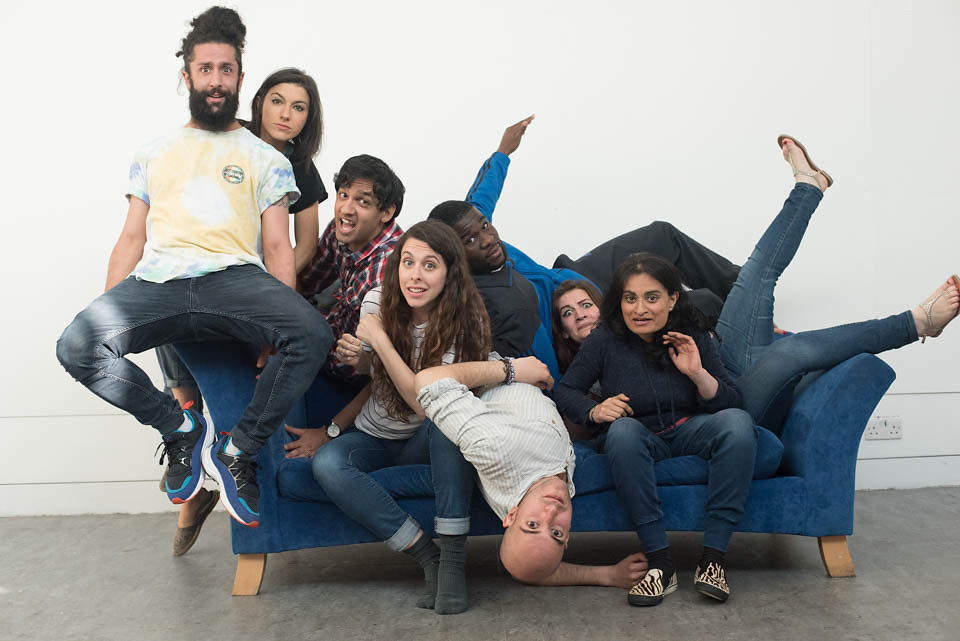
come in sit down, press 2015 On a day when the number of anti-Semitic incidents reported has risen again – and has, as usual, risen to the top of the news – it’s heartening to report on an evening that made an auditorium full of people of different backgrounds and ages laugh a lot together, as a bunch of talented Muslims and Jews mercilessly sent up both with great and good humour.

It’s good too, that this took place at the Tricycle Theatre and that the MuJu Crew is celebrating 10 years since it started life as a youth theatre group to bring together young Jews and Muslims through theatre. Indeed I remember reporting on the group’s early days myself.

One of the secrets of MuJu’s success is that they bring so many talents to create comedy – and musical comedy at that. They boast writing, clowning, improvising and composing experience on their CVs and it shows. In addition other experienced comedy creatives, including Chris Cookson and Dave Cohen (of BAFTA Award-winning Horrible Histories), were on hand with extra input. Another secret is that it’s often hard to tell who is the Muslim and who is the Jew in this talented bunch. For example, the luxuriant dark beard sported by Dominic Garfield proves equally handy to portray assorted Rabbis – and a sexy siren of a Jihadist, clad only in tight pants and velvet waistcoat, luring western women to go East.

What’s not to like about Israeli-type security checkpoints at all entrances to Brent Cross, the delectable prospect of Muslim women with four husbands to satisfy different needs (why limit it to Muslims!) and a chorus of Jihadists rendering 'Let it Go' from Frozen in a whole new way? And I did especially appreciate a sketch that sent up the Tricycle’s recent dilemmas with great good humour.

There’s hard-hitting stuff too. A white journalist captured by Jihadists claims superiority over his Arab counterpart because his execution will be high-profile with media coverage and a star executioner, while his fellow captive can look forward only to the anonymity of a mass execution in the middle of the desert.

It was good to see Daniella Isaacs, featured in Jewish Renaissance recently talking about Mush and Me, the play which she co-created and in which she also toured the UK, in a range of comedy creations – I especially liked the Jewish gap-year princess on the pull in the IDF (you had to be there, as they say). And I loved Amina Zia starring in her own sketch as that smug Muslim wife with four adoring men in attendance.

Everyone clearly had a ball creating Come In! Sit Down! And to add to the exclamation marks, what a friendly title that is!

By Judi Herman

Listen to cast members Daniella Isaacs and Ramzi DeHani talking to Judi (in the busy bar at the Tricycle after the performance): 

Come In! Sit Down! runs until Sunday 2 August. 7.30pm & 3pm. £13. The Tricycle Theatre, 269 Kilburn High Rd, NW6 7JR; 020 7328 1000. www.tricycle.co.uk

Review: Volpone – Judi Herman gets guilty pleasure from Henry Goodman’s wickedly good performance in the title role of The RSC's Volpone

Volpone, RSC, 2015 © Manuel Harlan Ben Jonson’s scabrously and cruelly comic take on greed premiered to huge acclaim in 1605, the year of the Gunpowder Plot, and has remained his most popular play. Although it shares its exotic (especially in Jacobean England) Venice setting with two other plays in the current Royal Shakespeare Company season – The Merchant of Venice and Othello – the RSC is actually pairing it with Christopher Marlowe’s The Jew of Malta (and a lesser known play, John Ford’s Love’s Sacrifice) calling them "contemporary takes on classic plays exploring the idea of the outsider".

Of course the RSC is also reviving The Merchant of Venice this season (which we reviewed), which could also be considered a classic exploring the idea of the outsider, as Shylock, though not the title role as in Volpone and The Jew of Malta,  is considered such a central character.

It is perhaps a relief that Jonson didn’t choose to cast his title character in this study of greed, the supremely greedy Volpone, as a Jew. His ruthless schemes to acquire more wealth and precious objects are based around his brilliant masquerade as a childless invalid on his deathbed seeking an heir to whom to leave his wealth. And they are, if anything, more ingenious than Barabas’s machinations in Marlowe’s play and like Barabas, he starts the play by taking the audience into his confidence. But Volpone is the wily fox not the wily Jew and pretty well everyone else in the play is as greedy and morally bankrupt as he is. Plus most of the other characters also have Italian names that flag up their types to the audience straightaway – like the greedy would-be heir, Corvino, the Crow and Mosca, Volpone’s assistant and partner in crime, The Fly.

More than 15 years ago, Henry Goodman played Shylock at the National Theatre, in a production of The Merchant of Venice by Trevor Nunn. I am not alone in considering Goodman’s Shylock to be the finest, the most complex, the most moving that I have ever seen. Now he is reunited with Nunn and actor and director find themselves back in Venice, once again in a modern dress production of a classic dark comedy. This time though, instead of playing a man who is an outsider cast in that role by his fellow citizens because of his race and religion, Goodman plays a man who is supremely comfortable in his skin. He’s positively gleeful in the Machiavellian masquerade that means he can never be himself with anyone except the circle of minions who are in his pay and in his confidence, Mosca his private secretary, and his dwarf, his eunuch and his hermaphrodite. But then his very best friends are his golden treasures and he simply can’t get enough of them.

Volpone, RSC, 2015 © Manuel Harlan

Like his earlier Shylock, this is a stellar performance by an actor at the height of his powers, working wonderfully with the director with whom he goes back such a long way. Goodman’s is a marvellously warm stage presence, with a vigorous energy and an irresistible twinkle in his eye, even if it is perhaps the glint of avarice. When he takes the audience into his confidence at the start of the play, it’s quite hard not to be bowled over by all that enthusiasm – and not to be impressed by the close tabs he keeps on the stock market, with an LED display of share prices constantly updating above his head – courtesy of Stephen Brimson Lewis. The British set designer has a spectacular sense of how to use the Swan Theatre’s roomy thrust stage with light and airy glass display cases containing the treasures and vital props and scenery, like Volpone’s sickbed, complete with drips and heart monitor, arriving smoothly and swiftly on stage as needed.

Goodman’s transformation, with the aid of his staff, from, frankly, a rather sexy millionaire clad in designer silk pyjamas and dressing gown into a pathetic, dying invalid "sans eyes, sans teeth, sans everything" is masterly – a fantastic and very funny coup de theatre.

As in The Jew of Malta, it’s hard to feel any sympathy for most of these greedy types. It’s also great to see so many members of The Jew of Malta playing almost parallel roles here. So Matthew Kelly and Geoffrey Freshwater, who played a pair of greedy clerics in Marlowe’s play, here get to play a pair of equally greedy clients and would-be heirs of Volpone. They are so unscrupulous that the one is not above prostituting his own wife when it’s implied that would further his chances to inherit and the other is prepared to disinherit his son for the same reason. Both men seem physically crooked and diminished by their lust for riches, while Volpone and his acolyte Mosca (a performance of terrifically sly and energetic intelligence from Orion Lee) seem rather invigorated by theirs.

Steven Pacy, the pusillanimous Governor of Malta, enjoys a great comic turn as the preposterous gentleman traveller in Venice, Sir Politic Would-Be, whose name speaks for himself. He is more than matched by his vacuous wife, the superbly brassy Annette McLaughlin, who's all big hair and extensions, tiny tight frocks and dizzyingly high heels, channelling Kim Kardashian and TV Reality show The Only Way is Essex followed by her long-suffering personal cameraman and girl assistants at all times. So no pearl of wisdom, no handy make up tip is lost to her Youtube followers; and with selfie stick at the ready so no photo opportunity is lost either. Again great use is made of huge onstage screens blowing Lady P up to a lot more than life-size (video designer Nina Dunn). Colin Ryan is great fun as Sir Politick’s nemesis, Peregrine (or ‘pilgrim’), a much more savvy, young American backpacker, complete with dreadlocks and iPad.

Volpone, RSC, 2015 © Manuel Harlan

Nunn and his creative team work seamlessly and wondrously together to build a production so fluid and so intelligent and so right for this time of social media and self-publicising, intrusive media scrutiny – and unbridled corporate and individual greed and inequality – that it’s hard to see how it could be bettered. There is a breath-taking moment when Volpone realises his deceptions are catching up with him. The bustling action of the court to which the invalid has been called to testify freezes around Volpone and his household, who are thrown into sharp monochrome relief by Tim Mitchell’s masterly lighting. It’s a real moment of truth and as fine as any I can remember from any of Nunn’s extraordinary body of work.

The whole is fabulously enhanced by Steven Edis’s gloriously appropriate music, directed by John Woolf on keyboards, with Andrew Stone-Fewings (trumpet), Andrew Waterson (guitar) and Kevin Waterman (percussion). In particular a speech about Pythagoras’s potentially problematical theory of the migration of souls becomes a bravura rap performed by Jon Key’s Nano the dwarf, Ankur Bahl’s Androgyno the hermaphrodite (a sexy Eurovision winner Conchita Wurst lookalike) and Julian Hoult’s Castrone the eunuch – all lovely movers! And I should finish by paying tribute to Ranjit Bolt’s sparkling script revisions which are spot on. This really is a must see.

By Judi Herman

Photography © Manuel Harlan

Volpone runs until Saturday 12 September. 7.30pm & 1.30pm. £8-£40. Swan Theatre, CV37 7LS; 084 4800 1110. www.rsc.org.uk

"An extraordinary man" – Judi Herman reports on the sad passing of humanitarian Sir Nicholas Winton

sir nicholas winton Sir Nicholas George Winton MBE 19 May 1909 – 1 July 2015

At the age of 106, Sir Nicholas Winton peacefully passed away in his sleep at Wexham Park Hospital on 1 July 2015. The poignant day also marked 76 years since 241 children – of the 669 Sir Nicky saved from Czechoslovakia – evacuated Prague by train. Sir Nicky was a true humanitarian; on the eve of the Second World War he instigated the Czech Kindertransport, which saw hundreds of children escape safely to homes that Sir Nicky had arranged for them in Britain. For this selfless act Czech President Miloš Zeman awarded Sir Nicky the highest honour of the Czech Republic, the Order of the White Lion (1st class).

In May 2003 I had the honour of meeting this extraordinary man. Sir Nicky was in his mid-90s at the time and I was lucky enough to be asked to make a feature for BBC Radio 4’s Woman’s Hour with Sir Nicky and the daughter of one of his "children", pilot Judy Leden, a world champion microlight flyer. She had planned a very special treat for his 94th birthday – a spin in a microlite aircraft. It made Sir Nicky the oldest person to fly in a microlight and by doing so he raised money for one of his favourite charities, Abbeyfield, who provide housing and support for the elderly.

Recording their in-flight conversation as they circled his Berkshire home was quite a challenge, but a total joy. I got to record him at his home afterwards too and he was witty, charming and welcoming – a truly great human being.

By Judi Herman

Review: The Trial – Judi Herman finds this updated Kafka fable suitably unsettling

Rory Kinnear as Josef K in The Trial at Young Vic, London © Keith Pattison© Keith Pattison

Franz Kafka's 1915 novella has always seemed uncannily prescient, first of life in Nazi-occupied Europe, then in the post-war Communist era. Now it assumes a whole new chilling significance in a 21st century full of mass media scrutiny, social media, online surveillance and CCTV.

Joseph K (played by Rory Kinnear) finds himself on trial for an unspecified crime. He is informed he is under arrest after a rude awakening by a pair of court officials who make off with some of his personal effects. At first it hardly affects his daily life and work, but soon righteous indignation gives way to frustration at not being able to get across his case and how it is progressing through seemingly unending layers of bureaucracy. So obsessive paranoia kicks in, fuelled by an uneasy sense of unspecified guilt, as events move inexorably – and not without a grim quirky humour – towards a dark conclusion.

The fable has proved attractive to theatre practitioners, including, notably, Steven Berkoff and now it has attracted the attention of playwright Nick Gill and director Richard Jones, himself no slouch in the staging of the dark and quirky. Together with designer Miriam Buether, costume designer Nicky Gillibrand, lighting designer Mimi Jordan Sherin and composer and sound designer David Sawer (sound also by Alex Twiselton), they have come up with a version that reflects the Kafkaesque in the era of Facebook and Twitter exactly one hundred years after Kafka wrote it.

Jones’s hugely accomplished and dedicated cast, led by Kinnear, skilfully negotiate Buether’s highly original conveyor belt set, moving between two banks of seating, casting the audience as jurors, and delivering rooms and offices as required. There’s something voyeuristic too about peering at these rooms furnished with coffee tables of family photographs, which also sits well with the paranoia. Best of all is that Kinnear’s increasingly-perspiring Joseph succumbs first gradually, and then faster and faster, to guilty feelings as he delves back through his life; starting with preschool toddler days, finding reasons to be guilty that would have done Sigmund Freud proud.

Kinnear gives an extraordinary performance, hugely intelligent and as open as a wound. Kate O’Flynn is wonderfully versatile as the young women and girls in this stage of Joseph’s life, from the what-you-see-is-what-you-get barmaid, who is everything from the girl next door, to sexy temptress and demanding adolescent. Sian Thomas shines in a terrific pair of turns as the stridently ineffective lawyer from hell and a scarily smooth doctor, and Hugh Skinner (the useless intern from TV comedy W1A) relishes two contrasting roles as a dangerously aspirational Number Two at Joseph K’s office and a terrifying example of what might be in store for K as an accused man almost at the end of the process on which he has inexorably been set. The rest of the cast are equally superb, working especially well in various incarnations of a sinister ensemble. Sarah Fahie's movement direction enhances their shifting stage pictures, raising the threat level exponentially as the conveyor belt rolls by.

Gill’s update mostly works a treat (or should that be a threat!). My only quibble is with the semaphore babble of K’s internal monologues, where verbs become imperatives with which he addresses himself, sentences and phrases lose the odd word and words lose the odd letter – "and" for example becoming "an". To quote the opening lines: “An almost woke ee up one morn – like baby innocent an bold, the great white hole, lord of all surveys, unslandered, clear of mind an hurt, future ahead an ee all indestructible – Josef K.”

These soliloquies are interestingly idiosyncratic, but they are more jarring than arresting (pun unintended).

By Judi Herman

The Trial runs until Saturday 22 August. 7.30pm & 2.30pm. £10-£35, £10 concs. Young Vic Theatre, 66 The Cut, SE1 8LZ; 020 7922 2922. www.youngvic.org

Small and perfectly proportioned: TAU Night at the Movies features the next big thing in Israeli talent

Every year I’m impressed by the quality of short student films presented by the Tel Aviv University Trust. It’s delightful to see such tight storytelling in as little as 12 minutes. That’s the length of Kapunka (trailer above), the film that opened this year’s mini festival, and it set the benchmark high.

The tale of crafty Shmulik – who sees his way round the rabbinate law of shmita that decrees land be left fallow every seven years – is also timely for this is that seventh year. Shmulik’s solution to sell his land temporarily to Changrong, his senior Thai worker, with the idea of buying it back when the year is up, inevitably goes spectacularly wrong. And I do mean spectacularly! To reveal more would be a shame, but director Tal Greenberg’s abrasively funny film may well remain a unique opportunity to marvel at a Thai temple sprouting in an Israeli field like Jack’s beanstalk. Greenberg’s cinematography is gorgeous, colouring a vivid landscape, the Spaghetti Western score is spot on for a comic confrontation on the land and the actors are wonderfully matched. It’s great to see the significant community of Thai workers in Israel given space too. Greenberg is definitely one to watch.

The spotlight turns on a rather larger minority community in Leeor Kaufman’s Papa. At first sight this is a story of schoolboys bullying 11-year-old Stas, who is a recent immigrant from Russia. His violinist father is reduced to busking and Stas, desperate for acceptance into a gang of Israeli boys, is reduced to a less than filial act. Kaufman says the film is first and foremost about fatherhood, putting your children first. Poignantly Sioma Perl, the TAU theatre department carpenter who plays Papa, was a theatre director in Russia before he emigrated to Israel. No wonder his performance has such depth. Kaufman gets terrific performances out of his young actors too and his film is both poignant and unsettling.

Even more unsettling is HomeMade, Lior Sagi’s story of a kibbutz mother trying to clear her son’s name when he is arrested for molesting a kibbutz child. Sagi cleverly puts the mother in charge of the nursery of even younger children, so she first appears confidently regaling them with bright, happy children’s stories. Her body language crumples as soon as she is confronted by the adult world in which she herself has become a news story. The cruelty of the young female TV journalist by whom she has agreed to be interviewed and the eventual outcome of the film are discomfiting and Sagi is not afraid to tackle this difficult subject.

Maayan Cohen is not afraid to be explicit in his shockingly funny comedy Zazaland, about a Georgian family trying to arrange a marriage for their gay son. The contrast between the prim, po-faced bride and her family and her prospective bridegroom’s louche and rather gorgeous lover, gleefully hiding naked in his bedroom, make for squeals of audience laughter and Cohen orchestrates the increasingly farcical situation he’s created with aplomb. His film is part of a project to take inspiration from a classic Israeli film to make a new short. He’s done a great job of making a pithy, daring little comedy inspired by Dover Koshashvili's full-length drama Late Marriage and his choice of a Georgian family is a subtle extra homage to Kosashvili's Georgian heritage.

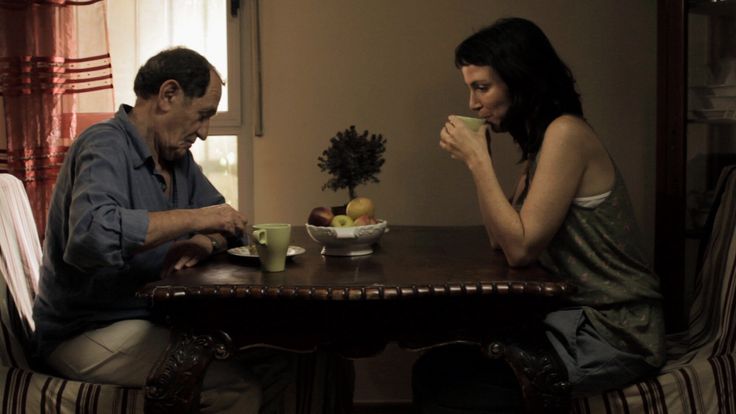
dinner

Finally, the most unashamedly charming of the five films, Lee Nechushtan’s Dinner (pictured above) proves that it’s never too late to date. Gadi, a 76-year-old local deliveryman, is looking forward to a dinner date he’s arranged via an agency, but he must first get through his busy day and one delivery threatens to scupper his evening. Veteran film and theatre actor Gedalia Besser charms as feisty Gadi and Nechushtan sets up the situation beautifully. She introduces her hero in his cosy cluttered apartment listening to an old favourite and organising his date on a cream-coloured old-fashioned Bakelite telephone, and then expertly steers her story through the encounters he has with a succession of regular customers.

On this showing the future of the Israeli film industry is safe in the hands of its graduating filmmakers and I’d be surprised if we don’t hear these five names again.

By Judi Herman

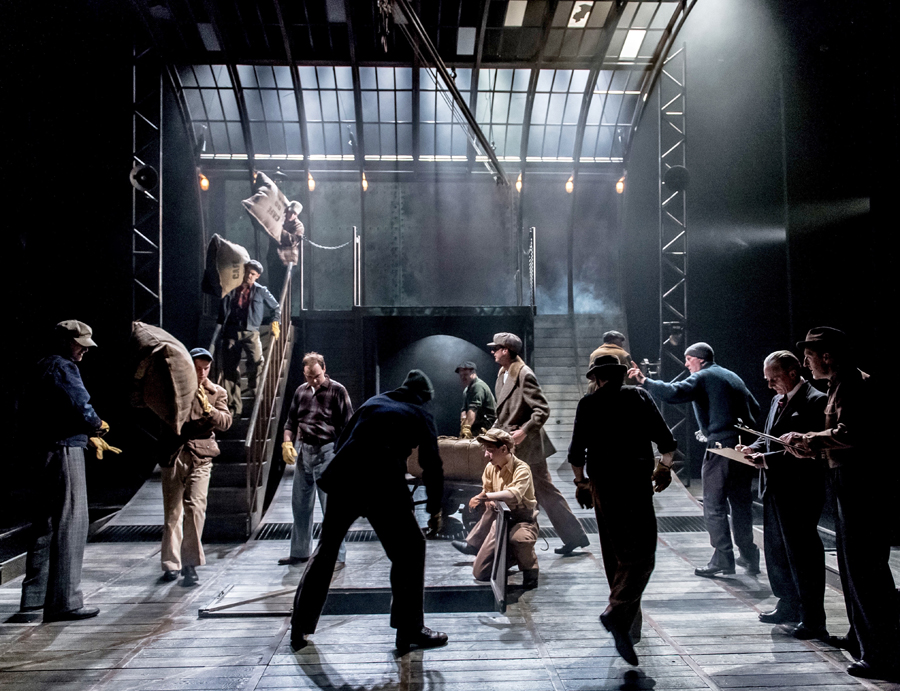
Review: The Hook by Arthur Miller – A compelling study of the ongoing struggle working man has for social justice

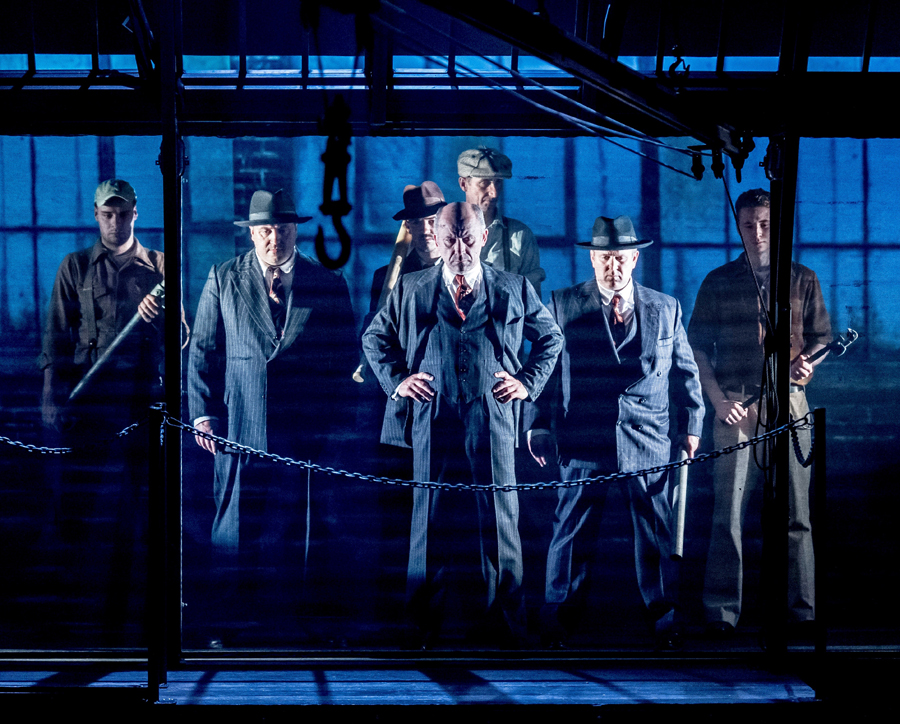
The Hook, Jamie Sives and company, 2015 © Manuel Harlan In the mid 1940’s Miller was captivated by the Red Hook neighbourhood of Brooklyn that contained so many docks and landing piers. He was fascinated by the close community of longshoremen (dockers) and their precarious life of casual day hire, unsafe working practices and exploitation by corrupt Union officials in thrall to the Mafia. Intrigued by the death of Pete Panto, a longshoreman who vanished after confronting Union corruption, Miller wrote “a play for the screen", believing that cinema could be a more democratic way of playing his story to the community he was writing about.

Miller’s Panto is Marty Ferrera, a loud-mouthed and opinionated longshoreman, complete with docker’s hook round his neck. He is also, as Miller himself wrote, that “strange, mysterious and dangerous thing” that is a “genuinely moral man…it’s as though a hand had been laid upon him, making him the rebel, pressing him towards a collision with everything that is established and accepted.” What is established and accepted on the docks is the injustice and corruption of a system that sees work awarded in exchange for bribes, making the hand-to-mouth existence of the longshoremen even more precarious. Marty makes his stand against the system when he can no longer support his wife and child, denied work even after offering his own bribe. So he decides to stand for Union President to address the issues head on.

But Marty Ferrera never reached the screen. Pressure from Hollywood executives and arm-twisting by the FBI who worried it would foment dissent in the dockyards, caused Miller to abandon the project and his director, Elia Kazan, went on to make the more acceptable On the Waterfront some five years later.

The Hook, Joe Alessi (centre) with ensemble, 2015 © Manuel Harlan

So how come the play is receiving its world premiere at Northampton’s Royal and Derngate Theatres this year? It’s down to the painstaking work the theatre's Artistic Director James Dacre has put in on realising the project. Of course his staging, a co-production with Liverpool's Everyman, coincides with the centenary of Miller's birth and Dacre says this timely play “talks about the living wage, zero-hours contracts and industrial communities on the brink of enormous change.” Together with designer Patrick Connellan, Dacre spent years collating Miller’s drafts of the play, illuminated by Miller’s own notes. But what we see has been pulled together into a more than workable script by playwright Ron Hutchinson, who proved he has a special insight into and era for Americana in his brilliant Hollywood comedy Moonlight and Magnolias (charting the painful birth of Gone With the Wind, the movie). Hutchinson was struck by the way Miller went out of his way to avoid stock characters and show just how the main protagonists are neither all good nor bad.

The challenge for the team has been to translate something written for the scale of the cinema into a stage production. Connellan’s brooding set, thanks to clever use of Nina Dunn’s projections and Charles Balfour’s moody lighting, is dockyards, streets, offices and homes, allowing all the cross-cutting demanded by the filmic element of the script. There is more than a nod here to film noir and the strictures of black and white lighting.

Dacre marshals his cast as if they are a vital part of the intercutting, and working with movement director Struan Leslie, choreographs the transitions between scenes with beautiful precision and speed.

The Hook, company, 2015 © Manuel Harlan

Jamie Sives as Marty Ferrera (pictured centre, at the top of the review) is suitably Brando-esque as required, yet brings out the humanity of this common man in a way Miller would have appreciated. Susie Trayling, as Marty’s passively supportive and docile wife Therese is nicely understated in a part that’s reminiscent of Linda Loman in Death of Salesman. Joseph Alessi gives a commanding performance as the ruthless Union Chief (if anyone is the man you love to hate, he is!) and the ensemble is effectively swelled by a community ensemble of local amateurs, totally convincing in the non-speaking crowd scenes. Some of the professionals, though, occasionally distract with slightly wandering New Jersey accents.

It’s not in the end as completely satisfying as Miller at his best in the plays we know and love, but it is a compelling study in treachery and probity and the ongoing struggle for social justice for the working man. It all makes for a genuinely exciting evening, with unexpected and twists and turns in a story perhaps more fast-moving yet less in-depth than in Miller’s dedicated stage plays.

By Judi Herman

Photography by Manuel Harlan

The Hook runs until Saturday 27 June. 7.45pm & 2.30pm. £10-£29. Royal & Derngate, Northampton, NN1 1DP; 016 0462 6222. www.royalandderngate.co.uk

The show then moves to Liverpool Wednesday 1 - Saturday 25 July. 7.30pm. £12-£20. Everyman, Liverpool L1 9BH; 015 1709 4776. www.everymanplayhouse.com

SERET 2015 reviews: Do You Believe in Love?

Do_You_Believe_in_Love, israeli film, seret 2015 Funny, tender and even gripping, this is Tova’s story – a larger-than-life matchmaker with a heart of gold, down-to-earth philosophy, a devoted husband and a crippling disease.

Tova conducts her business from the easy chair to which she is confined, loud and proud despite having no movement at all from the neck down, thanks to the muscular dystrophy that struck after she gave birth to her daughter Dolly. “I do everything with my mind,” she declares, and she certainly proves it in Dan Wasserman’s documentary.

Although she has a special interest in would-be brides and grooms with their own disabilities, she welcomes everyone and anyone of any age looking for a life partner. So the film opens with a parade of the long, the short and the tall; the old and the young; the abled and the differently-abled; all looking for love and each with their own wish list. She pulls no punches and is not afraid to ask wheelchair user Yossi whether he can get to the toilet unaided. “Do you believe in love?” is her constant question and she advises all her clients to be prepared to compromise.

And so the viewer is drawn in to the stories of Tova’s clients. You find yourself hoping against hope that they will find happiness with Mr or Ms Right. There’s spiky Rosan in her wheelchair, out and proud about her chain-smoking and entirely unprepared to compromise to impress health-conscious Asi on their first (and probably last) date. The beautiful young blind woman, with whom you get to share the pain of having a potential date hang up the phone when she confides that she cannot see, gets short shrift from Tova, who tells her sternly not to mention her sight until the prospective husband has set eyes on her.

In case you think her successes are few and far between, it is her proud boast that she has arranged more than 550 matches. The filmgoer does get invited to the wedding of one of Tova’s successes, thanks to daughter Dolly who goes on behalf of her mother and relays the ceremony via her mobile phone. The joy of both bride and groom is palpable and immensely touching and Wasserman does indeed give the audience a guest’s-eye-view of the details of the traditional ceremony.

And then there’s the overarching story of Tova herself and her devoted husband Gaby. It doesn’t matter that he has "heart and psyche problems", including a strange compulsion to buy huge quantities of fresh peppers every day. It’s his total devotion to Tova that is so moving and their unwillingness to survive each other as they make clear in the living wills they make on video.

The climax of the film is their 43rd wedding anniversary party, surrounded by their large and noisy family and many friends. The highlight is watching the film of their 1960s wedding, and it is extraordinarily moving to see the young sprightly couple dancing together – she so slender and lively, as she points out herself. But time certainly has not withered this indomitable spirit and she and Gaby are a shining example of what you can look forward to if you believe in love.

By Judi Herman

Do You Believe in Love screens Monday 15 June. 4pm. £14. JW3, 341-351 Finchley Rd, London NW3 6ET. www.seret.org.uk

Another loss for the original 1968 Oliver! cast – Ron Moody will be missed

Ron_Moody_and_Lord_Dahrendorf,_1975Ron Moody (left) with Lord Dahrendorf, 1975

"My proudest moment was the number Reviewing the Situation. I suspect that, because I gave my all to the role, and because I was working with such a fine team of people, it inhibited my future career. I turned down quite a few offers afterwards because I thought the people didn't come close to those I'd worked with on Oliver! which, in retrospect, was a mistake." – Ron Moody, 8 January 1924 – 11 June 2015.

Judi Herman reports on the recent death of actor Ron moody, one of the last remaining adult actors, bar Shani Wallis, from the 1968 musical Oliver!.

Readers will no doubt have heard a great deal over the last week about the long life of Ron Moody. Of course he is best known for his creation of Fagin, unforgettable for his gleeful physicality and for his musical phrasing. He relished rolling Bart’s delicious lyrics around his tongue, something I was lucky enough to experience live when I was not quite old enough to be in Fagin’s gang.

Much later on I went with Steve, my husband, to see him live in his one-man show at the also late-lamented Mermaid Theatre in London’s Puddle Dock. Doing a shtick about Hamlet, testing the audience's knowledge about Shakespeare’s play, he barked out the question: "Where did Hamlet live?" Moody had done a lot of stuff about the East End that night and before I could stop myself, I heard my voice yelling "Tower Hamlets!" After that there was no stopping Moody, he picked on me mercilessly for the next hour and I loved every minute of it (as did the rest of the audience). A true great, apparently sprightly right up to the end – he’ll be missed!

Jewish sculptor Simone Krok found inspiration in Old Testament and Kaballah for exhibition based on Paradise Lost

Simone Krok - Paradise Lost, press 2015: The Sequence of Many Levels of Deception Acclaimed sculptor Simone Krok’s latest exhibition, Paradise Lost, is named after John Milton’s 17th-century epic poem and explores the crucial themes of Milton’s work: creation, the fall of man, the loss of innocence and of free will. Milton’s work was heavily influenced by the Old Testament and the story of Adam and Eve, and Krok also takes inspiration from the Old Testament, as well as other religious traditions. Many of the pieces in Paradise Lost are inspired by the Jewish spiritual practice of Kabbalah.

As a Jewish South African, much of Krok’s work has been influenced by the parallel injustices she witnessed in her early life, with the apartheid in her home country and the concentration camps she saw when she travelled to Eastern Europe. In this exhibition, Krok aims to explore why the human race ‘lose the innocence we were born with as children and why it is that we so frequently use our freedom of choice to enter into the destructive path of greed, power, violence and manmade suffering that is all too common in our modern world.’ Paradise Lost closes this Thursday, so be sure to catch it if you can.

By Alice Weleminsky-Smith

Paradise Lost runs until Thursday 18 June. Gallery 223, 137-139 Lower Marsh St, London SE1 7AE. www.gallery223.co.uk

Simone Krok - Paradise Lost, press 2015:  portrait of the artist Simone Krok poses by The Sequence of Many Levels of Deception (also pictured above)


Simone Krok - Paradise Lost, press 2015: (L-R) Bronze, Co-exist, Gold, Jacob's Ladder; (L-R) Bronze, Co-exist, Gold, Jacob's Ladder


Simone Krok - Paradise Lost, press 2015: