

The centre at the synagogue aims to throw light on Jewish life in the City of London – and beyond. Hester Abrams takes a first look at some of the objects visitors will see when it opens later this spring
"Most people will probably never have seen these things," says Kris Musikant, Lead on the Collections of the Spanish & Portuguese Jews' Sephardi Community. "The collection is bigger than anyone realised." She is talking me through the vast depository of paintings, documents, photographs, silverware, furniture, books, textiles and ephemera that makes up the community's collection. These artefacts recall the history of the community's flagship site, Bevis Marks Synagogue, near Aldgate, in the City of London, as well as the story of the first Jews to settle in England after they were readmitted in 1656, under Oliver Cromwell. Now, the stories behind the collection are about to be more fully revealed in a dazzling display, due to open at Bevis Marks this spring.
A £9 million conservation and redevelopment programme, supported by the National Lottery Heritage Fund and other donors, has resulted in the creation of the Dangoor Heritage Centre at Bevis Marks, where visitors will be able to explore more than 300 items from the trove of objects commissioned and donated over centuries. Ritual silver and vestments will be shown in an undercroft, named the George Weisz Treasury.
The centre "will help people understand the diversity of the Jewish experience", adds Dinah Winch, Heritage Manager for the Bevis Marks Synagogue Heritage Foundation. Jews' continuous presence in Britain is surprisingly unknown and little understood, and often excluded from the story of migration to London. "I hope the project places the Jewish community more centre stage in that story," Winch says.

Dame Susan Langley, the City's First Lady Mayor, at Bevis Marks' first service to honour a non-Jewish Lord or Lady Mayor in November 2025 © Tenshi Lau, City of London Corporation
After being expelled by Edward I in 1290, no Jews 'officially' existed in England for 300 years. Then, in 1656 a Dutch Jew, Menasseh ben Israel, petitioned Cromwell to allow Jews to return. Cromwell was not unsympathetic. He gave permission for the Jews of Amsterdam (many of whose families had fled the Iberian peninsula during the Spanish and Portuguese Inquisitions) to come to London and transfer their trade with the Spanish Main from Holland to England. By the mid-17th century, around 300 merchants had settled in London, worshipping at a synagogue in a private house in Creechurch Lane; the diarist Samuel Pepys noted two visits there, in 1659 and 1663. In 1701 the community erected the country's first purpose-built synagogue, Bevis Marks, the oldest building of continuous Jewish worship in Europe. Some of the benches from Creechurch Lane can be seen in Bevis today.
Musikant predicts that non-Jewish visitors are most likely to be surprised by the sheer longevity of the community and the fact its members came from Spain and Portugal - it wasn't until 1831 that the first English sermon was given, by David Aaron de Sola. Even today a little brown book is consulted for the correct Spanish terminology for parts of the service.
Musikant's family can record 10 generations of marriages under the auspices of Bevis Marks. She and others who instigated the project have Bevis Marks "almost in our blood It is very much a thing of pride," she says. The new centre will perpetuate a tradition that her forebears consciously maintained, as they collected materials documenting the community's presence, and it will re-tell their stories for future generations.

1. A sweetener for the Lord Mayor
For 100 years from 1679, when Charles II was king, until 1779, with George III Bevis Marks annually presented an embossed silver salver laden with sweet delicacies, or sometimes just a silver cup, to the Lord Mayor of London and the City of London Corporation.
At a time when toleration of Jews was a highly political question for state and church, the gift was a symbolic pitch by Jews for benevolence, to minimise unfair dealing or heavy taxes imposed on them.
The Jews were not alone in paying this tribute, known as a 'douceur', or 'sweetener': the French and Dutch Protestant communities living and working in the Square Mile acted similarly. This plate dates from 1728 and is inscribed as one of the congregation's "most treasured possessions".
The last time Bevis Marks presented a Lord Mayor with a silver sweetie tray was at a celebration in 1993 to mark repairs following IRA explosions at the nearby Baltic Exchange and Bishopsgate.

2. Tea with the Disraelis
Possibly the most famous member of Bevis Marks was Isaac D'Israeli, the disputatious father of Britain's only Jewish-born prime minister, Benjamin Disraeli. According to the story, Isaac, angry at being fined by the synagogue when he refused to serve on its board, renounced his membership and had his children baptised. Benjamin could become a Conservative MP in 1837 only because he was Christian. It wasn't until 1858 that Lionel de Rothschild became the first Jewish MP, after parliament lifted its insistence that members swear on the true faith of a Christian.
Having climbed from unlikely beginnings to what he called "the top of the greasy pole", Disraeli, twice premier, was one of the greatest statesmen of the Victorian age. One may imagine him - or his loquacious wife, Mary Anne - pouring tea from this silver pot while sharing political gossip at their country pile, Hughenden Manor, in Buckinghamshire. Inscribed on the base is a note that it was bought at auction in July 1881, three months after Disraeli's death. Bevis Marks could not resist a souvenir of a celebrity they still considered their own.

3. Cheers for the strongman
This earthenware beer mug, dating from 1790, commemorates a crucial fight in the career of the bare- knuckle boxer Daniel Mendoza, one of Jewry's few sporting legends, whose descendants still belong to the community. The meeting with his arch rival, English gentleman Richard Humphreys, in Odiham, Hampshire, on 9 January 1788, was heralded as comparable to a clash between the classical heroes Achilles and Hector. It took place under driving rain on a specially mounted stage; the mug's decoration shows the ring bounded by red ropes. Beating Mendoza to the ground, Humphreys narrowly won, sparking accusations of foul play from Mendoza's side. Mendoza was carried away, apparently dead. The fight continued in the press, leading to two more battles, out of which Mendoza emerged victorious.
It was from Mendoza that an image was imprinted on the Jewish imagination of a "Strong Jew' who could battle the odds and win. The mug is a loan to Bevis Marks from its late spiritual head, Rabbi Abraham Levy.

4. Keeping the army marching on its stomach
The portrait shows the Dutch Jewish merchant Isaac Pereira. He was one of the Sephardi Jews who supported the Glorious Revolution of 1688-89 that led to the deposition of James II and the installation to the English throne of Mary II and her husband, William III of Orange.
When the deposed James attempted to regain the throne, by landing in Ireland, he was met by William's forces at the Battle of Boyne in 1690. Through links to Sephardi Dutch shippers and financiers, Pereira was contracted to the English army and set up bread ovens and kept the troops, men and horses fed and watered during the battle.
Pereira became a prominent member first of Creechurch Lane and later Bevis Marks. When the authorities needed help covering their war costs, they tried to raise taxes from the Jews. Some of these requests were successfully rebutted but, in 1690, the community was asked to pay a loan of £20,000 to demonstrate their loyalty to the Crown. Pereira, as Commissary General of the Army in Ireland, was delegated to collect the money. It is likely that the money, when it was paid, came from his own coffers.
The portrait (circa 1696) is by Sir Godfrey Kneller, the foremost portrait painter of the time. We don't know who commissioned the work but Pereira was certainly wealthy enough to afford it. He is shown without the powdered wig customary for formal wear of the period.
5. Spotless and fragile
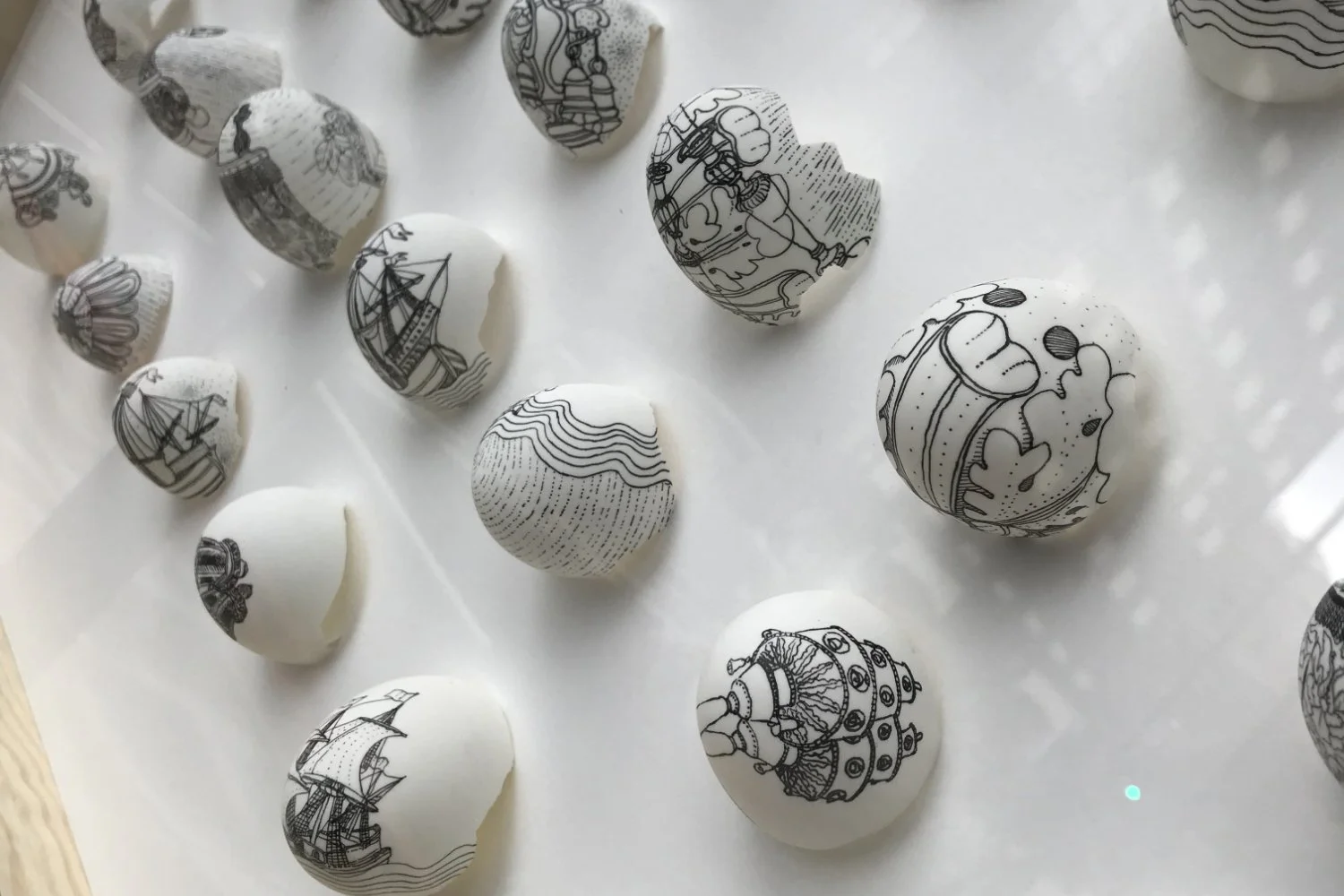
Thirty-two white duck eggshells, cracked in half and set on their jagged edges, make up an intriguing new art work, Vindiciae Judaeorum, created by the artist Tilla Crowne. Their white surface is inked in black lines, dots and cross- hatches that summon up Spanish galleons, churning waves and objects from around the synagogue. Sailing ships refer to the community's arrival and its mercantile origins trading the high seas.
The title Vindiciae Judaeorum (Vindication of the Jews) pays homage to the Dutch Rabbi Menasseh ben Israel, whose April 1656 petition of the same name was considered the final argument convincing Cromwell to drop objections to Jews being free to settle again in England. Israel had contested accusations of blood libel by arguing: "Not only do we not eat blood, we will not even eat an egg in which a blood spot is found."
"That's a fragile thing t-o pin everything on for Jews to be allowed back in," says Crowne. She made the piece in 2021 as a response to a proposed office tower development nearby that threatened Bevis and its redesign plans. Her work will greet visitors as they arrive and is the first in an ongoing display of contemporary artistic responses to the collection.
By Hester Abrams
Photos courtesy of the Collections of the Spanish & Portuguese Jews’ Sephardi Community, unless otherwise stated
The new Bevis Marks heritage centre is set to open in late spring 2026. bevismarksheritage.org.uk
This article appears in the Winter 2026 issue of JR.