

With a major exhibition by Anish Kapoor running at London's Hayward Gallery, we speak to the artist about his Mumbai heritage, the horror of the Venice ghetto and the role of art in troubled times
Possibly I'm in the Hayward Gallery on London's South Bank, but it could equally be that I've just walked onto the set of 1970s-vintage Doctor Who. An enormous blood-red mound of somethingearth? Lava? The fleshy folds of some giant geological organ?- rears up before me, topped by a mysterious door. Any moment you expect Tom Baker to burst out, chased by overwrought cyborgs.
This is Ha Makom, the newest work by Anish Kapoor, whose Hayward show is his first time back here since 1998, in an exhibition that established him at the front rank of British artists.
"I pondered about what to call it," he says, when we meet at the gallery's café. "I decided on the Hebrew word, Ha Makom. In the Kabbalah, it means 'the place'; it's also a name for God. The object is particular, the place is particular. It speaks of otherness." Cyborgs, indeed.

The show is full of this otherness: black discs that seem to curve, or fall into infinite depth, yet turn out barely a sheaf of paper thick; bendy mirrors on the terraces, showing you tipped upside down in a sea of South Bank concrete and sky; grisly mounds resembling bloodied innards, threatening to seep onto our shoes.
"I keep returning to parallel realities, philosophical questions, but also deep religious ones- what happens to consciousness, to our being after death, perhaps before birth. Science can't fully illuminate that, so the arts struggle with the ineffable," he says.
Speaking at a show of his early works at New York's Jewish Museum last year, he said: "We are religious beings, we carry a consciousness that there is something else." His art radiates a sense of the unknowable. His own spiritual heritage, though, is "complex". Born in what is now Mumbai, he had a Hindu father and a mother from a prominent Iraqi Jewish family; his grandfather was a cantor at synagogues in Pune and Bombay. He describes himself as a practising Buddhist.

"My wife is a Muslim. None of it's in conflict," he says. "My parents were spectacularly cosmopolitan, not tied to their ancestral religions. What I've discovered is that I keep returning to things that were in the background for me."
Which brings me to Mount Moriah at the Gate of the Ghetto, his 2022 piece: part inverted mountain, part submarine, its red and blackstreaked summit floating inches off the floor, rebuking gravity. It was first shown at Venice's Palazzo Manfrin, which was acquired by Kapoor in 2018 and is directly across the canal from the old Jewish ghetto.
"What a horror, what a horror," he says of the ghetto- the world's first, established by Venetian decree in 1516, which locked its Jewish residents in every night. "I'm a Sephardi Jew, so I don't have that experience Ashkenazi Jews have had, over generations, of exclusion in this way. It was important to address the location. Mount Moriah is the mountain on which Abraham was to have sacrificed Isaac- but didn't. The title reflects the sacrificial place, metaphorically 'over there'. I'm sad to say we see it happening in Palestine now. We should know better, us Jews.
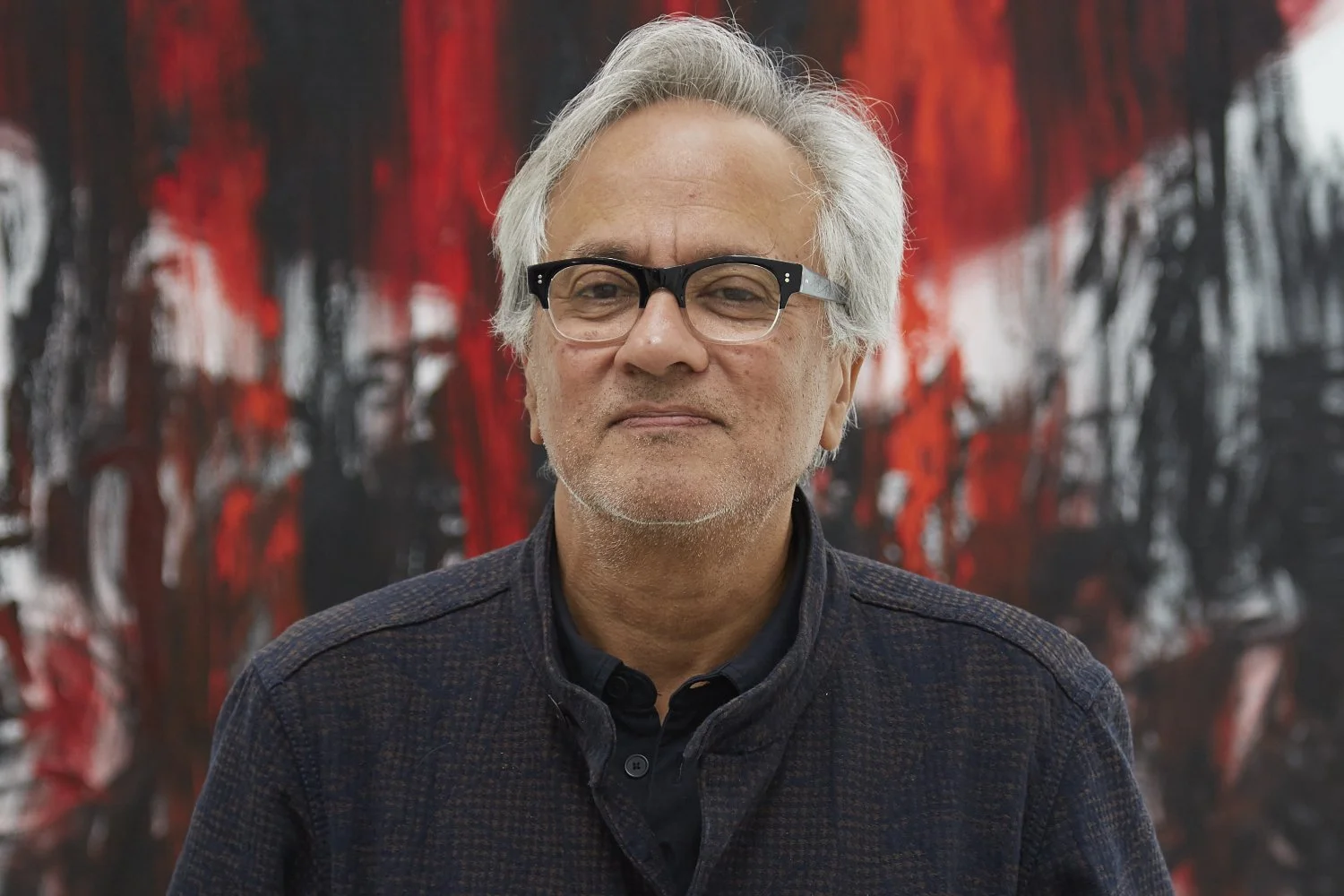
Anish Kapoor © George Darell
"Israeli artists have been courageous in resisting the pressure from Netanyahu, to take part in what is going on in all Jews' names. This is not us." He has spoken out, too, about Israel, Russia and the USA at this year's Venice Biennale. "I did not say Israel or Russia should be banned. I said the curators decided they couldn't be considered for the awards and they should have included the USA too. The American artist had to reflect American values. The White House doing shows for us? Forget it."
Should artists intervene politically? "I'm not for art that carries an overt political message - it makes it less good art but I do believe it can open up another psychic space."
Last year Greenpeace activists unveiled Kapoor's Butchered on the side of a Shell gas platform in the North Sea, drenching a giant canvas in blood-red liquid. "This was the first time I've made a political gesture with my work, but the issue is so important." Before leaving, I tell him I have been watching children posing gleefully in front of his distorting mirrors and gasping at the black voids. "Something happens in play that isn't conscious," he says. "That's perhaps where the deep secrets lie."
For all Kapoor's engagement with religion, politics and history, perhaps that sense of wonder remains his most radical proposition: that curiosity can take us somewhere certainty cannot.
By Rebecca Taylor
Photos by Dave Morgan unless otherwise stated. Courtesy of the Hayward Gallery and the artist © Anish Kapoor
Anish Kapoor runs until 18 October. Hayward Gallery, London, SE1 8XX. southbankcentre.co.uk
This article appears in the Summer 2026 issue of JR.