
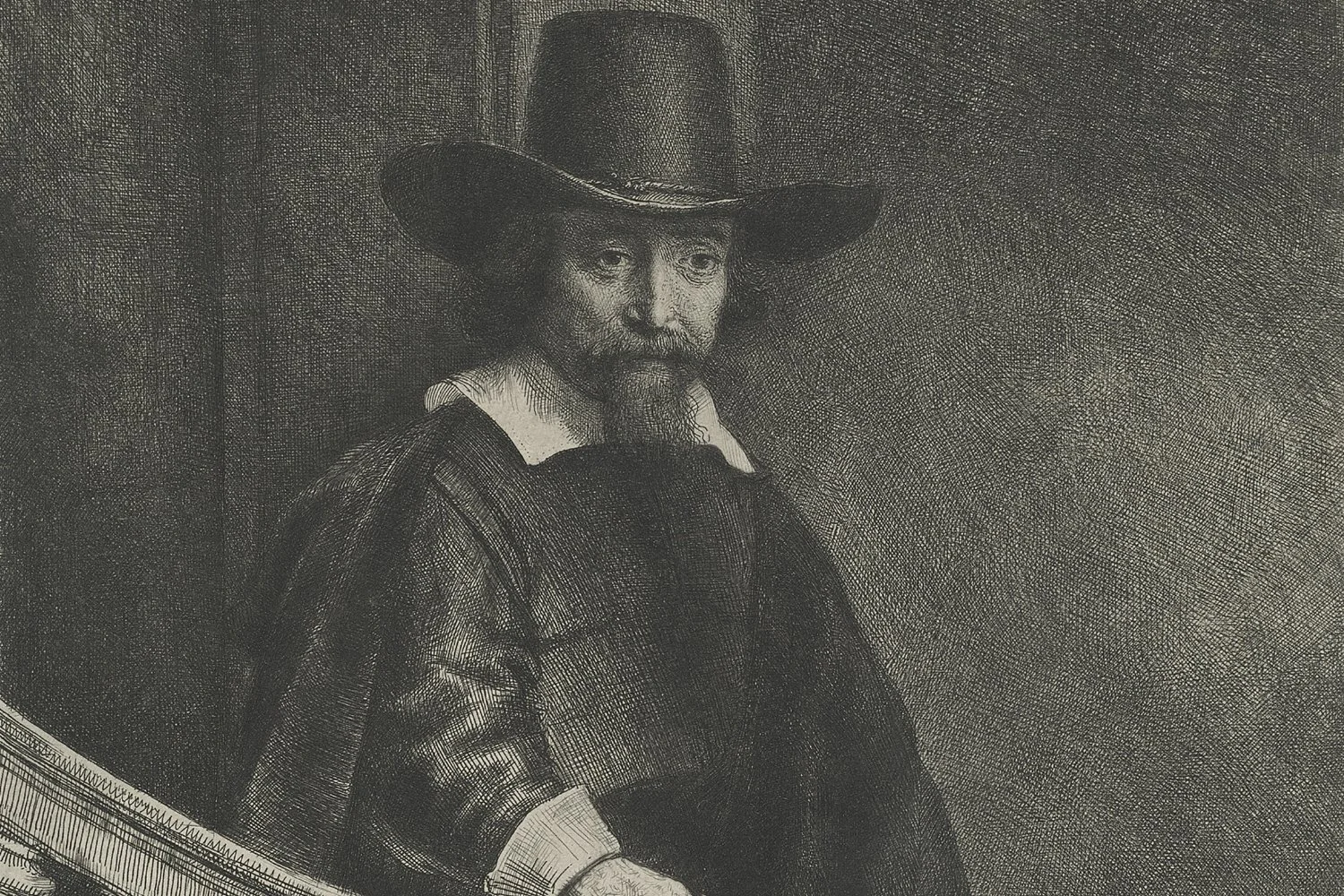
Though Rembrandt wasn't a Jew, this Boston exhibition shows how his artwork can, nonetheless, provide a unique look at Jewish life in 17th-century Amsterdam
It is not a random happenstance that Rembrandt bought a house on Breestraat, an Amsterdam street in a neighbourhood of wealthy Sephardim, far less wealthy Ashkenazim and formerly enslaved citizens of African descent. His house had been expensive, well beyond his means, but there were advantages to living in Vlooienburg, the Jewish quarter, to be near people who would commission portraits, and thus provide a shaky ladder out of the abyss of debt Rembrandt could never quite manage to climb out of. The quarter was in its relatively early days; Jews had, for centuries, been forbidden from living in the Low Countries (Northwestern Europe's coastal region, comprising Belgium, the Netherlands and Luxembourg), though some had arrived from Iberia, they were 'anusim', Jews forced to observe in secrecy. By 1639, when Rembrandt arrived in the quarter, Amsterdam had lifted restrictions, so Jews could and did practice openly until the German occupation.
It has been documented that every one of Rembrandt’s neighbours were Jewish, that he would have heard the sounds of Jewish life and been aware of yearly and weekly cycles and rituals. He used the people around him as models, both the wealthy Portuguese Jews and the Germanic Ashkenazim, who wore ragged clothes and begged on the streets.
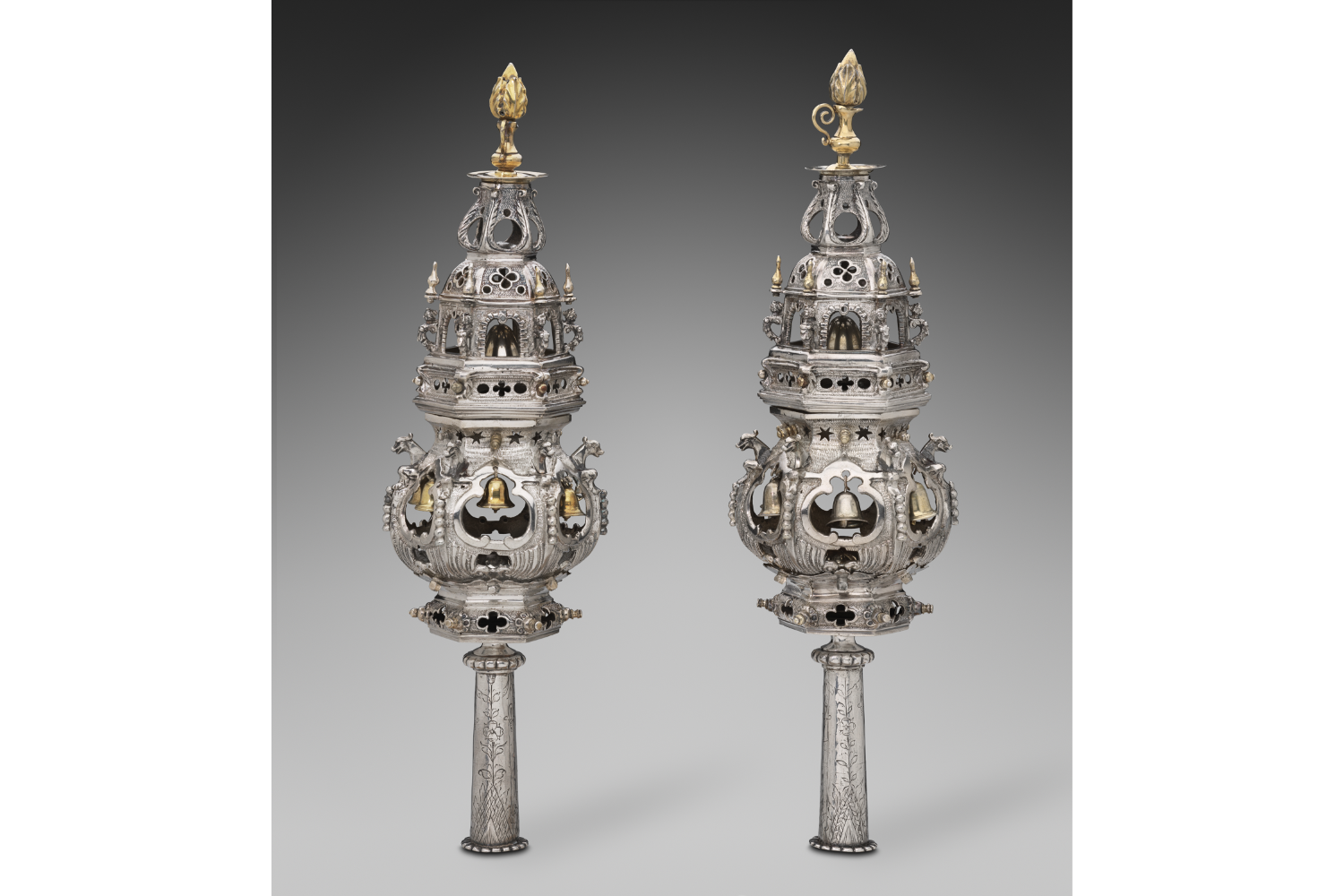
Pair of Torah finials, 1649, silver parcel gilt. Museum purchase with funds donated by Rose‑Marie and Eijk van Otterloo in support of the Centre for Netherlandish Art. Photograph © Museum of Fine Arts, Boston
Reality and Imagination: Rembrandt and the Jews in the Dutch Republic, currently on view at Boston's Museum of Fine Arts, offers a glimpse into that neighbourhood and how Rembrandt used the culture around him as a springboard into imagining both Old and New Testament scenes.
At the entrance to the show are two Torah silver finials made in 1649, some of the oldest Judaica in Holland, and they are posted like gates in a road that signal what lays ahead. The exhibit combines ritual objects with works by Rembrandt, contemporaneous artists, and cartographers mapping the physical world the images occupied. A 17th century plan of the quarter highlights the location of Rembrandt’s house, Sephardi and Ashkenazi synagogues, and the houses of Jewish residents who figured in his life. The urban setting shows how close each were and even if buildings were large, they were crowded together. Neighbours knew one another. Rembrandt did commissions for his neighbours, his work was known and respected by them, but he also never repaid the loan used to buy his house, among other outstanding debts he owed to these same people.

Left: Abraham's Sacrifice by Rembrandt Harmensz van Rijn, 1655, etching and drypoint. Gift of William Norton Bullard. Photograph © Museum of Fine Arts, Boston
Right: Abraham Casting out Hagar and Ishmael by Rembrandt Harmensz van Rijn, 1637, etching and drypoint. Harvey D Parker Collection – Harvey Drury Parker Fund. Photograph © Museum of Fine Arts, Boston
Reality and Imagination features a number of drypoint etchings that, unlike the paintings Rembrandt is known for, are small intimate scenes you could almost step into. In Christ Disputing with the Doctors (1652), the figures are drawn from Ashkenazim he knew as friends or acquaintances. In the image, among the crowd of men in long robes and a variety of head coverings, an African figure looks in from the upper right corner. He transposed those around him in Vloongiet to what he imagined these ancient scenes would have looked like. In doing so, Rembrandt’s works became a kind of document of Jewish life and, at the same time, drew criticism because, like Caravaggio, he painted scenes using ordinary people of the streets and markets to depict the life of saints and the sacred. If the subject matter of the day was bible stories waiting to be illustrated, he used what – or who – was at hand.
The wall text explains, “At times, he incorporated Ashkenazi dress into scenes from the Hebrew and Christian Bible, blurring the distinction between past and present. Rembrandt’s works are therefore neither a faithful representation of the Jewish world nor pure invention. Instead, they blend reality and imagination.”
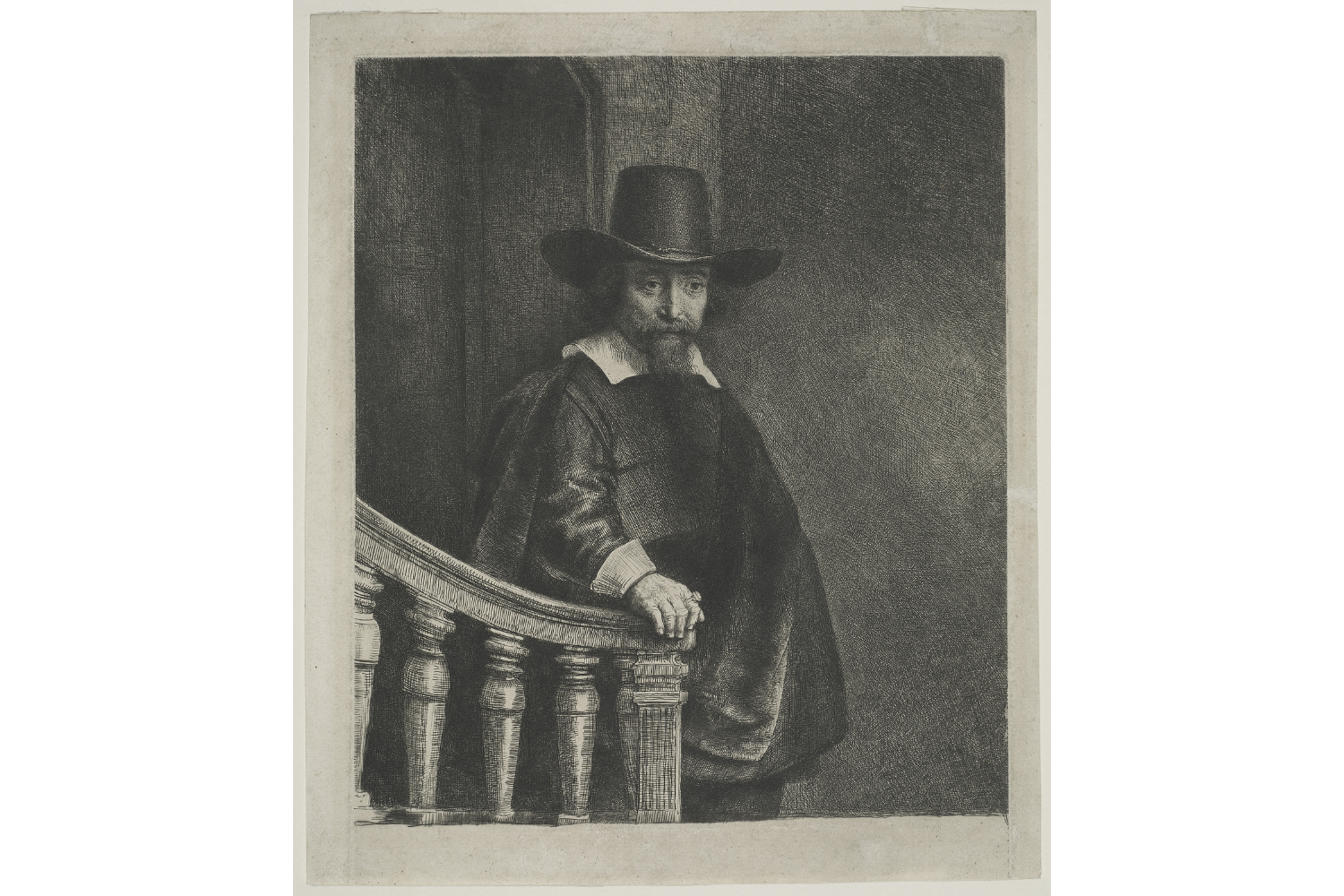
Ephraim Bonus, Physician by Rembrandt Harmensz van Rijn, 1647. Etching, drypoint and engraving. Harvey D Parker Collection – Harvey Drury Parker Fund. Photograph © Museum of Fine Arts, Boston
One of the best examples of Rembrandt’s hybridisation of what he saw and what he projected is Jews in the Synagogue (Pharisees in the Temple), a print made in 1648. The architecture, grand blocks of stone hinting at columns and arches, reflects no Dutch synagogue of the time, but looks more oriental, as do the figures in the print itself. There is a sense of debate in the pairs of men discussing and gesturing, coming or going. Another remarkable print is The Great Jewish Bride (1635). Sometimes interpreted as Queen Esther, many of the solitary women he painted were interpreted as Jewish brides. The impression in the exhibition was taken from an incomplete plate, which makes it all the more powerful. The bride with her hair spread out to her elbows looks as if she’s rising from a cloud under a moonlit sky.
There were few or no Jewish artists of that time, so we are seeing Jewish life through a non-Jewish lens. A difficult history exists regarding the representation of minorities depicted by artists of majority races (Eugène Delacroix, Jean-Léon Gérôme, Winslow Homer and Reginald Marsh, to name a few). The leap of imagination is sometimes met with disapproval (for different reasons now than in the 17th century) but the show at the Boston Museum of Fine Arts is an illumination of a little-known community that has survived to this day, and it’s definitely worth spending time in their company.
By Susan Daitch
Reality and Imagination: Rembrandt and the Jews in the Dutch Republic runs until Tuesday 1 December at the Museum of Fine Arts, Boston, Massachusetts 02115. mfa.org